engine oil CHEVROLET KODIAK 2008 User Guide
[x] Cancel search | Manufacturer: CHEVROLET, Model Year: 2008, Model line: KODIAK, Model: CHEVROLET KODIAK 2008Pages: 384, PDF Size: 5.4 MB
Page 158 of 384
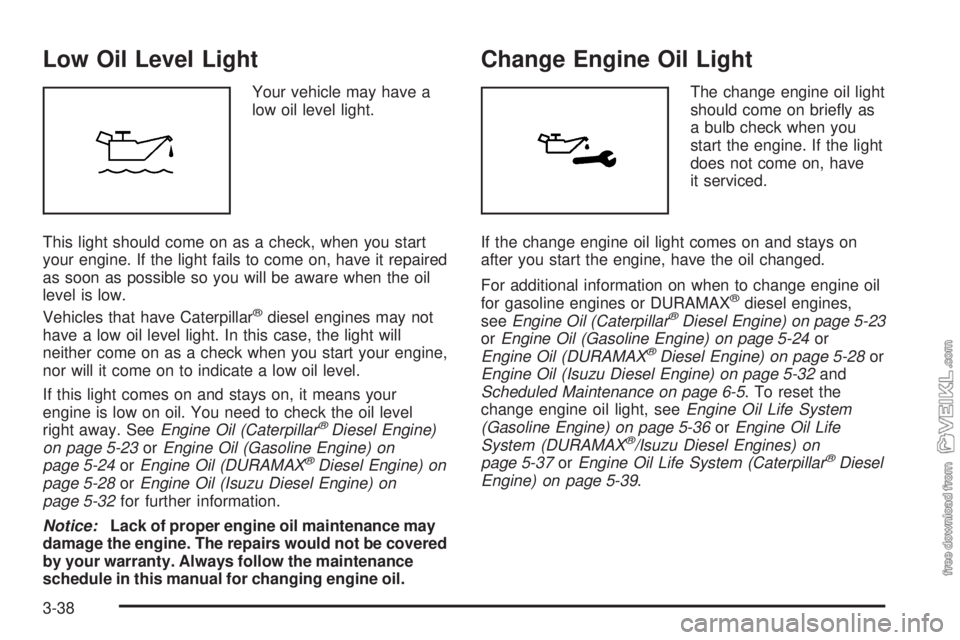
Low Oil Level Light
Your vehicle may have a
low oil level light.
This light should come on as a check, when you start
your engine. If the light fails to come on, have it repaired
as soon as possible so you will be aware when the oil
level is low.
Vehicles that have Caterpillar
®diesel engines may not
have a low oil level light. In this case, the light will
neither come on as a check when you start your engine,
nor will it come on to indicate a low oil level.
If this light comes on and stays on, it means your
engine is low on oil. You need to check the oil level
right away. SeeEngine Oil (Caterpillar
®Diesel Engine)
on page 5-23orEngine Oil (Gasoline Engine) on
page 5-24orEngine Oil (DURAMAX
®Diesel Engine) on
page 5-28orEngine Oil (Isuzu Diesel Engine) on
page 5-32for further information.
Notice:Lack of proper engine oil maintenance may
damage the engine. The repairs would not be covered
by your warranty. Always follow the maintenance
schedule in this manual for changing engine oil.
Change Engine Oil Light
The change engine oil light
should come on briefly as
a bulb check when you
start the engine. If the light
does not come on, have
it serviced.
If the change engine oil light comes on and stays on
after you start the engine, have the oil changed.
For additional information on when to change engine oil
for gasoline engines or DURAMAX
®diesel engines,
seeEngine Oil (Caterpillar®Diesel Engine) on page 5-23
orEngine Oil (Gasoline Engine) on page 5-24or
Engine Oil (DURAMAX
®Diesel Engine) on page 5-28or
Engine Oil (Isuzu Diesel Engine) on page 5-32and
Scheduled Maintenance on page 6-5. To reset the
change engine oil light, seeEngine Oil Life System
(Gasoline Engine) on page 5-36orEngine Oil Life
System (DURAMAX
®/Isuzu Diesel Engines) on
page 5-37orEngine Oil Life System (Caterpillar®Diesel
Engine) on page 5-39.
3-38
Page 159 of 384
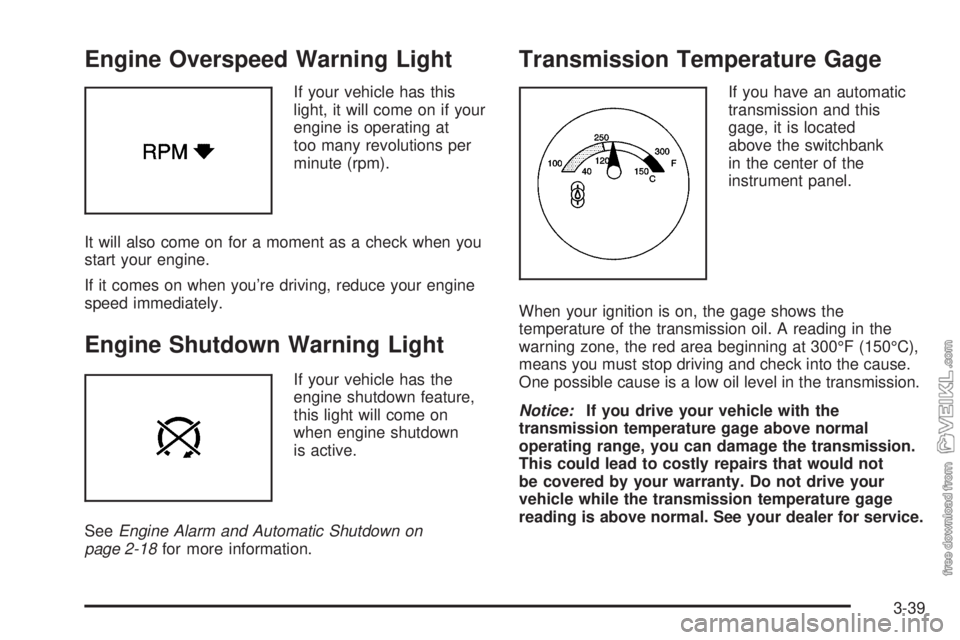
Engine Overspeed Warning Light
If your vehicle has this
light, it will come on if your
engine is operating at
too many revolutions per
minute (rpm).
It will also come on for a moment as a check when you
start your engine.
If it comes on when you’re driving, reduce your engine
speed immediately.
Engine Shutdown Warning Light
If your vehicle has the
engine shutdown feature,
this light will come on
when engine shutdown
is active.
SeeEngine Alarm and Automatic Shutdown on
page 2-18for more information.
Transmission Temperature Gage
If you have an automatic
transmission and this
gage, it is located
above the switchbank
in the center of the
instrument panel.
When your ignition is on, the gage shows the
temperature of the transmission oil. A reading in the
warning zone, the red area beginning at 300°F (150°C),
means you must stop driving and check into the cause.
One possible cause is a low oil level in the transmission.
Notice:If you drive your vehicle with the
transmission temperature gage above normal
operating range, you can damage the transmission.
This could lead to costly repairs that would not
be covered by your warranty. Do not drive your
vehicle while the transmission temperature gage
reading is above normal. See your dealer for service.
3-39
Page 162 of 384
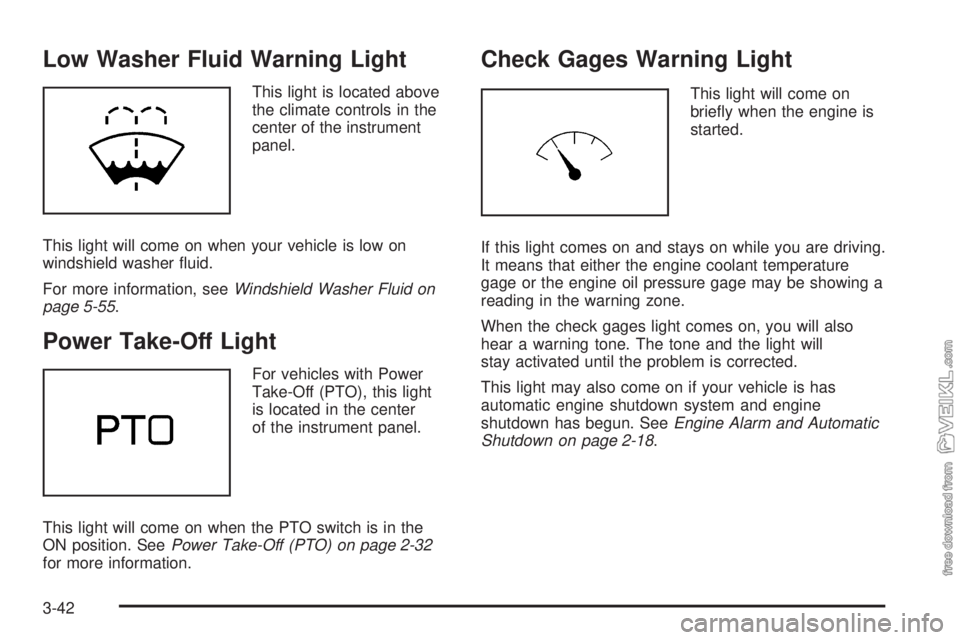
Low Washer Fluid Warning Light
This light is located above
the climate controls in the
center of the instrument
panel.
This light will come on when your vehicle is low on
windshield washer fluid.
For more information, seeWindshield Washer Fluid on
page 5-55.
Power Take-Off Light
For vehicles with Power
Take-Off (PTO), this light
is located in the center
of the instrument panel.
This light will come on when the PTO switch is in the
ON position. SeePower Take-Off (PTO) on page 2-32
for more information.
Check Gages Warning Light
This light will come on
briefly when the engine is
started.
If this light comes on and stays on while you are driving.
It means that either the engine coolant temperature
gage or the engine oil pressure gage may be showing a
reading in the warning zone.
When the check gages light comes on, you will also
hear a warning tone. The tone and the light will
stay activated until the problem is corrected.
This light may also come on if your vehicle is has
automatic engine shutdown system and engine
shutdown has begun. SeeEngine Alarm and Automatic
Shutdown on page 2-18.
3-42
Page 205 of 384
Service............................................................5-4
Accessories and Modifications..........................5-4
California Proposition 65 Warning.....................5-5
California Perchlorate Materials Requirements.....5-5
Doing Your Own Service Work.........................5-6
Engine Fan Breakage.....................................5-6
Fuel................................................................5-7
Gasoline Octane............................................5-7
Gasoline Specifications....................................5-7
Additives.......................................................5-8
Diesel Engine Fuel.........................................5-9
What Fuel to Use...........................................5-9
Very Cold Weather Operation.........................5-12
Water in Fuel...............................................5-12
Running Out of Fuel.....................................5-17
Fuel Filter Replacement.................................5-18
Fuels in Foreign Countries.............................5-19
Filling the Tank............................................5-20
Filling a Portable Fuel Container.....................5-21
Checking Things Under the Hood....................5-22
Hood Latches...............................................5-22
Engine Oil (Caterpillar
®Diesel Engine).............5-23
Engine Oil (Gasoline Engine)..........................5-24
Engine Oil (DURAMAX
®Diesel Engine)............5-28Engine Oil (Isuzu Diesel Engine).....................5-32
Engine Oil Life System (Gasoline Engine)........5-36
Engine Oil Life System (DURAMAX
®/Isuzu
Diesel Engines).........................................5-37
Engine Oil Life System (Caterpillar
®Diesel
Engine)....................................................5-39
Engine Air Cleaner/Filter................................5-39
Automatic Transmission Fluid.........................5-43
Manual Transmission Fluid.............................5-43
Engine Coolant (Caterpillar
®Diesel Engines).....5-44
Engine Coolant (Gas and DURAMAX®/
Isuzu 7.8L L6 Engines)..............................5-44
Coolant Surge Tank Pressure Cap..................5-47
Engine Overheating.......................................5-48
Cooling System............................................5-50
Engine Fan Noise.........................................5-54
Power Steering Fluid.....................................5-54
Windshield Washer Fluid................................5-55
Brakes........................................................5-57
Battery........................................................5-66
Jump Starting...............................................5-67
Rear Axle.......................................................5-72
Rear Axle Shift Motor....................................5-73
Section 5 Service and Appearance Care
5-1
Page 213 of 384
Diesel Engine Fuel
For the Caterpillar®diesel, see the Caterpillar®
Operation & Maintenance Manual for information
concerning fuel usage.
Notice:Diesel fuel or fuel additives not
recommended in this manual could damage the fuel
system and engine. Your warranty would not
cover this damage. And:
Diesel fuel that has been mixed with engine oil
or automatic transmission uid could damage
the engine and emission controls.
We do not test aftermarket diesel fuel additives.
Some additives, particularly those which
contain alcohol or water emulsiers, could
damage the fuel system. If you believe that
unique circumstances call for a fuel additive to
be used, consult your dealer/retailer for
advice.
If you ever run out of diesel fuel, it can be
difficult to restart the engine. To avoid this,
never let the tank get empty.
If gasoline is ever accidentally added to the fuel
tank, to avoid severe engine damage, do not run the
engine until the fuel tank can be drained.
If you run out of fuel,Running Out of Fuel on page 5-17
tells you how to restart the engine.
What Fuel to Use
Notice:Use of diesel fuel other than Ultra Low
Sulfur Diesel (15 ppm sulfur maximum) or engine oil
other than low ash CJ-4 oil will cause permanent
damage to the DPF and related components. This
damage would not be covered by your warranty.
The emission control system requires the use of diesel
fuel with ultra low-sulfur (0.0015% by weight, or 15 ppm,
maximum) content. Both Ultra Low Sulfur Diesel and Low
Sulfur Diesel fuels are available in the United States and
Ultra Low Sulfur Diesel fuel is available in Canada.
However, only higher sulfur diesel fuel is available
in Mexico.
At a minimum, the diesel fuel you use should meet the
latest version of ASTM specification D 975 (Grades
No. 2-D or No. 1-D S15 commonly known as Ultra Low
Sulfur diesel) in the United States. In addition, the
Engine Manufacturers Association (EMA) has identified
properties of an improved diesel fuel for better engine
performance and durability. Diesel fuels corresponding
to the EMA Recommended Guideline on Premium
Diesel Fuel (FQP-1A) could provide better starting, less
noise, and better vehicle performance. If there are
questions about the fuel you are using, contact your fuel
supplier.
5-9
Page 214 of 384
In the United States, for best results use No. 2-D diesel
fuel year-round (above and below freezing conditions)
as oil companies blend No. 2-D fuel to address climate
differences. No. 1-D diesel fuel can be used in very
cold temperatures (when it stays below 0°F or−18°C);
however, it will produce a power and fuel economy loss.
Avoid the use of No. 1-D diesel fuel in warm or hot
climates. It can result in stalling, poor starting when the
engine is hot, and could damage the fuel injection
system.
It is acceptable to use diesel fuel containing up to
5% biodiesel (B5), but the final blended fuel must meet
the same specification, ASTM D 975 (Grades No. 2-D or
No. 1-D S15 commonly known as Ultra Low Sulfur
diesel), as other fuels used in your vehicle, and the
biodiesel used for making this fuel must meet the latest
version of ASTM specification D 6751. Biodiesel is
produced from vegetable oils or animal fat that have been
chemically modified to reduce the possibility of damage to
the fuel system and engine. Higher concentration (i.e.,
greater than B5) biodiesel-containing fuels or the use of
unmodified bio-oils blended into diesel fuel at any
concentration is not recommended and could damage the
fuel system and engine. Such damage would not be
covered by your warranty. If there are questions about
the biodiesel-containing fuels you are using, contact your
fuel supplier.Because of the cleansing properties of biodiesel,
switching from straight diesel to a biodiesel blend can
prematurely restrict the fuel filter with normal deposits in
the fuel system. A fuel filter replacement might be
required sooner than the recommended interval.
Diesel fuel can foam when you fill the tank. This can
cause the automatic pump nozzle to shut off, even
though the tank is not full. If this happens, just wait for
the foaming to stop and then try filling the tank more
slowly. SeeFilling the Tank on page 5-20.
{CAUTION:
Heat coming from the engine can cause the
fuel to expand and force the fuel out of the
tank. If something ignites the fuel, a re could
start and people could be burned. To help
avoid this, try lling the tank more slowly and
ll the fuel tank only until the automatic nozzle
shuts off. Do not try to top it off.
5-10
Page 215 of 384
What Fuel to Use in Canada
Notice:Use of diesel fuel other than Ultra Low
Sulfur Diesel (15 ppm sulfur maximum) or engine oil
other than low ash CJ-4 oil will cause permanent
damage to the DPF and related components.
This damage would not be covered by your
warranty.
The emission control system requires the use of diesel
fuel with ultra low-sulfur (0.0015% by weight, or 15 ppm,
maximum) content. Both Ultra Low Sulfur Diesel and Low
Sulfur Diesel fuels are available in the United States and
Ultra Low Sulfur Diesel fuel is available in Canada.
However, only higher sulfur diesel fuel is available
in Mexico.
At a minimum, the diesel fuel you use should meet the
latest version of specification CAN/CGSB-3.517 (ULS) in
Canada. In addition, the Engine Manufacturers
Association (EMA) has identified properties of an
improved diesel fuel for better engine performance and
durability (FQP-1A). Diesel fuels corresponding to the
EMA description could provide better starting, less noise,
and better vehicle performance. If there are questions
about the fuel you are using, contact your fuel supplier.Canadian fuels are blended for seasonal changes.
Diesel Type “A” fuel is blended for better cold weather
starting (below 0°F or−18°C); however, you might notice
some power and fuel economy loss. If Type “A” fuel is
used in warmer temperatures, stalling and hard
starting may occur. Diesel Type “B” fuel is blended for
temperatures above 0°F (−18°C).
It is acceptable to use diesel fuel containing up to
5% biodiesel (B5), but the final blended fuel must meet
the same specification, CAN/CGSB-3.517 (ULS) in
Canada, as other fuels used in your vehicle, and the
biodiesel used for making this fuel must meet the latest
version of ASTM specification D 6751. Biodiesel is
produced from vegetable oils or animal fat that have been
chemically modified to reduce the possibility of damage to
the fuel system and engine. Higher concentration (i.e.,
greater than B5) biodiesel-containing fuels or the use of
unmodified bio-oils blended into diesel fuel at any
concentration is not recommended and could damage the
fuel system and engine. Such damage would not be
covered by your warranty. If there are questions about
the biodiesel-containing fuels you are using, contact your
fuel supplier.
5-11
Page 216 of 384
Very Cold Weather Operation
Follow the instructions listed previously under the
heading “What Fuel to Use.”
Notice:Never use home heating oil or gasoline in
your vehicle’s diesel engine. They can cause
engine damage.
In cold weather, the fuel filter could become clogged
(waxed). To unclog it, move the vehicle to a warm
garage area and warm the filter to between 32°F and
50°F (0°C to 10°C). You will not need to replace it.
Additional information on the fuel filter follows.
Water in Fuel
{CAUTION:
Diesel fuel containing water is still ammable.
You could be burned. If you ever try to drain
water from your fuel, keep sparks, ames and
smoking materials away from the mixture.Notice:If there is water in your diesel fuel and the
weather is warm or humid, fungus and bacteria
can grow in the fuel. They can damage your
fuel system. A diesel fuel biocide can be used to
sterilize your fuel system. However, your fuel system
may still need to be cleaned. Your dealer/retailer
can advise you of the appropriate solution.
If your fuel tank needs to be purged to remove
water, see your dealer/retailer or a qualied
technician. Improper purging can damage your fuel
system.
Sometimes, water can be pumped into your fuel tank
along with your diesel fuel. This can happen if a service
station does not regularly inspect and clean its fuel
tanks, or if it gets contaminated fuel from its suppliers.
If this happens, the
water-in-fuel light, if
equipped, will come on in
the instrument panel. If it
does, the water must be
drained. Your dealer/
retailer can show you how
to do this.
If the light comes on, use this chart to determine what
action to take.
5-12
Page 218 of 384
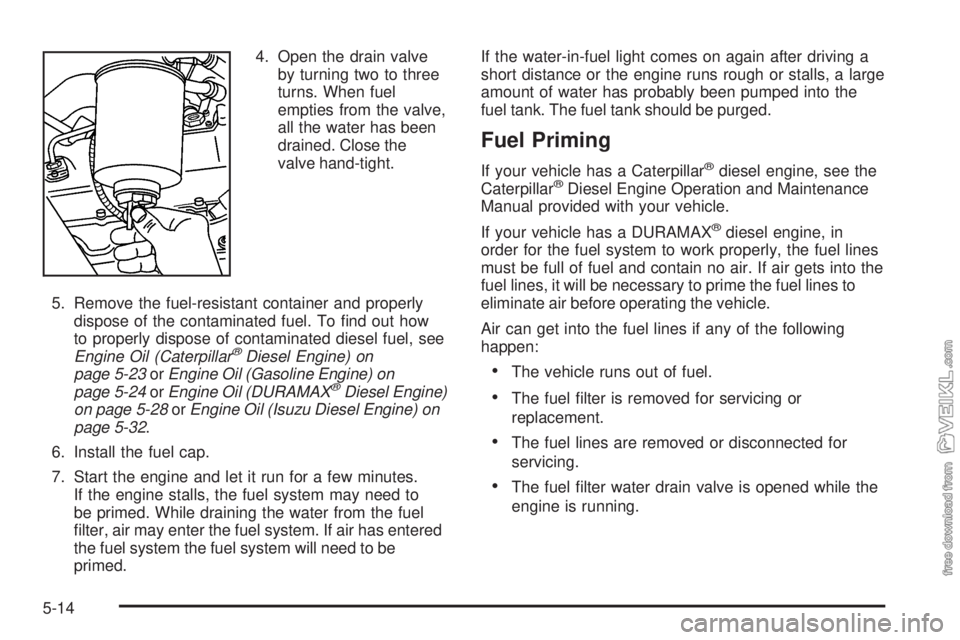
4. Open the drain valve
by turning two to three
turns. When fuel
empties from the valve,
all the water has been
drained. Close the
valve hand-tight.
5. Remove the fuel-resistant container and properly
dispose of the contaminated fuel. To find out how
to properly dispose of contaminated diesel fuel, see
Engine Oil (Caterpillar
®Diesel Engine) on
page 5-23orEngine Oil (Gasoline Engine) on
page 5-24orEngine Oil (DURAMAX
®Diesel Engine)
on page 5-28orEngine Oil (Isuzu Diesel Engine) on
page 5-32.
6. Install the fuel cap.
7. Start the engine and let it run for a few minutes.
If the engine stalls, the fuel system may need to
be primed. While draining the water from the fuel
filter, air may enter the fuel system. If air has entered
the fuel system the fuel system will need to be
primed.If the water-in-fuel light comes on again after driving a
short distance or the engine runs rough or stalls, a large
amount of water has probably been pumped into the
fuel tank. The fuel tank should be purged.
Fuel Priming
If your vehicle has a Caterpillar®diesel engine, see the
Caterpillar®Diesel Engine Operation and Maintenance
Manual provided with your vehicle.
If your vehicle has a DURAMAX
®diesel engine, in
order for the fuel system to work properly, the fuel lines
must be full of fuel and contain no air. If air gets into the
fuel lines, it will be necessary to prime the fuel lines to
eliminate air before operating the vehicle.
Air can get into the fuel lines if any of the following
happen:
•The vehicle runs out of fuel.
•The fuel filter is removed for servicing or
replacement.
•The fuel lines are removed or disconnected for
servicing.
•The fuel filter water drain valve is opened while the
engine is running.
5-14
Page 221 of 384
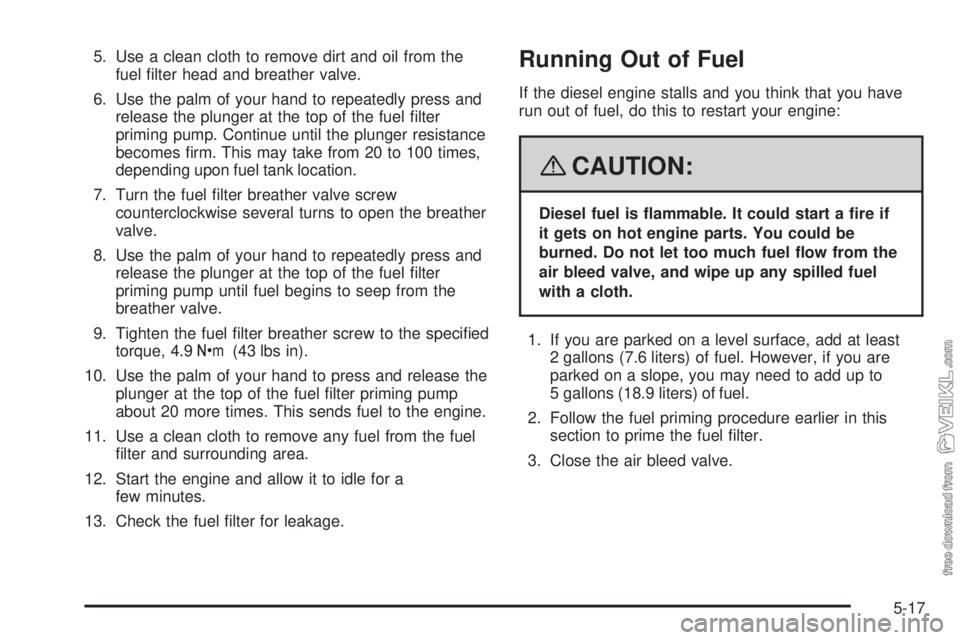
5. Use a clean cloth to remove dirt and oil from the
fuel filter head and breather valve.
6. Use the palm of your hand to repeatedly press and
release the plunger at the top of the fuel filter
priming pump. Continue until the plunger resistance
becomes firm. This may take from 20 to 100 times,
depending upon fuel tank location.
7. Turn the fuel filter breather valve screw
counterclockwise several turns to open the breather
valve.
8. Use the palm of your hand to repeatedly press and
release the plunger at the top of the fuel filter
priming pump until fuel begins to seep from the
breather valve.
9. Tighten the fuel filter breather screw to the specified
torque, 4.9Y(43 lbs in).
10. Use the palm of your hand to press and release the
plunger at the top of the fuel filter priming pump
about 20 more times. This sends fuel to the engine.
11. Use a clean cloth to remove any fuel from the fuel
filter and surrounding area.
12. Start the engine and allow it to idle for a
few minutes.
13. Check the fuel filter for leakage.Running Out of Fuel
If the diesel engine stalls and you think that you have
run out of fuel, do this to restart your engine:
{CAUTION:
Diesel fuel is ammable. It could start a re if
it gets on hot engine parts. You could be
burned. Do not let too much fuel ow from the
air bleed valve, and wipe up any spilled fuel
with a cloth.
1. If you are parked on a level surface, add at least
2 gallons (7.6 liters) of fuel. However, if you are
parked on a slope, you may need to add up to
5 gallons (18.9 liters) of fuel.
2. Follow the fuel priming procedure earlier in this
section to prime the fuel filter.
3. Close the air bleed valve.
5-17