seats CHEVROLET KODIAK 2008 User Guide
[x] Cancel search | Manufacturer: CHEVROLET, Model Year: 2008, Model line: KODIAK, Model: CHEVROLET KODIAK 2008Pages: 384, PDF Size: 5.4 MB
Page 32 of 384
Safety Belt Extender
If the vehicle’s safety belt will fasten around you, you
should use it.
But if a safety belt is not long enough, your
dealer/retailer will order you an extender. When you go
in to order it, take the heaviest coat you will wear,
so the extender will be long enough for you. To help
avoid personal injury, do not let someone else use
it, and use it only for the seat it is made to fit. The
extender has been designed for adults. Never use it for
securing child seats. To wear it, attach it to the
regular safety belt. For more information, see the
instruction sheet that comes with the extender.
Child Restraints
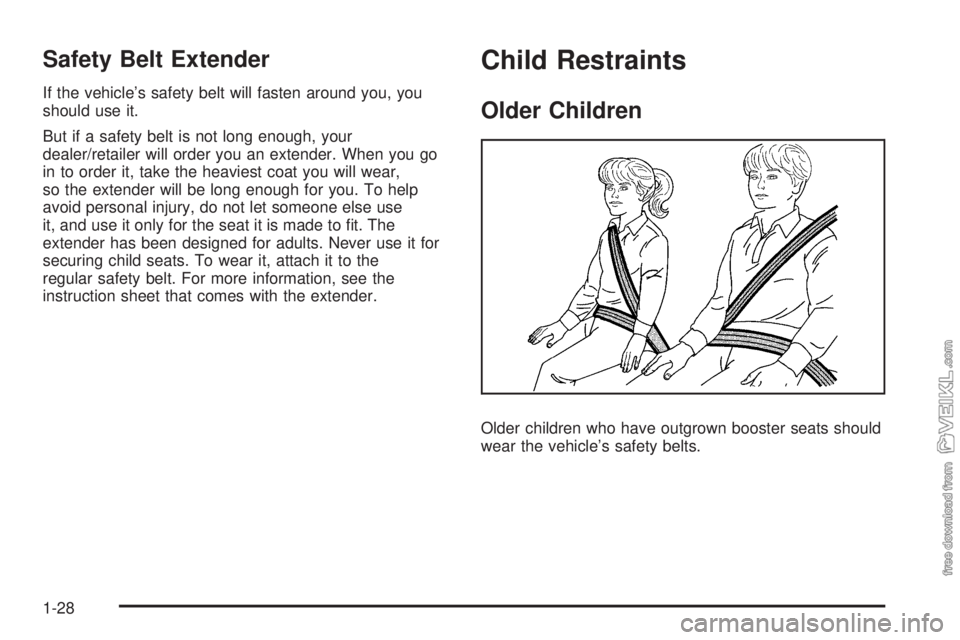
Older Children
Older children who have outgrown booster seats should
wear the vehicle’s safety belts.
1-28
Page 41 of 384
Securing an Add-on Child Restraint in
the Vehicle
{CAUTION:
A child can be seriously injured or killed in a
crash if the child restraint is not properly
secured in the vehicle. Make sure the child
restraint is properly installed in the vehicle
using the vehicle’s safety belt, following the
instructions that came with that restraint, and
also the instructions in this manual.
To help reduce the chance of injury, the child restraint
must be secured in the vehicle. Child restraint systems
must be secured in vehicle seats by lap belts or the
lap belt portion of a lap-shoulder belt. A child can
be endangered in a crash if the child restraint is not
properly secured in the vehicle.
When securing an add-on child restraint, refer to the
instructions that come with the restraint which may be on
the restraint itself or in a booklet, or both, and to this
manual. The child restraint instructions are important, so
if they are not available, obtain a replacement copy
from the manufacturer.Keep in mind that an unsecured child restraint can move
around in a collision or sudden stop and injure people in
the vehicle. Be sure to properly secure any child restraint
in your vehicle — even when no child is in it.
Securing the Child Within the Child
Restraint
{CAUTION:
A child can be seriously injured or killed in a
crash if the child is not properly secured in the
child restraint. Because there are different
systems, it is important to refer to the
instructions that come with the restraint. Make
sure the child is properly secured, following
the instructions that came with that restraint.
1-37
Page 42 of 384
Where to Put the Restraint
Accident statistics show that children are safer if they
are restrained in the rear rather than the front seat.
We recommend that children and child restraints
be secured in a rear seat, including: an infant or a child
riding in a rear-facing child restraint; a child riding in
a forward-facing child seat; an older child riding in
a booster seat; and children, who are large enough,
using safety belts.
Air Suspension Seats
{CAUTION:
A child restraint cannot be secured properly in
an air-suspension type seat. This is because
an air-suspension seat is designed to move up
and down for an adult passenger. Do not use a
child restraint in an air-suspension seat.If your vehicle is a regular cab model with an
air-suspension seat in the right front passenger’s
position, there is no place in your vehicle to secure a
child restraint. The only answer is to have infants
and young children make the trip in another vehicle,
where they can get the protection they need.
Bucket or Bench Seats
If your vehicle is a regular cab model with a bucket or
bench seat in the right front passenger’s position,
the child restraint must be secured properly.
If your vehicle has airbags and you need to secure a
child restraint in the right front passenger’s seat, there is
a switch on the instrument panel that you can use to
turn off the passenger’s airbag. SeeAirbag Off Switch
on page 1-56andSecuring a Child Restraint in the Right
Front Seat Position on page 1-44for more on this,
including important safety information.
A label on your sun visor says, “Never put a rear-facing
child seat in the front.” This is because the risk to the
rear-facing child is so great, if the airbag deploys.
1-38
Page 63 of 384
Servicing Your Airbag-Equipped
Vehicle
Airbags affect how your vehicle should be serviced.
There are parts of the airbag system in several places
around your vehicle. Your dealer/retailer and the service
manual have information about servicing your vehicle
and the airbag system. To purchase a service manual,
seeService Publications Ordering Information on
page 7-10.
{CAUTION:
For up to 10 seconds after the ignition is
turned off and the battery is disconnected, an
airbag can still inate during improper service.
You can be injured if you are close to an
airbag when it inates. Avoid yellow
connectors. They are probably part of the
airbag system. Be sure to follow proper
service procedures, and make sure the person
performing work for you is qualied to do so.
Adding Equipment to Your
Airbag-Equipped Vehicle
Q:Is there anything I might add to or change
about the vehicle that could keep the airbags
from working properly?
A:Yes. If you add things that change your vehicle’s
frame, bumper system, height, front end or side
sheet metal, they may keep the airbag system from
working properly. Changing or moving any parts
of the front seats, safety belts, the airbag sensing
and diagnostic module, steering wheel, instrument
panel, front sensors, or airbag wiring can affect
the operation of the airbag system.
If you have any questions about this, you should
contact Customer Assistance before you modify
your vehicle. The phone numbers and addresses for
Customer Assistance are in Step Two of the
Customer Satisfaction Procedure in this manual.
SeeCustomer Satisfaction Procedure on page 7-2.
1-59
Page 119 of 384
Storage Areas
Your vehicle includes a number of storage
compartments.
Some vehicles have storage areas in the instrument
panel. Another small storage area may be located
overhead. Other models may have more storage area
underneath the front passenger’s bench seat. Lift
the seat cushion to use the storage area.
Your vehicle may have a storage tray located behind
the driver and passenger seats.
All models have storage pockets and cupholders on
each of the doors. Some models may have additional
cupholders in the center floor console.
All models also have storage compartments located
beneath the floorboard on both sides of the vehicle.
Center Console Storage
Your vehicle may have a center console compartment.
The back of your center bench seat may also fold
forward to reveal a console compartment.
The release strap for the center console is located
between the center seat and passenger’s seat.
To expose the storage compartment, pull the strap to
release the seatback. Then fold the seatback forward.
To open the storage compartment, press the release
button and lift the lid rearward. With the lid closed, it can
be used as a clipboard to hold papers in place.
Before returning the seatback to the upright position,
make sure the console is closed. Lift the seatback all the
way up until it clicks. Push and pull on the seatback
to make sure the seat is locked in place.
2-53
Page 141 of 384
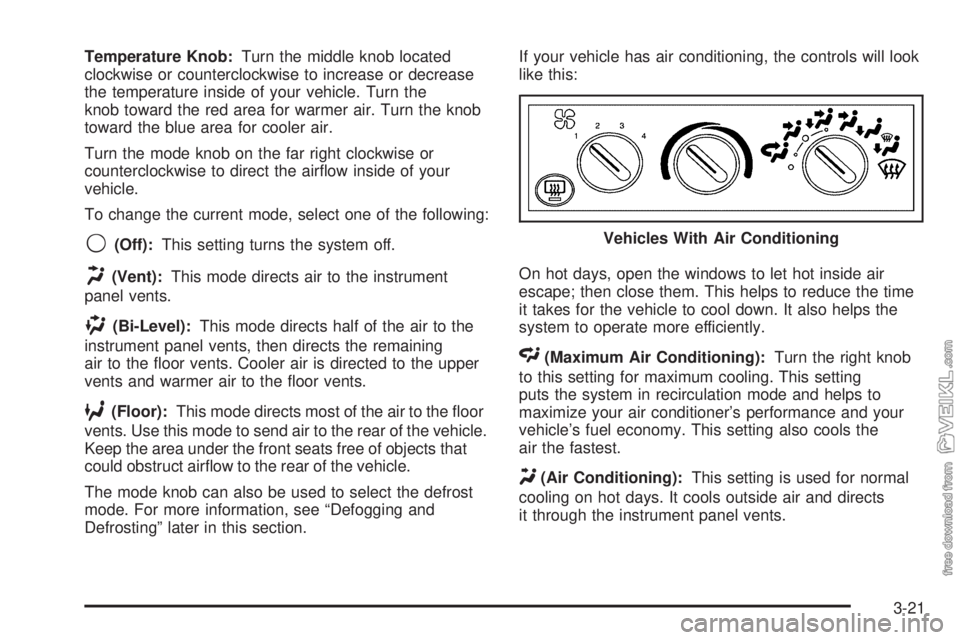
Temperature Knob:Turn the middle knob located
clockwise or counterclockwise to increase or decrease
the temperature inside of your vehicle. Turn the
knob toward the red area for warmer air. Turn the knob
toward the blue area for cooler air.
Turn the mode knob on the far right clockwise or
counterclockwise to direct the airflow inside of your
vehicle.
To change the current mode, select one of the following:
9(Off):This setting turns the system off.
H(Vent):This mode directs air to the instrument
panel vents.
)(Bi-Level):This mode directs half of the air to the
instrument panel vents, then directs the remaining
air to the floor vents. Cooler air is directed to the upper
vents and warmer air to the floor vents.
6(Floor):This mode directs most of the air to the floor
vents. Use this mode to send air to the rear of the vehicle.
Keep the area under the front seats free of objects that
could obstruct airflow to the rear of the vehicle.
The mode knob can also be used to select the defrost
mode. For more information, see “Defogging and
Defrosting” later in this section.If your vehicle has air conditioning, the controls will look
like this:
On hot days, open the windows to let hot inside air
escape; then close them. This helps to reduce the time
it takes for the vehicle to cool down. It also helps the
system to operate more efficiently.
<(Maximum Air Conditioning):Turn the right knob
to this setting for maximum cooling. This setting
puts the system in recirculation mode and helps to
maximize your air conditioner’s performance and your
vehicle’s fuel economy. This setting also cools the
air the fastest.
Y(Air Conditioning):This setting is used for normal
cooling on hot days. It cools outside air and directs
it through the instrument panel vents.Vehicles With Air Conditioning
3-21
Page 142 of 384
)(Bi-Level Air Conditioning):This setting divides
airflow between the floor vents and instrument panel
vents. The air conditioning compressor will cycle
continuously in this setting as long as the outside
temperature is warm enough to activate the compressor.
H(Vent):This mode directs air to the instrument
panel vents.
6(Floor):This mode directs most of the air to the
floor vents. Use this mode to send air to the rear of the
vehicle. Keep the area under the front seats free of
objects that could obstruct airflow to the rear of
the vehicle.
Defogging and Defrosting
Fog on the inside of windows is a result of high humidity
(moisture) condensing on the cool window glass. This
can be minimized if the climate control is used properly.
There are two modes to clear fog or frost from your
windshield and side windows.
Use the defog mode to clear the windows of fog or
moisture and warm the passengers. Use the defrost
mode to remove fog or frost from the windshield more
quickly. For best results, clear all snow and ice from the
windshield before defrosting.Turn the mode knob on the right of the climate control
panel to select the defog or defrost mode.
-(Defog):With this setting, the outside air comes out
of both the floor and defroster outlets. Adjust the
temperature knob for warmer or cooler air. The air
conditioning compressor may operate in this setting to
dehumidify the air.
0(Defrost):This setting operates the defroster.
Most of the air comes out near the windshield,
with some going to the floor outlets and front side
windows. The air conditioning compressor may operate
in this setting to dehumidify the air.
The defog setting is useful for cold weather with a large
number of passengers or very humid conditions to
help keep the windshield clear. Use defrost to remove
fog or ice from the windshield quickly in extremely
cold conditions. The temperature knob should be in
the red area and the fan control toward high. Do
not drive the vehicle until all the windows are clear.
3-22
Page 143 of 384
Rear Window Defogger
For vehicles with a rear window defogger, a warming
grid is used to remove fog or frost from the rear window.
Be sure to clear as much snow from the rear window
as possible.
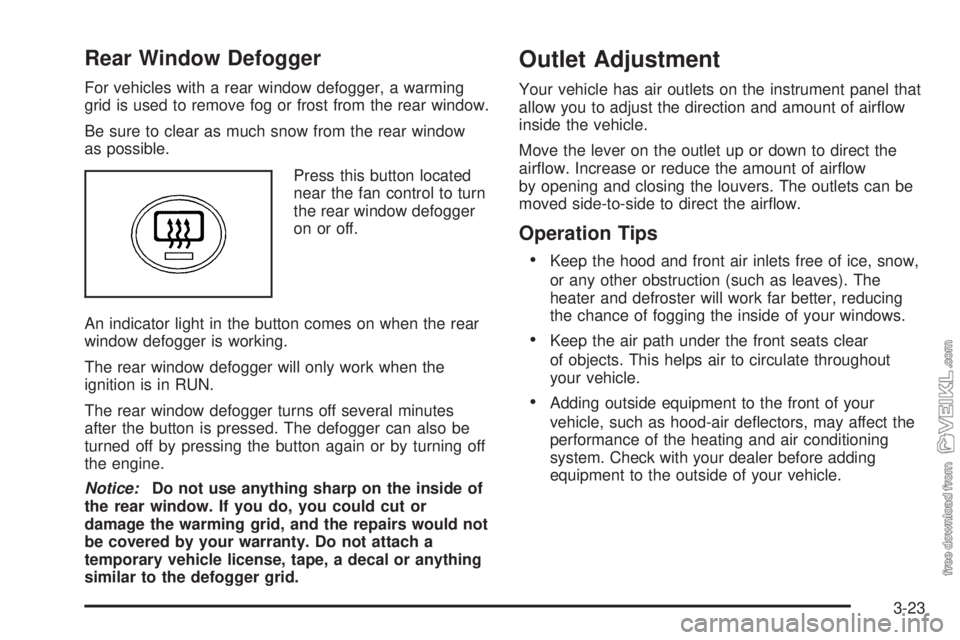
Press this button located
near the fan control to turn
the rear window defogger
on or off.
An indicator light in the button comes on when the rear
window defogger is working.
The rear window defogger will only work when the
ignition is in RUN.
The rear window defogger turns off several minutes
after the button is pressed. The defogger can also be
turned off by pressing the button again or by turning off
the engine.
Notice:Do not use anything sharp on the inside of
the rear window. If you do, you could cut or
damage the warming grid, and the repairs would not
be covered by your warranty. Do not attach a
temporary vehicle license, tape, a decal or anything
similar to the defogger grid.
Outlet Adjustment
Your vehicle has air outlets on the instrument panel that
allow you to adjust the direction and amount of airflow
inside the vehicle.
Move the lever on the outlet up or down to direct the
airflow. Increase or reduce the amount of airflow
by opening and closing the louvers. The outlets can be
moved side-to-side to direct the airflow.
Operation Tips
•
Keep the hood and front air inlets free of ice, snow,
or any other obstruction (such as leaves). The
heater and defroster will work far better, reducing
the chance of fogging the inside of your windows.
•Keep the air path under the front seats clear
of objects. This helps air to circulate throughout
your vehicle.
•Adding outside equipment to the front of your
vehicle, such as hood-air deflectors, may affect the
performance of the heating and air conditioning
system. Check with your dealer before adding
equipment to the outside of your vehicle.
3-23
Page 200 of 384
Never exceed the GVWR for your vehicle, or the GAWR
for either the front or rear axle.
And, if you do have a heavy load, spread it out.
{CAUTION:
Do not load your vehicle any heavier than
the Gross Vehicle Weight Rating (GVWR),
or either the maximum front or rear Gross
Axle Weight Rating (GAWR). If you do,
parts on your vehicle can break, and it
can change the way your vehicle handles.
These could cause you to lose control
and crash. Also, overloading can shorten
the life of your vehicle.
Using heavier suspension components to get added
durability might not change the weight ratings. Ask your
dealer to help you load your vehicle the right way.
Notice:Overloading your vehicle may cause
damage. Repairs would not be covered by your
warranty. Do not overload your vehicle.
If you put things inside your vehicle — like suitcases,
tools, packages, or anything else — they go as fast
as the vehicle goes. If you have to stop or turn quickly,
or if there is a crash, they keep going.
{CAUTION:
Things you put inside your vehicle can
strike and injure people in a sudden stop
or turn, or in a crash.
Put things in the cargo area of your
vehicle. Try to spread the weight
evenly.
Never stack heavier things, like
suitcases, inside the vehicle so that
some of them are above the tops of
the seats.
Do not leave an unsecured child
restraint in your vehicle.
When you carry something inside the
vehicle, secure it whenever you can.
Do not leave a seat folded down
unless you need to.
4-22
Page 373 of 384
A
Accessories and Modifications............................ 5-4
Adding a Snow Plow or Similar Equipment.........4-23
Adding Equipment to Your Airbag-Equipped
Vehicle.......................................................1-59
Additives, Fuel................................................. 5-8
Add-On Electrical Equipment...........................5-102
Air Cleaner/Filter, Engine.................................5-39
Air Conditioning..............................................3-20
Air Pressure Gage..........................................3-46
Air Suspension...............................................2-44
Air Suspension Seats........................................ 1-6
Airbag
Off Light.....................................................3-29
Readiness Light..........................................3-28
Airbag System................................................1-48
What Will You See After an Airbag Inflates?....1-54
When Should an Airbag Inflate?....................1-52
Where Are the Airbags?...............................1-51
Airbag Systems
Adding Equipment to Your Airbag-Equipped
Vehicle...................................................1-59
Airbag Off Switch........................................1-56
How Does an Airbag Restrain?......................1-54
Servicing Your Airbag-Equipped Vehicle..........1-59
What Makes an Airbag Inflate?......................1-53
Antenna, Fixed Mast.......................................3-58Antilock Brake System (ABS)............................. 4-5
Antilock Brake, System Warning Light................3-34
Antilock Brakes, Trailer System Warning Light.....3-34
Appearance Care
Aluminum or Chrome-Plated Wheels..............5-98
Care of Safety Belts....................................5-96
Chemical Paint Spotting..............................5-100
Cleaning Exterior Lamps/Lenses....................5-97
Fabric/Carpet..............................................5-95
Finish Care.................................................5-97
Finish Damage............................................5-99
Instrument Panel, Vinyl, and Other Plastic
Surfaces.................................................5-96
Interior Cleaning..........................................5-94
Sheet Metal Damage...................................5-99
Tires..........................................................5-99
Underbody Maintenance.............................5-100
Vehicle Care/Appearance Materials...............5-100
Washing Your Vehicle...................................5-97
Weatherstrips..............................................5-96
Windshield and Wiper Blades........................5-98
Ashtray.........................................................3-20
Audio System.................................................3-47
Chime Level Adjustment...............................3-58
Fixed Mast Antenna.....................................3-58
Radio Reception..........................................3-58
Setting the Clock.........................................3-48
Theft-Deterrent Feature................................3-57
1