tires CHEVROLET KODIAK 2008 User Guide
[x] Cancel search | Manufacturer: CHEVROLET, Model Year: 2008, Model line: KODIAK, Model: CHEVROLET KODIAK 2008Pages: 384, PDF Size: 5.4 MB
Page 199 of 384
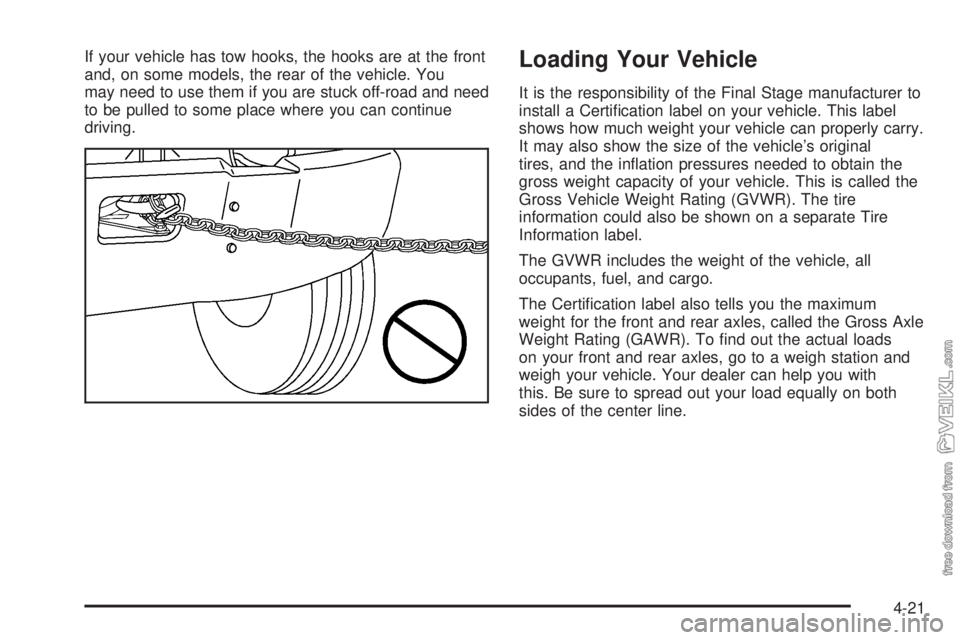
If your vehicle has tow hooks, the hooks are at the front
and, on some models, the rear of the vehicle. You
may need to use them if you are stuck off-road and need
to be pulled to some place where you can continue
driving.Loading Your Vehicle
It is the responsibility of the Final Stage manufacturer to
install a Certification label on your vehicle. This label
shows how much weight your vehicle can properly carry.
It may also show the size of the vehicle’s original
tires, and the inflation pressures needed to obtain the
gross weight capacity of your vehicle. This is called the
Gross Vehicle Weight Rating (GVWR). The tire
information could also be shown on a separate Tire
Information label.
The GVWR includes the weight of the vehicle, all
occupants, fuel, and cargo.
The Certification label also tells you the maximum
weight for the front and rear axles, called the Gross Axle
Weight Rating (GAWR). To find out the actual loads
on your front and rear axles, go to a weigh station and
weigh your vehicle. Your dealer can help you with
this. Be sure to spread out your load equally on both
sides of the center line.
4-21
Page 206 of 384
Four-Wheel Drive............................................5-73
Front Axle......................................................5-74
Noise Control System.....................................5-75
Tampering with Noise Control System
Prohibited.................................................5-75
Bulb Replacement..........................................5-76
Windshield Wiper Blade Replacement..............5-76
Other Service Items........................................5-78
Fuel Filter....................................................5-78
Primary Fuel Filter and Water Separator..........5-79
Secondary Fuel Filter and Water Separator/
Heater (Caterpillar
®Diesel).........................5-80
Front Wheel Bearings with
Oil-Filled Hubs..........................................5-81
Tires..............................................................5-82
Inflation - Tire Pressure.................................5-82
Wheel Loading.............................................5-83
Dual Tire Operation.......................................5-84
When It Is Time for New Tires.......................5-84
Buying New Tires.........................................5-85
Wheel Alignment and Tire Balance..................5-86Tightening the Wheel Nuts.............................5-86
Wheel Replacement......................................5-90
If a Tire Goes Flat........................................5-92
Appearance Care............................................5-94
Interior Cleaning...........................................5-94
Fabric/Carpet...............................................5-95
Instrument Panel, Vinyl, and Other Plastic
Surfaces..................................................5-96
Care of Safety Belts......................................5-96
Weatherstrips...............................................5-96
Washing Your Vehicle...................................5-97
Cleaning Exterior Lamps/Lenses.....................5-97
Finish Care..................................................5-97
Windshield and Wiper Blades.........................5-98
Aluminum or Chrome-Plated Wheels
and Trim..................................................5-98
Tires...........................................................5-99
Sheet Metal Damage.....................................5-99
Finish Damage.............................................5-99
Underbody Maintenance...............................5-100
Chemical Paint Spotting...............................5-100
Vehicle Care/Appearance Materials................5-100
Section 5 Service and Appearance Care
5-2
Page 263 of 384
Four-Wheel and Six-Wheel Drum
Brakes (Air Only)
The brake drums should be removed and inspected
each time the tires are removed for rotation or changing.
When you have the front brakes replaced, have the rear
brakes inspected, too.
Brake linings should always be replaced as complete
axle sets.
Brake Pedal Travel
See your dealer/retailer if the brake pedal does not
return to normal height, or if there is a rapid increase in
pedal travel. This could be a sign that brake service
might be required.
Brake Adjustment
Every time you make a brake stop, the brakes adjust
for wear.
Brake Adjustment on Air Braked Vehicles
Your vehicle has automatic slack adjusters. Every
time you make a brake stop, the brakes automatically
adjust for wear. Slack adjusters should never be
manually adjusted to correct excessive brake chamber
pushrod stroke. Excessive brake chamber pushrod
stroke means that the brake system needs to be
serviced by a qualified service technician.Notice:Do not manually adjust automatic slack
adjusters. Manual adjustment of the automatic slack
adjusters can result in a degradation of the slack
adjuster performance over time. If the brake
chamber pushrod stroke is out of adjustment, the
brake system needs to be serviced by a qualied
service technician.
Replacing Brake System Parts
The braking system on a vehicle is complex. Its many
parts have to be of top quality and work well together if
the vehicle is to have really good braking. Your vehicle
was designed and tested with top-quality brake parts.
When you replace parts of the braking system — for
example, when the brake linings wear down and you
need new ones put in — be sure you get new approved
replacement parts. If you do not, the brakes might not
work properly. For example, if someone puts in brake
linings that are wrong for your vehicle, the balance
between the front and rear brakes can change — for the
worse. The braking performance you have come to
expect can change in many other ways if someone puts
in the wrong replacement brake parts.
5-59
Page 286 of 384
Tires
Your new vehicle comes with high-quality tires
made by a leading tire manufacturer. If you ever
have questions about your tire warranty and where
to obtain service, see your vehicle Warranty
booklet for details.
{CAUTION:
Poorly maintained and improperly used
tires are dangerous.
Overloading your vehicle’s tires can
cause overheating as a result of too
much exing. You could have an
air-out and a serious accident. See
Loading Your Vehicle on page 4-21.
Underinated tires pose the same
danger as overloaded tires. The
resulting accident could cause serious
injury. Check all tires frequently to
maintain the recommended pressure.
Tire pressure should be checked when
your vehicle’s tires are cold. See
Inflation - Tire Pressure on page 5-82.
CAUTION: (Continued)
CAUTION: (Continued)
Overinated tires are more likely to be
cut, punctured, or broken by a sudden
impact — such as when you hit a
pothole. Keep tires at the
recommended pressure.
Worn, old tires can cause accidents. If
the tire’s tread is badly worn, or if
your vehicle’s tires have been
damaged, replace them.
Ination - Tire Pressure
Tires need the correct amount of air pressure to operate
effectively. The Certification or Tire Information label
shows the correct inflation pressures for your tires when
they are cold. Cold means your vehicle has been
sitting for at least three hours or driven no more than
1 mile (1.6 km).
5-82
Page 287 of 384
Notice:Do not let anyone tell you that
under-ination or over-ination is all right. It is
not. If your tires do not have enough air
(under-ination), you can get the following:
Too much exing
Too much heat
Tire overloading
Premature or irregular wear
Poor handling
Reduced fuel economy
If your tires have too much air (over-ination),
you can get the following:
Unusual wear
Poor handling
Rough ride
Needless damage from road hazards
When to Check
Check your tires once a month or more.
Also, check the tire pressure of the spare tire if your
vehicle has one.
How to Check
Use a good quality pocket-type gage to check tire
pressure. You cannot tell if your vehicle’s tires are
properly inflated simply by looking at them. Radial tires
may look properly inflated even when they are
underinflated. Check the tire’s inflation pressure when the
tires are cold. Cold means your vehicle has been sitting
for at least three hours or driven no more than
1 mile (1.6 km).
Remove the valve cap from the tire valve stem. Press
the tire gage firmly onto the valve to get a pressure
measurement. If the cold tire inflation pressure matches
the recommended pressure on the Certification or Tire
Information label, no further adjustment is necessary.
If the inflation pressure is low, add air until you reach the
recommended amount. If you overfill the tire, release air
by pushing on the metal stem in the center of the tire
valve. Re-check the tire pressure with the tire gage.
Be sure to put the valve caps back on the valve stems.
They help prevent leaks by keeping out dirt and
moisture.
Wheel Loading
Wheels are stamped with a maximum load and cold
inflation rating. Be sure you do not exceed these limits.
5-83
Page 288 of 384
Dual Tire Operation
When the vehicle is new, check the wheel nut tightness
on all wheels with a torque wrench after your first
100 miles (160 km) and then 1,000 miles (1 600 km)
after that. Whenever a wheel, wheel bolt or wheel nut is
removed or serviced, repeat the 100 miles (160 km),
and then 1,000 mile (1 600 km) wheel nut tightness
check.
SeeTightening the Wheel Nuts on page 5-86for wheel
nut tightening information and proper torque values.
{CAUTION:
If you operate your vehicle with a tire that is
badly underinated, the tire can overheat. An
overheated tire can lose air suddenly or catch
re. You or others could be injured. Be sure all
tires (including the spare, if any) are properly
inated.
SeeTires on page 5-82andInflation - Tire Pressure on
page 5-82for more information on proper tire inflation.
When It Is Time for New Tires
Various factors, such as maintenance, temperatures,
driving speeds, vehicle loading, and road conditions,
influence when you need new tires.
Replace your tires when the tread depth is down to
1/8 of an inch (3.2 mm) for the front tires, or 1/16 of an
inch (1.6 mm) for a rear tire. Also, you need a new
tire if:
•You can see cord or fabric showing through the
tire’s rubber.
•The tread or sidewall is cracked, cut, or snagged
deep enough to show cord or fabric.
•The tire has a bump, bulge, or split.
•The tire has a puncture, cut, or other damage that
cannot be repaired well because of the size or
location of the damage.
The rubber in tires degrades over time, even if they are
not being used. This is also true for the spare tire, if
your vehicle has one. Multiple conditions affect how fast
this aging takes place, including temperatures, loading
conditions, and inflation pressure maintenance. With
proper care and maintenance tires will typically wear out
before they degrade due to age. If you are unsure about
the need to replace your tires as they get older, consult
the tire manufacturer for more information.
5-84
Page 289 of 384
If your vehicle has four-wheel drive, the axle differentials,
propshafts, and transfer case may be damaged if tires
of different sizes, brands or tread types are installed
on the front and rear axles. That damage would not be
covered under your warranty.
Buying New Tires
GM has developed and matched specific tires for your
vehicle. If you need replacement tires, GM strongly
recommends that you get tires that are the same size,
brand, load range, speed rating, and construction type
(radial and bias-belted tires) as your vehicle’s original
tires. This way, your vehicle will continue to have tires
that are designed to give the same performance and
vehicle safety, during normal use, as the original tires.
GM recommends replacing tires in sets of six or eight as
applicable. This is because uniform tread depth on all
tires will help keep your vehicle performing most like it
did when the tires were new. Replacing less than a full
set of tires can affect the braking and handling
performance of your vehicle.
{CAUTION:
Mixing tires could cause you to lose
control while driving. If you mix tires of
different sizes, brands, or types (radial
and bias-belted tires) the vehicle may not
handle properly, and you could have a
crash. Using tires of different sizes,
brands, or types may also cause damage
to your vehicle. Be sure to use the correct
size, brand, and type of tires on your
vehicle’s wheels.
{CAUTION:
If you use bias-ply tires on your vehicle,
the wheel rim anges could develop
cracks after many miles of driving. A tire
and/or wheel could fail suddenly, causing
a crash. Use only radial-ply tires with the
wheels on your vehicle.
5-85
Page 294 of 384
Wheel Replacement
Replace any wheel that is bent, cracked, or badly rusted
or corroded. If wheel nuts keep coming loose, replace
the wheel, wheel bolts, and wheel nuts. If the wheel
leaks air, replace it.
Your dealer will know the kind of wheel you need.
Each new wheel should have the same load-carrying
capacity, diameter, width, offset and be mounted
the same way as the one it replaces.
{CAUTION:
Using the wrong replacement wheels, wheel
bolts, or wheel nuts on your vehicle can be
dangerous. It could affect the braking and
handling of your vehicle, make your tires lose
air and make you lose control. You could have
a collision in which you or others could be
injured. Always use the correct wheel, wheel
bolts, and wheel nuts for replacement.If you need to replace any of your wheels, wheel bolts
or wheel nuts, replace them only with new GM
original equipment parts. This way, you will be sure to
have the right wheel, wheel bolts and wheel nuts for
your vehicle.
{CAUTION:
A leaking wheel could fail without warning. A
wheel designed for tubeless tires could be
leaking because it is damaged. Do not use an
inner tube or some other thing to try to stop the
leaking. Get a new wheel of the proper type.
5-90
Page 295 of 384
{CAUTION:
Without the correct wheel, wheel bolts or
wheel nuts, you may not be able to stop
properly, and you could have other problems
like a tire air-out. You could have a collision. If
you do not go to your dealer to get a new
wheel, wheel bolts or wheel nuts, be sure you
get the correct ones. Each new wheel should
match the original wheel in load-carrying
capacity, ination pressure capacity, diameter,
width, offset and mounting conguration.Using wheels and tires with higher load-carrying limits
than the original wheels and tires does not change
the Gross Axle Weight Rating (GAWR) or the Gross
Vehicle Weight Rating (GVWR) of your vehicle.
SeeLoading Your Vehicle on page 4-21for more
information.
Notice:The wrong wheel can cause trouble in
bearing life, brake cooling, speedometer/odometer
calibration, headlamp aim, bumper height, vehicle
ground clearance, stopping distance and tire
clearance to the body and chassis. You could also
have other problems like a tire air-out.
5-91
Page 296 of 384
Used Replacement Wheels
{CAUTION:
Putting a used wheel on your vehicle is
dangerous. You cannot know how it has been
used or how far it has been driven. It could fail
suddenly and cause a crash. If you have to
replace a wheel, use a new GM original
equipment wheel.
If a Tire Goes Flat
It is unusual for a tire to blowout while you are driving,
especially if you maintain your tires properly. If air goes
out of a tire, it is much more likely to leak out slowly. But if
you should ever have a blowout, here are a few tips about
what to expect and what to do:
If a front tire fails, the flat tire will create a drag that
pulls the vehicle toward that side. Take your foot off the
accelerator pedal and grip the steering wheel firmly. Steer
to maintain lane position, and then gently brake to a stop
well out of the traffic lane.
A rear blowout, particularly on a curve, acts much like a
skid and may require the same correction you would
use in a skid. In any rear blowout, remove your foot from
the accelerator pedal. Get the vehicle under control by
steering the way you want the vehicle to go. It may be
very bumpy and noisy, but you can still steer. Gently
brake to a stop –– well off the road if possible.
If a tire goes flat, avoid further tire and wheel damage
by driving slowly to a level place and turn on your
hazard warning flashers. SeeHazard Warning Flashers
on page 3-6.
5-92