towing CHEVROLET KODIAK 2008 User Guide
[x] Cancel search | Manufacturer: CHEVROLET, Model Year: 2008, Model line: KODIAK, Model: CHEVROLET KODIAK 2008Pages: 384, PDF Size: 5.4 MB
Page 204 of 384
Trailer Connections
Heavy-Duty Trailer Wiring Package
Your vehicle may be equipped with an eight-wire trailer
towing harness. This harness, with a seven-pin
universal heavy-duty trailer connector, is attached to a
bracket on the platform hitch.
The Center High-Mounted Stoplamp (CHMSL) wire is
tied next to the trailer wiring harness for use with a
trailer.
The eight-wire harness contains the following trailer
circuits:
•Yellow: Left Stop/Turn Signal
•Dark Green: Right Stop/Turn Signal
•Brown: Taillamps
•White: Ground
•Light Green: Back-up Lamps
•Light Blue: CHMSL
•Red: Battery Feed
•Dark Blue: Trailer Brake
Trailer Connections
(C7/C8 Models Only)
If your vehicle has these trailer connections, they are
located at the rear of the cab for a tractor and at the rear
of the chassis when towing a trailer. There will be an
air connection and an electrical connection.
Be sure that the couplings to the trailer are made
correctly.
Air Connections
If you are not connecting the trailer air line connections
to another piece of equipment, be sure to replace
their protective caps.
Electrical Connections
This system is a seven-wire cable that will connect to
the trailer, supplying power to the trailer’s lighting
system. When not in use, it is stored in the trailer
air-hose storage bracket.
4-26
Page 258 of 384
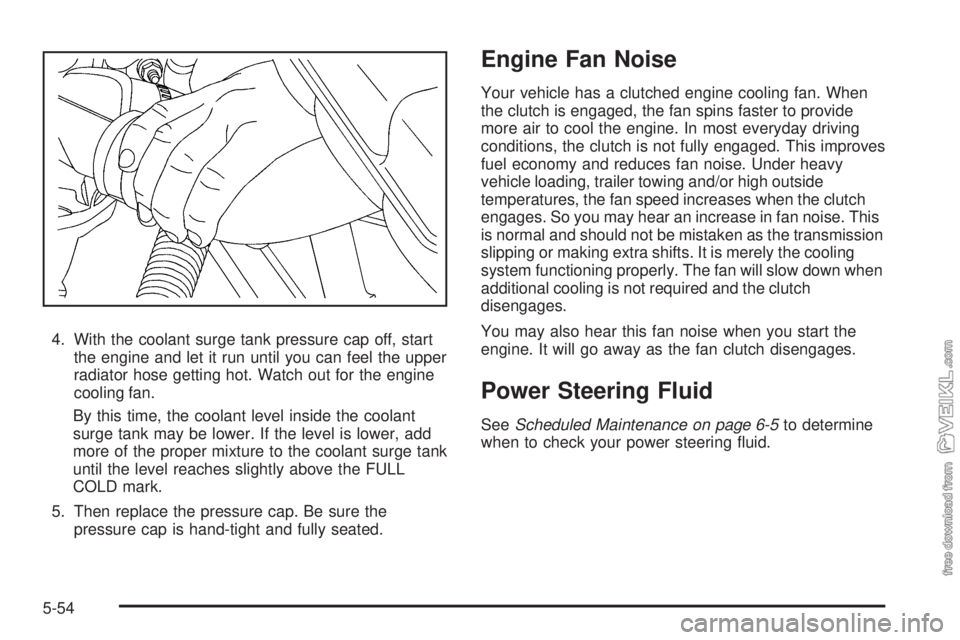
4. With the coolant surge tank pressure cap off, start
the engine and let it run until you can feel the upper
radiator hose getting hot. Watch out for the engine
cooling fan.
By this time, the coolant level inside the coolant
surge tank may be lower. If the level is lower, add
more of the proper mixture to the coolant surge tank
until the level reaches slightly above the FULL
COLD mark.
5. Then replace the pressure cap. Be sure the
pressure cap is hand-tight and fully seated.
Engine Fan Noise
Your vehicle has a clutched engine cooling fan. When
the clutch is engaged, the fan spins faster to provide
more air to cool the engine. In most everyday driving
conditions, the clutch is not fully engaged. This improves
fuel economy and reduces fan noise. Under heavy
vehicle loading, trailer towing and/or high outside
temperatures, the fan speed increases when the clutch
engages. So you may hear an increase in fan noise. This
is normal and should not be mistaken as the transmission
slipping or making extra shifts. It is merely the cooling
system functioning properly. The fan will slow down when
additional cooling is not required and the clutch
disengages.
You may also hear this fan noise when you start the
engine. It will go away as the fan clutch disengages.
Power Steering Fluid
SeeScheduled Maintenance on page 6-5to determine
when to check your power steering fluid.
5-54
Page 365 of 384
GM Mobility Reimbursement
Program
This program, available to qualified applicants, can
reimburse you up to $1,000 of the cost of eligible
aftermarket adaptive equipment required for your vehicle,
such as hand controls or a wheelchair/scooter lift.
The offer is available for a very limited period of time
from the date of vehicle purchase/lease. For more
details, or to determine your vehicle’s eligibility, visit
gmmobility.com or call the GM Mobility Assistance
Center at 1-800-323-9935. Text telephone (TTY) users,
call 1-800-833-9935.
General Motors of Canada also has a Mobility Program.
Call 1-800-GM-DRIVE (463-7483) for details. TTY
users call 1-800-263-3830.
Roadside Assistance Program
GM Medium Duty truck’s Roadside Assistance provides
stranded owner/operators with towing service for
disabled GM Medium Duty trucks, during the base
and/or engine warranty period, to the nearest authorized
GM Medium Duty dealer. This service combines the
efforts of trained telephone representatives with a
network of GM Medium Duty truck services.
Call GM Medium Duty truck’s Roadside Assistance at
1-800-862-4389 to reach a qualified representative who
can assist you in arranging a tow to the nearest GM
Medium Duty truck dealer when your vehicle is disabled.
We also provide dealer information at no charge,
such as location of the nearest authorized GM Medium
Duty truck dealer and their hours of operation.
Our Roadside Assistance is available 24 hours a day,
7 days a week, 365 days a year which includes
weekends and holidays. Should you have questions
about GM Medium Duty truck Roadside Assistance, call
the GM Medium Duty Roadside Assistance Center or
contact your dealer.
Canadian Roadside Assistance
Whenever a Medium Duty truck owned and operated in
Canada becomes disabled, the owner/operator should
contact the Canadian Roadside Assistance Center
at 1-800-268-6800 for assistance.
7-5
Page 367 of 384
Insuring Your Vehicle
Protect your investment in your GM vehicle with
comprehensive and collision insurance coverage. There
are significant differences in the quality of coverage
afforded by various insurance policy terms. Many
insurance policies provide reduced protection to your
GM vehicle by limiting compensation for damage repairs
by using aftermarket collision parts. Some insurance
companies will not specify aftermarket collision
parts. When purchasing insurance, we recommend that
you assure your vehicle will be repaired with GM
original equipment collision parts. If such insurance
coverage is not available from your current insurance
carrier, consider switching to another insurance carrier.
If your vehicle is leased, the leasing company may
require you to have insurance that assures repairs with
Genuine GM Original Equipment Manufacturer (OEM)
parts or Genuine Manufacturer replacement parts. Read
your lease carefully, as you may be charged at the
end of your lease for poor quality repairs.
If a Crash Occurs
Here is what to do if you are involved in a crash.
•Try to relax and then check to make sure you are all
right. If you are uninjured, make sure that no one else
in your vehicle, or the other vehicle, is injured.
•If there has been an injury, call emergency services
for help. Do not leave the scene of a crash until all
matters have been taken care of. Move your vehicle
only if its position puts you in danger or you are
instructed to move it by a police officer.
•Give only the necessary and requested information
to police and other parties involved in the crash. Do
not discuss your personal condition, mental frame of
mind, or anything unrelated to the crash. This will
help guard against post-crash legal action.
•If you need roadside assistance, call GM Roadside
Assistance. SeeRoadside Assistance Program on
page 7-5for more information.
•If your vehicle cannot be driven, know where the
towing service will be taking it. Get a card from the
tow truck operator or write down the driver’s name,
the service’s name, and the phone number.
•Remove any valuables from your vehicle before it is
towed away. Make sure this includes your insurance
information and registration if you keep these items
in your vehicle.
7-7
Page 383 of 384
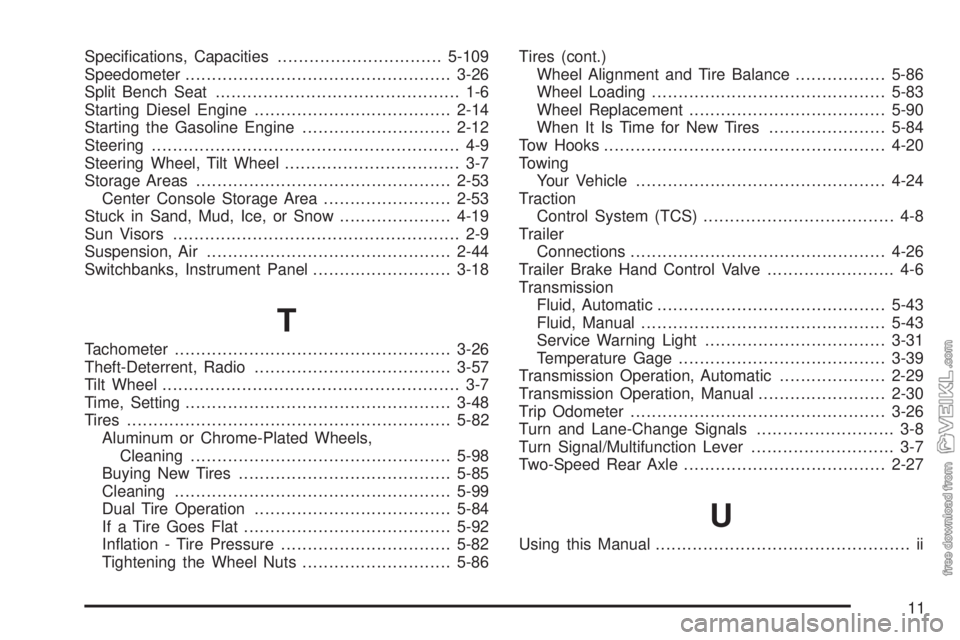
Specifications, Capacities...............................5-109
Speedometer..................................................3-26
Split Bench Seat.............................................. 1-6
Starting Diesel Engine.....................................2-14
Starting the Gasoline Engine............................2-12
Steering.......................................................... 4-9
Steering Wheel, Tilt Wheel................................. 3-7
Storage Areas................................................2-53
Center Console Storage Area........................2-53
Stuck in Sand, Mud, Ice, or Snow.....................4-19
Sun Visors...................................................... 2-9
Suspension, Air..............................................2-44
Switchbanks, Instrument Panel..........................3-18
T
Tachometer....................................................3-26
Theft-Deterrent, Radio.....................................3-57
Tilt Wheel........................................................ 3-7
Time, Setting..................................................3-48
Tires.............................................................5-82
Aluminum or Chrome-Plated Wheels,
Cleaning.................................................5-98
Buying New Tires........................................5-85
Cleaning....................................................5-99
Dual Tire Operation.....................................5-84
If a Tire Goes Flat.......................................5-92
Inflation - Tire Pressure................................5-82
Tightening the Wheel Nuts............................5-86Tires (cont.)
Wheel Alignment and Tire Balance.................5-86
Wheel Loading............................................5-83
Wheel Replacement.....................................5-90
When It Is Time for New Tires......................5-84
Tow Hooks.....................................................4-20
Towing
Your Vehicle...............................................4-24
Traction
Control System (TCS).................................... 4-8
Trailer
Connections................................................4-26
Trailer Brake Hand Control Valve........................ 4-6
Transmission
Fluid, Automatic...........................................5-43
Fluid, Manual..............................................5-43
Service Warning Light..................................3-31
Temperature Gage.......................................3-39
Transmission Operation, Automatic....................2-29
Transmission Operation, Manual........................2-30
Trip Odometer................................................3-26
Turn and Lane-Change Signals.......................... 3-8
Turn Signal/Multifunction Lever........................... 3-7
Two-Speed Rear Axle......................................2-27
U
Using this Manual................................................ ii
11