light CHEVROLET KODIAK 2008 Owner's Manual
[x] Cancel search | Manufacturer: CHEVROLET, Model Year: 2008, Model line: KODIAK, Model: CHEVROLET KODIAK 2008Pages: 384, PDF Size: 5.4 MB
Page 99 of 384
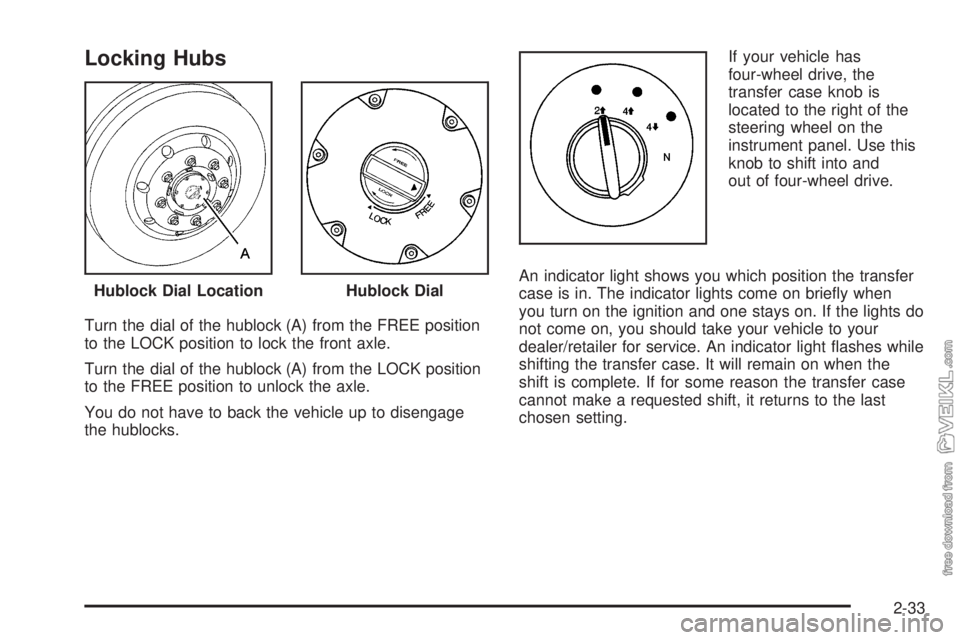
Locking Hubs
Turn the dial of the hublock (A) from the FREE position
to the LOCK position to lock the front axle.
Turn the dial of the hublock (A) from the LOCK position
to the FREE position to unlock the axle.
You do not have to back the vehicle up to disengage
the hublocks.If your vehicle has
four-wheel drive, the
transfer case knob is
located to the right of the
steering wheel on the
instrument panel. Use this
knob to shift into and
out of four-wheel drive.
An indicator light shows you which position the transfer
case is in. The indicator lights come on briefly when
you turn on the ignition and one stays on. If the lights do
not come on, you should take your vehicle to your
dealer/retailer for service. An indicator light flashes while
shifting the transfer case. It will remain on when the
shift is complete. If for some reason the transfer case
cannot make a requested shift, it returns to the last
chosen setting. Hublock Dial Location
Hublock Dial
2-33
Page 101 of 384
Notice:If your vehicle has an Allison®transmission
and you try to put the transmission in PARK (P)
while the transfer case is in Four-Wheel Low,
the transmission might not go into PARK (P) and
could damage your vehicle. When parking your
vehicle, make sure the transfer case is in Two-Wheel
High or Four-Wheel High.
NEUTRAL:Shift the vehicle’s transfer case to
NEUTRAL only when towing your vehicle.
Shifting Into Four-Wheel High
Turn the knob to four-wheel high. This can be done at
3 mph or less, while you are shifting out of Four-Wheel
Low. The indicator light flashes while shifting. It
remains on after the shift is complete. Be sure to lock
your front hubs.
Shifting Into Two-Wheel High
Turn the knob to Two-Wheel High. This can be done
at 3 mph or less, while you are shifting out of
Four-Wheel Low.
Shifting Into Four-Wheel Low
To shift to Four-Wheel Low, the vehicle’s engine must
be running and the vehicle must be stopped or
moving less than 3 mph (5 km/h) with the transmission
in NEUTRAL (N). The preferred method for shifting
into Four-Wheel Low is to have your vehicle moving
1 or 2 mph (1.6 to 3.2 km/h). Turn the knob to
Four-Wheel Low. You must wait for the Four-Wheel Low
indicator light to stop flashing and remain on before
shifting the transmission into gear. Be sure to lock the
front hubs.
Notice:Shifting the transmission into gear before
the Four-Wheel Drive Low indicator light has stopped
ashing could damage the transfer case. To help
avoid damaging your vehicle, always wait for the
Four-Wheel Drive Low indicator light to stop ashing
before shifting the transmission into gear.
If you turn the knob to Four-Wheel Low while your
vehicle is in gear and/or moving, the Four-Wheel Low
indicator light flashes for 30 seconds and does not
complete the shift unless your vehicle is moving less
than 3 mph (4.8 km/h) and the transmission is in
NEUTRAL (N). After 30 seconds, the transfer case
returns to the setting last chosen. If your vehicle is in
gear and moving less than 3 mph (4.8 km/h), the
transfer case shifts to Four-Wheel High.
2-35
Page 102 of 384
Shifting Out of Four-Wheel Low
To shift from Four-Wheel Low to Four-Wheel High or
Two-Wheel High, your vehicle must be stopped or
moving less than 3 mph (5 km/h) with the transmission in
NEUTRAL (N) and the engine running. The preferred
method for shifting out of Four-Wheel Low is to have your
vehicle moving 1 or 2 mph (1.6 to 3.2 km/h). Turn the
knob to Four-Wheel High or Two-Wheel High. You must
wait for the Four-Wheel High or Two-Wheel High
indicator light to stop flashing and remain on before
shifting the transmission into gear.
Notice:Shifting the transmission into gear before
the Four-Wheel High or Two-Wheel High indicator
light has stopped ashing could damage the transfer
case. To help avoid damaging your vehicle, always
wait for the Four-Wheel High or Two-Wheel High
indicator light to stop ashing before shifting
the transmission into gear.
If the knob is turned to Four-Wheel High or Two-Wheel
High while your vehicle is in gear and/or moving, the
Four-Wheel High or Two-Wheel high indicator light
flashes for 30 seconds. It will not complete the shift
unless your vehicle is moving less than 3 mph (5 km/h)
with the transmission in NEUTRAL (N).
Shifting Into NEUTRAL
Before shifting the transfer case to NEUTRAL, first
make sure the vehicle is parked so that it will not roll.
1. Set the parking brake. SeeParking Brake (With
Hydraulic Brakes) on page 2-38orParking Brake
(With Air Brakes) on page 2-41for parking
brake apply procedure.
2. Start the vehicle.
3. Put the transmission in NEUTRAL (N).
4. Shift the transfer case to Two-Wheel High.
5. Turn the transfer case knob all of the way past
Four-Wheel Low and hold it there for a minimum of
10 seconds. The NEUTRAL indicator light comes on.
6. Shift the transmission to REVERSE (R) for
one second, then shift the transmission to
DRIVE (D) for one second.
7. Turn the ignition to OFF.
8. Place the transmission shift lever in PARK (P).
9. Turn the ignition to LOCK.
2-36
Page 103 of 384
Shifting Out of NEUTRAL
To shift the transfer case out of NEUTRAL, do the
following:
1. Set the parking brake. SeeParking Brake (With
Hydraulic Brakes) on page 2-38orParking Brake
(With Air Brakes) on page 2-41for parking
brake apply procedure.
2. Apply the regular brake pedal.
3. Turn the ignition to ON/RUN with the engine off.
4. Put the transmission in NEUTRAL (N).
5. Turn the transfer case knob to the desired shift
position (Two-Wheel High, Four-Wheel High,
Four-Wheel Low).
6. After the transfer case has shifted out of NEUTRAL,
the indicator light goes out.
Notice:Driving with the parking brake on can
overheat the brake system and cause premature
wear or damage to brake system parts. Verify that
the parking brake is fully released and the brake
warning light is off before driving.7. Release the parking brake.
8. Start the engine and shift the transmission lever to
the desired position.
Excessively shifting the transfer case into or out of the
different modes can cause the transfer case to enter the
shift protection mode. This protects the transfer case from
possible damage and only allows the transfer case to
respond to one shift per 10 seconds. The transfer case
can stay in this mode for up to three minutes.
Parking
{CAUTION:
If you do not park your vehicle properly, it can
roll. If you have left the engine running, it can
move very quickly. You or others could be
injured. To be sure your vehicle will not move,
even when you are on level ground, follow the
steps below.
2-37
Page 105 of 384
To set the foot pedal parking brake, hold the regular
brake pedal down with your right foot. Push down
the parking brake pedal with your left foot.
{CAUTION:
It can be dangerous to get out of your vehicle
without the parking brake rmly set. Your
vehicle can roll. If you have left the engine
running, the vehicle can move suddenly. You or
others could be injured. To be sure your vehicle
will not move, even when you are on fairly level
ground, always set the parking brake.
To set the hand lever parking brake, hold the regular
brake pedal down with your right foot. Pull up on
the handle with your right hand, until it stops.If the ignition is on when the parking brake is set, the
brake system warning light will come on.
Once the parking brake is applied, slowly remove your
foot from the regular brake pedal, while checking to
see if the vehicle moves. If the vehicle does start
to move, press the regular brake pedal and adjust the
parking brake holding force. See “Parking Brake
Adjustment” later in this section.
If the parking brake still does not set, take the vehicle to
your dealer/retailer for service.
To release the foot pedal parking brake, hold the
regular brake pedal down. Pull the brake release handle,
located just above the parking brake pedal.
To release the hand lever parking brake, hold the
regular brake pedal down and push down on the handle
until it stops.
If the ignition is on when the parking brake is released,
the brake system warning light will go off.
2-39
Page 107 of 384
4. Check to see if the vehicle moves by slowly
removing your foot from the regular brake pedal.
5. If the vehicle moves, press the regular brake and
repeat the adjustment procedure.
Notice:Over-tightening the park brake lever can
cause damage to the park brake system.
Over-tightening is possible by turning the knob
more than half a turn.
Over-tightening is similar to driving down the road with
your regular brakes applied. If your park brake system is
over-tightened your vehicle may seem sluggish to
accelerate, and/or your park brake hand lever maybe
very hard to pull up and apply the park brake.
If the park brake is over-tightened turn the knob to the
left until it stops and follow the parking brake adjustment
procedure.
Vehicles with a foot-pedal park brake system must be
serviced to make this adjustment. SeeScheduled
Maintenance on page 6-5for more information.Parking Brake (With Air Brakes)
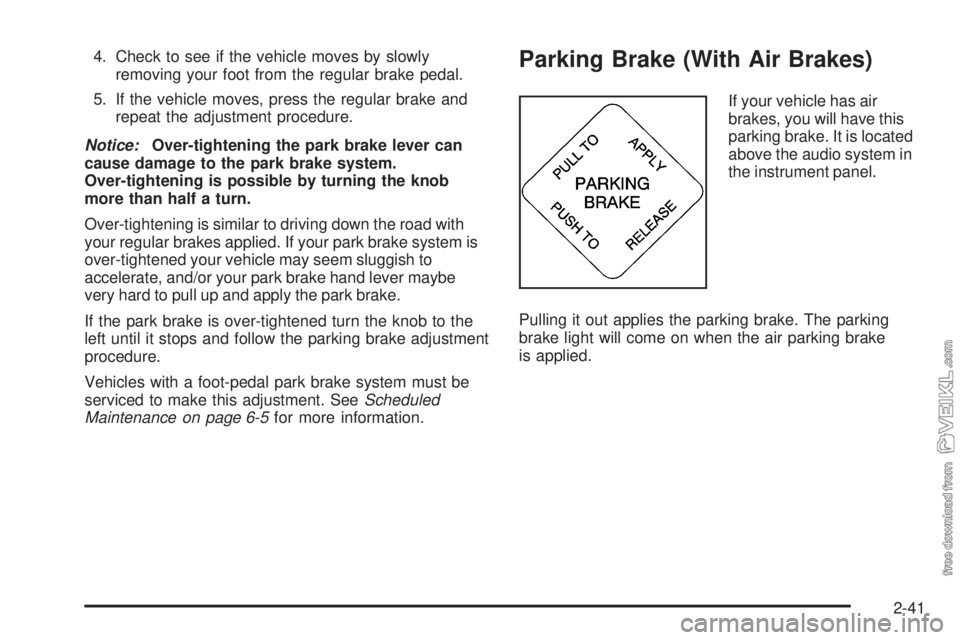
If your vehicle has air
brakes, you will have this
parking brake. It is located
above the audio system in
the instrument panel.
Pulling it out applies the parking brake. The parking
brake light will come on when the air parking brake
is applied.
2-41
Page 109 of 384
{CAUTION:
If you apply any one of the air brake parking
controls while the vehicle is moving, your rig
will stop suddenly. If you are not ready for
this, you or others could be injured. Do not
apply any one of these controls while you are
driving, unless you have to make an
emergency stop.
If the air pressure drops below 60 to 70 psi
(413 to 482 kPa), the primary brake light and warning
buzzer will come on. If the air pressure drops to
35 to 45 psi (241 to 310 kPa), the red trailer air supply
knob will automatically pop out and apply the spring
brakes on the trailer.
If the air pressure drops to 35 to 45 psi (241 to 310 kPa),
the yellow park brake knob will automatically pop out
and apply the spring brakes on the truck or tractor.
If you ever have a complete loss of air so that your air
brakes automatically apply, there is a way that the
tow operator can release the parking brakes to tow the
vehicle. SeeTowing Your Vehicle on page 4-24.
Parking Brake Burnish Procedure
All vehicles which have hydraulic brakes have a parking
brake. It is recommended that the parking brake be
burnished as part of the new vehicle break-in. The
parking brake will work best after it has been burnished
following these instructions:
1. Make sure that there is no other traffic around,
bring the vehicle speed up to 20 mph (32 km/h)
and apply the parking brake. Let the vehicle come
to a complete stop. Apply the base brakes and
disengage the parking brake.
2. Repeat the burnishing procedure in Step 1 a total
of 10 times
3. Between stops, drive the vehicle about
2.5 miles (4 km)
Notice:Driving with the parking brake on can
damage the transmission and brake system parts.
Verify that the parking brake is fully released and the
brake warning light is off before driving.
2-43
Page 110 of 384
Air Suspension
Your vehicle may have the Hendrickson HAS Series
single-axle air suspension which is designed for a
single-axle on-highway use. This feature is available in
19,000 lb (8 613.3 kg), 21,000 lb (9 525.4 kg) and
23,000 lb (10 432.6 kg) capacities.
Rear Air Suspension Dump Control
If your vehicle is equipped with the Hendrickson
HAS Series single-axle air suspension, you may have
this control. The air suspension dump control allows the
operator to lower the deck height approximately
4.5 inches (11.5 cm) from the normal frame height.
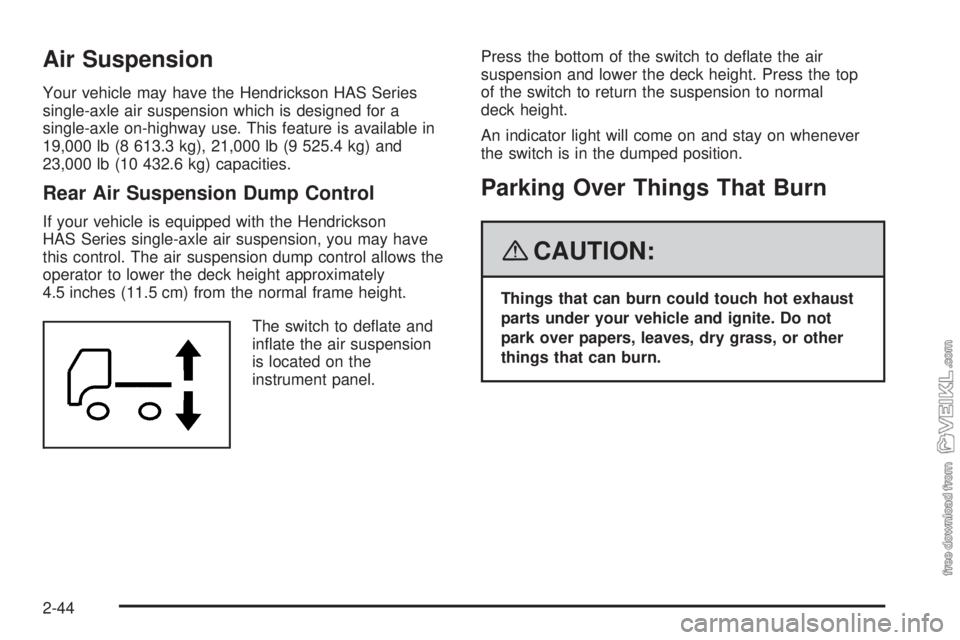
The switch to deflate and
inflate the air suspension
is located on the
instrument panel.Press the bottom of the switch to deflate the air
suspension and lower the deck height. Press the top
of the switch to return the suspension to normal
deck height.
An indicator light will come on and stay on whenever
the switch is in the dumped position.
Parking Over Things That Burn
{CAUTION:
Things that can burn could touch hot exhaust
parts under your vehicle and ignite. Do not
park over papers, leaves, dry grass, or other
things that can burn.
2-44
Page 113 of 384
{CAUTION:
During DPF regeneration, the exhaust system
and exhaust gases are very hot. Things that
burn could touch hot exhaust parts under your
vehicle and ignite. You or others could be
burned. Do not park near or over papers, leaves,
dry grass, or other things that can burn.
When the yellow DPF indicator comes on, the filter is
dirty and DPF regeneration is necessary. When
driving continues without regeneration, the DPF indicator
will change from yellow to red. Continuing to drive the
vehicle with the red indicator can cause filter damage.
To clean the filter, either drive the vehicle above
30 mph (50 km/h) to activate the automatic regeneration
or stop the vehicle and perform the manual regeneration
procedure. For the automatic regeneration, drive until
the green DPF indicator light goes off. This will take
approximately 20 minutes. Once automatic regeneration
has started, drive until the green indicator light goes
off to complete the regeneration in a single operation if
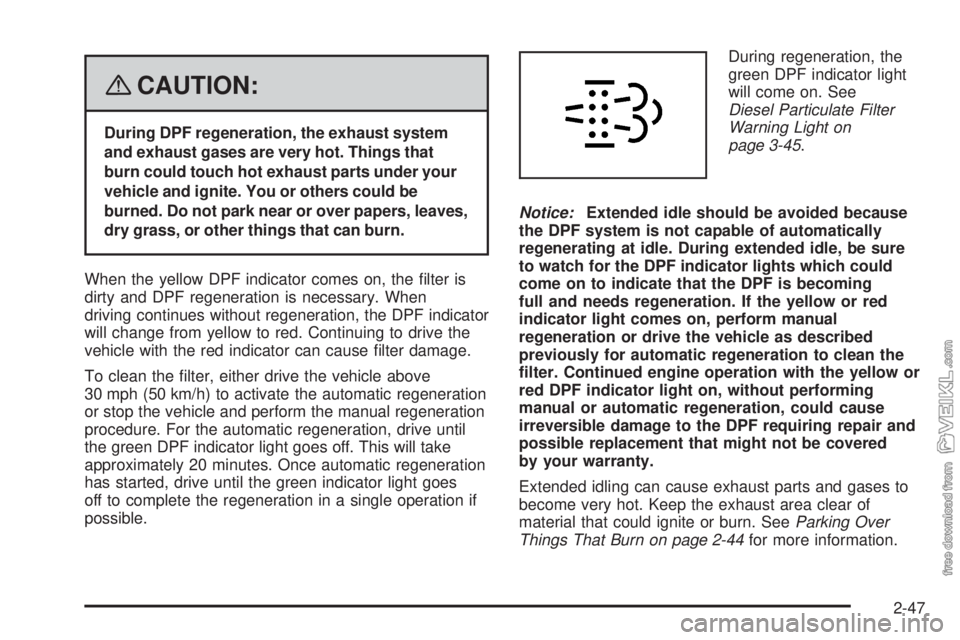
possible.During regeneration, the
green DPF indicator light
will come on. See
Diesel Particulate Filter
Warning Light on
page 3-45.
Notice:Extended idle should be avoided because
the DPF system is not capable of automatically
regenerating at idle. During extended idle, be sure
to watch for the DPF indicator lights which could
come on to indicate that the DPF is becoming
full and needs regeneration. If the yellow or red
indicator light comes on, perform manual
regeneration or drive the vehicle as described
previously for automatic regeneration to clean the
lter. Continued engine operation with the yellow or
red DPF indicator light on, without performing
manual or automatic regeneration, could cause
irreversible damage to the DPF requiring repair and
possible replacement that might not be covered
by your warranty.
Extended idling can cause exhaust parts and gases to
become very hot. Keep the exhaust area clear of
material that could ignite or burn. SeeParking Over
Things That Burn on page 2-44for more information.
2-47
Page 114 of 384
For vehicles with Power Take-Off (PTO), monitor the
instrument panel cluster for lights related to the DPF.
All engines consume some amount of engine oil. This is
normal. The by-product of combustion of engine oil is
ash. The ash will become trapped in the DPF over
the life of the vehicle. Eventually, the buildup of ash will
restrict the exhaust gases and the DPF will need to
be cleaned or replaced.
SeeAccessories and Modifications on page 5-4for
important information.
Manual Regeneration Procedure
{CAUTION:
During DPF regeneration, the exhaust system
and exhaust gases are very hot. Stay clear of
the tailpipe area and do not park over things
that burn. You or others could be burned or
your vehicle could catch re. SeeParking Over
Things That Burn on page 2-44.If the yellow or red DPF indicator is on, you can clean
the DPF by performing a manual regeneration.
When it is safe to do so, stop the vehicle. Perform
manual DPF regeneration in a well ventilated area.
Manual DPF regeneration must be performed outdoors,
as follows. Once manual regeneration is started,
complete the regeneration in a single operation if
possible. If manual regeneration is not completed, as
indicated by the green DPF indicator going off, and the
yellow or red indicator light remains on, automatic
regeneration might not be allowed until the vehicle is
stopped and manual regeneration is performed
until completed.
1. Check engine oil and engine coolant levels to be
sure they are at proper operating levels.
2. To prevent running out of fuel during regeneration,
make sure there is at least a quarter of a tank
of fuel.
3. Check to make sure the area near the exhaust
tailpipe and under the exhaust system are clear
of any materials that could catch fire. Keep people
away from the area of the exhaust system and
exhaust gases.
2-48