brake CHEVROLET KODIAK 2008 Workshop Manual
[x] Cancel search | Manufacturer: CHEVROLET, Model Year: 2008, Model line: KODIAK, Model: CHEVROLET KODIAK 2008Pages: 384, PDF Size: 5.4 MB
Page 193 of 384
Highway Hypnosis
Always be alert and pay attention to your surroundings
while driving. If you become tired or sleepy, find a
safe place to park your vehicle and rest.
Other driving tips include:
•Keep the vehicle well ventilated.
•Keep interior temperature cool.
•Keep your eyes moving — scan the road ahead
and to the sides.
•Check the rearview mirror and vehicle instruments
often.
Hill and Mountain Roads
Driving on steep hills or through mountains is different
than driving on flat or rolling terrain. Tips for driving
in these conditions include:
•Keep your vehicle serviced and in good shape.
•Check all fluid levels and brakes, tires, cooling
system, and transmission.
•Going down steep or long hills, shift to a
lower gear.
{CAUTION:
If you do not shift down, the brakes could get
so hot that they would not work well. You
would then have poor braking or even none
going down a hill. You could crash. Shift down
to let the engine assist the brakes on a steep
downhill slope.
{CAUTION:
Coasting downhill in NEUTRAL (N) or with the
ignition off is dangerous. The brakes will have
to do all the work of slowing down and they
could get so hot that they would not work well.
You would then have poor braking or even
none going down a hill. You could crash.
Always have the engine running and your
vehicle in gear when you go downhill.
4-15
Page 195 of 384
If your vehicle has the Traction Control System (TCS), it
improves your ability to accelerate when driving on a
slippery road. But you can turn the TCS off if you ever
need to. You should turn the system off if your
vehicle ever gets stuck in sand, mud, ice, or snow. See
If Your Vehicle is Stuck in Sand, Mud, Ice, or Snow
on page 4-19. Even though your vehicle has TCS, slow
down and adjust your driving to the road conditions.
Under certain conditions, you might want to turn the TCS
off, such as when driving through deep snow and
loose gravel, to help maintain vehicle motion at lower
speeds. SeeTraction Control System (TCS) on
page 4-8.
If your vehicle does not have TCS, accelerate gently.
Try not to break the fragile traction. If you accelerate too
fast, the drive wheels will spin and polish the surface
under the tires even more.
Unless your vehicle has the Antilock Brake System
(ABS), you will want to brake very gently, too. If you do
have ABS, seeAntilock Brake System (ABS) on
page 4-5. ABS improves your vehicle’s stability when
you make a hard stop on a slippery road. Whether your
vehicle has ABS or not, begin stopping sooner than
you would on dry pavement. Without ABS, if you
feel your vehicle begin to slide, let up on the brakes a
little. Push the brake pedal down steadily to get the most
traction you can.Remember, unless your vehicle has ABS, if you brake
so hard that the wheels stop rolling, you will just
slide. Brake so the wheels always keep rolling and you
can still steer.
•Whatever your vehicle’s braking system, allow
greater following distance on any slippery road.
•Watch for slippery spots. The road might be fine
until you hit a spot that is covered with ice. On
an otherwise clear road, ice patches can appear in
shaded areas where the sun cannot reach, such
as around clumps of trees, behind buildings,
or under bridges. Sometimes the surface of a curve
or an overpass can remain icy when the
surrounding roads are clear. If you see a patch of
ice ahead of you, brake before you are on it. Try not
to brake while you are actually on the ice, and
avoid sudden steering maneuvers.
4-17
Page 201 of 384
Adding a Snow Plow or Similar
Equipment
If you will be installing a snow plow on your vehicle, we
recommend that the vehicle have the snow plow
prep package (RPO ANQ). Before installing a snow
plow, see your dealer/retailer for information on
other recommended optional equipment and vehicle
weight restrictions.
Notice:The payload your vehicle can carry will be
reduced when a snow plow is installed. Your
vehicle can be damaged if either the front or rear
axle ratings, or the GVW, are exceeded. See
your dealer/retailer for more information.
{CAUTION:
On some vehicles that have certain front
mounted equipment, such as a snow plow, it
may be possible to load the front axle to the
front gross axle weight rating (GAWR) but not
have enough weight on the rear axle to have
proper braking performance. If your brakes can
not work properly, you could have a crash. To
help your brakes work properly when a snow
plow is installed, always follow the snow plow
manufacturer or installer’s recommendation for
rear ballast to ensure a proper front and rear
weight distribution ratio, even though the
actual front weight may be less than the front
GAWR, and the total vehicle weight is less
than the gross vehicle weight rating (GVWR).
Maintaining a proper front and rear weight
distribution ratio is necessary to provide
proper braking performance.
4-23
Page 202 of 384
Towing
Towing Your Vehicle
Consult your dealer/retailer or a professional towing
service if you need to have your disabled vehicle towed.
SeeRoadside Assistance Program on page 7-5.
Releasing Air-Operated Parking Brakes
If your vehicle has air brakes, you could have a
special towing problem. If your vehicle has to be towed
because of a complete loss of air pressure from
both systems, the parking brakes will have automatically
engaged. The tow operator can release the brakes
manually by using the following steps. Then your vehicle
can be towed with all wheels or only the rear wheels
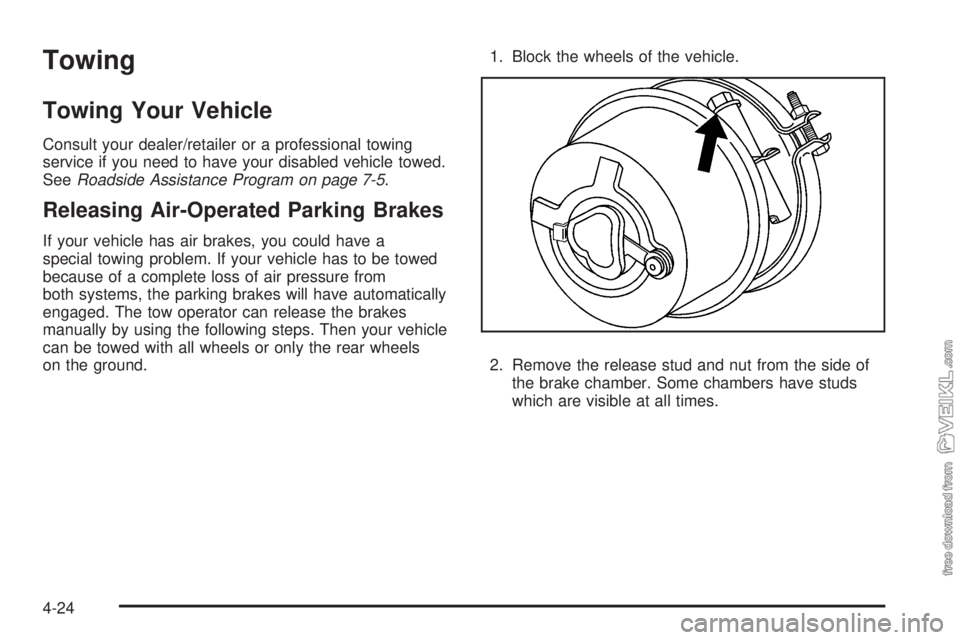
on the ground.1. Block the wheels of the vehicle.
2. Remove the release stud and nut from the side of
the brake chamber. Some chambers have studs
which are visible at all times.
4-24
Page 203 of 384
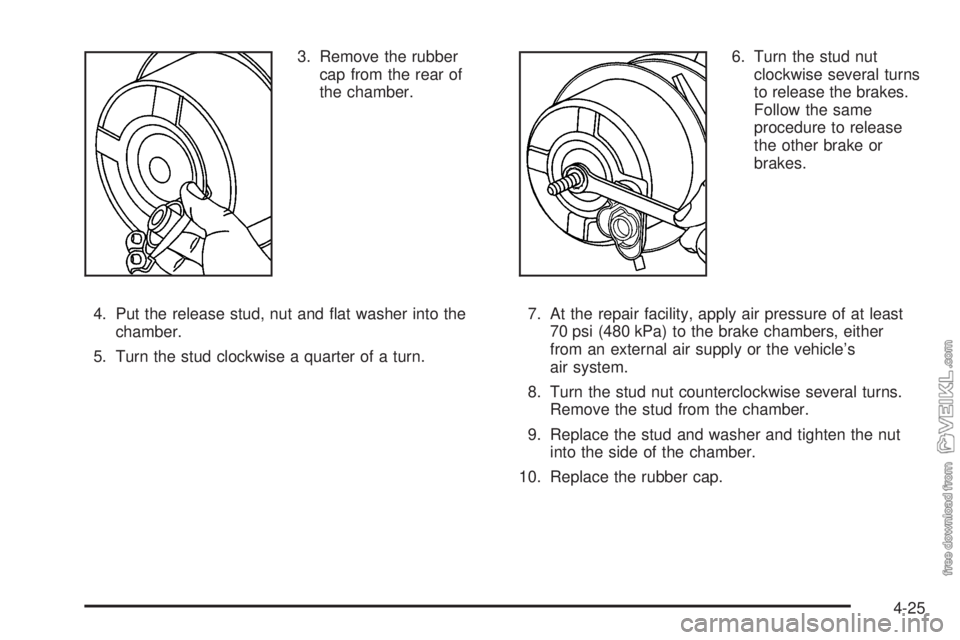
3. Remove the rubber
cap from the rear of
the chamber.
4. Put the release stud, nut and flat washer into the
chamber.
5. Turn the stud clockwise a quarter of a turn.6. Turn the stud nut
clockwise several turns
to release the brakes.
Follow the same
procedure to release
the other brake or
brakes.
7. At the repair facility, apply air pressure of at least
70 psi (480 kPa) to the brake chambers, either
from an external air supply or the vehicle’s
air system.
8. Turn the stud nut counterclockwise several turns.
Remove the stud from the chamber.
9. Replace the stud and washer and tighten the nut
into the side of the chamber.
10. Replace the rubber cap.
4-25
Page 204 of 384
Trailer Connections
Heavy-Duty Trailer Wiring Package
Your vehicle may be equipped with an eight-wire trailer
towing harness. This harness, with a seven-pin
universal heavy-duty trailer connector, is attached to a
bracket on the platform hitch.
The Center High-Mounted Stoplamp (CHMSL) wire is
tied next to the trailer wiring harness for use with a
trailer.
The eight-wire harness contains the following trailer
circuits:
•Yellow: Left Stop/Turn Signal
•Dark Green: Right Stop/Turn Signal
•Brown: Taillamps
•White: Ground
•Light Green: Back-up Lamps
•Light Blue: CHMSL
•Red: Battery Feed
•Dark Blue: Trailer Brake
Trailer Connections
(C7/C8 Models Only)
If your vehicle has these trailer connections, they are
located at the rear of the cab for a tractor and at the rear
of the chassis when towing a trailer. There will be an
air connection and an electrical connection.
Be sure that the couplings to the trailer are made
correctly.
Air Connections
If you are not connecting the trailer air line connections
to another piece of equipment, be sure to replace
their protective caps.
Electrical Connections
This system is a seven-wire cable that will connect to
the trailer, supplying power to the trailer’s lighting
system. When not in use, it is stored in the trailer
air-hose storage bracket.
4-26
Page 205 of 384
Service............................................................5-4
Accessories and Modifications..........................5-4
California Proposition 65 Warning.....................5-5
California Perchlorate Materials Requirements.....5-5
Doing Your Own Service Work.........................5-6
Engine Fan Breakage.....................................5-6
Fuel................................................................5-7
Gasoline Octane............................................5-7
Gasoline Specifications....................................5-7
Additives.......................................................5-8
Diesel Engine Fuel.........................................5-9
What Fuel to Use...........................................5-9
Very Cold Weather Operation.........................5-12
Water in Fuel...............................................5-12
Running Out of Fuel.....................................5-17
Fuel Filter Replacement.................................5-18
Fuels in Foreign Countries.............................5-19
Filling the Tank............................................5-20
Filling a Portable Fuel Container.....................5-21
Checking Things Under the Hood....................5-22
Hood Latches...............................................5-22
Engine Oil (Caterpillar
®Diesel Engine).............5-23
Engine Oil (Gasoline Engine)..........................5-24
Engine Oil (DURAMAX
®Diesel Engine)............5-28Engine Oil (Isuzu Diesel Engine).....................5-32
Engine Oil Life System (Gasoline Engine)........5-36
Engine Oil Life System (DURAMAX
®/Isuzu
Diesel Engines).........................................5-37
Engine Oil Life System (Caterpillar
®Diesel
Engine)....................................................5-39
Engine Air Cleaner/Filter................................5-39
Automatic Transmission Fluid.........................5-43
Manual Transmission Fluid.............................5-43
Engine Coolant (Caterpillar
®Diesel Engines).....5-44
Engine Coolant (Gas and DURAMAX®/
Isuzu 7.8L L6 Engines)..............................5-44
Coolant Surge Tank Pressure Cap..................5-47
Engine Overheating.......................................5-48
Cooling System............................................5-50
Engine Fan Noise.........................................5-54
Power Steering Fluid.....................................5-54
Windshield Washer Fluid................................5-55
Brakes........................................................5-57
Battery........................................................5-66
Jump Starting...............................................5-67
Rear Axle.......................................................5-72
Rear Axle Shift Motor....................................5-73
Section 5 Service and Appearance Care
5-1
Page 208 of 384
Service
For service and parts needs, visit your dealer/retailer.
You will receive genuine GM parts and GM-trained and
supported service people.
Genuine GM parts have one of these marks:
Accessories and Modications
Adding non-dealer accessories to your vehicle can
affect its performance and safety. Such things as,
airbags, braking, stability, ride and handling, emissions
systems, aerodynamics, durability, and electronic
systems like anti-lock brakes, traction control, and
stability control could be affected. Some non-dealer
accessories could even cause malfunction or damage to
parts and systems and would not be covered by the
vehicle warranty.
GM Accessories are designed to complement and
function with other systems on your vehicle. Your GM
dealer can accessorize your vehicle using genuine
GM Accessories. When you go to your GM dealer and
ask for GM Accessories, you will know that GM-trained
and supported service technicians will perform the work
using genuine GM Accessories.
Also, seeAdding Equipment to Your Airbag-Equipped
Vehicle on page 1-59.
5-4
Page 217 of 384
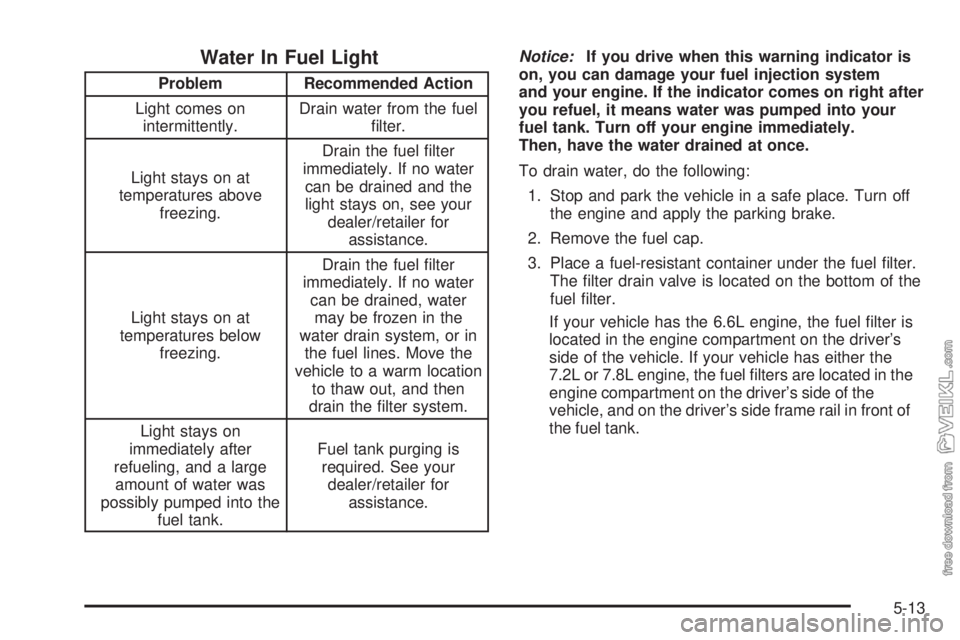
Water In Fuel Light
Problem Recommended Action
Light comes on
intermittently.Drain water from the fuel
filter.
Light stays on at
temperatures above
freezing.Drain the fuel filter
immediately. If no water
can be drained and the
light stays on, see your
dealer/retailer for
assistance.
Light stays on at
temperatures below
freezing.Drain the fuel filter
immediately. If no water
can be drained, water
may be frozen in the
water drain system, or in
the fuel lines. Move the
vehicle to a warm location
to thaw out, and then
drain the filter system.
Light stays on
immediately after
refueling, and a large
amount of water was
possibly pumped into the
fuel tank.Fuel tank purging is
required. See your
dealer/retailer for
assistance.Notice:If you drive when this warning indicator is
on, you can damage your fuel injection system
and your engine. If the indicator comes on right after
you refuel, it means water was pumped into your
fuel tank. Turn off your engine immediately.
Then, have the water drained at once.
To drain water, do the following:
1. Stop and park the vehicle in a safe place. Turn off
the engine and apply the parking brake.
2. Remove the fuel cap.
3. Place a fuel-resistant container under the fuel filter.
The filter drain valve is located on the bottom of the
fuel filter.
If your vehicle has the 6.6L engine, the fuel filter is
located in the engine compartment on the driver’s
side of the vehicle. If your vehicle has either the
7.2L or 7.8L engine, the fuel filters are located in the
engine compartment on the driver’s side of the
vehicle, and on the driver’s side frame rail in front of
the fuel tank.
5-13
Page 222 of 384
4. Turn the ignition key to START for 10 to 15 seconds
at a time until your engine starts. If the engine tries
to run, but does not run smoothly, increase the rpm
a little using the accelerator pedal. This will help
force air through the system.
Your service engine soon light may come on if the
vehicle has run out of fuel. This light may stay on for a
few drive cycles after the condition is corrected, but
will eventually clear itself.
Fuel Filter Replacement
If you want to change the diesel engine fuel filter
yourself, here is how to do it:
{CAUTION:
Diesel fuel is ammable. It could start a re if
something ignites it, and you could be burned.
Do not let it get on hot engine parts, and keep
matches or other ignition sources away.
First, drain any water from the filter by following the
water draining procedure earlier in this section.
Your vehicle’s engine should be off until the end of this
procedure.If your vehicle has the 6.6L engine, the fuel filter is
located in the engine compartment on the driver’s side
of the vehicle. If your vehicle has either the 7.2L or
7.8L engine, the fuel filters are located in the engine
compartment on the driver’s side of the vehicle, and on
the driver’s side frame rail in front of the fuel tank.
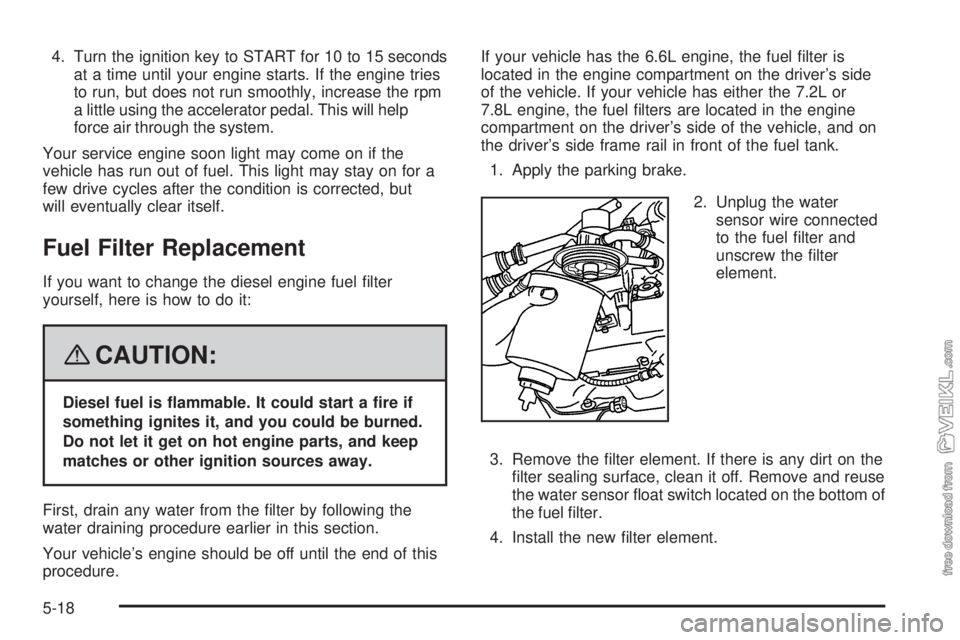
1. Apply the parking brake.
2. Unplug the water
sensor wire connected
to the fuel filter and
unscrew the filter
element.
3. Remove the filter element. If there is any dirt on the
filter sealing surface, clean it off. Remove and reuse
the water sensor float switch located on the bottom of
the fuel filter.
4. Install the new filter element.
5-18