battery CHEVROLET KODIAK 2008 Owners Manual
[x] Cancel search | Manufacturer: CHEVROLET, Model Year: 2008, Model line: KODIAK, Model: CHEVROLET KODIAK 2008Pages: 384, PDF Size: 5.4 MB
Page 63 of 384
Servicing Your Airbag-Equipped
Vehicle
Airbags affect how your vehicle should be serviced.
There are parts of the airbag system in several places
around your vehicle. Your dealer/retailer and the service
manual have information about servicing your vehicle
and the airbag system. To purchase a service manual,
seeService Publications Ordering Information on
page 7-10.
{CAUTION:
For up to 10 seconds after the ignition is
turned off and the battery is disconnected, an
airbag can still inate during improper service.
You can be injured if you are close to an
airbag when it inates. Avoid yellow
connectors. They are probably part of the
airbag system. Be sure to follow proper
service procedures, and make sure the person
performing work for you is qualied to do so.
Adding Equipment to Your
Airbag-Equipped Vehicle
Q:Is there anything I might add to or change
about the vehicle that could keep the airbags
from working properly?
A:Yes. If you add things that change your vehicle’s
frame, bumper system, height, front end or side
sheet metal, they may keep the airbag system from
working properly. Changing or moving any parts
of the front seats, safety belts, the airbag sensing
and diagnostic module, steering wheel, instrument
panel, front sensors, or airbag wiring can affect
the operation of the airbag system.
If you have any questions about this, you should
contact Customer Assistance before you modify
your vehicle. The phone numbers and addresses for
Customer Assistance are in Step Two of the
Customer Satisfaction Procedure in this manual.
SeeCustomer Satisfaction Procedure on page 7-2.
1-59
Page 69 of 384
Remote Keyless Entry (RKE)
System
If the vehicle has the Remote Keyless Entry (RKE)
system, it operates on a radio frequency subject
to Federal Communications Commission (FCC) Rules
and with Industry Canada.
This device complies with Part 15 of the FCC Rules.
Operation is subject to the following two conditions:
1. This device may not cause interference.
2. This device must accept any interference received,
including interference that may cause undesired
operation of the device.
This device complies with RSS-210 of Industry Canada.
Operation is subject to the following two conditions:
1. This device may not cause interference.
2. This device must accept any interference received,
including interference that may cause undesired
operation of the device.Changes or modifications to this system by other than
an authorized service facility could void authorization to
use this equipment.
At times you may notice a decrease in range. This is
normal for any RKE system. If the transmitter does not
work or if you have to stand closer to your vehicle
for the transmitter to work, try this:
•Check the distance. You may be too far from your
vehicle. You may need to stand closer during
rainy or snowy weather.
•Check the location. Other vehicles or objects may
be blocking the signal. Take a few steps to the
left or right, hold the transmitter higher, and
try again.
•Check to determine if battery replacement is
necessary. See “Battery Replacement” later in this
section.
•If you are still having trouble, see your dealer/retailer
or a qualified technician for service.
2-3
Page 70 of 384
Remote Keyless Entry (RKE)
System Operation
If your vehicle has this feature, you can lock and unlock
your doors from about 3 feet (1 m) up to 30 feet (9 m)
away using the remote keyless entry transmitter supplied
with your vehicle.
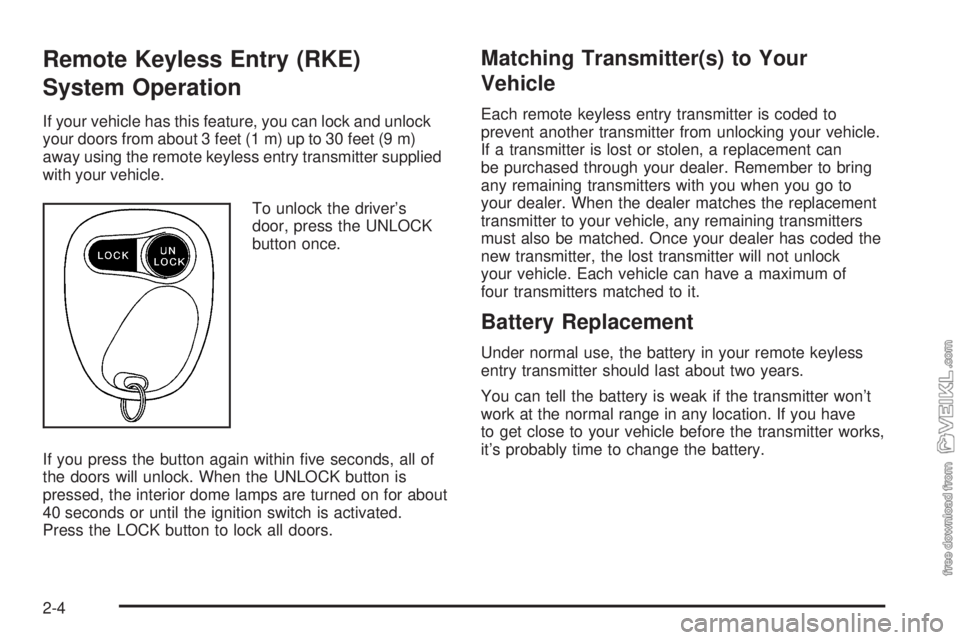
To unlock the driver’s
door, press the UNLOCK
button once.
If you press the button again within five seconds, all of
the doors will unlock. When the UNLOCK button is
pressed, the interior dome lamps are turned on for about
40 seconds or until the ignition switch is activated.
Press the LOCK button to lock all doors.
Matching Transmitter(s) to Your
Vehicle
Each remote keyless entry transmitter is coded to
prevent another transmitter from unlocking your vehicle.
If a transmitter is lost or stolen, a replacement can
be purchased through your dealer. Remember to bring
any remaining transmitters with you when you go to
your dealer. When the dealer matches the replacement
transmitter to your vehicle, any remaining transmitters
must also be matched. Once your dealer has coded the
new transmitter, the lost transmitter will not unlock
your vehicle. Each vehicle can have a maximum of
four transmitters matched to it.
Battery Replacement
Under normal use, the battery in your remote keyless
entry transmitter should last about two years.
You can tell the battery is weak if the transmitter won’t
work at the normal range in any location. If you have
to get close to your vehicle before the transmitter works,
it’s probably time to change the battery.
2-4
Page 71 of 384
Notice:When replacing the battery, use care not to
touch any of the circuitry. Static from your body
transferred to these surfaces may damage the
transmitter.
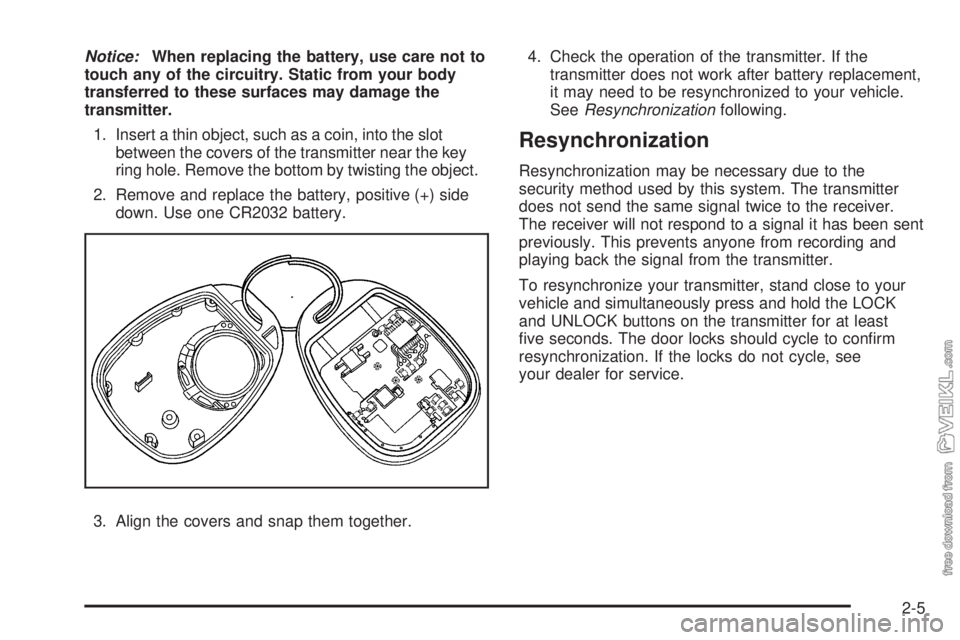
1. Insert a thin object, such as a coin, into the slot
between the covers of the transmitter near the key
ring hole. Remove the bottom by twisting the object.
2. Remove and replace the battery, positive (+) side
down. Use one CR2032 battery.
3. Align the covers and snap them together.4. Check the operation of the transmitter. If the
transmitter does not work after battery replacement,
it may need to be resynchronized to your vehicle.
SeeResynchronizationfollowing.
Resynchronization
Resynchronization may be necessary due to the
security method used by this system. The transmitter
does not send the same signal twice to the receiver.
The receiver will not respond to a signal it has been sent
previously. This prevents anyone from recording and
playing back the signal from the transmitter.
To resynchronize your transmitter, stand close to your
vehicle and simultaneously press and hold the LOCK
and UNLOCK buttons on the transmitter for at least
five seconds. The door locks should cycle to confirm
resynchronization. If the locks do not cycle, see
your dealer for service.
2-5
Page 77 of 384
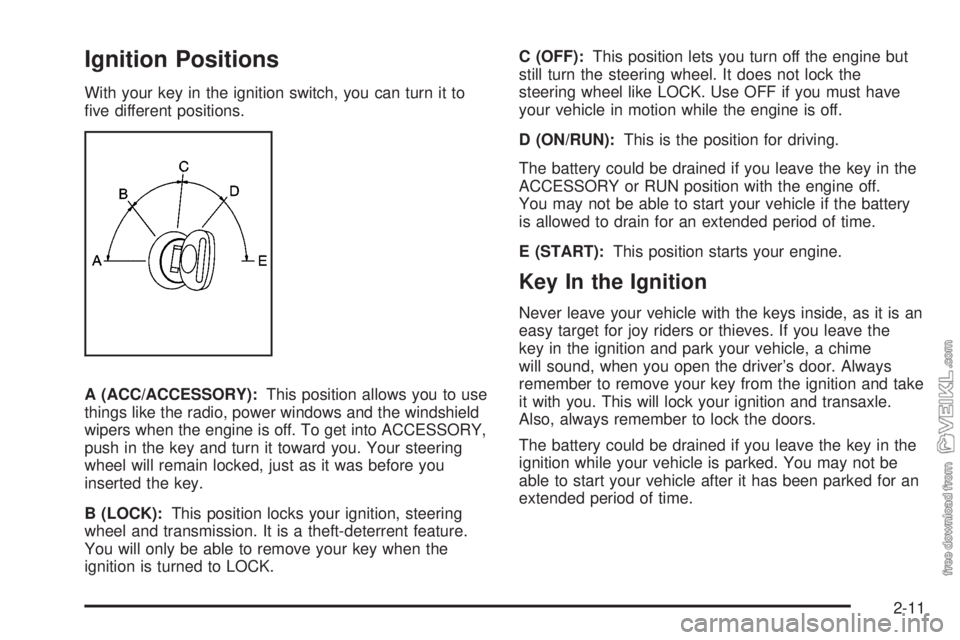
Ignition Positions
With your key in the ignition switch, you can turn it to
five different positions.
A (ACC/ACCESSORY):This position allows you to use
things like the radio, power windows and the windshield
wipers when the engine is off. To get into ACCESSORY,
push in the key and turn it toward you. Your steering
wheel will remain locked, just as it was before you
inserted the key.
B (LOCK):This position locks your ignition, steering
wheel and transmission. It is a theft-deterrent feature.
You will only be able to remove your key when the
ignition is turned to LOCK.C (OFF):This position lets you turn off the engine but
still turn the steering wheel. It does not lock the
steering wheel like LOCK. Use OFF if you must have
your vehicle in motion while the engine is off.
D (ON/RUN):This is the position for driving.
The battery could be drained if you leave the key in the
ACCESSORY or RUN position with the engine off.
You may not be able to start your vehicle if the battery
is allowed to drain for an extended period of time.
E (START):This position starts your engine.
Key In the Ignition
Never leave your vehicle with the keys inside, as it is an
easy target for joy riders or thieves. If you leave the
key in the ignition and park your vehicle, a chime
will sound, when you open the driver’s door. Always
remember to remove your key from the ignition and take
it with you. This will lock your ignition and transaxle.
Also, always remember to lock the doors.
The battery could be drained if you leave the key in the
ignition while your vehicle is parked. You may not be
able to start your vehicle after it has been parked for an
extended period of time.
2-11
Page 81 of 384
Starting Your Engine
1. Turn your ignition key to RUN.
Observe the wait to start light. SeeWait to Start
Indicator on page 3-36. This light may not come on
if the engine is hot.
If you have a Caterpillar
®diesel engine, see your
Caterpillar®Diesel Engine Operation & Maintenance
Manual for proper wait to start light operation.
2. As soon as the wait to start light goes off,
immediately turn the ignition key to START. When
the engine starts, let go of the key.
If your vehicle is equipped with a DURAMAX
®6600
Diesel Engine, it has a fast warm-up glow plug
system. The wait to start light will illuminate for a
much shorter time than most diesel engines, due to
the rapid heating of the glow plug system.
Notice:Holding your key in START for longer than
15 seconds at a time will cause your battery to
be drained much sooner. And the excessive heat
can damage your starter motor.Notice:If the wait to start light stays on after
starting your vehicle, your vehicle may not run
properly. Have your vehicle serviced right away.
3. If the engine does not start after 15 seconds
of cranking, turn the ignition key to OFF. Wait
one minute for the starter to cool, then try the same
steps again.
If you are trying to start your engine after you have run
out of fuel, seeRunning Out of Fuel on page 5-17.
When your engine is cold, let it run for a few minutes
before you move your vehicle. This lets oil pressure
build up. Your engine will sound louder when it is cold.
Notice:If you are not in an idling vehicle and
the engine overheats, you would not be there to see
the overheated engine indication. This could
damage your vehicle. Do not let your engine run
when you are not in your vehicle.
2-15
Page 84 of 384
If the light does not come on when the engine is cold,
your vehicle needs service.
If your batteries do not have enough charge to start
your engine, seeBattery on page 5-66.
Be sure you have the right oil for your engine, and that
you have changed the oil at the proper times. If you
use the wrong oil, your engine may be harder to start.
Be sure you are using the proper fuel for existing
weather conditions. SeeWhat Fuel to Use on page 5-9.
If the engine starts, runs a short time, then stops,
your vehicle needs service.
{CAUTION:
Do not use gasoline or starting aids, such as
ether, in the air intake. They could damage
your engine. There could also be a re, which
could cause serious personal injury.
Engine Alarm and Automatic
Shutdown
Your check gages warning light will come on if the
system senses high engine temperature, and a low or
high engine oil pressure. If high engine temperature
is detected, you will hear a tone alarm at two beats per
second. If a low or high engine oil pressure is
detected, you will also hear a tone alarm at two beats
per second. The alarm and the light will remain on until
the condition is fixed. If the engine temperature or oil
pressure condition worsens, the tone alarm will go to
five beats per second.
If the system senses low engine coolant, the five beat
per second alarm and the low coolant warning light
will come on.
The five beats per second tone alarm means that your
engine will shut down in about 25 to 30 seconds.
There is also an engine shutdown light to indicate that
the engine will shut down. SeeEngine Shutdown
Warning Light on page 3-39.
2-18
Page 86 of 384
The engine will not go into idle shutdown mode if:
•The Power Take-Off (PTO) equipment is operating.
SeePower Take-Off (PTO) on page 2-32for more
information.
•The engine coolant temperature is below 60° F.
The engine idle shutdown will be activated once
the vehicle coolant reaches 60°F or above.
•The Diesel Particulate Filter (DPF) is in regeneration
mode and the green DPF lamp is illuminated to
notify the driver that DPF is regenerating. The
engine idle shutdown mode will be overridden for
the time necessary to complete the regeneration
process, up to a maximum of 30 minutes.
•Service or maintenance is being performed on the
engine. The engine idle shutdown mode may be
deactivated, by using a diagnostic scan tool,
for a period of up to a maximum of 60 minutes.
The ENGINE SHUTDOWN WARNING LIGHT will come
on and a continuous chime will alert the driver
30 seconds before the engine goes into idle shutdown
mode. The engine shutdown warning light and chime will
stay on for the entire duration of the idle shutdown
event to inform the driver that the engine is in idle
shutdown mode. SeeEngine Shutdown Warning Light
on page 3-39for more information.After the engine shutdown occurs, the engine is no
longer running, and the ignition is still in the ON/RUN
position, all accessories can be used. Turn the ignition
switch to START to restart the engine or turn it to
LOCK/OFF to prevent the battery from draining.
High Idle System
High Idle System with Switch
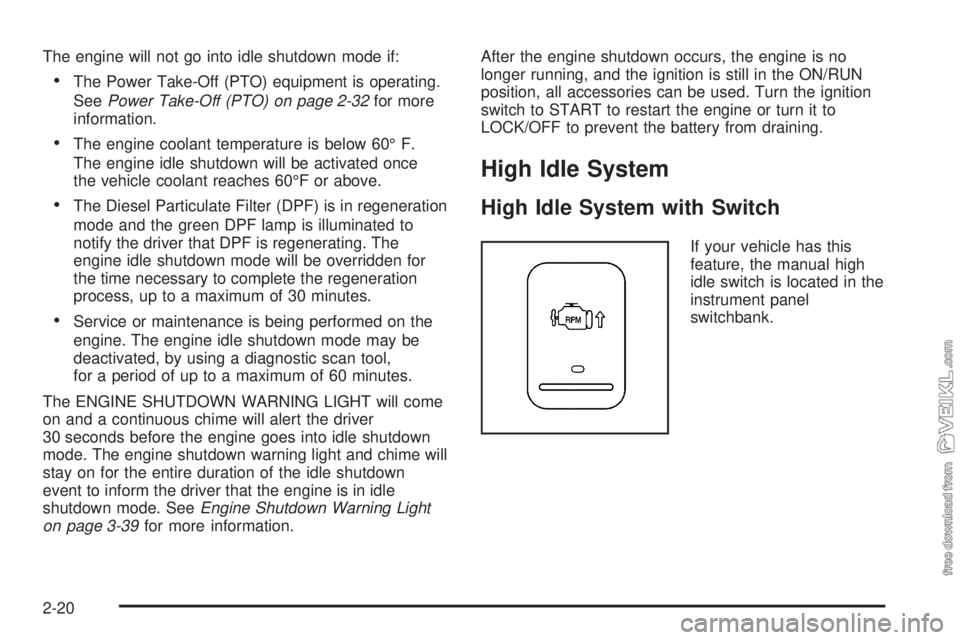
If your vehicle has this
feature, the manual high
idle switch is located in the
instrument panel
switchbank.
2-20
Page 90 of 384
During this warm-up period, check your warning lights
and gages:
•If oil pressure does not begin to rise within
15 seconds of starting, stop the engine and find the
cause. SeeOil Pressure Gage on page 3-37for
more information.
•If the engine coolant temperature gage needle goes
into the hot area on the gage, stop the engine and
find the cause of the overheating. SeeEngine
Coolant Temperature Gage on page 3-35for more
information.
•If you have air brakes, the dual-needle air pressure
gage should read at least 115 psi (790 kPa) for both
service systems before you try to move the vehicle.
When air pressure is below 60 psi (420 kPa), the
LOW AIR light will come on and you will hear a tone
alarm. SeeBrake System Warning Light on
page 3-32for more information. If the pressure does
not build up or drops during warm-up, stop the
engine and find the cause before you try to move the
vehicle. Recommended air pressure before driving is
120 psi (830 kPa). SeeAir Pressure Gage on
page 3-46for more information.
•The charging system light should come on when the
ignition key is turned to ON/RUN or START and
should go out when the engine is running above idle.
If the light does not go out or comes back on during
normal engine operation, have the charging system
checked right away. (This light tells you if the
generator is not charging; it does not reflect the
condition of the battery.) SeeCharging System Light
on page 3-30for more information.
•The voltmeter charge indicator gage tells you the
condition of your battery’s charge. The gage should
be in the center area during engine operation. The
red area on the left indicates an undercharge
condition; the red area on the right indicates an
overcharge. If the gage is in either red area, have the
battery and charging system checked right away.
SeeVoltmeter Gage on page 3-31for more
information.
Notice:Do not allow the engine to operate at low
idle for more than ve minutes. This can cause
low engine operating temperatures which can affect
engine operation and reduce engine life. Engine
idle speed should be increased to 1200 rpm
whenever extended idle is required. Once started,
the engine should be placed under load to allow the
engine coolant temperature to reach 150°F (66°C)
before shutting off the engine.
2-24
Page 115 of 384
4. Fully set the parking brake.
5. Shift the transmission to PARK (P) or
NEUTRAL (N).
6. Idle the engine. If you used the idling control knob
to increase the engine speed, restore it all the way
to the left to reduce the engine speed.
7. If the vehicle has Power Take Off (PTO), turn the
PTO off. SeePower Take-Off (PTO) on page 2-32.
8. Press the DPF switch in the instrument panel
switchbank. SeeInstrument Panel Switchbank
on page 3-18. The green DPF indicator light comes
on, the exhaust gas control valve operates,
engine idle speed automatically increases, and DPF
regeneration begins. Do not leave the vehicle
unattended during manual regeneration.
9. When both the green and the yellow or red DPF
indicator lights go off, regeneration is completed.
Regeneration is normally completed in about
30 minutes.Under certain operating conditions, manual regeneration
might not be able to be performed, even if the soot
level in the DPF requires regeneration. This can occur
because of low coolant temperature, low battery voltage,
or high exhaust temperature or immediately after
starting the vehicle. When manual regeneration is
requested, by pressing the DPF switch, when coolant
temperature is low, engine warm-up is started, the green
indicator light will come on, the exhaust gas control
valve operates, and engine rpm increases to help raise
engine coolant temperature. When operating conditions
allow, regeneration will start.
2-49