trailer CHEVROLET KODIAK 2008 Owners Manual
[x] Cancel search | Manufacturer: CHEVROLET, Model Year: 2008, Model line: KODIAK, Model: CHEVROLET KODIAK 2008Pages: 384, PDF Size: 5.4 MB
Page 13 of 384
{CAUTION:
Sitting in a reclined position when your vehicle
is in motion can be dangerous. Even if you
buckle up, your safety belts cannot do their
job when you are reclined like this.
The shoulder belt cannot do its job. In a crash,
you could go into it, receiving neck or other
injuries.
The lap belt cannot do its job either. In a crash
the belt could go up over your abdomen. The
belt forces would be there, not at your pelvic
bones. This could cause serious internal
injuries.
For proper protection when the vehicle is in
motion, have the seatback upright. Then sit
well back in the seat and wear your safety belt
properly.
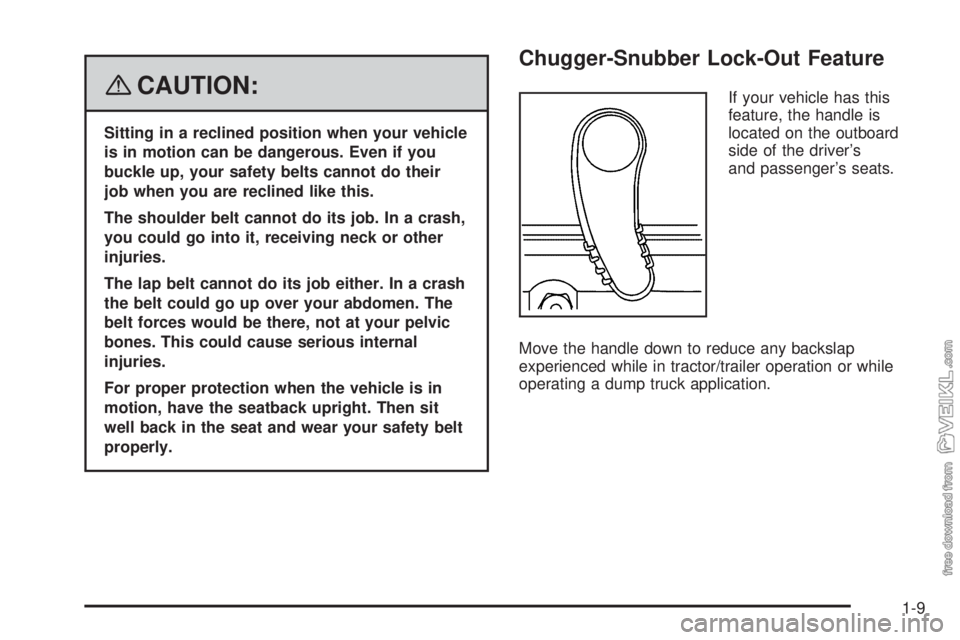
Chugger-Snubber Lock-Out Feature
If your vehicle has this
feature, the handle is
located on the outboard
side of the driver’s
and passenger’s seats.
Move the handle down to reduce any backslap
experienced while in tractor/trailer operation or while
operating a dump truck application.
1-9
Page 96 of 384
Overdrive Defeat
If your vehicle has this feature, you can select not to
shift up to fifth gear. This is useful when towing or under
a heavy load.
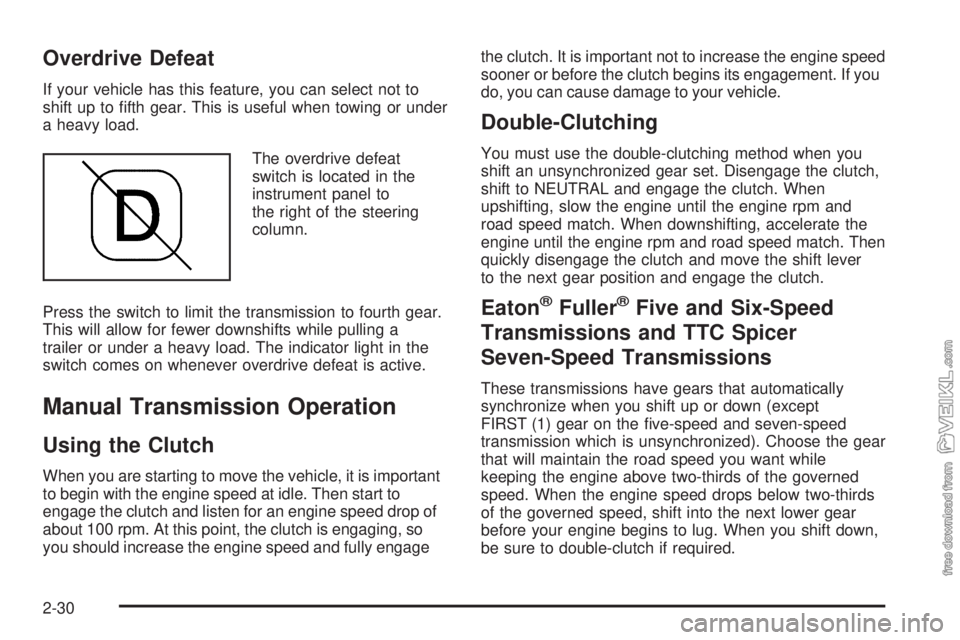
The overdrive defeat
switch is located in the
instrument panel to
the right of the steering
column.
Press the switch to limit the transmission to fourth gear.
This will allow for fewer downshifts while pulling a
trailer or under a heavy load. The indicator light in the
switch comes on whenever overdrive defeat is active.
Manual Transmission Operation
Using the Clutch
When you are starting to move the vehicle, it is important
to begin with the engine speed at idle. Then start to
engage the clutch and listen for an engine speed drop of
about 100 rpm. At this point, the clutch is engaging, so
you should increase the engine speed and fully engagethe clutch. It is important not to increase the engine speed
sooner or before the clutch begins its engagement. If you
do, you can cause damage to your vehicle.
Double-Clutching
You must use the double-clutching method when you
shift an unsynchronized gear set. Disengage the clutch,
shift to NEUTRAL and engage the clutch. When
upshifting, slow the engine until the engine rpm and
road speed match. When downshifting, accelerate the
engine until the engine rpm and road speed match. Then
quickly disengage the clutch and move the shift lever
to the next gear position and engage the clutch.
Eaton®Fuller®Five and Six-Speed
Transmissions and TTC Spicer
Seven-Speed Transmissions
These transmissions have gears that automatically
synchronize when you shift up or down (except
FIRST (1) gear on the five-speed and seven-speed
transmission which is unsynchronized). Choose the gear
that will maintain the road speed you want while
keeping the engine above two-thirds of the governed
speed. When the engine speed drops below two-thirds
of the governed speed, shift into the next lower gear
before your engine begins to lug. When you shift down,
be sure to double-clutch if required.
2-30
Page 108 of 384
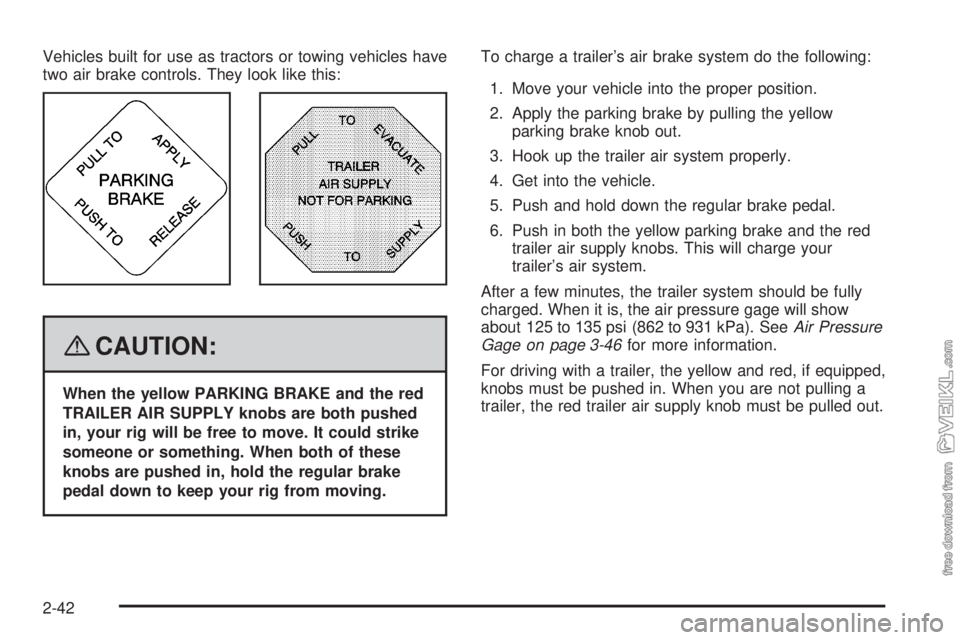
Vehicles built for use as tractors or towing vehicles have
two air brake controls. They look like this:
{CAUTION:
When the yellow PARKING BRAKE and the red
TRAILER AIR SUPPLY knobs are both pushed
in, your rig will be free to move. It could strike
someone or something. When both of these
knobs are pushed in, hold the regular brake
pedal down to keep your rig from moving.To charge a trailer’s air brake system do the following:
1. Move your vehicle into the proper position.
2. Apply the parking brake by pulling the yellow
parking brake knob out.
3. Hook up the trailer air system properly.
4. Get into the vehicle.
5. Push and hold down the regular brake pedal.
6. Push in both the yellow parking brake and the red
trailer air supply knobs. This will charge your
trailer’s air system.
After a few minutes, the trailer system should be fully
charged. When it is, the air pressure gage will show
about 125 to 135 psi (862 to 931 kPa). SeeAir Pressure
Gage on page 3-46for more information.
For driving with a trailer, the yellow and red, if equipped,
knobs must be pushed in. When you are not pulling a
trailer, the red trailer air supply knob must be pulled out.
2-42
Page 109 of 384
{CAUTION:
If you apply any one of the air brake parking
controls while the vehicle is moving, your rig
will stop suddenly. If you are not ready for
this, you or others could be injured. Do not
apply any one of these controls while you are
driving, unless you have to make an
emergency stop.
If the air pressure drops below 60 to 70 psi
(413 to 482 kPa), the primary brake light and warning
buzzer will come on. If the air pressure drops to
35 to 45 psi (241 to 310 kPa), the red trailer air supply
knob will automatically pop out and apply the spring
brakes on the trailer.
If the air pressure drops to 35 to 45 psi (241 to 310 kPa),
the yellow park brake knob will automatically pop out
and apply the spring brakes on the truck or tractor.
If you ever have a complete loss of air so that your air
brakes automatically apply, there is a way that the
tow operator can release the parking brakes to tow the
vehicle. SeeTowing Your Vehicle on page 4-24.
Parking Brake Burnish Procedure
All vehicles which have hydraulic brakes have a parking
brake. It is recommended that the parking brake be
burnished as part of the new vehicle break-in. The
parking brake will work best after it has been burnished
following these instructions:
1. Make sure that there is no other traffic around,
bring the vehicle speed up to 20 mph (32 km/h)
and apply the parking brake. Let the vehicle come
to a complete stop. Apply the base brakes and
disengage the parking brake.
2. Repeat the burnishing procedure in Step 1 a total
of 10 times
3. Between stops, drive the vehicle about
2.5 miles (4 km)
Notice:Driving with the parking brake on can
damage the transmission and brake system parts.
Verify that the parking brake is fully released and the
brake warning light is off before driving.
2-43
Page 121 of 384
Instrument Panel Overview...............................3-4
Hazard Warning Flashers................................3-6
Other Warning Devices...................................3-6
Horn.............................................................3-6
Tilt Wheel.....................................................3-7
Turn Signal/Multifunction Lever.........................3-7
Turn and Lane-Change Signals........................3-8
Headlamp High/Low-Beam Changer..................3-8
Windshield Wipers..........................................3-9
Windshield Washer.......................................3-10
Cruise Control..............................................3-10
Exterior Lamps.............................................3-14
Headlamps on Reminder................................3-15
Daytime Running Lamps (DRL).......................3-15
Marker Lamps..............................................3-16
Instrument Panel Brightness...........................3-16
Dome Lamps...............................................3-16
Entry Lighting...............................................3-17
Reading Lamps............................................3-17
Instrument Panel Switchbank..........................3-18
Accessory Power Outlet(s).............................3-19
Ashtray(s) and Cigarette Lighter......................3-20
Climate Controls............................................3-20
Climate Control System.................................3-20
Outlet Adjustment.........................................3-23
Rear Heating System....................................3-24Warning Lights, Gages, and Indicators............3-24
Instrument Panel Cluster................................3-25
Speedometer and Odometer...........................3-26
Trip Odometer..............................................3-26
Tachometer.................................................3-26
Engine Speed Limiter....................................3-27
Safety Belt Reminders...................................3-27
Airbag Readiness Light..................................3-28
Airbag Off Light............................................3-29
Charging System Light..................................3-30
Voltmeter Gage............................................3-31
Service Transmission Warning Light................3-31
Range Inhibit Warning Indicator......................3-32
Brake System Warning Light..........................3-32
Anti-lock Brake System (ABS) Warning Light. . . .3-34
Trailer Antilock Brake System Warning Light.....3-34
Engine Coolant Temperature Gage..................3-35
Low Coolant Warning Light............................3-35
Wait to Start Indicator...................................3-36
Malfunction Indicator Lamp.............................3-36
Oil Pressure Gage........................................3-37
Low Oil Level Light.......................................3-38
Change Engine Oil Light................................3-38
Engine Overspeed Warning Light....................3-39
Engine Shutdown Warning Light.....................3-39
Transmission Temperature Gage.....................3-39
Section 3 Instrument Panel
3-1
Page 154 of 384
Anti-lock Brake System (ABS)
Warning Light
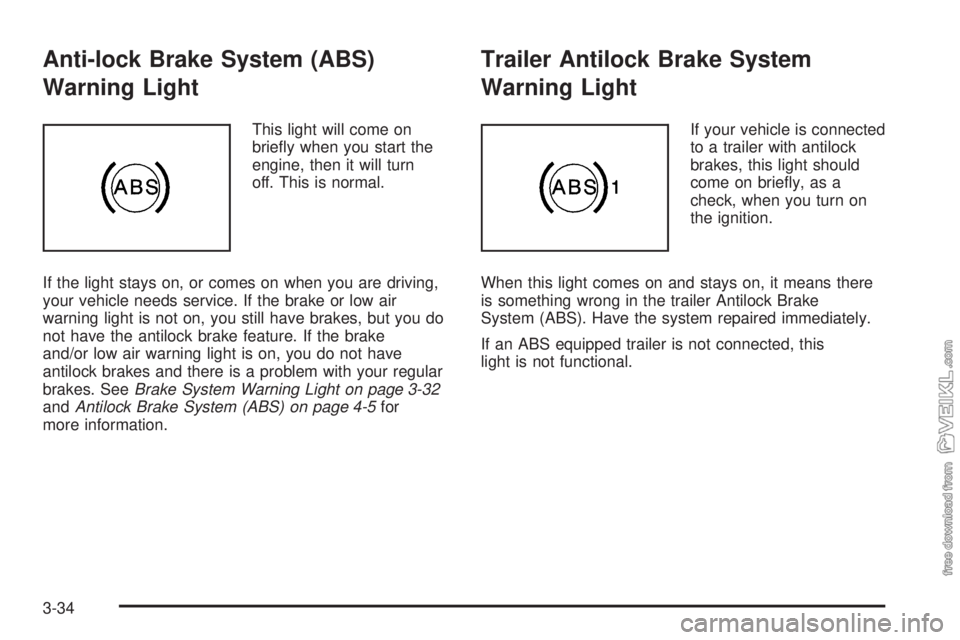
This light will come on
briefly when you start the
engine, then it will turn
off. This is normal.
If the light stays on, or comes on when you are driving,
your vehicle needs service. If the brake or low air
warning light is not on, you still have brakes, but you do
not have the antilock brake feature. If the brake
and/or low air warning light is on, you do not have
antilock brakes and there is a problem with your regular
brakes. SeeBrake System Warning Light on page 3-32
andAntilock Brake System (ABS) on page 4-5for
more information.
Trailer Antilock Brake System
Warning Light
If your vehicle is connected
to a trailer with antilock
brakes, this light should
come on briefly, as a
check, when you turn on
the ignition.
When this light comes on and stays on, it means there
is something wrong in the trailer Antilock Brake
System (ABS). Have the system repaired immediately.
If an ABS equipped trailer is not connected, this
light is not functional.
3-34
Page 179 of 384
Your Driving, the Road, and Your Vehicle..........4-2
Defensive Driving...........................................4-2
Drunk Driving.................................................4-3
Control of a Vehicle........................................4-3
Braking.........................................................4-4
Hydraulic Brake Systems.................................4-4
Antilock Brake System (ABS)...........................4-5
Braking in Emergencies...................................4-5
Trailer Brake Hand Control Valve......................4-6
Rear Axle Differential Lock Control....................4-7
Traction Control System (TCS).........................4-8
Steering........................................................4-9
Off-Road Recovery.......................................4-11
Passing.......................................................4-11
Loss of Control.............................................4-12Driving at Night............................................4-13
Driving in Rain and on Wet Roads..................4-14
Highway Hypnosis........................................4-15
Hill and Mountain Roads................................4-15
Winter Driving..............................................4-16
If Your Vehicle is Stuck in Sand, Mud, Ice,
or Snow...................................................4-19
Rocking Your Vehicle to Get It Out.................4-20
Tow Hooks..................................................4-20
Loading Your Vehicle....................................4-21
Adding a Snow Plow or Similar Equipment.......4-23
Towing..........................................................4-24
Towing Your Vehicle.....................................4-24
Trailer Connections.......................................4-26
Section 4 Driving Your Vehicle
4-1
Page 184 of 384
Trailer Brake Hand Control Valve
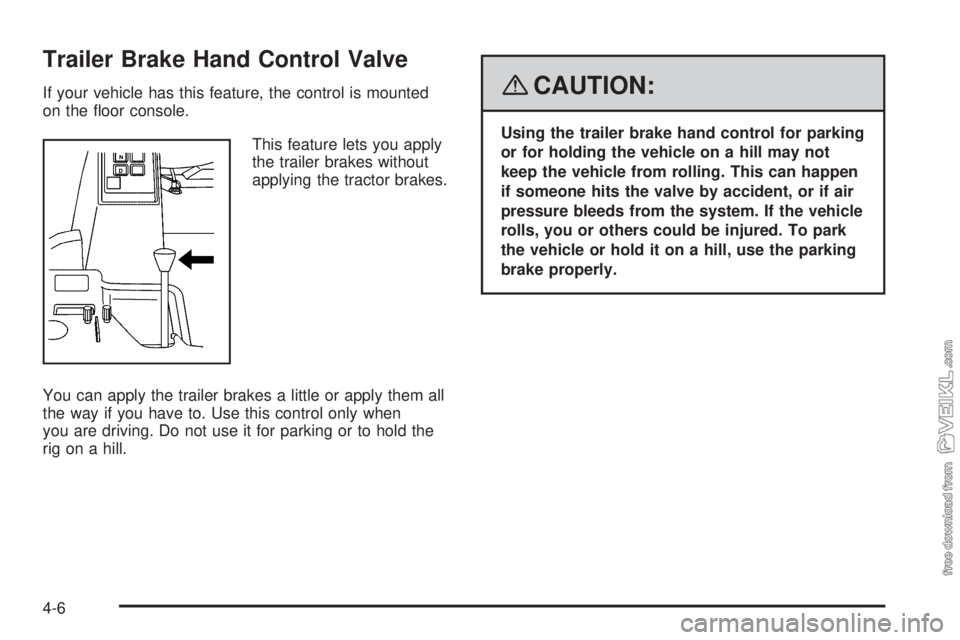
If your vehicle has this feature, the control is mounted
on the floor console.
This feature lets you apply
the trailer brakes without
applying the tractor brakes.
You can apply the trailer brakes a little or apply them all
the way if you have to. Use this control only when
you are driving. Do not use it for parking or to hold the
rig on a hill.{CAUTION:
Using the trailer brake hand control for parking
or for holding the vehicle on a hill may not
keep the vehicle from rolling. This can happen
if someone hits the valve by accident, or if air
pressure bleeds from the system. If the vehicle
rolls, you or others could be injured. To park
the vehicle or hold it on a hill, use the parking
brake properly.
4-6
Page 204 of 384
Trailer Connections
Heavy-Duty Trailer Wiring Package
Your vehicle may be equipped with an eight-wire trailer
towing harness. This harness, with a seven-pin
universal heavy-duty trailer connector, is attached to a
bracket on the platform hitch.
The Center High-Mounted Stoplamp (CHMSL) wire is
tied next to the trailer wiring harness for use with a
trailer.
The eight-wire harness contains the following trailer
circuits:
•Yellow: Left Stop/Turn Signal
•Dark Green: Right Stop/Turn Signal
•Brown: Taillamps
•White: Ground
•Light Green: Back-up Lamps
•Light Blue: CHMSL
•Red: Battery Feed
•Dark Blue: Trailer Brake
Trailer Connections
(C7/C8 Models Only)
If your vehicle has these trailer connections, they are
located at the rear of the cab for a tractor and at the rear
of the chassis when towing a trailer. There will be an
air connection and an electrical connection.
Be sure that the couplings to the trailer are made
correctly.
Air Connections
If you are not connecting the trailer air line connections
to another piece of equipment, be sure to replace
their protective caps.
Electrical Connections
This system is a seven-wire cable that will connect to
the trailer, supplying power to the trailer’s lighting
system. When not in use, it is stored in the trailer
air-hose storage bracket.
4-26
Page 258 of 384
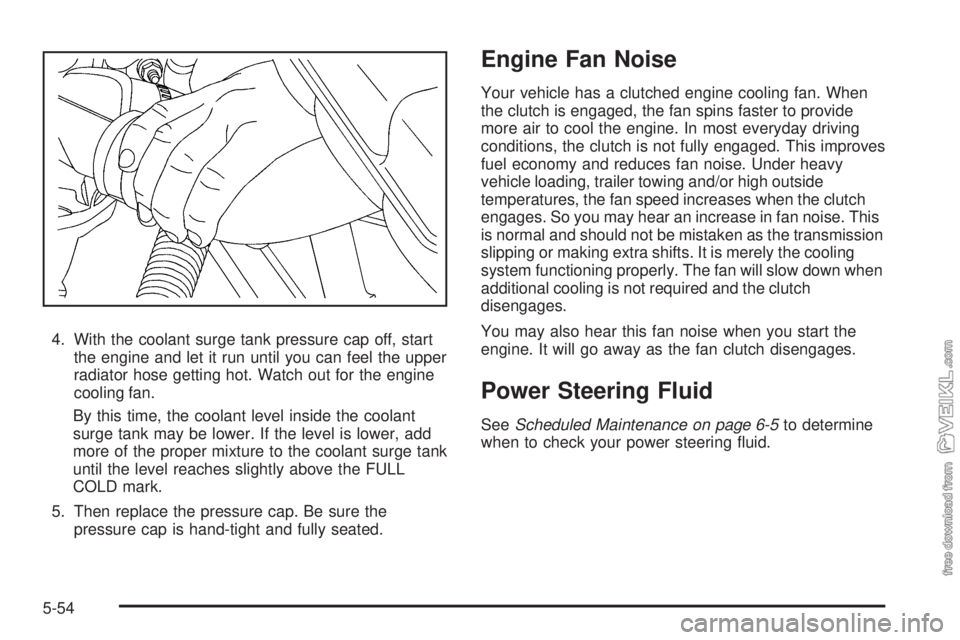
4. With the coolant surge tank pressure cap off, start
the engine and let it run until you can feel the upper
radiator hose getting hot. Watch out for the engine
cooling fan.
By this time, the coolant level inside the coolant
surge tank may be lower. If the level is lower, add
more of the proper mixture to the coolant surge tank
until the level reaches slightly above the FULL
COLD mark.
5. Then replace the pressure cap. Be sure the
pressure cap is hand-tight and fully seated.
Engine Fan Noise
Your vehicle has a clutched engine cooling fan. When
the clutch is engaged, the fan spins faster to provide
more air to cool the engine. In most everyday driving
conditions, the clutch is not fully engaged. This improves
fuel economy and reduces fan noise. Under heavy
vehicle loading, trailer towing and/or high outside
temperatures, the fan speed increases when the clutch
engages. So you may hear an increase in fan noise. This
is normal and should not be mistaken as the transmission
slipping or making extra shifts. It is merely the cooling
system functioning properly. The fan will slow down when
additional cooling is not required and the clutch
disengages.
You may also hear this fan noise when you start the
engine. It will go away as the fan clutch disengages.
Power Steering Fluid
SeeScheduled Maintenance on page 6-5to determine
when to check your power steering fluid.
5-54