air condition CHEVROLET KODIAK 2009 User Guide
[x] Cancel search | Manufacturer: CHEVROLET, Model Year: 2009, Model line: KODIAK, Model: CHEVROLET KODIAK 2009Pages: 376, PDF Size: 5.39 MB
Page 194 of 376
Blizzard Conditions
Being stuck in snow can be in a serious situation. Stay
with the vehicle unless there is help nearby. If possible,
use theRoadside Assistance Program on page 7-5.
To get help and keep everyone in the vehicle safe:
•Turn on theHazard Warning Flashers on page 3-6.
•Tie a red cloth to an outside mirror.
{CAUTION:
Snow can trap engine exhaust under the vehicle.
This may cause exhaust gases to get inside.
Engine exhaust contains carbon monoxide (CO)
which cannot be seen or smelled. It can cause
unconsciousness and even death.
If the vehicle is stuck in the snow:
•Clear away snow from around the base of
your vehicle, especially any that is blocking
the exhaust pipe.
•Check again from time to time to be sure
snow does not collect there.
CAUTION: (Continued)
CAUTION: (Continued)
•
Open a window about two inches (5 cm) on
the side of the vehicle that is away from the
wind to bring in fresh air.
•Fully open the air outlets on or under the
instrument panel.
•Adjust the Climate Control system to a setting
that circulates the air inside the vehicle and
set the fan speed to the highest setting. See
Climate Control System in the Index.
For more information about carbon monoxide, see
Engine Exhaust on page 2-45.
Snow can trap exhaust gases under your vehicle.
This can cause deadly CO (carbon monoxide) gas
to get inside. CO could overcome you and kill you.
You cannot see it or smell it, so you might not
know it is in your vehicle. Clear away snow from
around the base of your vehicle, especially any
that is blocking the exhaust.
Run the engine for short periods only as needed to
keep warm, but be careful.
To save fuel, run the engine for only short periods as
needed to warm the vehicle and then shut the engine off
and close the window most of the way to save heat.
4-18
Page 219 of 376
Running Out of Fuel
If the diesel engine stalls and you think that you have
run out of fuel, do this to restart the engine:
{CAUTION:
Diesel fuel is flammable. It could start a fire if it
gets on hot engine parts. You could be burned. Do
not let too much fuel flow from the air bleed valve,
and wipe up any spilled fuel with a cloth.
1. If parked on a level surface, add at least 2 gallons
(7.6 liters) of fuel. However, if parked on a slope, up
to 5 gallons (18.9 liters) of fuel might need to be
added.2. Follow the fuel priming procedure earlier in this
section to prime the fuel filter.
3. Close the air bleed valve.
4. Turn the ignition key to START for 10 to 15 seconds
at a time until the engine starts. If the engine tries
to run, but does not run smoothly, increase the rpm
a little using the accelerator pedal. This will help
force air through the system.
The service engine soon light may come on if the
vehicle has run out of fuel. This light may stay on for a
few drive cycles after the condition is corrected, but
will eventually clear itself.
5-17
Page 241 of 376
When to Inspect the Engine Air
Cleaner/Filters
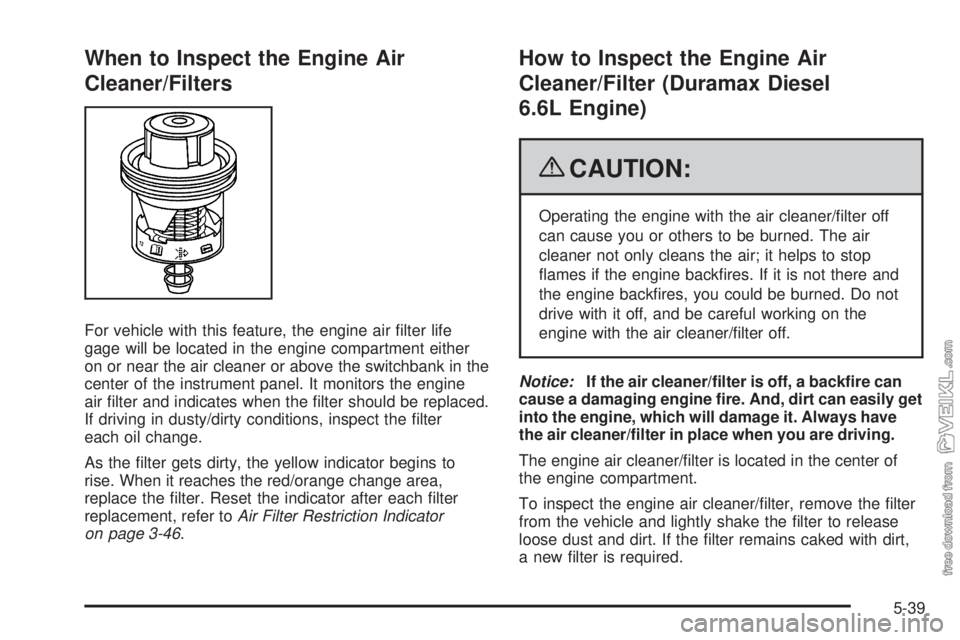
For vehicle with this feature, the engine air filter life
gage will be located in the engine compartment either
on or near the air cleaner or above the switchbank in the
center of the instrument panel. It monitors the engine
air filter and indicates when the filter should be replaced.
If driving in dusty/dirty conditions, inspect the filter
each oil change.
As the filter gets dirty, the yellow indicator begins to
rise. When it reaches the red/orange change area,
replace the filter. Reset the indicator after each filter
replacement, refer toAir Filter Restriction Indicator
on page 3-46.
How to Inspect the Engine Air
Cleaner/Filter (Duramax Diesel
6.6L Engine)
{CAUTION:
Operating the engine with the air cleaner/filter off
can cause you or others to be burned. The air
cleaner not only cleans the air; it helps to stop
flames if the engine backfires. If it is not there and
the engine backfires, you could be burned. Do not
drive with it off, and be careful working on the
engine with the air cleaner/filter off.
Notice:If the air cleaner/filter is off, a backfire can
cause a damaging engine fire. And, dirt can easily get
into the engine, which will damage it. Always have
the air cleaner/filter in place when you are driving.
The engine air cleaner/filter is located in the center of
the engine compartment.
To inspect the engine air cleaner/filter, remove the filter
from the vehicle and lightly shake the filter to release
loose dust and dirt. If the filter remains caked with dirt,
a new filter is required.
5-39
Page 243 of 376
Hood Inlet Seal
If the vehicle is being used in heavy snow conditions or
for snow plowing, there is a possibility of snow and
ice build up in the inlet to the air cleaner, which
can block airflow to the engine and affect impacting
engine performance.
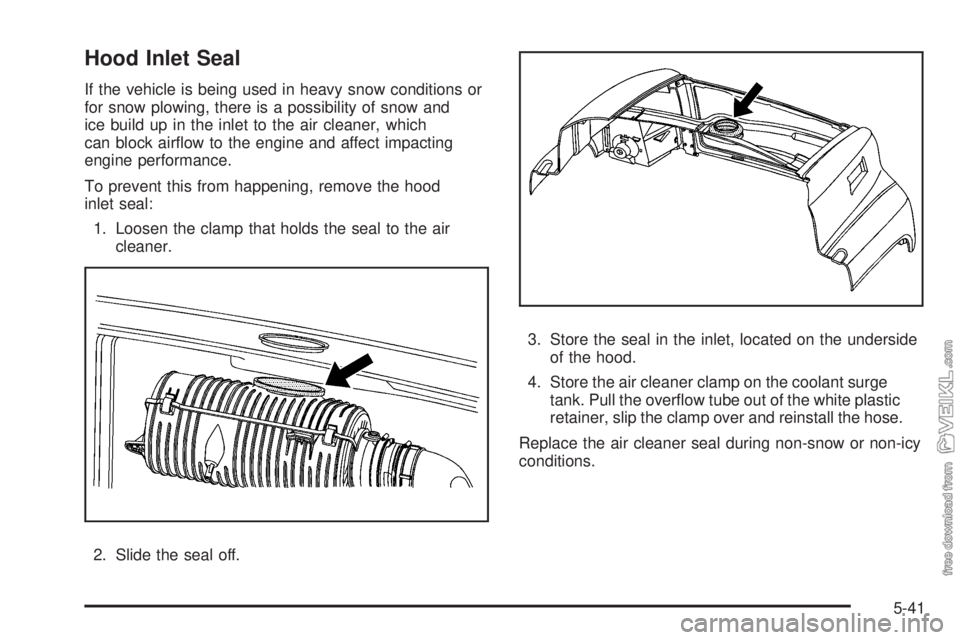
To prevent this from happening, remove the hood
inlet seal:
1. Loosen the clamp that holds the seal to the air
cleaner.
2. Slide the seal off.3. Store the seal in the inlet, located on the underside
of the hood.
4. Store the air cleaner clamp on the coolant surge
tank. Pull the overflow tube out of the white plastic
retainer, slip the clamp over and reinstall the hose.
Replace the air cleaner seal during non-snow or non-icy
conditions.
5-41
Page 251 of 376
If you get the overheat warning with no sign of steam,
try this for a minute or so:
1. In heavy traffic, let the engine idle in N (Neutral)
while stopped. If it is safe to do so, pull off the
road, shift to P (Park) or N (Neutral) and let
the engine idle.
2. Turn on your heater to full hot at the highest fan
speed and open the windows as necessary.
3. If climbing a hill, downshift to raise engine and fan
speeds.
If you no longer have the overheat warning, you can
drive. Just to be safe, drive slower for about 10 minutes.
If the warning does not come back on, you can drive
normally.
If the warning continues and you have not stopped, pull
over, stop, and park your vehicle right away.
If there is still no sign of steam, you can push down the
accelerator until the engine speed is about twice as
fast as normal idle speed for at least three minutes while
you are parked. If you still have the warning, turn off
the engine and get everyone out of the vehicle until it
cools down.
You may decide not to lift the hood but to get service
help right away.Engine Fan Noise
Your vehicle has a clutched engine cooling fan. When
the clutch is engaged, the fan spins faster to provide
more air to cool the engine. In most everyday driving
conditions, the clutch is not fully engaged. This improves
fuel economy and reduces fan noise. Under heavy
vehicle loading, trailer towing and/or high outside
temperatures, the fan speed increases when the clutch
engages. So you may hear an increase in fan noise.
This is normal and should not be mistaken as the
transmission slipping or making extra shifts. It is merely
the cooling system functioning properly. The fan will
slow down when additional cooling is not required and
the clutch disengages.
You may also hear this fan noise when you start the
engine. It will go away as the fan clutch disengages.
Power Steering Fluid
SeeScheduled Maintenance on page 6-5to determine
when to check your power steering fluid.
5-49
Page 256 of 376
Four-Wheel Disc Brakes
(Hydraulic Only)
The vehicle has four-wheel disc brakes.
Some driving conditions or climates can cause a brake
squeal when the brakes are first applied or lightly
applied. This does not mean something is wrong with
the brakes.
Brake linings should always be replaced as complete
axle sets.
Four-Wheel and Six-Wheel Drum
Brakes (Air Only)
The brake drums should be removed and inspected
each time the tires are removed for rotation or changing.
When the front brakes are replaced, have the rear
brakes inspected, too.
Brake linings should always be replaced as complete
axle sets.
Brake Pedal Travel
See your dealer/retailer if the brake pedal does not
return to normal height, or if there is a rapid increase in
pedal travel. This could be a sign that brake service
might be required.
Brake Adjustment
Every brake stop, the brakes adjust for wear.
Brake Adjustment on Air Braked Vehicles
The vehicle has automatic slack adjusters. Every
brake stop, the brakes automatically adjust for wear.
Slack adjusters should never be manually adjusted
to correct excessive brake chamber pushrod stroke.
Excessive brake chamber pushrod stroke means
that the brake system needs to be serviced by a
qualified service technician.
Notice:Do not manually adjust automatic slack
adjusters. Manual adjustment of the automatic slack
adjusters can result in a degradation of the slack
adjuster performance over time. If the brake
chamber pushrod stroke is out of adjustment, the
brake system needs to be serviced by a qualified
service technician.
5-54
Page 271 of 376
When to Change Lubricant
Refer to the Maintenance Schedule to determine how
often to change the lubricant. SeeScheduled
Maintenance on page 6-5.
What to Use
Refer to the Maintenance Schedule to determine what
kind of lubricant to use. SeePart C: Recommended
Fluids and Lubricants on page 6-31.
Front Axle
When to Check Lubricant
It is not necessary to regularly check front axle fluid
unless you suspect there is a leak or you hear an
unusual noise. A fluid loss could indicate a problem.
Have it inspected and repaired.
Notice:If you drive your vehicle through deep water
that is higher than the front or rear axle, water may
enter the axle housing and cause the axle lubricant to
break down. This could damage the gears inside.
Avoid driving your vehicle through deep water.
You should avoid driving your vehicle through deep
puddles or standing water. If you must drive through
water that is higher than the front or rear axle, see your
dealer immediately afterward to have the condition of
the axle lubricant checked.
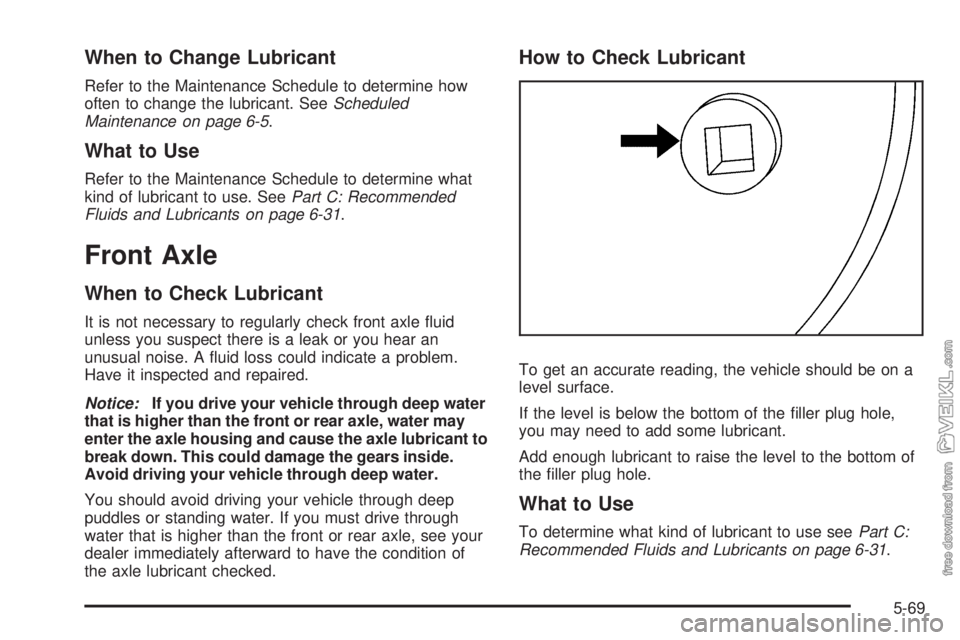
How to Check Lubricant
To get an accurate reading, the vehicle should be on a
level surface.
If the level is below the bottom of the filler plug hole,
you may need to add some lubricant.
Add enough lubricant to raise the level to the bottom of
the filler plug hole.
What to Use
To determine what kind of lubricant to use seePart C:
Recommended Fluids and Lubricants on page 6-31.
5-69
Page 280 of 376
Wheel Loading
Wheels are stamped with a maximum load and cold
inflation rating. Be sure you do not exceed these limits.
Dual Tire Operation
When the vehicle is new, check the wheel nut tightness
on all wheels with a torque wrench after your first
100 miles (160 km) and then 1,000 miles (1 600 km) after
that. Whenever a wheel, wheel bolt or wheel nut is
removed or serviced, repeat the 100 miles (160 km), and
then 1,000 mile (1 600 km) wheel nut tightness check.
SeeTightening the Wheel Nuts on page 5-80for wheel
nut tightening information and proper torque values.
{CAUTION:
If you operate your vehicle with a tire that is badly
underinflated, the tire can overheat. An overheated
tire can lose air suddenly or catch fire. You or
others could be injured. Be sure all tires (including
the spare, if any) are properly inflated.
SeeTires on page 5-76andInflation - Tire Pressure on
page 5-77for more information on proper tire inflation.
When It Is Time for New Tires
Various factors, such as maintenance, temperatures,
driving speeds, vehicle loading, and road conditions,
influence when you need new tires.
Replace your tires when the tread depth is down to
1/8 of an inch (3.2 mm) for the front tires, or 1/16 of an
inch (1.6 mm) for a rear tire. Also, you need a new
tire if:
•You can see cord or fabric showing through the
tire’s rubber.
•The tread or sidewall is cracked, cut, or snagged
deep enough to show cord or fabric.
•The tire has a bump, bulge, or split.
•The tire has a puncture, cut, or other damage that
cannot be repaired well because of the size or
location of the damage.
The rubber in tires degrades over time, even if they are
not being used. This is also true for the spare tire, if your
vehicle has one. Multiple conditions affect how fast this
aging takes place, including temperatures, loading
conditions, and inflation pressure maintenance. With
proper care and maintenance tires will typically wear out
before they degrade due to age. If you are unsure about
the need to replace your tires as they get older, consult
the tire manufacturer for more information.
5-78
Page 295 of 376
Sheet Metal Damage
If the vehicle is damaged and requires sheet metal
repair or replacement, make sure the body repair shop
applies anti-corrosion material to parts repaired or
replaced to restore corrosion protection.
Original manufacturer replacement parts will provide the
corrosion protection while maintaining the vehicle
warranty.
Finish Damage
Any stone chips, fractures or deep scratches in the
finish should be repaired right away. Bare metal
will corrode quickly and may develop into major repair
expense.
Minor chips and scratches can be repaired with touch-up
materials available from your dealer/retailer. Larger
areas of finish damage can be corrected in your
dealer’s/retailer’s body and paint shop.
Underbody Maintenance
Chemicals used for ice and snow removal and dust
control can collect on the underbody. If these are not
removed, corrosion and rust can develop on the
underbody parts such as fuel lines, frame, floor pan,
and exhaust system even though they have corrosion
protection.
At least every spring, flush these materials from the
underbody with plain water. Clean any areas where mud
and debris can collect. Dirt packed in close areas of
the frame should be loosened before being flushed.
Your dealer/retailer or an underbody car washing system
can do this.
Chemical Paint Spotting
Some weather and atmospheric conditions can create a
chemical fallout. Airborne pollutants can fall upon and
attack painted surfaces on the vehicle. This damage can
take two forms: blotchy, ring-shaped discolorations, and
small, irregular dark spots etched into the paint surface.
Although no defect in the paint job causes this, we will
repair, at no charge to the owner, the surfaces of
new vehicles damaged by this fallout condition within
12 months or 12,000 miles (20 000 km) of purchase,
whichever occurs first.
5-93
Page 299 of 376
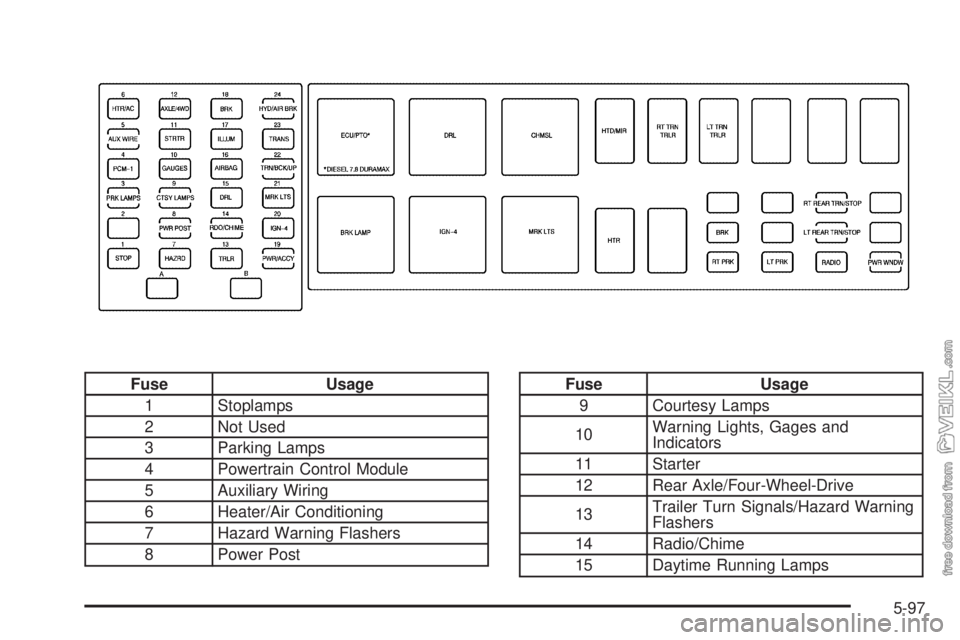
Fuse Usage
1 Stoplamps
2 Not Used
3 Parking Lamps
4 Powertrain Control Module
5 Auxiliary Wiring
6 Heater/Air Conditioning
7 Hazard Warning Flashers
8 Power PostFuse Usage
9 Courtesy Lamps
10Warning Lights, Gages and
Indicators
11 Starter
12 Rear Axle/Four-Wheel-Drive
13Trailer Turn Signals/Hazard Warning
Flashers
14 Radio/Chime
15 Daytime Running Lamps
5-97