clutch CHEVROLET KODIAK 2009 User Guide
[x] Cancel search | Manufacturer: CHEVROLET, Model Year: 2009, Model line: KODIAK, Model: CHEVROLET KODIAK 2009Pages: 376, PDF Size: 5.39 MB
Page 102 of 376
Split Upshift (Manual Transmissions Only)
To downshift the axle with a transmission upshift:
1. Push the clutch.
2. Shift the Transmission to a higher gear.
3. Shift the axle control from High to Low Range.
4. Release the clutch.
5. Push the accelerator pedal until the axle shifts.
Split Downshift (Manual
Transmission Only)
To upshift the axle with a transmission downshift:
1. Shift the axle control from Low to High Range.
2. Push the clutch.
3. Shift the transmission to a lower gear.
4. Release the clutch.
5. Push the accelerator pedal until the axle shifts.
Parking Brake (With Hydraulic
Brakes)
If the vehicle has hydraulic brakes, it has either a
parking brake foot pedal or hand lever. If you have the
parking brake foot pedal, it is located below the
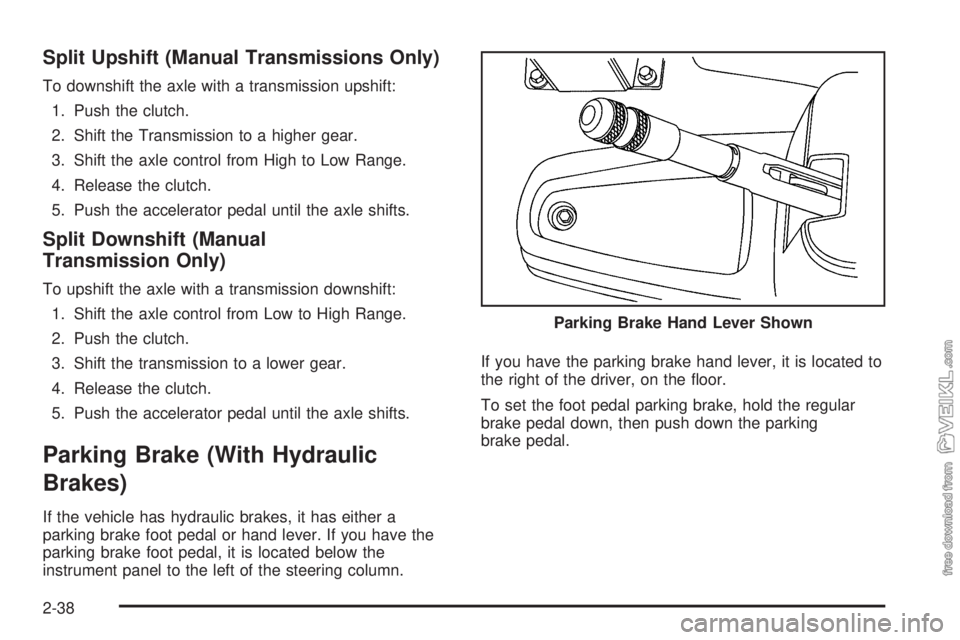
instrument panel to the left of the steering column.If you have the parking brake hand lever, it is located to
the right of the driver, on the floor.
To set the foot pedal parking brake, hold the regular
brake pedal down, then push down the parking
brake pedal.Parking Brake Hand Lever Shown
2-38
Page 128 of 376
Cruise Control
With cruise control, a speed of about 25 mph (40 km/h)
or more can be maintained without keeping your foot
on the accelerator. Cruise control does not work
at speeds below about 25 mph (40 km/h).
If the brakes or clutch pedal, if the vehicle has a manual
transmission, is applied, the cruise control will shut off.
{CAUTION:
Cruise control can be dangerous where you
cannot drive safely at a steady speed. So, do not
use the cruise control on winding roads or in
heavy traffic.
Cruise control can be dangerous on slippery
roads. On such roads, fast changes in tire traction
can cause excessive wheel slip, and you could
lose control. Do not use cruise control on slippery
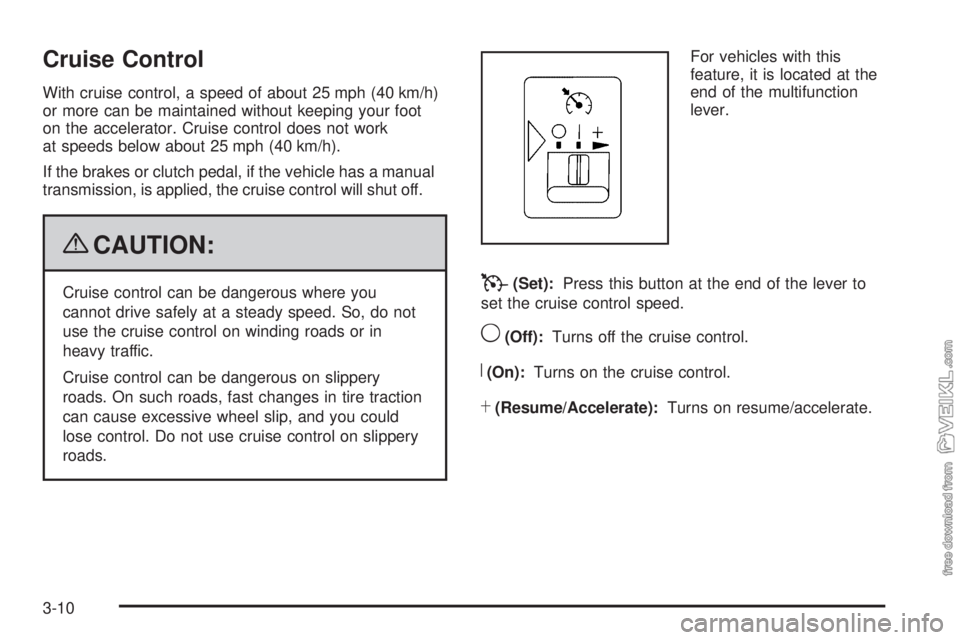
roads.For vehicles with this
feature, it is located at the
end of the multifunction
lever.T(Set):Press this button at the end of the lever to
set the cruise control speed.
9(Off):Turns off the cruise control.
R(On):Turns on the cruise control.
S(Resume/Accelerate):Turns on resume/accelerate.
3-10
Page 131 of 376
Using Cruise Control on Hills
How well the cruise control works on hills depends upon
the vehicles speed, load and the steepness of the hills.
When going up steep hills, you may want to step on the
accelerator pedal to maintain your speed. When going
downhill, you may have to brake or shift to a lower gear to
keep your speed down. When the brake or clutch is
applied the cruise control will shut off.
For vehicles with the exhaust brake option and the
exhaust brake is turned on, the exhaust brake may come
on and try to slow down the vehicle to the set cruise
control speed if the vehicle has accelerated past the set
cruise control speed while going downhill.
Ending Cruise Control
There are four different ways to turn off the cruise
control:
•Step lightly on the brake pedal (manual and
automatic transmissions).
•Press the clutch pedal to the floor (manual
transmissions).
•Move the cruise switch to9.
•Shift the transmission to N (Neutral).
Erasing Speed Memory
The cruise control set speed memory is erased when
the ignition is turned off.
3-13
Page 251 of 376
If you get the overheat warning with no sign of steam,
try this for a minute or so:
1. In heavy traffic, let the engine idle in N (Neutral)
while stopped. If it is safe to do so, pull off the
road, shift to P (Park) or N (Neutral) and let
the engine idle.
2. Turn on your heater to full hot at the highest fan
speed and open the windows as necessary.
3. If climbing a hill, downshift to raise engine and fan
speeds.
If you no longer have the overheat warning, you can
drive. Just to be safe, drive slower for about 10 minutes.
If the warning does not come back on, you can drive
normally.
If the warning continues and you have not stopped, pull
over, stop, and park your vehicle right away.
If there is still no sign of steam, you can push down the
accelerator until the engine speed is about twice as
fast as normal idle speed for at least three minutes while
you are parked. If you still have the warning, turn off
the engine and get everyone out of the vehicle until it
cools down.
You may decide not to lift the hood but to get service
help right away.Engine Fan Noise
Your vehicle has a clutched engine cooling fan. When
the clutch is engaged, the fan spins faster to provide
more air to cool the engine. In most everyday driving
conditions, the clutch is not fully engaged. This improves
fuel economy and reduces fan noise. Under heavy
vehicle loading, trailer towing and/or high outside
temperatures, the fan speed increases when the clutch
engages. So you may hear an increase in fan noise.
This is normal and should not be mistaken as the
transmission slipping or making extra shifts. It is merely
the cooling system functioning properly. The fan will
slow down when additional cooling is not required and
the clutch disengages.
You may also hear this fan noise when you start the
engine. It will go away as the fan clutch disengages.
Power Steering Fluid
SeeScheduled Maintenance on page 6-5to determine
when to check your power steering fluid.
5-49
Page 259 of 376
Electric Air Compressor
The vehicle might have an electric air compressor.
This compressor is used to run options that require
pressurized air, such as an air horn or air seat.
The air compressor is used when vehicles do not have
an air brake system.
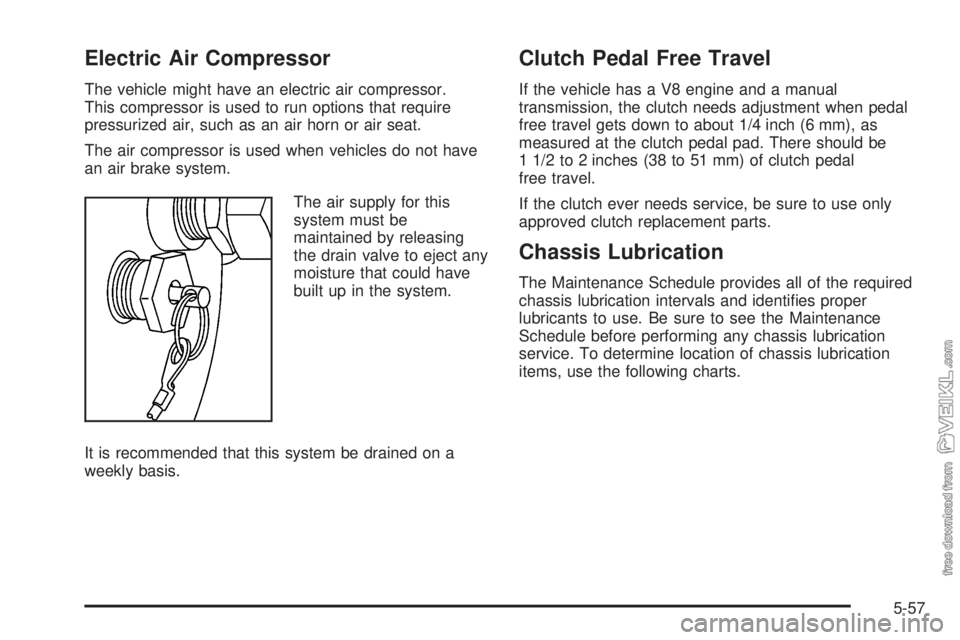
The air supply for this
system must be
maintained by releasing
the drain valve to eject any
moisture that could have
built up in the system.
It is recommended that this system be drained on a
weekly basis.
Clutch Pedal Free Travel
If the vehicle has a V8 engine and a manual
transmission, the clutch needs adjustment when pedal
free travel gets down to about 1/4 inch (6 mm), as
measured at the clutch pedal pad. There should be
1 1/2 to 2 inches (38 to 51 mm) of clutch pedal
free travel.
If the clutch ever needs service, be sure to use only
approved clutch replacement parts.
Chassis Lubrication
The Maintenance Schedule provides all of the required
chassis lubrication intervals and identifies proper
lubricants to use. Be sure to see the Maintenance
Schedule before performing any chassis lubrication
service. To determine location of chassis lubrication
items, use the following charts.
5-57
Page 261 of 376
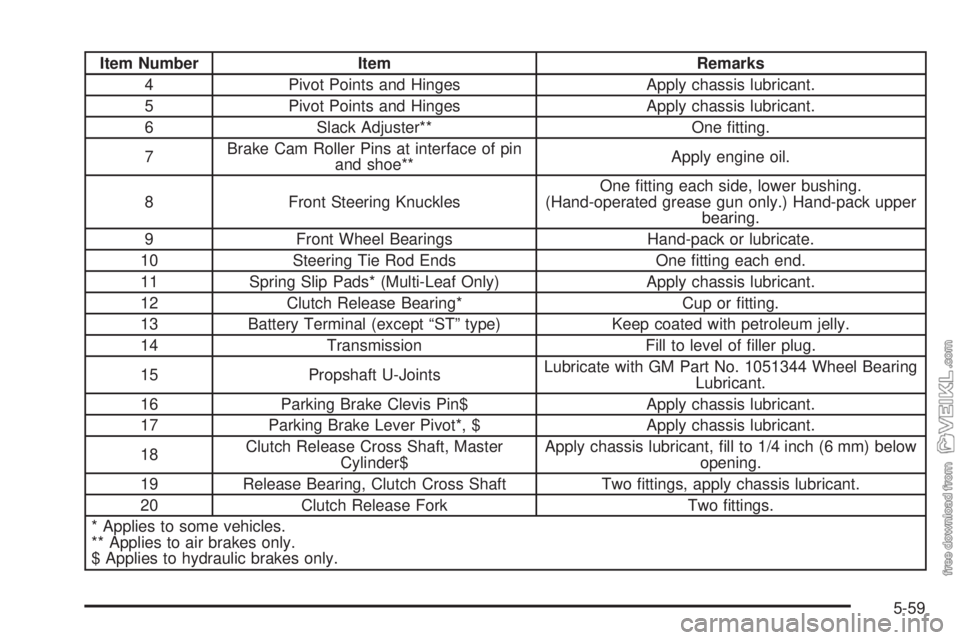
Item Number Item Remarks
4 Pivot Points and Hinges Apply chassis lubricant.
5 Pivot Points and Hinges Apply chassis lubricant.
6 Slack Adjuster** One fitting.
7Brake Cam Roller Pins at interface of pin
and shoe**Apply engine oil.
8 Front Steering KnucklesOne fitting each side, lower bushing.
(Hand-operated grease gun only.) Hand-pack upper
bearing.
9 Front Wheel Bearings Hand-pack or lubricate.
10 Steering Tie Rod Ends One fitting each end.
11 Spring Slip Pads* (Multi-Leaf Only) Apply chassis lubricant.
12 Clutch Release Bearing* Cup or fitting.
13 Battery Terminal (except “ST” type) Keep coated with petroleum jelly.
14 Transmission Fill to level of filler plug.
15 Propshaft U-JointsLubricate with GM Part No. 1051344 Wheel Bearing
Lubricant.
16 Parking Brake Clevis Pin$ Apply chassis lubricant.
17 Parking Brake Lever Pivot*, $ Apply chassis lubricant.
18Clutch Release Cross Shaft, Master
Cylinder$Apply chassis lubricant, fill to 1/4 inch (6 mm) below
opening.
19 Release Bearing, Clutch Cross Shaft Two fittings, apply chassis lubricant.
20 Clutch Release Fork Two fittings.
* Applies to some vehicles.
** Applies to air brakes only.
$ Applies to hydraulic brakes only.
5-59
Page 272 of 376
Noise Control System
Tampering with Noise Control
System Prohibited
The following information relates to compliance with
federal noise emission standards for vehicles with a
Gross Vehicle Weight Rating (GVWR) of more than
10,000 lbs (4 536 kg). The Maintenance Schedule
provides information on maintaining the noise control
system to minimize degradation of the noise emission
control system during the life of your vehicle. The noise
control system warranty is given in your warranty booklet.
These standards apply only to vehicles sold in the
United States.
Federal law prohibits the following acts or the causing
thereof:
1. The removal or rendering inoperative by any person,
other than for purposes of maintenance, repair or
replacement, of any device or element of design
incorporated into any new vehicle for the purpose of
noise control, prior to its sale or delivery to the
ultimate purchaser or while it is in use; or
2. The use of the vehicle after such device or element
of design has been removed or rendered inoperative
by any person.Among those acts presumed to constitute tampering are
the acts listed below.
Insulation:
•
Removal of the noise shields or any underhood
insulation.
Engine:
•
Removal or rendering engine speed governor, if the
vehicle has one, inoperative so as to allow engine
speed to exceed manufacturer specifications.
Fan and Drive:
•
Removal of fan clutch, if the vehicle has one, or
rendering clutch inoperative.
•Removal of the fan shroud, if the vehicle has one.
Air Intake:
•
Removal of the air cleaner silencer.
•Modification of the air cleaner.
Exhaust:
•
Removal of the muffler or resonator.
•Removal of the exhaust pipes and exhaust pipe
clamps.
•Removal of the DOC converter, the Diesel
Particulate Filter, or the diesel exhaust gas cooler
device.
5-70
Page 336 of 376
(11)= Chassis Lubrication Service: Lubricate all grease
fittings in front suspension, front axle, and steering
linkage. Do not lubricate kingpin bushings with air
pressure equipment; instead, use a hand grease gun to
ensure complete purge and eliminate sealer cap
distortion. Front axle tie rod ends, both upper and lower
kingpin fittings, and both steering linkage relay rod ends
should be greased with the vehicle loaded on the ground
and wheels turned straight ahead, not with the vehicle on
a hoist. Apply kingpin bushing lubricant to both upper and
lower kingpin grease fittings until new lubricant purges
from between the upper shim pack and thrust bearing.
Lubricate transmission and shift linkage, hood latches
and hood hinges, parking brake lever pivot, clevis pins
and linkage, disc brake caliper rails, clutch linkage and
release bearing (if equipped), bearing pads, propshaft
universal joints, brake camshaft bracket, slack adjusters,
pedal shaft, clutch cross shaft, clutch pedal springs, and
clutch cable bushing at transmission. Lubricate
suspension, axle, and steering linkage more often when
operating under dusty or muddy conditions and in
excessive off-road use. Frequently power-washed
vehicles will require more frequent lubrication.(12)= Check steering system:
•Look for damaged, loose, or missing parts. Inspect
the steering linkage relay rod and tie rod ends for
looseness or lack of lubricant. Also look for
parts showing signs of wear or lack of lubrication.
Replace parts as needed. Also check steering gear
mounting bolts, pitman arm nut, gear housing
upper cover and side cover attaching bolts, steering
column mounting bolts and cardan joint clamp
bolts; tighten if necessary. See the service manual.
•Inspect power steering hoses, tubes, and fittings for
leaks. Hoses and lines must not be twisted, kinked,
or tightly bent. Make sure clips, clamps, supporting
tubes, and hoses are in place and properly secured.
•Check steering gear for leakage around pitman shaft
and housing. If leakage is evident (lubricant oozing
out, not just oily film), leak should be corrected
immediately.
(13)= Check front and rear suspension. Look for
damaged, loose, or missing parts or parts showing signs
of wear or lack of lubrication. Replace parts as
needed.
6-22
Page 341 of 376
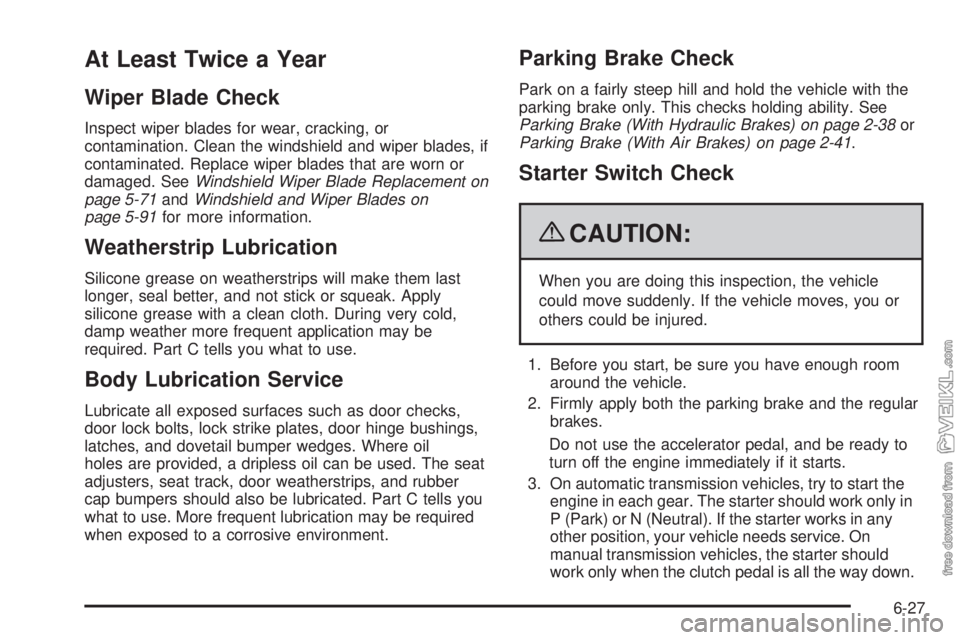
At Least Twice a Year
Wiper Blade Check
Inspect wiper blades for wear, cracking, or
contamination. Clean the windshield and wiper blades, if
contaminated. Replace wiper blades that are worn or
damaged. SeeWindshield Wiper Blade Replacement on
page 5-71andWindshield and Wiper Blades on
page 5-91for more information.
Weatherstrip Lubrication
Silicone grease on weatherstrips will make them last
longer, seal better, and not stick or squeak. Apply
silicone grease with a clean cloth. During very cold,
damp weather more frequent application may be
required. Part C tells you what to use.
Body Lubrication Service
Lubricate all exposed surfaces such as door checks,
door lock bolts, lock strike plates, door hinge bushings,
latches, and dovetail bumper wedges. Where oil
holes are provided, a dripless oil can be used. The seat
adjusters, seat track, door weatherstrips, and rubber
cap bumpers should also be lubricated. Part C tells you
what to use. More frequent lubrication may be required
when exposed to a corrosive environment.
Parking Brake Check
Park on a fairly steep hill and hold the vehicle with the
parking brake only. This checks holding ability. See
Parking Brake (With Hydraulic Brakes) on page 2-38or
Parking Brake (With Air Brakes) on page 2-41.
Starter Switch Check
{CAUTION:
When you are doing this inspection, the vehicle
could move suddenly. If the vehicle moves, you or
others could be injured.
1. Before you start, be sure you have enough room
around the vehicle.
2. Firmly apply both the parking brake and the regular
brakes.
Do not use the accelerator pedal, and be ready to
turn off the engine immediately if it starts.
3. On automatic transmission vehicles, try to start the
engine in each gear. The starter should work only in
P (Park) or N (Neutral). If the starter works in any
other position, your vehicle needs service. On
manual transmission vehicles, the starter should
work only when the clutch pedal is all the way down.
6-27
Page 345 of 376
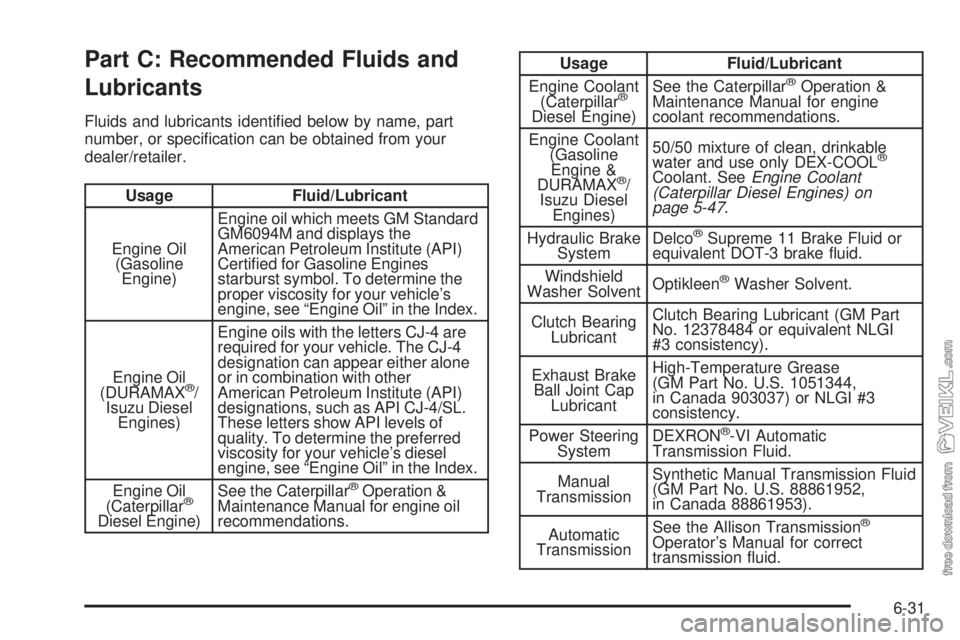
Part C: Recommended Fluids and
Lubricants
Fluids and lubricants identified below by name, part
number, or specification can be obtained from your
dealer/retailer.
Usage Fluid/Lubricant
Engine Oil
(Gasoline
Engine)Engine oil which meets GM Standard
GM6094M and displays the
American Petroleum Institute (API)
Certified for Gasoline Engines
starburst symbol. To determine the
proper viscosity for your vehicle’s
engine, see “Engine Oil” in the Index.
Engine Oil
(DURAMAX
®/
Isuzu Diesel
Engines)Engine oils with the letters CJ-4 are
required for your vehicle. The CJ-4
designation can appear either alone
or in combination with other
American Petroleum Institute (API)
designations, such as API CJ-4/SL.
These letters show API levels of
quality. To determine the preferred
viscosity for your vehicle’s diesel
engine, see “Engine Oil” in the Index.
Engine Oil
(Caterpillar
®
Diesel Engine)See the Caterpillar
®Operation &
Maintenance Manual for engine oil
recommendations.
Usage Fluid/Lubricant
Engine Coolant
(Caterpillar
®
Diesel Engine)See the Caterpillar
®Operation &
Maintenance Manual for engine
coolant recommendations.
Engine Coolant
(Gasoline
Engine &
DURAMAX
®/
Isuzu Diesel
Engines)50/50 mixture of clean, drinkable
water and use only DEX-COOL
®
Coolant. SeeEngine Coolant
(Caterpillar Diesel Engines) on
page 5-47.
Hydraulic Brake
SystemDelco
®Supreme 11 Brake Fluid or
equivalent DOT-3 brake fluid.
Windshield
Washer SolventOptikleen
®Washer Solvent.
Clutch Bearing
LubricantClutch Bearing Lubricant (GM Part
No. 12378484 or equivalent NLGI
#3 consistency).
Exhaust Brake
Ball Joint Cap
LubricantHigh-Temperature Grease
(GM Part No. U.S. 1051344,
in Canada 903037) or NLGI #3
consistency.
Power Steering
SystemDEXRON
®-VI Automatic
Transmission Fluid.
Manual
TransmissionSynthetic Manual Transmission Fluid
(GM Part No. U.S. 88861952,
in Canada 88861953).
Automatic
TransmissionSee the Allison Transmission
®
Operator’s Manual for correct
transmission fluid.
6-31