warning light CHEVROLET KODIAK 2009 User Guide
[x] Cancel search | Manufacturer: CHEVROLET, Model Year: 2009, Model line: KODIAK, Model: CHEVROLET KODIAK 2009Pages: 376, PDF Size: 5.39 MB
Page 111 of 376
Notice:Extended idle should be avoided because
the DPF system is not capable of self cleaning at
idle. During extended idle operation, monitor the
instrument panel telltale lights and Driver Information
Center for messages and take appropriate indicated
action. Continued idling with the warning light/
message on could cause irreversible damage to the
DPF requiring repair and possible replacement that
might not be covered by the vehicle warranty.
When the yellow DPF indicator comes on, the filter is
dirty and needs cleaning. You will also notice a change
in the exhaust sound and engine idle speed. This is
normal. If you continue to drive and the exhaust filter is
not cleaned as required, the DPF indicator will change
from yellow to red. Continuing to drive the vehicle
with the red indicator can cause filter damage.
Vehicles with DPF have specific fuel and engine oil
requirements. SeeWhat Fuel to Use on page 5-8and
Engine Oil (DURAMAX Diesel Engine) on page 5-24
orEngine Oil (Caterpillar Diesel Engine) on page 5-27or
Engine Oil (Isuzu Diesel Engine) on page 5-28or
Engine Oil (Gasoline Engine) on page 5-32for more
information on those requirements.Notice:Permanent damage can occur to the DPF
or related components if the required Ultra Low
Sulfur Diesel (15 ppm sulfur maximum) or low ash
CJ-4 engine oil is not used. This damage would
not be covered by the vehicle warranty.
For vehicles with Power Take-Off (PTO), monitor the
instrument panel cluster for lights related to the DPF.
All engines consume some amount of engine oil. Ash
is the by-product of engine oil consumption. The ash will
become trapped in the DPF over the life of the vehicle.
Eventually, the buildup of ash will restrict the exhaust
gases and the DPF will need to be cleaned or replaced.
SeeAccessories and Modifications on page 5-3for
important information if you are considering adding
accessories or modifying the vehicle.
2-47
Page 119 of 376
Instrument Panel Overview...............................3-4
Hazard Warning Flashers................................3-6
Horn .............................................................3-6
Tilt Wheel.....................................................3-6
Turn Signal/Multifunction Lever.........................3-7
Turn and Lane-Change Signals........................3-7
Headlamp High/Low-Beam Changer..................3-8
Windshield Wipers..........................................3-8
Windshield Washer.........................................3-9
Cruise Control..............................................3-10
Exterior Lamps.............................................3-14
Headlamps on Reminder................................3-14
Daytime Running Lamps (DRL).......................3-15
Marker Lamps..............................................3-16
Instrument Panel Brightness...........................3-16
Dome Lamps ...............................................3-16
Entry Lighting...............................................3-17
Reading Lamps............................................3-17
Instrument Panel Switchbank..........................3-18
Accessory Power Outlet(s).............................3-19
Ashtray(s) and Cigarette Lighter......................3-19Climate Controls............................................3-20
Climate Control System.................................3-20
Outlet Adjustment.........................................3-22
Rear Heating System....................................3-23
Warning Lights, Gages, and Indicators............3-23
Instrument Panel Cluster................................3-24
Speedometer and Odometer...........................3-25
Trip Odometer..............................................3-25
Tachometer.................................................3-25
Engine Speed Limiter....................................3-25
Safety Belt Reminders...................................3-26
Airbag Readiness Light..................................3-27
Airbag Off Light............................................3-28
Charging System Light
..................................3-29
Voltmeter Gage............................................3-30
Service Transmission Warning Light................3-30
Range Inhibit Warning Indicator......................3-31
Brake System Warning Light..........................3-31
Antilock Brake System (ABS) Warning Light........3-33
Trailer Antilock Brake System Warning Light.......3-34
Engine Coolant Temperature Gage..................3-34
Section 3 Instrument Panel
3-1
Page 120 of 376
Low Coolant Warning Light............................3-35
Wait to Start Light........................................3-35
Malfunction Indicator Lamp.............................3-36
Oil Pressure Gage........................................3-38
Low Oil Level Light.......................................3-39
Change Engine Oil Light................................3-39
Engine Overspeed Warning Light....................3-40
Engine Shutdown Warning Light.....................3-40
Transmission Temperature Gage.....................3-40
Exhaust Brake Indicator Light.........................3-41
Differential Lock Indicator Light.......................3-41
Reduced Engine Power Light.........................3-42
Highbeam On Light.......................................3-42
Daytime Running Lamps (DRL)
Indicator Light...........................................3-42
Low Washer Fluid Warning Light.....................3-43
Power Take-Off Light (PTO)...........................3-43Check Gages Warning Light...........................3-43
Fuel Gage...................................................3-44
Water in Fuel Warning Light...........................3-45
Change Fuel Filter Warning Light....................3-45
Diesel Particulate Filter Warning Light..............3-46
Air Filter Restriction Indicator..........................3-46
Air Pressure Gage........................................3-47
Hourmeter Gage...........................................3-47
Audio System(s).............................................3-48
Setting the Clock..........................................3-48
Radio(s)......................................................3-49
Theft-Deterrent Feature..................................3-57
Radio Reception...........................................3-58
Fixed Mast Antenna......................................3-58
Chime Level Adjustment................................3-58
Section 3 Instrument Panel
3-2
Page 123 of 376
The main components of the instrument panel are the following:
A.Outlet Adjustment on page 3-22.
B.Instrument Panel Cluster on page 3-24.
C. Shift Lever. SeeAutomatic Transmission Operation
on page 2-27orManual Transmission Operation
on page 2-28.
D. Air Brake Controls. SeeParking Brake (With
Hydraulic Brakes) on page 2-38orParking Brake
(With Air Brakes) on page 2-41.
E. Transfer Case Controls (If Equipped). See
Four-Wheel Drive on page 2-30. Air Filter Gage
(If Equipped). SeeAir Filter Restriction Indicator on
page 3-46.F. Auxiliary Gages. SeeWarning Lights, Gages, and
Indicators on page 3-23.
G.Exterior Lamps on page 3-14.
H.Turn Signal/Multifunction Lever on page 3-7.
I.Hazard Warning Flashers on page 3-6.
J.Audio System(s) on page 3-48.
K.Climate Control System on page 3-20.
L.Instrument Panel Switchbank on page 3-18.
M.Airbag Off Switch on page 1-55.
N.Accessory Power Outlet(s) on page 3-19.
3-5
Page 141 of 376

Rear Heating System
If the vehicle has a crew
cab and has a rear heater,
the thumbwheel for this
feature is located on
the headliner.
To increase and decrease the flow of heated air to the
rear floor vents, turn the thumbwheel to the desired
fan speed. To turn the fan off, turn the thumbwheel all
the way down.
Warning Lights, Gages, and
Indicators
Warning lights and gages can signal that something is
wrong before it becomes serious enough to cause
an expensive repair or replacement. Paying attention to
the warning lights and gages could prevent injury.
Warning lights come on when there may be or is a
problem with one of the vehicle’s functions. Some
warning lights come on briefly when the engine is started
to indicate they are working.
Gages can indicate when there may be or is a problem
with one of the vehicle’s functions. Often gages and
warning lights work together to indicate a problem with
the vehicle.
When one of the warning lights comes on and stays on
while driving, or when one of the gages shows there
may be a problem, check the section that explains what
to do. Follow this manual’s advice. Waiting to do
repairs can be costly and even dangerous.
3-23
Page 147 of 376
{CAUTION:
If the airbag readiness light ever comes on and
stays on, it means that something may be wrong
with the airbag system. For example, the right
front passenger airbag could inflate even though
the airbag on-off switch is turned off.
To help avoid injury to yourself or others, have the
vehicle serviced right away. SeeAirbag Readiness
Light on page 3-27for more information, including
important safety information.
If the word ON is lit, it means that the right front
passenger frontal airbag is enabled (may inflate). See
Airbag Off Switch on page 1-55for more on this,
including important safety information.
Charging System Light
The charging system light
may be located in the
instrument panel cluster, or
with the auxiliary warning
lights in the center of
the instrument panel.
It should come on briefly when you turn on the ignition,
before the engine is running, as a check to show
that it is working.
If it stays on, or comes on while you are driving, have
your vehicle checked right away. You could have a loose
generator drive belt or some other problem.
Driving while this light is on will drain your battery. If you
must drive a short distance with the light on, turn off
your radio and other accessories. Sustained driving with
a generator failure could result in a lack of back-up
braking if the engine quits or the power steering pump
should fail.
3-29
Page 148 of 376
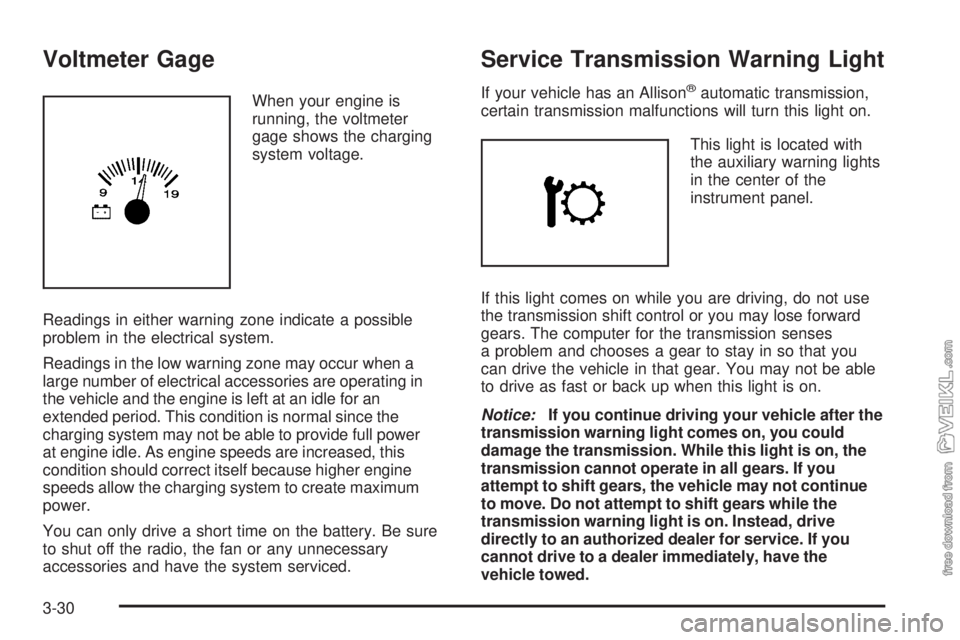
Voltmeter Gage
When your engine is
running, the voltmeter
gage shows the charging
system voltage.
Readings in either warning zone indicate a possible
problem in the electrical system.
Readings in the low warning zone may occur when a
large number of electrical accessories are operating in
the vehicle and the engine is left at an idle for an
extended period. This condition is normal since the
charging system may not be able to provide full power
at engine idle. As engine speeds are increased, this
condition should correct itself because higher engine
speeds allow the charging system to create maximum
power.
You can only drive a short time on the battery. Be sure
to shut off the radio, the fan or any unnecessary
accessories and have the system serviced.
Service Transmission Warning Light
If your vehicle has an Allison®automatic transmission,
certain transmission malfunctions will turn this light on.
This light is located with
the auxiliary warning lights
in the center of the
instrument panel.
If this light comes on while you are driving, do not use
the transmission shift control or you may lose forward
gears. The computer for the transmission senses
a problem and chooses a gear to stay in so that you
can drive the vehicle in that gear. You may not be able
to drive as fast or back up when this light is on.
Notice:If you continue driving your vehicle after the
transmission warning light comes on, you could
damage the transmission. While this light is on, the
transmission cannot operate in all gears. If you
attempt to shift gears, the vehicle may not continue
to move. Do not attempt to shift gears while the
transmission warning light is on. Instead, drive
directly to an authorized dealer for service. If you
cannot drive to a dealer immediately, have the
vehicle towed.
3-30
Page 149 of 376
Range Inhibit Warning Indicator
If your vehicle has an Allison 1000/2200/2300/
2500 series automatic transmission, a lighted bar
under the current gear selected will flash.
If your vehicle has an Allison 3000/3500 series automatic
transmission, the current gear selected on the pushbutton
display will flash.
The flashing bar or gear selection indicates that
transmission range shifts may not occur.
For detailed information on shift inhibit limitations, see
the Allison Automatic Transmission Operator’s Manual in
your vehicle for further information.
Brake System Warning Light
Your vehicle has either hydraulic or air brakes. Each
system has different warning lights.
Hydraulic Brake System Warning Lights
Vehicles with hydraulic brake systems have two brake
system warning lights on the instrument panel.
If the brake warning light
comes on, it means that the
fluid level in the master
cylinder reservoir is low or
there is another problem
with your hydraulic brakes.
When it comes on, you will also hear a warning tone.
This light should come on briefly when you turn the
ignition key to ON/RUN. If it does not come on, then have
it fixed so it will be ready to warn you if there is a problem.
3-31
Page 150 of 376
If the light comes on while driving, pull off the road and
stop carefully. The pedal might be harder to push or
might go the floor. It can take longer to stop. If the light
remains on, have the vehicle towed for service. See
Towing Your Vehicle on page 4-23for more information.
The brake warning light may come on, and the
warning tone may sound, when you are turning and
braking at the same time. This is normal. See “Hydraulic
Brake Systems” underBraking on page 4-4.
Parking Brake Warning Light
Your vehicle has a brake warning light. When the
ignition is on, this light will come on when you set your
parking brake. The light will stay on if your parking
brake does not release fully.
This light should also come on when you turn the
ignition key to START. If it does not come on then, have
it fixed so it will be ready to remind you if the parking
brake is applied or has not released fully.
Air Brake System Warning Light
Vehicles with air brake systems have a brake system
warning light on the instrument panel.
The low air warning light
should come on, as a
check, whenever you start
the engine.
However, it is designed to come on, and stay on, when
brake reservoir pressure has dropped below 60 psi
(410 kPa).
3-32
Page 151 of 376
When the warning light comes on while you are driving,
you should drive only as far as the nearest point of
safety and then stop the vehicle. Here is a very
important thing for you to know:
{CAUTION:
If the air brake system warning light comes on and
the warning tone sounds, the vehicle can stop
suddenly and without further warning. This is
because the parking brake will come on if the
pressure falls below 35 to 45 psi (240 to 310 kPa).
You or others could be injured. If the air brake
system warning light comes on and the warning
tone sounds, stop as soon as you can. You will
not know how quickly the system is losing
pressure, so be aware that the parking brake may
come on suddenly.
Antilock Brake System (ABS)
Warning Light
This light will come on
briefly when you start the
engine, then it will turn
off. This is normal.
If the light stays on, or comes on when you are driving,
your vehicle needs service. If the brake or low air warning
light is not on, you still have brakes, but you do not have
the antilock brake feature. If the brake and/or low air
warning light is on, you do not have antilock brakes and
there is a problem with your regular brakes. SeeBrake
System Warning Light on page 3-31andAntilock Brake
System (ABS) on page 4-5for more information.
3-33