brakes CHEVROLET KODIAK 2009 Owner's Guide
[x] Cancel search | Manufacturer: CHEVROLET, Model Year: 2009, Model line: KODIAK, Model: CHEVROLET KODIAK 2009Pages: 376, PDF Size: 5.39 MB
Page 205 of 376
Service
For service and parts needs, visit your dealer/retailer.
You will receive genuine GM parts and GM-trained and
supported service people.
Genuine GM parts have one of these marks:
Accessories and Modifications
Adding non-dealer accessories to the vehicle can affect
its performance and safety. Such things as airbags,
braking, stability, ride and handling, emissions systems,
aerodynamics, durability, and electronic systems like
anti-lock brakes, traction control, and stability control
could be affected. Some non-dealer accessories could
even cause malfunction or damage to parts and systems
and would not be covered by the vehicle warranty.
Damage to vehicle components resulting from the
installation or use of non-GM certified parts, including
control module modifications, are not covered under the
terms of the vehicle warranty and may affect remaining
warranty coverage for affected parts.
GM Accessories are designed to complement and
function with other systems on the vehicle. Your GM
dealer can accessorize the vehicle using genuine
GM Accessories. When you go to your GM dealer and
ask for GM Accessories, you will know that GM-trained
and supported service technicians will perform the
work using genuine GM Accessories.
Also, seeAdding Equipment to Your Airbag-Equipped
Vehicle on page 1-58.
5-3
Page 252 of 376
How To Check Power Steering Fluid
Check your power steering fluid only when the engine is
warm. If the engine is not warm, you probably will not
get an accurate reading.
If the fluid level is between the MIN (Minimum) and
MAX (Maximum) marks, you have enough. If you need
fluid, add only enough of the proper fluid to bring it
in between the MIN and MAX marks.
If your power steering fluid level is low, this can cause
the brake or service brakes soon warning lights to come
on. In addition, the steering effort and emergency
brake distance could increase.
If either light remains on after you have added power
steering fluid to the proper level, then shut off the engine
for 10 seconds. This should reset the brake warning
lights. If one or both lights stay on, see “Hydraulic Brake
System Warning Lights” underBrake System Warning
Light on page 3-31for more information.
What to Use
To determine what kind of fluid to use, seePart C:
Recommended Fluids and Lubricants on page 6-31.
Notice:When adding power steering fluid or
making a complete fluid change, always use the
proper fluid. Failure to use the proper fluid can
cause leaks and damage hoses and seals.
Windshield Washer Fluid
What to Use
When you need windshield washer fluid, be sure to read
the manufacturer’s instructions before use. If you will
be operating your vehicle in an area where the
temperature may fall below freezing, use a fluid that has
sufficient protection against freezing.
5-50
Page 254 of 376
Brakes
Brake Fluid
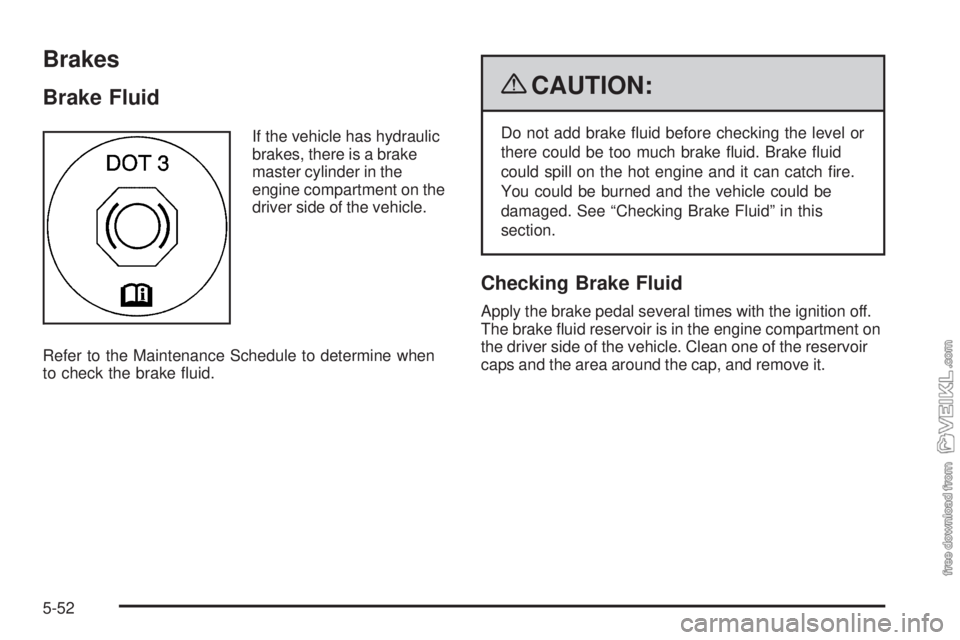
If the vehicle has hydraulic
brakes, there is a brake
master cylinder in the
engine compartment on the
driver side of the vehicle.
Refer to the Maintenance Schedule to determine when
to check the brake fluid.
{CAUTION:
Do not add brake fluid before checking the level or
there could be too much brake fluid. Brake fluid
could spill on the hot engine and it can catch fire.
You could be burned and the vehicle could be
damaged. See “Checking Brake Fluid” in this
section.
Checking Brake Fluid
Apply the brake pedal several times with the ignition off.
The brake fluid reservoir is in the engine compartment on
the driver side of the vehicle. Clean one of the reservoir
caps and the area around the cap, and remove it.
5-52
Page 255 of 376
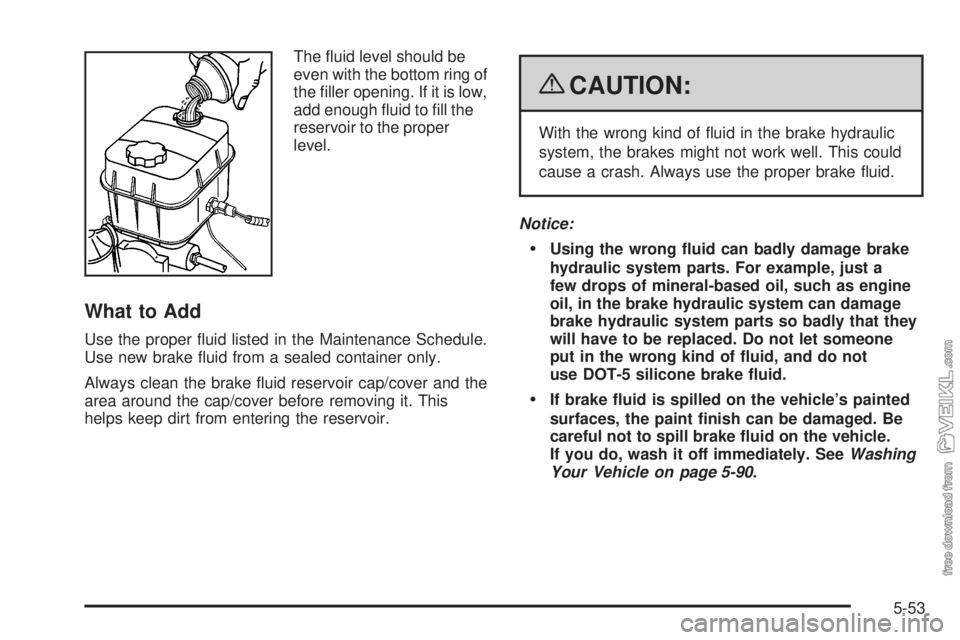
The fluid level should be
even with the bottom ring of
the filler opening. If it is low,
add enough fluid to fill the
reservoir to the proper
level.
What to Add
Use the proper fluid listed in the Maintenance Schedule.
Use new brake fluid from a sealed container only.
Always clean the brake fluid reservoir cap/cover and the
area around the cap/cover before removing it. This
helps keep dirt from entering the reservoir.
{CAUTION:
With the wrong kind of fluid in the brake hydraulic
system, the brakes might not work well. This could
cause a crash. Always use the proper brake fluid.
Notice:
•Using the wrong fluid can badly damage brake
hydraulic system parts. For example, just a
few drops of mineral-based oil, such as engine
oil, in the brake hydraulic system can damage
brake hydraulic system parts so badly that they
will have to be replaced. Do not let someone
put in the wrong kind of fluid, and do not
use DOT-5 silicone brake fluid.
•If brake fluid is spilled on the vehicle’s painted
surfaces, the paint finish can be damaged. Be
careful not to spill brake fluid on the vehicle.
If you do, wash it off immediately. SeeWashing
Your Vehicle on page 5-90.
5-53
Page 256 of 376
Four-Wheel Disc Brakes
(Hydraulic Only)
The vehicle has four-wheel disc brakes.
Some driving conditions or climates can cause a brake
squeal when the brakes are first applied or lightly
applied. This does not mean something is wrong with
the brakes.
Brake linings should always be replaced as complete
axle sets.
Four-Wheel and Six-Wheel Drum
Brakes (Air Only)
The brake drums should be removed and inspected
each time the tires are removed for rotation or changing.
When the front brakes are replaced, have the rear
brakes inspected, too.
Brake linings should always be replaced as complete
axle sets.
Brake Pedal Travel
See your dealer/retailer if the brake pedal does not
return to normal height, or if there is a rapid increase in
pedal travel. This could be a sign that brake service
might be required.
Brake Adjustment
Every brake stop, the brakes adjust for wear.
Brake Adjustment on Air Braked Vehicles
The vehicle has automatic slack adjusters. Every
brake stop, the brakes automatically adjust for wear.
Slack adjusters should never be manually adjusted
to correct excessive brake chamber pushrod stroke.
Excessive brake chamber pushrod stroke means
that the brake system needs to be serviced by a
qualified service technician.
Notice:Do not manually adjust automatic slack
adjusters. Manual adjustment of the automatic slack
adjusters can result in a degradation of the slack
adjuster performance over time. If the brake
chamber pushrod stroke is out of adjustment, the
brake system needs to be serviced by a qualified
service technician.
5-54
Page 257 of 376
Replacing Brake System Parts
The braking system on a vehicle is complex. Its many
parts have to be of top quality and work well together if
the vehicle is to have really good braking. The vehicle
was designed and tested with top-quality brake parts.
When parts of the braking system are replaced — for
example, when the brake linings wear down and new
ones are installed — be sure to get new approved
replacement parts. If this is not done, the brakes might
not work properly. For example, if someone puts in brake
linings that are wrong for the vehicle, the balance
between the front and rear brakes can change — for the
worse. The braking performance expected can change in
many other ways if the wrong replacement brake parts
are installed.
Hydraulic Brake Pads
Brake pad lining life will vary depending on
vehicle application, working environment, equipment
maintenance, and style of driving. The brake pad lining
wear rate has to be monitored for individual driving
habits — original equipment linings have mechanical
wear indicators to help with this. When down to the last
10% of the brake lining, the brake lining wear indicator
rubs on the rotor, causing a scratching or chirping
sound. When this sound is heard, service to the brake
pads is needed. SeeScheduled Maintenance on
page 6-5.
Aftermarket brake linings might not meet the same
stringent requirements as the original equipment linings.
Using aftermarket brake linings can affect braking
performance, pedal feel, noise, and lining wear.
5-55
Page 258 of 376
Air Brake Systems
If the vehicle has air brakes, it is important to get rid of
moisture in the system. Moisture will damage the system
if it is not removed daily.
There are two ways to do this. One is automatic through
the air brake vehicle’s air dryer with integral automatic
moisture ejector that purges air from the system through
a self-contained reservoir. The other way to drain
moisture from the air brake system is to manually activate
drain valves at each reservoir. Drain the air reservoirs
occasionally to be sure the air dryer is working properly.
Drain the air brakes at full system pressure. To be sure of
full pressure, check the air pressure gage. It should read
at least 100 psi (692 kPa).
Air Dryer
If the vehicle has air brakes, it has an air dryer mounted
on the passenger side frame rail. This collects and
removes dirt, moisture, or other foreign matter from the
air prior to entering the brake system. The dryer also
acts as a moisture ejector. It automatically ejects
the moisture when the compressor cycles. The purge
tank has a manual drain valve that must be drained
every day. See “Air Brake Systems” for the manual drain
procedure.
The dryer has a filter that needs changing at intervals.
SeeScheduled Maintenance on page 6-5for more about
servicing this filter.
5-56
Page 261 of 376
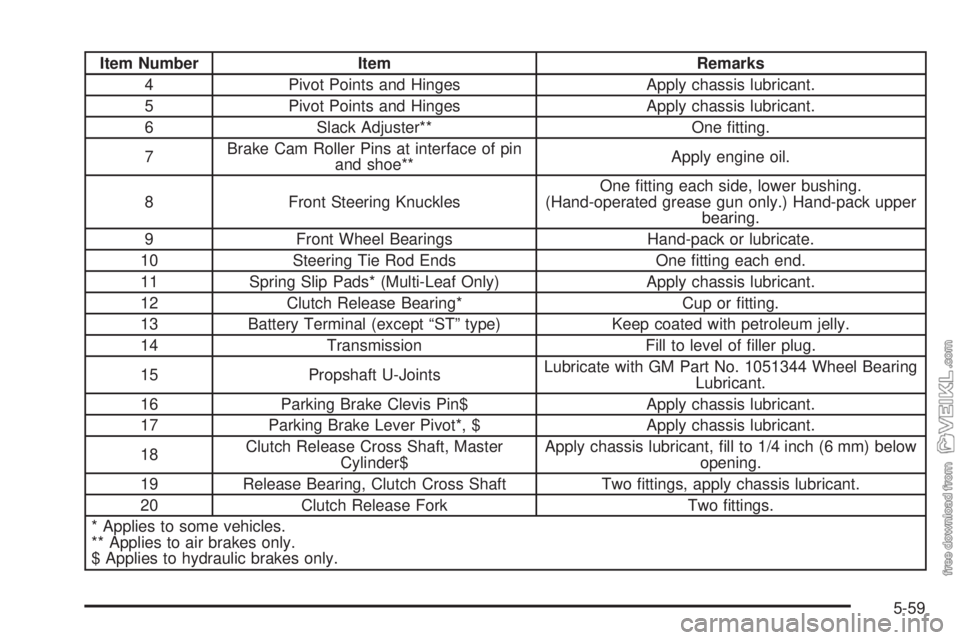
Item Number Item Remarks
4 Pivot Points and Hinges Apply chassis lubricant.
5 Pivot Points and Hinges Apply chassis lubricant.
6 Slack Adjuster** One fitting.
7Brake Cam Roller Pins at interface of pin
and shoe**Apply engine oil.
8 Front Steering KnucklesOne fitting each side, lower bushing.
(Hand-operated grease gun only.) Hand-pack upper
bearing.
9 Front Wheel Bearings Hand-pack or lubricate.
10 Steering Tie Rod Ends One fitting each end.
11 Spring Slip Pads* (Multi-Leaf Only) Apply chassis lubricant.
12 Clutch Release Bearing* Cup or fitting.
13 Battery Terminal (except “ST” type) Keep coated with petroleum jelly.
14 Transmission Fill to level of filler plug.
15 Propshaft U-JointsLubricate with GM Part No. 1051344 Wheel Bearing
Lubricant.
16 Parking Brake Clevis Pin$ Apply chassis lubricant.
17 Parking Brake Lever Pivot*, $ Apply chassis lubricant.
18Clutch Release Cross Shaft, Master
Cylinder$Apply chassis lubricant, fill to 1/4 inch (6 mm) below
opening.
19 Release Bearing, Clutch Cross Shaft Two fittings, apply chassis lubricant.
20 Clutch Release Fork Two fittings.
* Applies to some vehicles.
** Applies to air brakes only.
$ Applies to hydraulic brakes only.
5-59
Page 335 of 376
(4)= Applies to vehicles sold in the United States and is
recommended for vehicles sold in Canada.
(5)= Check fluidlevel in brake master cylinder, power
steering pump, front and rear axles, transmission, and
hydraulic spring parking brake pump (if equipped). A low
fluid level in the brake master cylinder can indicate worn
brake linings and should be checked accordingly.
(6)= Inspect brake lines and hoses for proper hook-up,
binding, leaks, cracks, chafing, etc. Inspect disc
brake pads for wear and rotors for surface condition.
Inspect caliper assemblies. Check brake pedal for
excessive free play or travel (or every 6 months,
whichever occurs first) and have serviced if needed.
Check brakes more often if driving habits and conditions
result in frequent braking.
(7)= Check for filter ash, sensor adjustment, and
sensor hose restriction. Clean as needed. This service
can be complex; you should have your dealer/retailer
perform this service.
(8)= This vehicle has the Engine Oil Life System. This
system will show you when to change the engine oil
and filter — usually between 3,000 miles (5 000 km) and
7,500 miles (12 000 km) since your last oil change.
Under severe conditions, the indicator may come
on before 3,000 miles (5 000 km). Never drive your
gasoline engine vehicle more than 7,500 miles
(12 000 km) or 12 months without an oil and filter
change.Remember to reset the Engine Oil Life System
whenever the oil is changed. For more information, see
Engine Oil Life System (Gasoline Engine) on page 5-35
orEngine Oil Life System (DURAMAX/Isuzu Diesel
Engines) on page 5-36orEngine Oil Life System
(Caterpillar Diesel Engine) on page 5-38.
(9)= This vehicle has the Engine Oil Life System. This
system will show you when to change the engine oil
and filter — usually between 3,000 miles (5 000 km) and
15,000 miles (24 000 km) since your last oil change.
Under severe conditions, the indicator may come
on before 3,000 miles (5 000 km). Never drive your
diesel engine vehicle more than 15,000 miles
(24 000 km), or 12 months, or 750 engine hours,
without an oil and filter change.
Remember to reset the Engine Oil Life System
whenever the oil is changed. For more information, see
Engine Oil Life System (Gasoline Engine) on page 5-35
orEngine Oil Life System (DURAMAX/Isuzu Diesel
Engines) on page 5-36orEngine Oil Life System
(Caterpillar Diesel Engine) on page 5-38.
(10)= Inspect rear axle air shift motor for fluid leaks.
Remove plug to check fluid level. Inspect air lines
and hoses for proper hook-up, binding, leaks, etc.
Inspect at 1,000 miles (1 600 km) and 22,500 miles
(36 000 km) and then every 22,500 miles (36 000 km)
thereafter.
6-21
Page 338 of 376

(24)= Evaporative Control System Service, if equipped:
Check all fuel and vapor lines and hoses for proper
connections and correct routing (or every 24 months,
whichever occurs first). Replace parts as needed.
(25)= Replace spark plugs. Inspect wires for damage.
Check the wire boot and boot heat shield fit at spark
plugs and coil. Replace parts as needed.
(26)= Check the fuel tank, fuel cap and fuel lines for
damage which could cause leakage. Inspect fuel cap for
correct sealing ability and any indications of damage.
Check fuel cap gasket for even filler neck imprint.
Replace parts as needed.
(27)= Check Exhaust Gas Recirculation (EGR) system
as described in the service manual. SeeService
Publications Ordering Information on page 7-10.
(28)= Inspect Electronic Vacuum Regulator Valve
(EVRV) filter for excessive contamination or plugging.
If needed, clean filter with solution of soap and water, let
dry and install.
(29)= Drain, flush, and refill cooling system. This service
can be complex; you should have your dealer/retailer
perform this service. SeePart C: Recommended Fluids
and Lubricants on page 6-31for what to use. Inspect
hoses. Clean radiator, condenser, pressure cap, and
neck. Pressure test cooling system and pressure cap.
For Caterpillar
®diesel engines, always refer to the
Caterpillar®Diesel Engine Operation & Maintenance
Manual for coolant recommendations and change
intervals.(30)= Change the lubricant. SeePart C: Recommended
Fluids and Lubricants on page 6-31.
(31)= Front axle service: Re-pack upper kingpin roller
bearing.
(32)= Air brake service:
•Inspect brake lines and hoses for proper hook-up,
binding, leaks, cracks, chafing, etc. Inspect drum
brake linings for wear or cracks. Inspect other brake
parts at each wheel, including drums and wheel
speed sensor wiring. Check brake pedal for
excessive free play or travel (or every 6 months,
whichever occurs first) and have serviced if needed.
Check brakes more often if driving habits and
conditions result in frequent braking. Replace air
dryer cartridge only if excessive oil or moisture is
present. A small amount of oil in the system is normal
and should not be considered as a reason to replace
the cartridge.
•Test air lines for leaks; tighten as needed. Replace
compressor filter.
•Inspect air parking brake chamber for leaks and
damage. Inspect lines and hoses for leaks, cracks,
chafing, etc. Also check all attachments for tightness,
wear, or damage. Note: The spring brake section of
the rear brake diaphragms are non-serviceable.
6-24