ignition CHEVROLET KODIAK 2009 Owner's Guide
[x] Cancel search | Manufacturer: CHEVROLET, Model Year: 2009, Model line: KODIAK, Model: CHEVROLET KODIAK 2009Pages: 376, PDF Size: 5.39 MB
Page 150 of 376
If the light comes on while driving, pull off the road and
stop carefully. The pedal might be harder to push or
might go the floor. It can take longer to stop. If the light
remains on, have the vehicle towed for service. See
Towing Your Vehicle on page 4-23for more information.
The brake warning light may come on, and the
warning tone may sound, when you are turning and
braking at the same time. This is normal. See “Hydraulic
Brake Systems” underBraking on page 4-4.
Parking Brake Warning Light
Your vehicle has a brake warning light. When the
ignition is on, this light will come on when you set your
parking brake. The light will stay on if your parking
brake does not release fully.
This light should also come on when you turn the
ignition key to START. If it does not come on then, have
it fixed so it will be ready to remind you if the parking
brake is applied or has not released fully.
Air Brake System Warning Light
Vehicles with air brake systems have a brake system
warning light on the instrument panel.
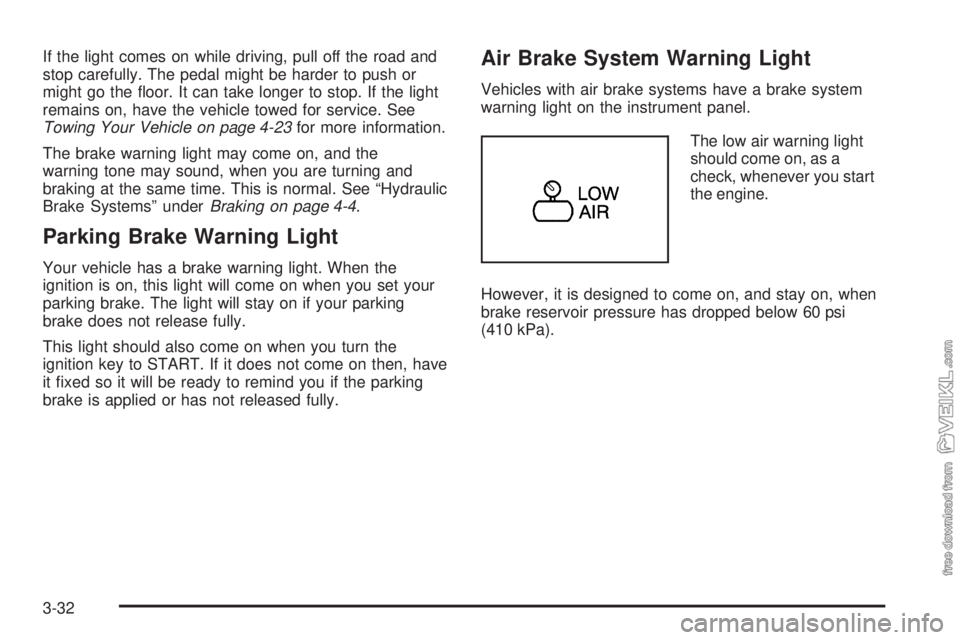
The low air warning light
should come on, as a
check, whenever you start
the engine.
However, it is designed to come on, and stay on, when
brake reservoir pressure has dropped below 60 psi
(410 kPa).
3-32
Page 152 of 376
Trailer Antilock Brake System
Warning Light
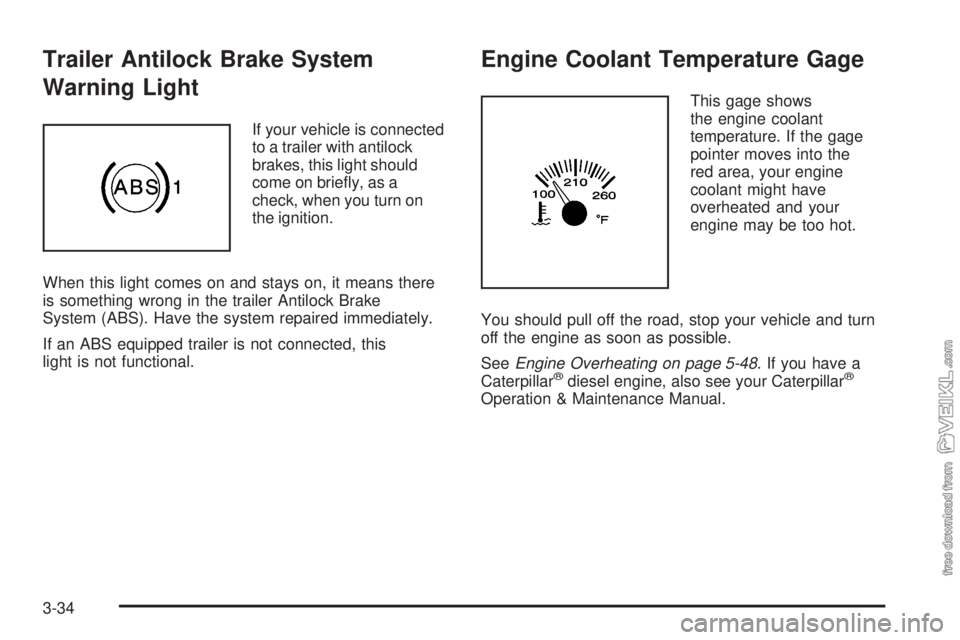
If your vehicle is connected
to a trailer with antilock
brakes, this light should
come on briefly, as a
check, when you turn on
the ignition.
When this light comes on and stays on, it means there
is something wrong in the trailer Antilock Brake
System (ABS). Have the system repaired immediately.
If an ABS equipped trailer is not connected, this
light is not functional.
Engine Coolant Temperature Gage
This gage shows
the engine coolant
temperature. If the gage
pointer moves into the
red area, your engine
coolant might have
overheated and your
engine may be too hot.
You should pull off the road, stop your vehicle and turn
off the engine as soon as possible.
SeeEngine Overheating on page 5-48. If you have a
Caterpillar
®diesel engine, also see your Caterpillar®
Operation & Maintenance Manual.
3-34
Page 153 of 376
Low Coolant Warning Light
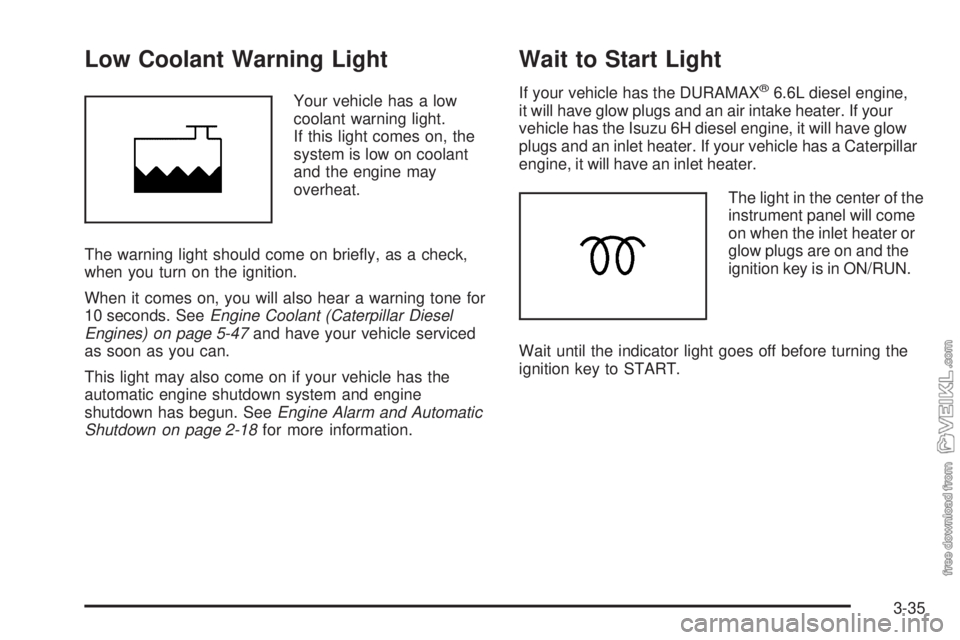
Your vehicle has a low
coolant warning light.
If this light comes on, the
system is low on coolant
and the engine may
overheat.
The warning light should come on briefly, as a check,
when you turn on the ignition.
When it comes on, you will also hear a warning tone for
10 seconds. SeeEngine Coolant (Caterpillar Diesel
Engines) on page 5-47and have your vehicle serviced
as soon as you can.
This light may also come on if your vehicle has the
automatic engine shutdown system and engine
shutdown has begun. SeeEngine Alarm and Automatic
Shutdown on page 2-18for more information.
Wait to Start Light
If your vehicle has the DURAMAX®6.6L diesel engine,
it will have glow plugs and an air intake heater. If your
vehicle has the Isuzu 6H diesel engine, it will have glow
plugs and an inlet heater. If your vehicle has a Caterpillar
engine, it will have an inlet heater.
The light in the center of the
instrument panel will come
on when the inlet heater or
glow plugs are on and the
ignition key is in ON/RUN.
Wait until the indicator light goes off before turning the
ignition key to START.
3-35
Page 154 of 376
Malfunction Indicator Lamp
Check Engine Light
A computer system called OBD II (On-Board
Diagnostics-Second Generation) monitors operation
of the fuel, ignition, and emission control systems.
It makes sure that emissions are at acceptable levels
for the life of the vehicle, helping to produce a cleaner
environment.
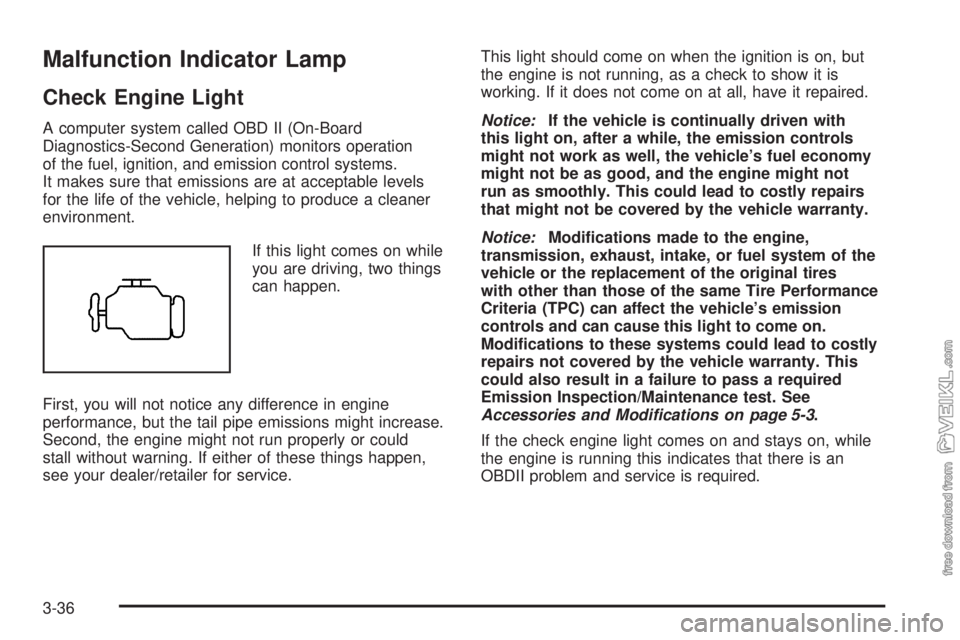
If this light comes on while
you are driving, two things
can happen.
First, you will not notice any difference in engine
performance, but the tail pipe emissions might increase.
Second, the engine might not run properly or could
stall without warning. If either of these things happen,
see your dealer/retailer for service.This light should come on when the ignition is on, but
the engine is not running, as a check to show it is
working. If it does not come on at all, have it repaired.
Notice:If the vehicle is continually driven with
this light on, after a while, the emission controls
might not work as well, the vehicle’s fuel economy
might not be as good, and the engine might not
run as smoothly. This could lead to costly repairs
that might not be covered by the vehicle warranty.
Notice:Modifications made to the engine,
transmission, exhaust, intake, or fuel system of the
vehicle or the replacement of the original tires
with other than those of the same Tire Performance
Criteria (TPC) can affect the vehicle’s emission
controls and can cause this light to come on.
Modifications to these systems could lead to costly
repairs not covered by the vehicle warranty. This
could also result in a failure to pass a required
Emission Inspection/Maintenance test. See
Accessories and Modifications on page 5-3.
If the check engine light comes on and stays on, while
the engine is running this indicates that there is an
OBDII problem and service is required.
3-36
Page 158 of 376
Engine Overspeed Warning Light
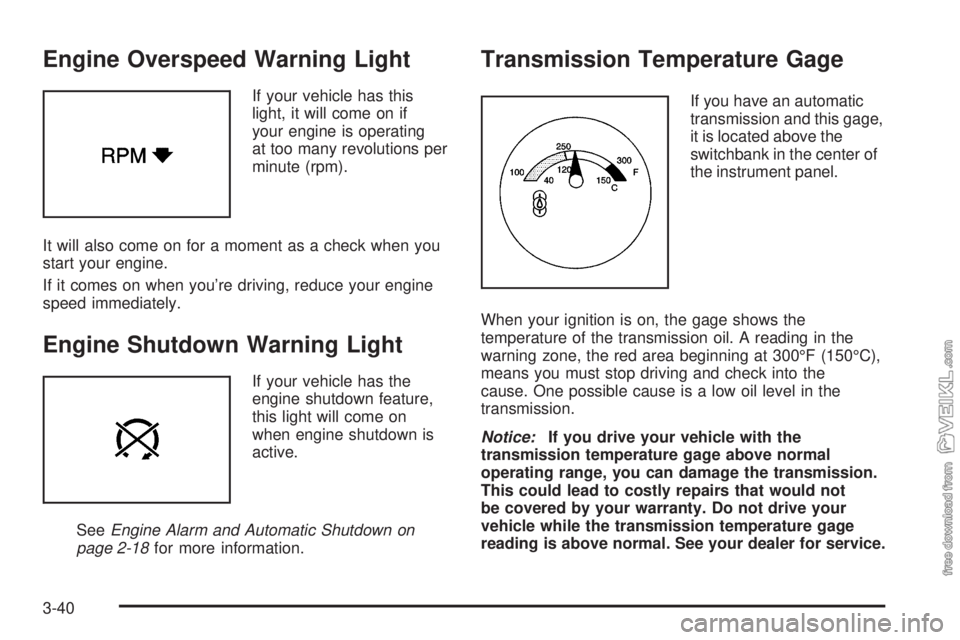
If your vehicle has this
light, it will come on if
your engine is operating
at too many revolutions per
minute (rpm).
It will also come on for a moment as a check when you
start your engine.
If it comes on when you’re driving, reduce your engine
speed immediately.
Engine Shutdown Warning Light
If your vehicle has the
engine shutdown feature,
this light will come on
when engine shutdown is
active.
SeeEngine Alarm and Automatic Shutdown on
page 2-18for more information.
Transmission Temperature Gage
If you have an automatic
transmission and this gage,
it is located above the
switchbank in the center of
the instrument panel.
When your ignition is on, the gage shows the
temperature of the transmission oil. A reading in the
warning zone, the red area beginning at 300°F (150°C),
means you must stop driving and check into the
cause. One possible cause is a low oil level in the
transmission.
Notice:If you drive your vehicle with the
transmission temperature gage above normal
operating range, you can damage the transmission.
This could lead to costly repairs that would not
be covered by your warranty. Do not drive your
vehicle while the transmission temperature gage
reading is above normal. See your dealer for service.
3-40
Page 162 of 376
Fuel Gage
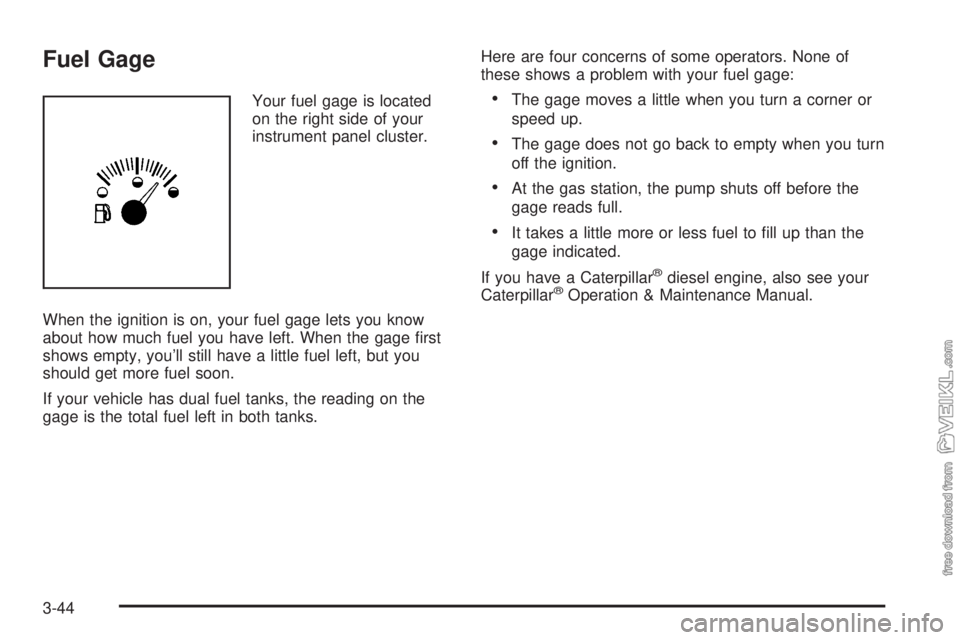
Your fuel gage is located
on the right side of your
instrument panel cluster.
When the ignition is on, your fuel gage lets you know
about how much fuel you have left. When the gage first
shows empty, you’ll still have a little fuel left, but you
should get more fuel soon.
If your vehicle has dual fuel tanks, the reading on the
gage is the total fuel left in both tanks.Here are four concerns of some operators. None of
these shows a problem with your fuel gage:•The gage moves a little when you turn a corner or
speed up.
•The gage does not go back to empty when you turn
off the ignition.
•At the gas station, the pump shuts off before the
gage reads full.
•It takes a little more or less fuel to fill up than the
gage indicated.
If you have a Caterpillar
®diesel engine, also see your
Caterpillar®Operation & Maintenance Manual.
3-44
Page 164 of 376
Diesel Particulate Filter Warning
Light
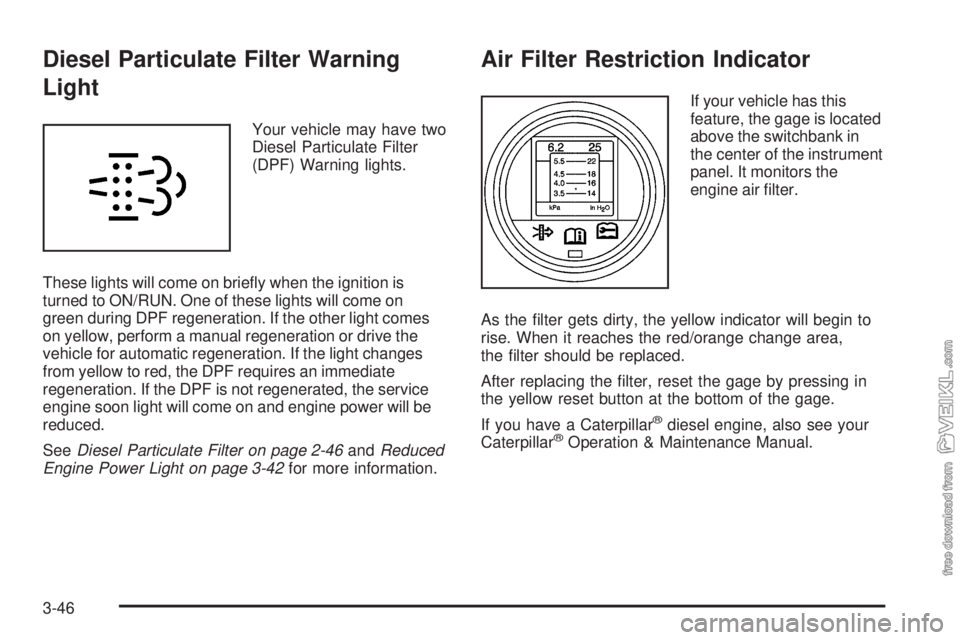
Your vehicle may have two
Diesel Particulate Filter
(DPF) Warning lights.
These lights will come on briefly when the ignition is
turned to ON/RUN. One of these lights will come on
green during DPF regeneration. If the other light comes
on yellow, perform a manual regeneration or drive the
vehicle for automatic regeneration. If the light changes
from yellow to red, the DPF requires an immediate
regeneration. If the DPF is not regenerated, the service
engine soon light will come on and engine power will be
reduced.
SeeDiesel Particulate Filter on page 2-46andReduced
Engine Power Light on page 3-42for more information.
Air Filter Restriction Indicator
If your vehicle has this
feature, the gage is located
above the switchbank in
the center of the instrument
panel. It monitors the
engine air filter.
As the filter gets dirty, the yellow indicator will begin to
rise. When it reaches the red/orange change area,
the filter should be replaced.
After replacing the filter, reset the gage by pressing in
the yellow reset button at the bottom of the gage.
If you have a Caterpillar
®diesel engine, also see your
Caterpillar®Operation & Maintenance Manual.
3-46
Page 165 of 376
Air Pressure Gage
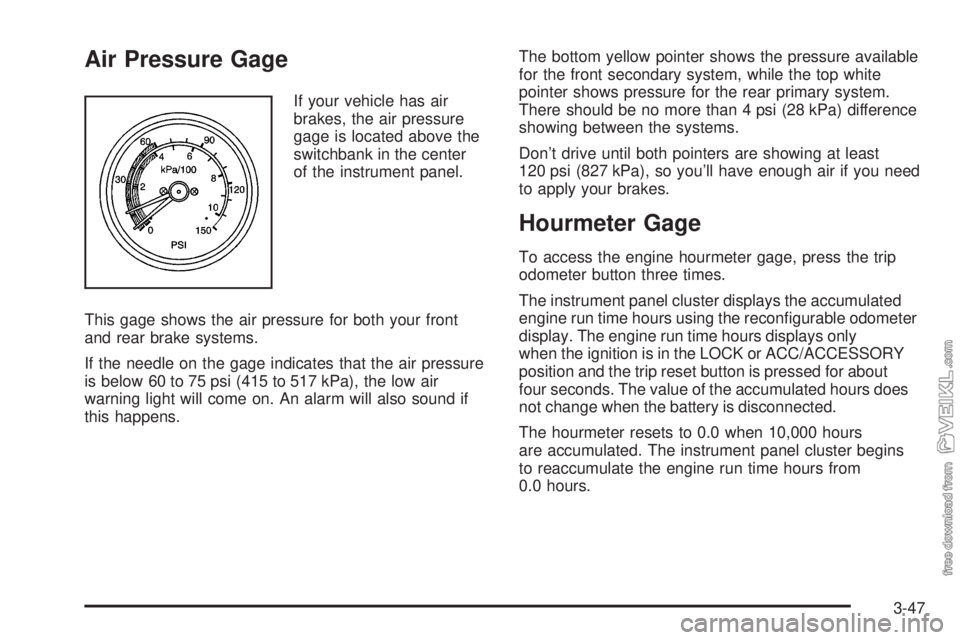
If your vehicle has air
brakes, the air pressure
gage is located above the
switchbank in the center
of the instrument panel.
This gage shows the air pressure for both your front
and rear brake systems.
If the needle on the gage indicates that the air pressure
is below 60 to 75 psi (415 to 517 kPa), the low air
warning light will come on. An alarm will also sound if
this happens.The bottom yellow pointer shows the pressure available
for the front secondary system, while the top white
pointer shows pressure for the rear primary system.
There should be no more than 4 psi (28 kPa) difference
showing between the systems.
Don’t drive until both pointers are showing at least
120 psi (827 kPa), so you’ll have enough air if you need
to apply your brakes.
Hourmeter Gage
To access the engine hourmeter gage, press the trip
odometer button three times.
The instrument panel cluster displays the accumulated
engine run time hours using the reconfigurable odometer
display. The engine run time hours displays only
when the ignition is in the LOCK or ACC/ACCESSORY
position and the trip reset button is pressed for about
four seconds. The value of the accumulated hours does
not change when the battery is disconnected.
The hourmeter resets to 0.0 when 10,000 hours
are accumulated. The instrument panel cluster begins
to reaccumulate the engine run time hours from
0.0 hours.
3-47
Page 166 of 376
Audio System(s)
If the vehicle came without a radio, the wiring provisions
for a radio and an antenna were installed at the
assembly plant, so that if you want, a radio can be
installed at the dealer/retailer.
Determine which radio the vehicle has and read the
following pages to become familiar with its features.
{CAUTION:
Taking your eyes off the road for extended periods
could cause a crash resulting in injury or death to
you or others. Do not give extended attention to
entertainment tasks while driving.
This system provides access to many audio and non
audio listings.
To minimize taking your eyes off the road while driving,
do the following while the vehicle is parked:
•Become familiar with the operation and controls of
the audio system.
•Set up the tone, speaker adjustments, and preset
radio stations.
For more information, seeDefensive Driving on
page 4-2.Notice:Contact your dealer/retailer before adding
any equipment.
Adding audio or communication equipment could
interfere with the operation of the vehicle’s engine,
radio, or other systems, and could damage them.
Follow federal rules covering mobile radio and
telephone equipment.
Notice:The chime signals related to safety belts,
parking brake, and other functions of your vehicle
operate through the radio/entertainment system.
If that equipment is replaced or additional equipment
is added to your vehicle, the chimes may not
work. Make sure that replacement or additional
equipment is compatible with your vehicle before
installing it. SeeAccessories and Modifications
on page 5-3.
Setting the Clock
Press and hold the HR (down) or MIN (up) arrow for
two seconds. Then press HR until the correct hour
displays. Press and hold MIN until the correct minute
displays. The time can be set with the ignition on or off.
3-48
Page 167 of 376
Radio(s)
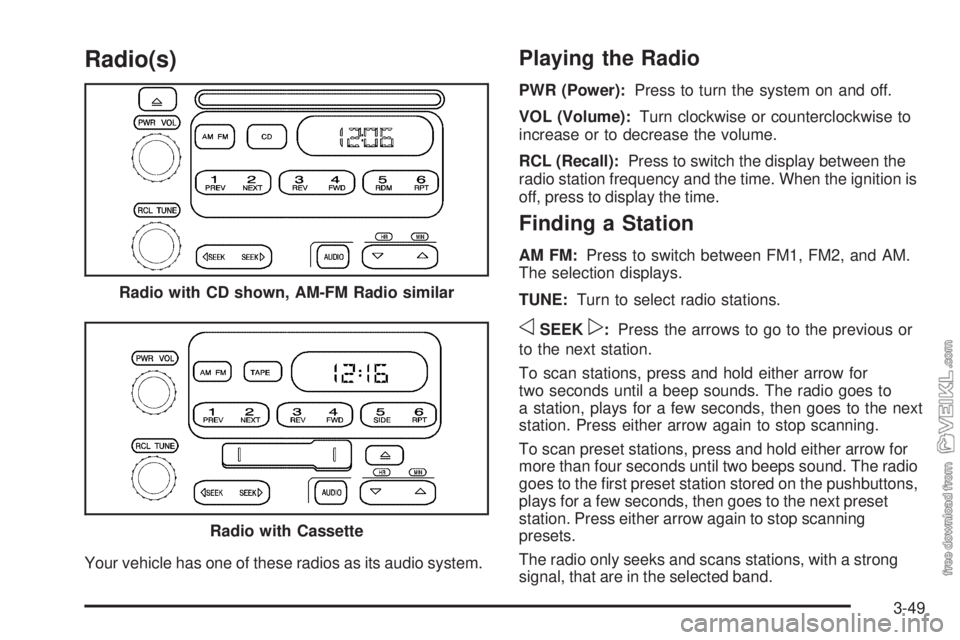
Your vehicle has one of these radios as its audio system.
Playing the Radio
PWR (Power):Press to turn the system on and off.
VOL (Volume):Turn clockwise or counterclockwise to
increase or to decrease the volume.
RCL (Recall):Press to switch the display between the
radio station frequency and the time. When the ignition is
off, press to display the time.
Finding a Station
AM FM:Press to switch between FM1, FM2, and AM.
The selection displays.
TUNE:Turn to select radio stations.
oSEEKp:Press the arrows to go to the previous or
to the next station.
To scan stations, press and hold either arrow for
two seconds until a beep sounds. The radio goes to
a station, plays for a few seconds, then goes to the next
station. Press either arrow again to stop scanning.
To scan preset stations, press and hold either arrow for
more than four seconds until two beeps sound. The radio
goes to the first preset station stored on the pushbuttons,
plays for a few seconds, then goes to the next preset
station. Press either arrow again to stop scanning
presets.
The radio only seeks and scans stations, with a strong
signal, that are in the selected band. Radio with CD shown, AM-FM Radio similar
Radio with Cassette
3-49