oil CHEVROLET KODIAK 2009 Workshop Manual
[x] Cancel search | Manufacturer: CHEVROLET, Model Year: 2009, Model line: KODIAK, Model: CHEVROLET KODIAK 2009Pages: 376, PDF Size: 5.39 MB
Page 284 of 376
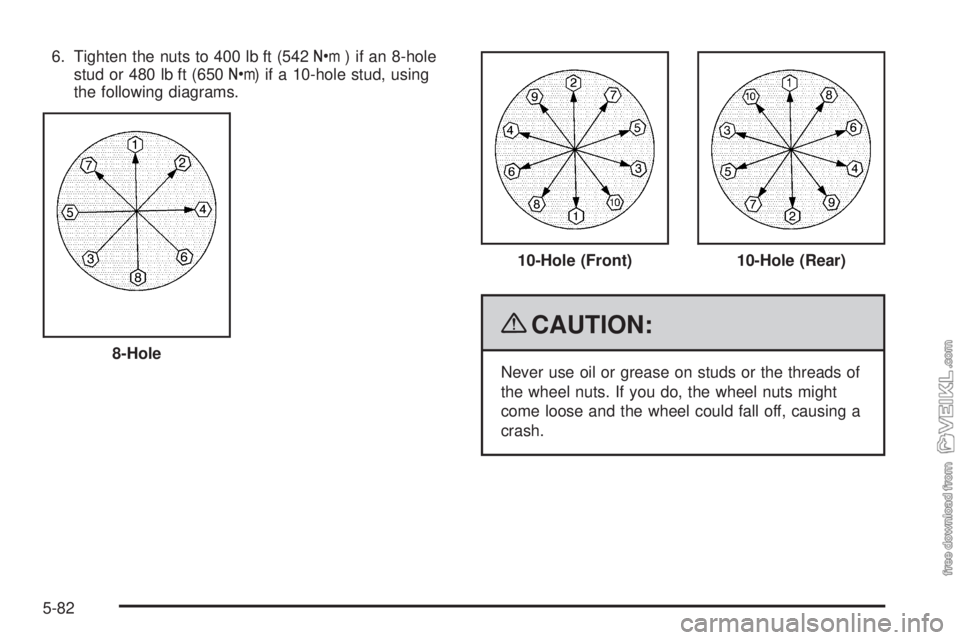
6. Tighten the nuts to 400 lb ft (542Y) if an 8-hole
stud or 480 lb ft (650Y) if a 10-hole stud, using
the following diagrams.
{CAUTION:
Never use oil or grease on studs or the threads of
the wheel nuts. If you do, the wheel nuts might
come loose and the wheel could fall off, causing a
crash. 8-Hole
10-Hole (Front)10-Hole (Rear)
5-82
Page 289 of 376
Appearance Care
Interior Cleaning
The vehicle’s interior will continue to look its best if it is
cleaned often. Although not always visible, dust and
dirt can accumulate on the upholstery. Dirt can damage
carpet, fabric, leather, and plastic surfaces. Regular
vacuuming is recommended to remove particles from the
upholstery. It is important to keep the upholstery from
becoming and remaining heavily soiled. Soils should be
removed as quickly as possible. The vehicle’s interior
may experience extremes of heat that could cause
stains to set rapidly.
Lighter colored interiors may require more frequent
cleaning. Use care because newspapers and garments
that transfer color to home furnishings may also
transfer color to the vehicle’s interior.
When cleaning the vehicle’s interior, only use cleaners
specifically designed for the surfaces being cleaned.
Permanent damage may result from using cleaners onsurfaces for which they were not intended. Use glass
cleaner only on glass. Remove any accidental over-spray
from other surfaces immediately. To prevent over-spray,
apply cleaner directly to the cleaning cloth.
Notice:Using abrasive cleaners when cleaning
glass surfaces on the vehicle, could scratch
the glass and/or cause damage to the rear window
defogger. When cleaning the glass on the vehicle,
use only a soft cloth and glass cleaner.
Many cleaners contain solvents that may become
concentrated in the vehicle’s breathing space. Before
using cleaners, read and adhere to all safety instructions
on the label. While cleaning the vehicle’s interior,
maintain adequate ventilation by opening the vehicle’s
doors and windows.
Dust may be removed from small buttons and knobs
using a small brush with soft bristles.
Products that remove odors from the vehicle’s
upholstery and clean the vehicle’s glass can be obtained
from your dealer/retailer.
5-87
Page 290 of 376
Do not clean the vehicle using:
•A knife or any other sharp object to remove a soil
from any interior surface.
•A stiff brush. It can cause damage to the vehicle’s
interior surfaces.
•Heavy pressure or aggressive rubbing with a
cleaning cloth. Use of heavy pressure can damage
the interior and does not improve the effectiveness
of soil removal.
•Laundry detergents or dishwashing soaps with
degreasers can leave residue that streaks and
attracts dirt. For liquid cleaners, about 20 drops
per gallon (3.78 L) of water is a good guide.
Use only mild, neutral-pH soaps.
•Too much cleaner that saturates the upholstery.
•Organic solvents such as naptha, alcohol, etc. that
can damage the vehicle’s interior.
Fabric/Carpet
Use a vacuum cleaner with a soft brush attachment
frequently to remove dust and loose dirt. A canister
vacuum with a beater bar in the nozzle may only be used
on floor carpet and carpeted floor mats. For any soil,
always try to remove it first with plain water or club soda.
Before cleaning, gently remove as much of the soil as
possible using one of the following techniques:
•For liquids: gently blot the remaining soil with a paper
towel. Allow the soil to absorb into the paper towel
until no more can be removed.
•For solid dry soils: remove as much as possible and
then vacuum.
To clean:
1. Saturate a lint-free, clean white cloth with water or
club soda.
2. Wring the cloth to remove excess moisture.
3. Start on the outside edge of the soil and gently rub
toward the center. Continue cleaning, using a clean
area of the cloth each time it becomes soiled.
4. Continue to gently rub the soiled area until the
cleaning cloth remains clean.
5. If the soil is not completely removed, use a mild
soap solution and repeat the cleaning process
that was used with plain water.
5-88
Page 291 of 376
If any of the soil remains, a commercial fabric cleaner
or spot lifter may be necessary. When a commercial
upholstery cleaner or spot lifter is to be used, test
a small hidden area for colorfastness first. If the locally
cleaned area gives any impression that a ring
formation may result, clean the entire surface.
After the cleaning process has been completed, a paper
towel can be used to blot excess moisture from the
fabric or carpet.
Instrument Panel, Vinyl, and Other
Plastic Surfaces
A soft cloth dampened with water may be used to
remove dust. If a more thorough cleaning is necessary,
a clean soft cloth dampened with a mild soap solution
can be used to gently remove dust and dirt. Never use
spot lifters or removers on plastic surfaces. Many
commercial cleaners and coatings that are sold to
preserve and protect soft plastic surfaces may
permanently change the appearance and feel of the
interior and are not recommended. Do not use silicone
or wax-based products, or those containing organic
solvents to clean the vehicle’s interior because they can
alter the appearance by increasing the gloss in a
non-uniform manner.Some commercial products may increase gloss on the
instrument panel. The increase in gloss may cause
annoying reflections in the windshield and even make it
difficult to see through the windshield under certain
conditions.
Care of Safety Belts
Keep belts clean and dry.
{CAUTION:
Do not bleach or dye safety belts. It may severely
weaken them. In a crash, they might not be able
to provide adequate protection. Clean safety belts
only with mild soap and lukewarm water.
Weatherstrips
Silicone grease on weatherstrips will make them last
longer, seal better, and not stick or squeak. Apply silicone
grease with a clean cloth. During very cold, damp
weather frequent application may be required. SeePart
C: Recommended Fluids and Lubricants on page 6-31.
5-89
Page 293 of 376
Notice:Machine compounding or aggressive
polishing on a basecoat/clearcoat paint finish may
damage it. Use only non-abrasive waxes and
polishes that are made for a basecoat/clearcoat
paint finish on the vehicle.
Foreign materials such as calcium chloride and other
salts, ice melting agents, road oil and tar, tree sap, bird
droppings, chemicals from industrial chimneys, etc.,
can damage the vehicle’s finish if they remain on painted
surfaces. Wash the vehicle as soon as possible. If
necessary, use non-abrasive cleaners that are marked
safe for painted surfaces to remove foreign matter.
Exterior painted surfaces are subject to aging, weather
and chemical fallout that can take their toll over a period
of years. To help keep the paint finish looking new, keep
the vehicle garaged or covered whenever possible.
Protecting Exterior Bright Metal Parts
Bright metal parts should be cleaned regularly to keep
their luster. Washing with water is all that is usually
needed. However, chrome polish may be used on
chrome or stainless steel trim, if necessary.
Use special care with aluminum trim. To avoid damaging
protective trim, never use auto or chrome polish, steam or
caustic soap to clean aluminum. A coating of wax, rubbed
to high polish, is recommended for all bright metal parts.
Windshield and Wiper Blades
Clean the outside of the windshield with glass cleaner.
Clean the rubber blades using a lint free cloth or paper
towel soaked with windshield washer fluid or a mild
detergent. Wash the windshield thoroughly when
cleaning the blades. Bugs, road grime, sap, and a buildup
of vehicle wash/wax treatments may cause wiper
streaking. Replace the wiper blades if they are worn or
damaged.
Wipers can be damaged by:
•Extreme dusty conditions
•Sand and salt
•Heat and sun
•Snow and ice, without proper removal
5-91
Page 305 of 376
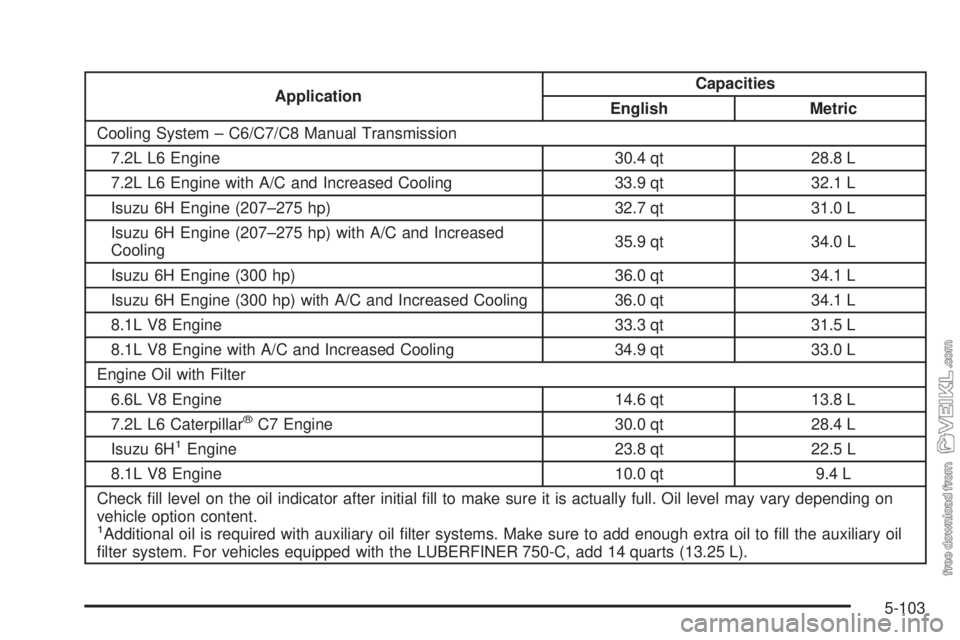
ApplicationCapacities
English Metric
Cooling System – C6/C7/C8 Manual Transmission
7.2L L6 Engine 30.4 qt 28.8 L
7.2L L6 Engine with A/C and Increased Cooling 33.9 qt 32.1 L
Isuzu 6H Engine (207–275 hp) 32.7 qt 31.0 L
Isuzu 6H Engine (207–275 hp) with A/C and Increased
Cooling35.9 qt 34.0 L
Isuzu 6H Engine (300 hp) 36.0 qt 34.1 L
Isuzu 6H Engine (300 hp) with A/C and Increased Cooling 36.0 qt 34.1 L
8.1L V8 Engine 33.3 qt 31.5 L
8.1L V8 Engine with A/C and Increased Cooling 34.9 qt 33.0 L
Engine Oil with Filter
6.6L V8 Engine 14.6 qt 13.8 L
7.2L L6 Caterpillar
®C7 Engine 30.0 qt 28.4 L
Isuzu 6H
1Engine 23.8 qt 22.5 L
8.1L V8 Engine 10.0 qt 9.4 L
Check fill level on the oil indicator after initial fill to make sure it is actually full. Oil level may vary depending on
vehicle option content.
1Additional oil is required with auxiliary oil filter systems. Make sure to add enough extra oil to fill the auxiliary oil
filter system. For vehicles equipped with the LUBERFINER 750-C, add 14 quarts (13.25 L).
5-103
Page 310 of 376
Normal Maintenance Replacement Parts
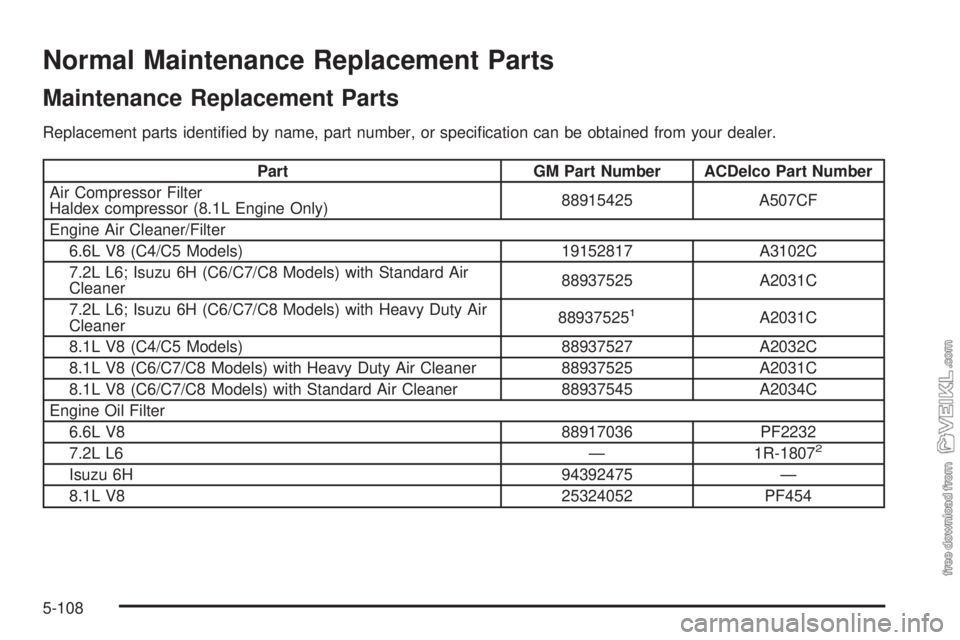
Maintenance Replacement Parts
Replacement parts identified by name, part number, or specification can be obtained from your dealer.
Part GM Part Number ACDelco Part Number
Air Compressor Filter
Haldex compressor (8.1L Engine Only)88915425 A507CF
Engine Air Cleaner/Filter
6.6L V8 (C4/C5 Models) 19152817 A3102C
7.2L L6; Isuzu 6H (C6/C7/C8 Models) with Standard Air
Cleaner88937525 A2031C
7.2L L6; Isuzu 6H (C6/C7/C8 Models) with Heavy Duty Air
Cleaner88937525
1A2031C
8.1L V8 (C4/C5 Models) 88937527 A2032C
8.1L V8 (C6/C7/C8 Models) with Heavy Duty Air Cleaner 88937525 A2031C
8.1L V8 (C6/C7/C8 Models) with Standard Air Cleaner 88937545 A2034C
Engine Oil Filter
6.6L V8 88917036 PF2232
7.2L L6 — 1R-1807
2
Isuzu 6H 94392475 —
8.1L V8 25324052 PF454
5-108
Page 316 of 376
Maintenance Schedule
Introduction
Important: Keep engine oil at the proper level and
change as recommended.
Have you purchased the GM Protection Plan? The Plan
supplements the vehicle warranties. See the Warranty
and Owner Assistance booklet or your dealer/retailer for
details.
Maintenance Requirements
Maintenance intervals, checks, inspections and
recommended fluids and lubricants as prescribed in this
manual are necessary to keep this vehicle in good
working condition. Any damage caused by failure to
follow scheduled maintenance may not be covered by
the vehicle warranty.
Your Vehicle and the Environment
Proper vehicle maintenance not only helps to keep
the vehicle in good working condition, but also helps the
environment. Improper vehicle maintenance can even
affect the quality of the air we breathe. Improper
fluid levels or the wrong tire inflation can increase the
level of emissions from the vehicle. To help protect
the environment, and to keep the vehicle in good
condition, be sure to maintain the vehicle properly.
6-2
Page 319 of 376
Scheduled Maintenance
The services shown in this schedule up to 100,000 miles
(166 000 km) should be repeated after 100,000 miles
(166 000 km) at the same intervals for the life of
this vehicle. The services shown after 100,000 miles
(166 000 km) should be repeated at the same miles (km)
after those intervals for the life of this vehicle.
Gasoline engine vehicles and some DURAMAX
®diesel
and Isuzu diesel engine vehicles have a computer
that lets you know when to change the engine oil. This
is not based on mileage, but on engine operation
and engine temperature. When the computer has
calculated that the oil needs changing, the Engine Oil
Life System will indicate that a change is necessary. See
Engine Oil Life System (Gasoline Engine) on page 5-35
orEngine Oil Life System (DURAMAX/Isuzu Diesel
Engines) on page 5-36orEngine Oil Life System
(Caterpillar Diesel Engine) on page 5-38.
The “Footnotes” at the end of this Maintenance
Schedule further explain maintenance services.
SeeService Publications Ordering Information on
page 7-10.
100 Miles (160 km)
❑Wheel stud nut service.(36)
1,000 Miles (1 600 km)
❑Wheel stud nut service.(36)
❑Rear axle air shift motor service.(10)
7,500 Miles (12 000 km)
❑Gasoline Engine Only: Check engine oil life system.
If engine oil and filter are changed, reset system. See
“Engine Oil (Gasoline Engine)” in the Index.(2) (8)
❑Check fluid levels (or every 3 months, whichever
occurs first).(1) (5)
❑Chassis lubrication service (or every 6 months,
whichever occurs first).(11)
❑Spring-to-axle U-bolts and shackle bolts service.(15)
❑Wheels and tires service.(14)
❑Hydraulic brake service (or every 6 months, whichever
occurs first).(6) (36)
❑Parking brake service (or every 6 months, whichever
occurs first).(21)
❑Air brake service (or every 6 months, whichever
occurs first).(32)
❑Air brake automatic slack adjuster service (or every
500 hours, whichever occurs first).(33)
6-5
Page 320 of 376

❑Check air brake relay valve operation and check for
leaks (or every month, or every 300 hours, whichever
occurs first).
❑Clean air brake application valve (or every 3 months,
or every 300 hours, whichever occurs first). Lubricate
linkage.
❑Air brake chamber service (or every 2 months,
whichever occurs first).(34)
15,000 Miles (24 000 km)
❑Gasoline Engine Only: Check engine oil life system.
If engine oil and filter are changed, reset system. See
“Engine Oil (Gasoline Engine)” in the Index.(2) (8)
❑DURAMAX/Isuzu Diesel Without Engine Oil Life
System Only: Change engine oil and filter (or every
12 months, or every 750 hours of engine operation,
whichever occurs first).(2) (39)
❑DURAMAX/Isuzu Diesel With Engine Oil Life System
Only: Check oil life system. If engine oil and filter are
changed, reset system. See “Engine Oil (DURAMAX/
Isuzu Diesel)” in the Index.(2) (9)
❑Chassis lubrication service (or every 6 months,
whichever occurs first).(11)
❑Check fluid levels (or every 3 months, whichever
occurs first).(1) (5)❑Gasoline Engine: Inspect engine air cleaner filter.
If necessary, replace the filter. If vehicle is driven in
dusty/dirty conditions, inspect filter at every engine oil
change. SeeEngine Air Cleaner/Filter on page 5-38
for more information.
❑Diesel Engine: Inspect engine air cleaner filter change
indicator. If necessary, replace the filter. If vehicle is
driven in dusty/dirty conditions, inspect filter change
indicator at every engine oil change. SeeEngine Air
Cleaner/Filter on page 5-38for more information.
❑Diesel Only: Replace fuel filter (or every 750 hours of
engine operation, whichever occurs first).
❑Steering system service.(12)
❑Front and rear suspension service.(13)
❑Spring-to-axle U-bolts and shackle bolts service.(15)
❑Exhaust system service (or every 6 months, whichever
occurs first).(2) (3) (16)
❑Wheels and tires service.(14)
❑Hydraulic brake service (or every 6 months, whichever
occurs first).(6) (36)
❑Parking brake service (or every 6 months, whichever
occurs first).(21)
6-6