brake CHEVROLET LOW CAB FORWARD 2017 Owners Manual
[x] Cancel search | Manufacturer: CHEVROLET, Model Year: 2017, Model line: LOW CAB FORWARD, Model: CHEVROLET LOW CAB FORWARD 2017Pages: 414, PDF Size: 7.97 MB
Page 286 of 414

Chevrolet Low Cab Forward Owner Manual (GMNA-Localizing-U.S.-
10716700) - 2017 - crc - 12/6/16
Vehicle Care 285
Engine:
Removal or rendering engine speed
governor, if so equipped, inoperative
so as to allow engine speed to
exceed manufacturer specifications.
Fan and Drive:
.Removal of fan clutch or
rendering clutch inoperative.
. Removal of the fan shroud.
Air Intake:
. Removal of air cleaner silencer.
. Reversing air cleaner cover.
Exhaust:
. Removal of muffler, catalytic
converter, and/or resonator.
. Removal of exhaust pipes and
exhaust pipe clamps.
. For diesel vehicles, removal or
modification of diesel particulate
filter (DPF).
. For diesel vehicles, removal or
modification of selective catalytic
reduction (SCR) catalyst.Automatic Transmission
Shift Lock Control
Function Check
(Diesel Only)
When the Selector Lever
Cannot be Moved From the "P"
Position
Perform the following when the
selector lever cannot be moved from
the "P" position.
When performing the below
operations, make sure the parking
brake is securely engaged.
1. Securely pull the parking brake lever and stop the engine.
2. Remove the cup holder (1) byremoving the three Torx®
bolts (2).
Page 300 of 414
Chevrolet Low Cab Forward Owner Manual (GMNA-Localizing-U.S.-
10716700) - 2017 - crc - 12/6/16
Vehicle Care 299
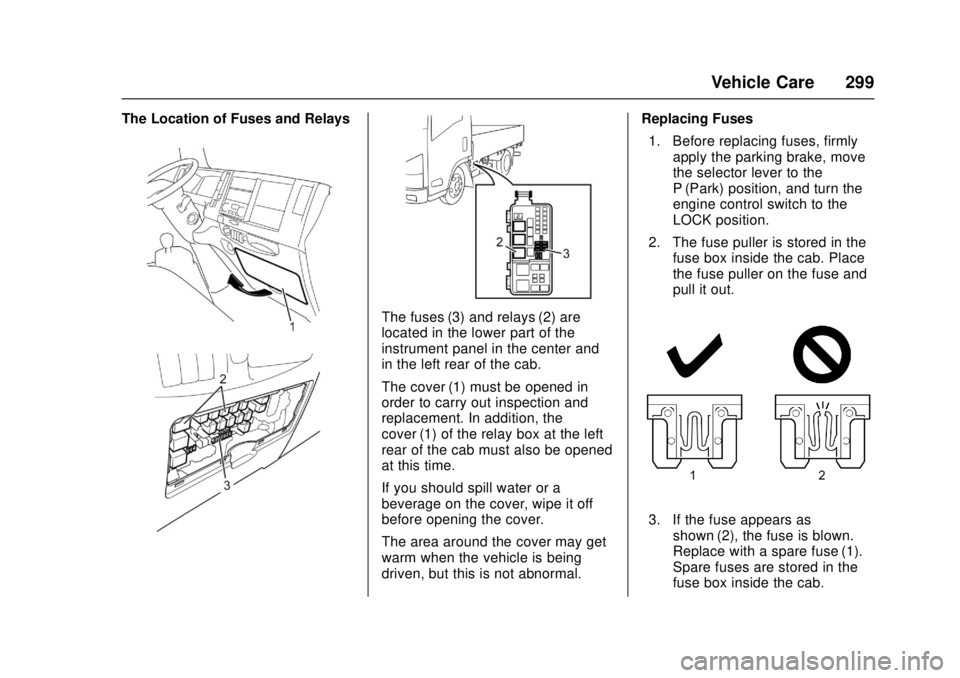
The Location of Fuses and Relays
The fuses (3) and relays (2) are
located in the lower part of the
instrument panel in the center and
in the left rear of the cab.
The cover (1) must be opened in
order to carry out inspection and
replacement. In addition, the
cover (1) of the relay box at the left
rear of the cab must also be opened
at this time.
If you should spill water or a
beverage on the cover, wipe it off
before opening the cover.
The area around the cover may get
warm when the vehicle is being
driven, but this is not abnormal.Replacing Fuses
1. Before replacing fuses, firmly apply the parking brake, move
the selector lever to the
P (Park) position, and turn the
engine control switch to the
LOCK position.
2. The fuse puller is stored in the fuse box inside the cab. Place
the fuse puller on the fuse and
pull it out.
3. If the fuse appears asshown (2), the fuse is blown.
Replace with a spare fuse (1).
Spare fuses are stored in the
fuse box inside the cab.
Page 302 of 414

Chevrolet Low Cab Forward Owner Manual (GMNA-Localizing-U.S.-
10716700) - 2017 - crc - 12/6/16
Vehicle Care 301
Fuse and Relay Location–Cab InteriorFuse locations:
No. Description Rating
1 RR P / WINDOW 25A
2 – –
3 ROOM LAMP, AUDIO 10A
4 DOOR LOCK 15A
5 TRAILER BRAKE 15A
6 P/ WINDOW 25A
7 ABS 10A
8 WIPER 25A
9 H / LAMP LO (LH) 10A
10 LAMPS (BATT) 10A 11 H / LAMP LO (RH) 10A
12 BRAKE LAMPS 10A
13 STARTER 10A
14 H / LAMP HI (LH) 10A
15 H / LAMP HI (RH) 10A
Page 305 of 414

Chevrolet Low Cab Forward Owner Manual (GMNA-Localizing-U.S.-
10716700) - 2017 - crc - 12/6/16
304 Vehicle Care
Gasoline Engine Relay LocationRelay locations:
No. Description
1 STOP LAMP
2 DAYTIME RUNNING LAMP
3 KEY ON
4 TCM
5 PARKING/NEUTRAL
6 WIPER MAIN
7 HORN
8 WIPER HI LO
9 TRAILER BRAKE
10 –/REAR POWER
WINDOW (if
equipped)
11 –/CHARGE (ENG
RUN) - Gasoline
12 POWER WINDOW
13 HEAD LAMP LO
14 VACUUM PUMP
15 HEAD LAMP HI
16 TAIL LAMP
17 CIGAR LIGHTER
Page 314 of 414
Chevrolet Low Cab Forward Owner Manual (GMNA-Localizing-U.S.-
10716700) - 2017 - crc - 12/6/16
Vehicle Care 313
If the original equipment tires are
low rolling tires, it is recommended
to use the LRRA tires shown in the
above table.
For gas engines, please refer to the
emission control identifiers on
Greenhouse Gas (GHG) emission
plate for your original equipment
tires. Also, please refer to“Vehicle
Certification and Greenhouse Gas
(GHG) Emissions Plate” for the
location of the Greenhouse Gas
(GHG) emission plate. See Vehicle
Identification Number (VIN) 0383.
For the 5.2L diesel engine, please
refer to the emission control
identifiers on Greenhouse Gas
(GHG) emission plate for your
original equipment tires. Also,
please refer to “VIN, Weight Rating,
and Greenhouse Gas (GHG)
Emissions Plate” for the location of
the Greenhouse Gas (GHG)
emission plate. See Vehicle
Identification Number (VIN) 0383. Wheel Replacement
Recommendations
Wheels must be replaced if they
become damaged (for example:
bent, heavily rusted, leak air) or if
wheel nuts often become loose. Do
not use bent wheels that have been
straightened and do not use inner
tubes in leaking wheels which are
designed for tubeless tires. Such
wheels may have structural damage
and could fail without warning.
When replacing wheels for any
reason, the new wheels should be
equal in load capacity, diameter,
width, offset and mounting types to
those originally installed in your
vehicle.
A wheel of the wrong size or type
may adversely affect wheel and
bearing life, brake cooling,
speedometer/odometer calibration,
stopping ability, headlight aim,
bumper height, vehicle ground
clearance and tire or tire chain
clearance on the body and chassis. Replacement with "used" wheels is
not advised. They may have been
subjected to harsh treatment or very
high mileage and could fail without
warning.
{Warning
Consult your dealer before
replacing wheels. Never use
wheels that are not designed for
the vehicle. Doing so would
impede safe vehicle operation.
The use of wheels and/or tires with
higher load carrying limits than
originally equipped on your vehicle
does not in itself increase the
GAWR or the GVWR of the vehicle.
Replacement wheels can be
obtained from the authorized dealer
or tire dealer.
Page 319 of 414

Chevrolet Low Cab Forward Owner Manual (GMNA-Localizing-U.S.-
10716700) - 2017 - crc - 12/6/16
318 Vehicle Care
Using worn-out tires is dangerous
because they might have an
increased chance of getting
punctured or bursting while driving.
Check all tires to see if tread wear
indicators appear on their treads
and also check their entire tread for
its depth with a depth gauge to
make sure that the grooves are
deeper than the specified depth.
A tire with tread wear indicators
appearing must be changed. Also,
check the tires for uneven or
otherwise abnormal wear.
{Warning
Tires with excessively shallow
tread grooves will increase the
chance of skidding and, when
driving at high speeds,
hydroplaning. You and others
could be seriously injured.
Hydroplaning occurs when a vehicle
is running at high speeds on a wet
road and a layer of water forms
between the road surface and tires
causing the tires to float on it.
Hydroplaning prevents the driver from steering correctly and from
slowing down the vehicle with the
brake pedal.
Use of Low Aspect Ratio Tires
1. Standard tire
2. Low aspect ratio tire
Low aspect ratio tires for truck
applications (aspect ratio at 70%)
have an air volume 20% to 30%
smaller than that of standard tires.
When air begins to leak, therefore,
low aspect ratio tires adversely
affect vehicle operation much faster
than standard tires. Check air
pressure of low aspect ratio tires
more often than standard tires using
a tire air pressure gauge.
Damaged Tires
{Warning
It is dangerous to mount the
wrong size tire on a wheel. If you
do so, the tire/wheel can explode
as air is being added. This
explosion may result in severe
personal injury or death. For the
3.0L diesel engine, to learn which
wheels and tires are correct, look
at the "VIN and Weight Rating
Plate" on the left side rear pillar
panel below the striker. For the
5.2L diesel engine, to learn which
wheels and tires are correct, look
at the "VIN, Weight Rating, and
Greenhouse Gas (GHG)
Emissions Plate" on the left side
rear pillar panel below the striker
(single cab) or on the left center
pillar panel beside the shoulder
seat belt anchor (crew cab).For
(Continued)
Page 324 of 414
Chevrolet Low Cab Forward Owner Manual (GMNA-Localizing-U.S.-
10716700) - 2017 - crc - 12/6/16
Vehicle Care 323
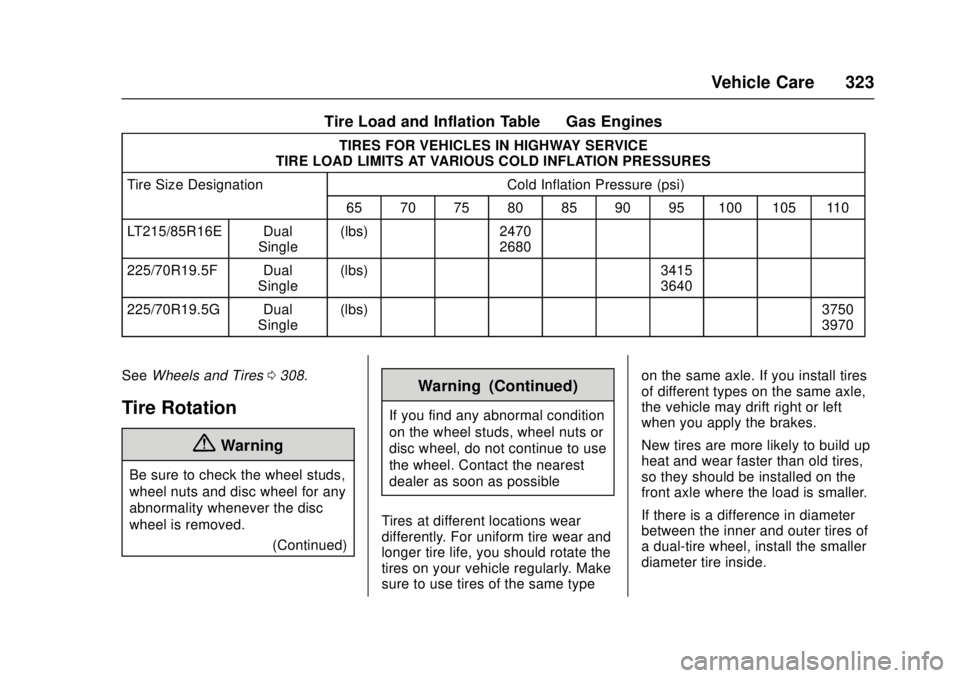
Tire Load and Inflation Table—Gas Engines
TIRES FOR VEHICLES IN HIGHWAY SERVICE
TIRE LOAD LIMITS AT VARIOUS COLD INFLATION PRESSURES
Tire Size Designation Cold Inflation Pressure (psi) 65 70 75 80 85 90 95 100 105 110
LT215/85R16E Dual Single(lbs) 2470
2680
225/70R19.5F Dual Single(lbs) 3415
3640
225/70R19.5G Dual Single(lbs)
3750
3970
See Wheels and Tires 0308.
Tire Rotation
{Warning
Be sure to check the wheel studs,
wheel nuts and disc wheel for any
abnormality whenever the disc
wheel is removed.
(Continued)
Warning (Continued)
If you find any abnormal condition
on the wheel studs, wheel nuts or
disc wheel, do not continue to use
the wheel. Contact the nearest
dealer as soon as possible
Tires at different locations wear
differently. For uniform tire wear and
longer tire life, you should rotate the
tires on your vehicle regularly. Make
sure to use tires of the same type on the same axle. If you install tires
of different types on the same axle,
the vehicle may drift right or left
when you apply the brakes.
New tires are more likely to build up
heat and wear faster than old tires,
so they should be installed on the
front axle where the load is smaller.
If there is a difference in diameter
between the inner and outer tires of
a dual-tire wheel, install the smaller
diameter tire inside.
Page 329 of 414

Chevrolet Low Cab Forward Owner Manual (GMNA-Localizing-U.S.-
10716700) - 2017 - crc - 12/6/16
328 Vehicle Care
Warning (Continued)
Never tow the vehicle to start
because a surge forward when
the engine starts could cause a
collision with the tow vehicle.
Also, this vehicle has a 12-volt
battery, 12-volt starting system
and a negative ground electrical
system; be sure the vehicle or
equipment used to jump start your
engine is also 12-volt. Use of any
other system may damage the
vehicle's electrical components.
Under no circumstances should
the battery's positive and negative
terminals be put in contact with
one another.
When connecting the cables,
under no circumstances should
the clips be allowed to touch each
other.(Continued)
Warning (Continued)
Do not disconnect a battery
terminal with the engine running.
It could cause a breakdown in the
electrical system.
You and others could be seriously
injured.
If you notice battery fluid leaking,
have an inspection carried out
immediately by the nearest dealer.
Diesel engine vehicles have more
than one battery because of the
higher torque required to start a
diesel engine. This procedure can
be used to start a single-battery
vehicle from any of the diesel
vehicle's batteries. However, at low
temperatures, it may not be possible
to start a diesel engine from a single
battery from another vehicle. 1. Use a vehicle that has a charged battery with the same
voltage. Make sure that the
other vehicle also has a 12-volt
starting system, and that it is the negative (–) terminal which
is grounded (attached to the
engine block, or frame rail).
2. Position the vehicle with the good (charged) battery so that
the booster (jumper) cables will
reach. But never let the
vehicles touch. Also, be sure
the booster cables to be used
do not have loose or missing
insulation.
3. In both vehicles, turn off the ignition (engine control) switch
and all lights and accessories
except the hazard flasher or
any lights needed for the work
area. In both vehicles, apply
the parking brake firmly and
move the selector lever to the
"P" position.
Page 334 of 414

Chevrolet Low Cab Forward Owner Manual (GMNA-Localizing-U.S.-
10716700) - 2017 - crc - 12/6/16
Vehicle Care 333
After Towing
After towing the vehicle, block the
rear wheels and install axle shafts
or driveshaft.
Apply the parking brake before
disconnecting from the towing
vehicle.
Front End Towing (All Wheels On
the Ground)
Your vehicle may be towed on all
wheels provided the steering is
operable. Remember that power
steering and brakes will not have
power assist. There must be a tow
bar installed between the tow
vehicle and the disabled vehicle.
Towing with all wheels on theground
1. Bumper
2. Tow Hook
3. Front Axle
4. Towing Guide
5. Towing Chain
To prepare a disabled vehicle for
front end towing with all wheels on
the ground, the following steps are
necessary:
.Block the rear wheels of the
disabled vehicle.
. For gasoline vehicles, move the
selector lever into "N" position,
vehicles can be towed at speeds below 48 km/h (30 mph) and up
to distances less than
80 km (50 mi).
. Disconnect the driveshaft at the
rear axle. Secure the driveshaft
to the frame or crossmember.
When towing, disconnect the
driveshaft at the rear axle to ensure
the transmission is not damaged.
The rear end of the driveshaft must
be disconnected and safely secured
if the 80 km (50 mi) or 48 km/h
(30 mph) is exceeded.
Provide wood blocking to prevent
towing chains and bar from coming
into contact with the bumper.
If there is damage or suspected
damage to the rear axle, remove the
axle shafts.
Cover the hub openings to prevent
the loss of lubricant or entry of dirt
or foreign objects.
After Towing
After towing the vehicle, block the
rear wheels and install axle shafts
or driveshaft.
Page 335 of 414

Chevrolet Low Cab Forward Owner Manual (GMNA-Localizing-U.S.-
10716700) - 2017 - crc - 12/6/16
334 Vehicle Care
Apply the parking brake before
disconnecting from the towing
vehicle. Check and fill rear axle with
oil, if required.
Rear End Towing
When towing a vehicle with rear
wheels raised, secure the steering
wheel to maintain straight-ahead
position. Make certain that the front
axle is not loaded beyond the front
axle gross axle weight rating
(GAWR) as indicated on the
vehicle's VIN and weight rating plate
(diesel) or the vehicle's "Vehicle
Certification and Greenhouse Gas
(GHG) Emissions Plate" (gasoline).
Special Towing Instructions1. All state and local laws regarding such items as
warning signals, night
illumination, speed, etc., must
be followed.
2. Safety chains must be used.
3. No vehicle should ever be towed over 88 km/h (55 mph). 4. Loose or protruding parts of
damaged vehicles should be
secured prior to moving.
5. A safety chain system completely independent of the
primary lifting and towing
attachment must be used.
6. Operators should refrain from going under a vehicle which is
being lifted by the towing
equipment unless the vehicle is
adequately supported by safety
stands.
7. No towing operation which for any reason jeopardizes the
safety of the wrecker operator
or any bystanders or other
motorists should be attempted.Appearance Care
Exterior Care
Exterior Finish
The paint finish on your vehicle
provides beauty, depth of color,
gloss retention and durability.
While cleaning the vehicle, do not
grip the roof marker lights to prevent
damage or water leakage.
Washing
The best way to preserve your
vehicle's finish is to keep it clean by
washing it often.
Wash the vehicle in lukewarm or
cold water. Do not use hot water or
wash your vehicle in the direct rays
of the sun. Do not use strong soap
or chemical detergents. All cleaning
agents should be flushed promptly
from the surface and not allowed to
dry on the finish.
These vehicles are designed to
operate under normal environmental
conditions to withstand natural
elements. However, unusual