light CHEVROLET LOW CAB FORWARD 2017 Owner's Manual
[x] Cancel search | Manufacturer: CHEVROLET, Model Year: 2017, Model line: LOW CAB FORWARD, Model: CHEVROLET LOW CAB FORWARD 2017Pages: 414, PDF Size: 7.97 MB
Page 295 of 414
Chevrolet Low Cab Forward Owner Manual (GMNA-Localizing-U.S.-
10716700) - 2017 - crc - 12/6/16
294 Vehicle Care
3. To install the lamps, performthe same sequence of
operations in reverse, taking
care to turn the connector
clockwise to lock it securely.
If the socket is not locked securely,
water could get inside the lamp and
lead to a breakdown.
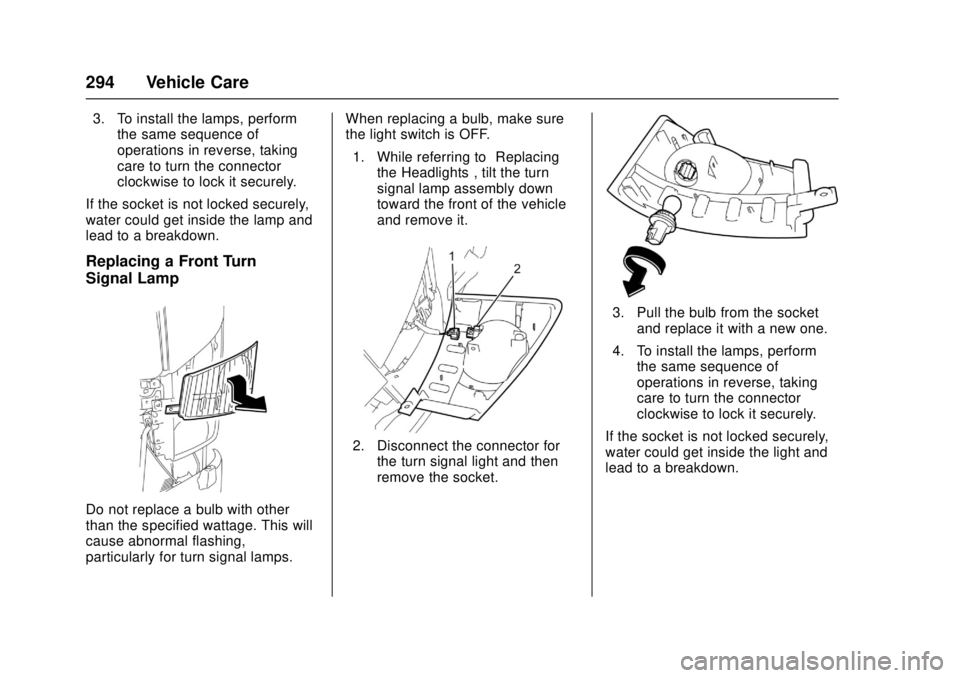
Replacing a Front Turn
Signal Lamp
Do not replace a bulb with other
than the specified wattage. This will
cause abnormal flashing,
particularly for turn signal lamps. When replacing a bulb, make sure
the light switch is OFF.
1. While referring to “Replacing
the Headlights”, tilt the turn
signal lamp assembly down
toward the front of the vehicle
and remove it.
2. Disconnect the connector for the turn signal light and then
remove the socket.
3. Pull the bulb from the socketand replace it with a new one.
4. To install the lamps, perform the same sequence of
operations in reverse, taking
care to turn the connector
clockwise to lock it securely.
If the socket is not locked securely,
water could get inside the light and
lead to a breakdown.
Page 296 of 414
Chevrolet Low Cab Forward Owner Manual (GMNA-Localizing-U.S.-
10716700) - 2017 - crc - 12/6/16
Vehicle Care 295
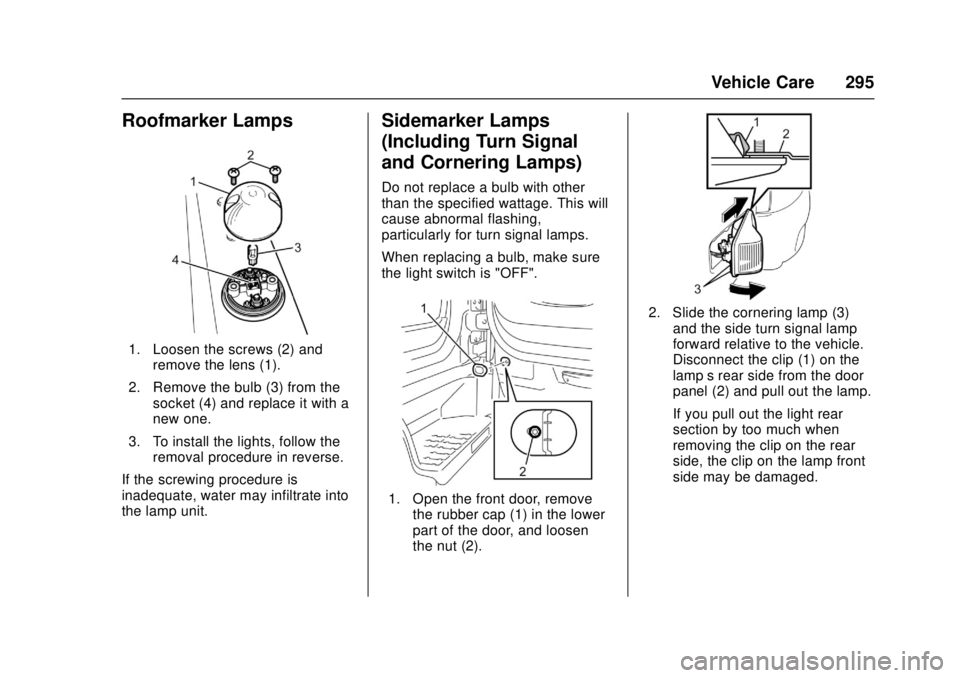
Roofmarker Lamps
1. Loosen the screws (2) andremove the lens (1).
2. Remove the bulb (3) from the socket (4) and replace it with a
new one.
3. To install the lights, follow the removal procedure in reverse.
If the screwing procedure is
inadequate, water may infiltrate into
the lamp unit.
Sidemarker Lamps
(Including Turn Signal
and Cornering Lamps)
Do not replace a bulb with other
than the specified wattage. This will
cause abnormal flashing,
particularly for turn signal lamps.
When replacing a bulb, make sure
the light switch is "OFF".
1. Open the front door, remove the rubber cap (1) in the lower
part of the door, and loosen
the nut (2).
2. Slide the cornering lamp (3)and the side turn signal lamp
forward relative to the vehicle.
Disconnect the clip (1) on the
lamp’s rear side from the door
panel (2) and pull out the lamp.
If you pull out the light rear
section by too much when
removing the clip on the rear
side, the clip on the lamp front
side may be damaged.
Page 297 of 414

Chevrolet Low Cab Forward Owner Manual (GMNA-Localizing-U.S.-
10716700) - 2017 - crc - 12/6/16
296 Vehicle Care
3. When the clip (1) has beenremoved, pull the lamp out
while sliding it out toward the
rear of the vehicle.
4. Loosen the socket by turning it counterclockwise.5. Pull the bulb out from the
socket and replace it with a
new one.
6. To install the lights, perform the same sequence of operations
in reverse taking care of the
following points:
A. Turn the socket clockwiseto lock securely.
If the socket is not locked
securely, water could get
inside the light and lead to
a breakdown.B. Insert the clip on the backof the rear part of the light
into the door panel.
C. Push the front part of the light into the door panel,
and insert the clip on the
back of the front part of the
light in the door panel.
Page 298 of 414

Chevrolet Low Cab Forward Owner Manual (GMNA-Localizing-U.S.-
10716700) - 2017 - crc - 12/6/16
Vehicle Care 297
D. Open the front door, tightenthe nut from the inside of
the door, and install the
rubber cap.
Taillamps, Turn Signal,
Stoplamps, and Back-Up
Lamps
1. Turn Signal Lamp
2. Taillamp/Stoplamp
3. Back-Up Lamp
4. Lens
1. Loosen the screws and remove the lens.
2. Loosen the bulb by turning it counterclockwise while
pressing on it.
3. To install the lights, follow the removal procedure in reverse.
License Plate Lamp
1. Bulb
2. Lens
3. Screw
4. Cover
1. Loosen the screws and removethe cover.
2. Remove the lens.
3. Loosen the bulb by turning it counterclockwise while
pressing on it.
4. To install the lights, follow the removal procedure in reverse.
Page 299 of 414

Chevrolet Low Cab Forward Owner Manual (GMNA-Localizing-U.S.-
10716700) - 2017 - crc - 12/6/16
298 Vehicle Care
Interior Lamps
1. Remove the lens and pull outthe bulb.
2. To install the lights, follow the removal procedure in reverse.
Electrical System
Electrical System
Overload
Electrical System
Following the after-delivery service,
it is the owner's responsibility to
check all wiring periodically for
cracked, chafed or oil-soaked
insulation and maintain it in a clean
and tight condition to ensure
satisfactory operation of the
electrical system.
Replacing the Fuses and Relays
Your vehicle is equipped with fuses
and fusible links to protect your
electrical wiring and equipment in
case of electrical overload.
When the lights do not come on or
flash, or the equipment in the
electrical system does not operate,
check to see if a fuse has blown.
Fuses : In case of an electrical
overload, the fuse will blow and stop
the flow of current in the circuit
before electrical components
become damaged. The cause of the circuit overload
must be identified and corrected
before the blown fuse is replaced,
or else the new fuse will also blow.
Since different circuits handle
different amounts of current, fuses
of various ampere ratings are used.
Be sure to replace a blown fuse with
a fuse of the correct rating.
To know if a fuse is blown or not,
remove the suspected fuse and look
at the wire for a break. If the wire is
broken, replace the fuse with one of
equal amperage rating.
The amperage rating of each fuse is
molded in its head.
Fuses are installed in the fuse
panel.
Page 305 of 414

Chevrolet Low Cab Forward Owner Manual (GMNA-Localizing-U.S.-
10716700) - 2017 - crc - 12/6/16
304 Vehicle Care
Gasoline Engine Relay LocationRelay locations:
No. Description
1 STOP LAMP
2 DAYTIME RUNNING LAMP
3 KEY ON
4 TCM
5 PARKING/NEUTRAL
6 WIPER MAIN
7 HORN
8 WIPER HI LO
9 TRAILER BRAKE
10 –/REAR POWER
WINDOW (if
equipped)
11 –/CHARGE (ENG
RUN) - Gasoline
12 POWER WINDOW
13 HEAD LAMP LO
14 VACUUM PUMP
15 HEAD LAMP HI
16 TAIL LAMP
17 CIGAR LIGHTER
Page 306 of 414

Chevrolet Low Cab Forward Owner Manual (GMNA-Localizing-U.S.-
10716700) - 2017 - crc - 12/6/16
Vehicle Care 305
No. Description18 CORNERING LAMP
19 POWER ACC
20 BLOWER MOTOR Fuse and Relay Location
–Cab Exterior
Diesel Engine Fuse and Relay Location
Fuse locations (2): No. Description Rating
1 MARKER LIGHT 20A
2 TAIL MAIN 20A
3 FUEL HEATER 15A
4 SCR 20A
5 PM SENSOR 15A No. Description Rating
6 RR DOME LIGHT 15A
7 CONDENSER FAN 20A
8 A/C 10A
Page 307 of 414

Chevrolet Low Cab Forward Owner Manual (GMNA-Localizing-U.S.-
10716700) - 2017 - crc - 12/6/16
306 Vehicle Care
Relay locations (1):No. Description
1 STARTER
2 PM SENSOR
3 NOX & DEF SENSOR
4 A/C COMPRESSOR
5 CONDENSER FAN
6 RR DOME LIGHT
7 SCR HEATER VALVE
8 MARKER LIGHT
9 –
10 –
11 FUEL HEATER
Gasoline Engine Fuse and Relay Location
Fuse locations (2): No. Description Rating
1 MARKER LIGHT 20A
Page 308 of 414

Chevrolet Low Cab Forward Owner Manual (GMNA-Localizing-U.S.-
10716700) - 2017 - crc - 12/6/16
Vehicle Care 307
No. Description Rating2 TAIL MAIN 20A
3 PCM 1 15A
4 PCM 2 20A
5 PCM 3 15A
6 POWER SOURCE 15A
7 CONDENSER FAN 20A
8 A/C COMPRESSOR 10A
Relay locations (1): No. Description
1 STARTER
2 A/C COMPRESSOR
3 CONDENSER FAN
4 FUEL PUMP
5 RR DOME LAMP
6 MARKER LAMP
7 PCM MAIN
8 –
9 A/C No. Description
10 –
11 FUEL HEATER
When Slow-blow Fuses Blow Out
Slow-blow fuses protect the
electrical circuits, and they are
installed so that they can be quickly
replaced if there is a malfunction.
If an overload exists in the circuit
from the battery, the slow-blow fuse
will blow out before the wiring
harness is damaged to protect the
electrical circuitry. Inspection
When the headlights and other
devices in the electrical system do
not work, but there is no problem
with the fuses, check the
slow-blow fuse.
The slow-blow fuse is blown if it
looks like the illustration.
Immediately contact the nearest
dealer.
Page 314 of 414
Chevrolet Low Cab Forward Owner Manual (GMNA-Localizing-U.S.-
10716700) - 2017 - crc - 12/6/16
Vehicle Care 313
If the original equipment tires are
low rolling tires, it is recommended
to use the LRRA tires shown in the
above table.
For gas engines, please refer to the
emission control identifiers on
Greenhouse Gas (GHG) emission
plate for your original equipment
tires. Also, please refer to“Vehicle
Certification and Greenhouse Gas
(GHG) Emissions Plate” for the
location of the Greenhouse Gas
(GHG) emission plate. See Vehicle
Identification Number (VIN) 0383.
For the 5.2L diesel engine, please
refer to the emission control
identifiers on Greenhouse Gas
(GHG) emission plate for your
original equipment tires. Also,
please refer to “VIN, Weight Rating,
and Greenhouse Gas (GHG)
Emissions Plate” for the location of
the Greenhouse Gas (GHG)
emission plate. See Vehicle
Identification Number (VIN) 0383. Wheel Replacement
Recommendations
Wheels must be replaced if they
become damaged (for example:
bent, heavily rusted, leak air) or if
wheel nuts often become loose. Do
not use bent wheels that have been
straightened and do not use inner
tubes in leaking wheels which are
designed for tubeless tires. Such
wheels may have structural damage
and could fail without warning.
When replacing wheels for any
reason, the new wheels should be
equal in load capacity, diameter,
width, offset and mounting types to
those originally installed in your
vehicle.
A wheel of the wrong size or type
may adversely affect wheel and
bearing life, brake cooling,
speedometer/odometer calibration,
stopping ability, headlight aim,
bumper height, vehicle ground
clearance and tire or tire chain
clearance on the body and chassis. Replacement with "used" wheels is
not advised. They may have been
subjected to harsh treatment or very
high mileage and could fail without
warning.
{Warning
Consult your dealer before
replacing wheels. Never use
wheels that are not designed for
the vehicle. Doing so would
impede safe vehicle operation.
The use of wheels and/or tires with
higher load carrying limits than
originally equipped on your vehicle
does not in itself increase the
GAWR or the GVWR of the vehicle.
Replacement wheels can be
obtained from the authorized dealer
or tire dealer.