seats CHEVROLET LOW CAB FORWARD 2017 User Guide
[x] Cancel search | Manufacturer: CHEVROLET, Model Year: 2017, Model line: LOW CAB FORWARD, Model: CHEVROLET LOW CAB FORWARD 2017Pages: 414, PDF Size: 7.97 MB
Page 54 of 414

Chevrolet Low Cab Forward Owner Manual (GMNA-Localizing-U.S.-
10716700) - 2017 - crc - 12/6/16
Seats and Restraints 53
When the passenger's seat belt is
fully taken up (or not pulled out),
check that the stopper is holding the
belt in a fully taut state.
Emergency Locking Retractor
(ELR) Function
The three-point seat belts are
provided with an Emergency
Locking Retractor (ELR) function.
The ELR normally allows the seat
belt to move in and out freely as the
occupant moves. However, it locks
the seat belt to restrain the
occupant when a forward force
resulting from a collision or sudden
stop acts on the occupant.
The ELR also locks the seat belt
when the belt is pulled out quickly.
If this happens, allow it to retract
once and then pull it out slowly.Seat Belt Use During
Pregnancy
{Warning
Unless the seat belt is correctly
worn, it may dig into the abdomen
in the event of hard braking or a
collision, harming not only the
expectant mother but also the
unborn child, putting them both in
danger of serious injuries or
death.
An expectant mother or a person
who is ill riding in the vehicle must
also wear a seat belt. In light of the
risk that the seat belt will apply
pressure to the abdomen, chest and
shoulders in the event of a collision,
however, an expectant mother or
person who is ill should get advice
from a physician beforehand.
.An expectant mother should use
a three-point seat belt.
. An expectant mother should
position the lap belt snugly as
low as possible on the hips (not
across the abdomen). Also, she
should fasten the shoulder belt
so it rests on her chest, not on
her abdomen.
Lap Belt
The center seat lap belt has no
retractor, but should be positioned,
worn, and released as described
below.
Page 55 of 414

Chevrolet Low Cab Forward Owner Manual (GMNA-Localizing-U.S.-
10716700) - 2017 - crc - 12/6/16
54 Seats and Restraints
To Fasten:1. Sit on the seat in the correct position.
2. Pull out the latch plate side ofthe belt a little longer than
necessary. Placing the latch
plate at right angles with the
belt makes this easier.
3. After checking that there are notwists in the belt, insert the
latch plate into the buckle until
it clicks.
4. Position the seat belt acrossthe lap as low as possible on
the hips. Pull the fold-back end
of the belt (upper side) until the
belt is adjusted to a snug fit.
To Unfasten:
Push the button on the buckle to
unfasten the belt.
The center seat belt
(length-adjustable two-point belt) is
designed so that it cannot be
connected with any of the
windowside seat belts (three-point
seat belts with ELR).
Page 56 of 414
Chevrolet Low Cab Forward Owner Manual (GMNA-Localizing-U.S.-
10716700) - 2017 - crc - 12/6/16
Seats and Restraints 55
Seat Belt Extender
If the vehicle's seat belt will fasten
around you, you should use it. But if
a seat belt isn't long enough to
fasten, your dealer can order you an
extender. When you go in to order it,
take the heaviest coat you will wear,
so the extender will be long enough
for you. The extender will be just for
you, and just for the seat in your
vehicle that you choose. Do not let
someone else use it, and use it only
for the seat it is made to fit. To wear
it, just attach it to the regular
seat belt.
Safety System Check
Now and then check that the belts,
buckles, latch plates, retractors,
anchorages and guide loops work
properly; look for loose parts or
damage (without disassembly) that
could keep the restraint system from
doing its job. Have a belt assembly
replaced if the webbing has been
cut or otherwise damaged. Replace
belts, retractors, and hardware used
in all but a minor collision. Also,
restraint systems should bereplaced and anchorages properly
repaired if they were in areas
damaged by a collision, whether the
belt was in use or not. If there is any
question, replace the belt system.
Damage, whether visible or not,
could result in a serious personal
injury in the event of an accident.
Seat Belt Care
{Warning
Keep belts clean and dry.
Clean seat belts only with mild
soaps and lukewarm water.
Do not bleach or dye belts since
this may severely weaken them.
Seat belt webbing can lose its
strength when bleached or
redyed, or when cleaned using
gasoline, paint thinners or other
volatile substances.
Do not disassemble the seat belt
mechanism in order to remove
any foreign material or objects
(Continued)
Warning (Continued)
that may have entered the buckle.
Instead, arrange for inspection
and maintenance to be carried
out by your dealer. You and
others could be seriously injured.
A dirty seat belt can develop
retracting problems, and for this
reason, regular inspection and
upkeep are required.
Cleaning a Seat Belt Fold-Back
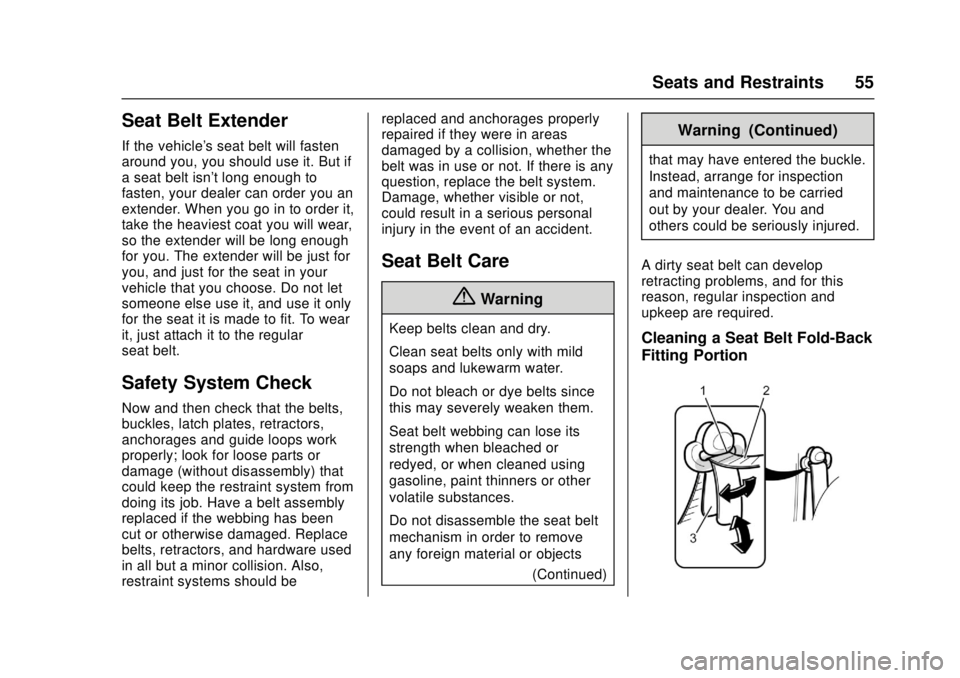
Fitting Portion
Page 57 of 414
Chevrolet Low Cab Forward Owner Manual (GMNA-Localizing-U.S.-
10716700) - 2017 - crc - 12/6/16
56 Seats and Restraints
1. Seat belt fold-back fittingportion
2. Seat belt
3. Cloth
Cleaning a Seat Belt Fold-Back
Fitting Portion:
1. Fold a piece of cotton cloth, absorbent gauze, or the like of
approximately 50 mm (2 in) in
width into a rectangle.
2. Mix one part neutral detergent into approximately twenty parts
warm water.
3. Wet the cloth in the detergent mixture, pass it through the
fold-back fitting portion of the
belt, and slide it back and forth
and laterally until dirt can no
longer be seen.
4. Remove the cloth, remove moisture from the fitting portion
of the belt using a dry cloth,
and then allow it to dry
naturally out of direct sunlight.
5. Check to be sure the seat belt retracts and pulls out correctly. Avoid using anything like a tool to
pass the cloth through the fold-back
fitting portion or try to remove
stubborn dirt. Using such an object
can result in plastic parts or seat
belt webbing damage.
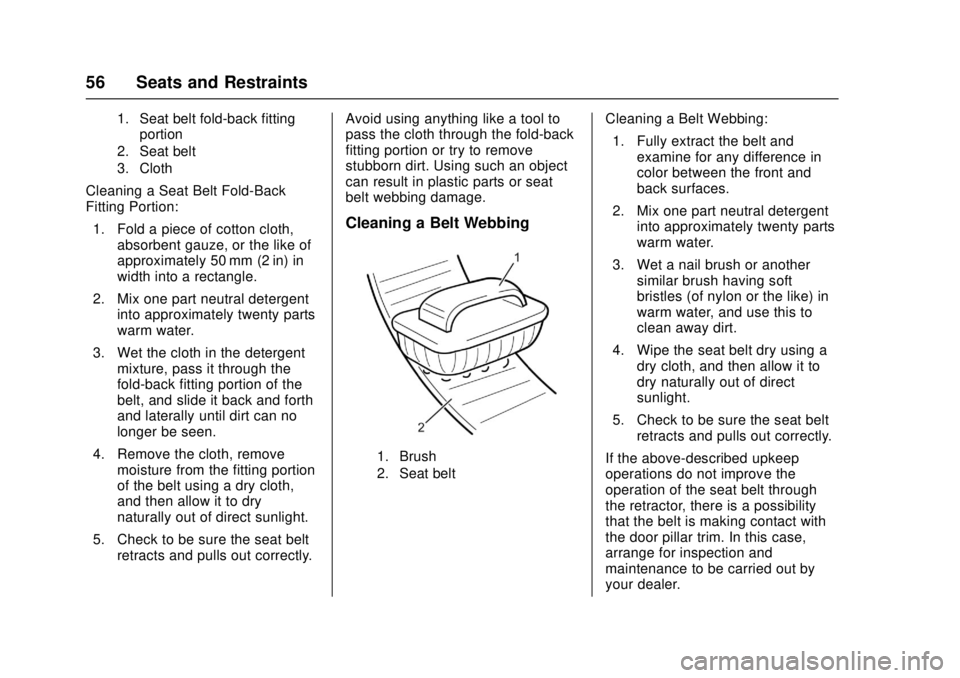
Cleaning a Belt Webbing
1. Brush
2. Seat belt
Cleaning a Belt Webbing:
1. Fully extract the belt and examine for any difference in
color between the front and
back surfaces.
2. Mix one part neutral detergent into approximately twenty parts
warm water.
3. Wet a nail brush or another similar brush having soft
bristles (of nylon or the like) in
warm water, and use this to
clean away dirt.
4. Wipe the seat belt dry using a dry cloth, and then allow it to
dry naturally out of direct
sunlight.
5. Check to be sure the seat belt retracts and pulls out correctly.
If the above-described upkeep
operations do not improve the
operation of the seat belt through
the retractor, there is a possibility
that the belt is making contact with
the door pillar trim. In this case,
arrange for inspection and
maintenance to be carried out by
your dealer.
Page 58 of 414
Chevrolet Low Cab Forward Owner Manual (GMNA-Localizing-U.S.-
10716700) - 2017 - crc - 12/6/16
Seats and Restraints 57
If the belt is not winding and
unwinding correctly, or if inspection
reveals problems such as loose
mountings, metal parts deformation,
webbing damage, fraying or
discoloration, arrange for
replacement to be carried out by
your dealer.Child Restraints
Infants and Young
Children
{Warning
The vehicle's seat belts are
designed for adults. If a seat belt
touches a child's neck or chin,
or does not rest across his/her
hips, use a baby seat, child seat
or junior seat. If the seat belt were
used as it is, it could apply
intense pressure to the child's
abdomen in the event of a
collision. A small child who is not
able to sit up by him/herself must
be placed in a child seat.
Do not fit a baby seat, child seat
or junior seat on the center seat.
It could hinder your driving.
The appropriate type of baby seat,
child seat or junior seat and the
proper installation for it depend
upon the weight and height of the
child. It may not be possible to correctly fit certain child seats
depending on their shapes. Be sure
to use a child seat that is suitable
for the vehicle.
For detailed instructions, see the
instruction manual supplied with the
baby seat, child seat or junior seat.Child Restraint Systems
{Warning
Children small enough for child
restraints (as indicated on the
label of such restraints), including
booster seats, should always be
transported in them. Children who
have outgrown child restraint
systems should wear seat belts.
The lap belt should be snug and
positioned low on the abdomen
so that it is below the top of the
hipbone. Otherwise, the belt could
intrude into the child's abdomen
during an accident and cause
personal injury. When a child has
grown enough so that the
(Continued)
Page 59 of 414
Chevrolet Low Cab Forward Owner Manual (GMNA-Localizing-U.S.-
10716700) - 2017 - crc - 12/6/16
58 Seats and Restraints
Warning (Continued)
shoulder belt can be worn, a
seating position with a shoulder
belt should be chosen whenever
possible.
Any unrestrained child could be
injured by striking the vehicle's
interior or by ejection from the
vehicle during an accident or
driving maneuver. Never allow a
child to be held by another
occupant instead of being
properly restrained. If not properly
restrained, the child could strike
the vehicle interior or be crushed
by the person holding the child,
or by other occupants.
Be sure to follow all installation and
use instructions that come with any
child restraint system.
Child restraint systems are designed
to be secured in vehicle seats either
by the lap belt, or the lap portion of
the lap-shoulder belt at that seating
position. The child must also be
secured within the restraint by the means provided by the child
restraint manufacturer. If the child or
the child restraint is not properly
secured, the child risks personal
injury in the event of a collision.
Using a Lap Belt That Has No
Retractor
When securing a child restraint with
the center seat lap belt, pull the
excess webbing through the belt's
adjustment feature, then take these
steps:
.
Once installed, push and pull the
child restraint in all directions to
be sure it is secure. If it comes
loose, flip the end of the belt
with the adjustment feature over
before rebuckling.
. If the child restraint is still not
secure, use the outboard seating
position in the vehicle and
contact your dealer and the child
restraint manufacturer for help.
. Secure the child in the restraint
in accordance with the child
restraint manufacturer's
instructions.
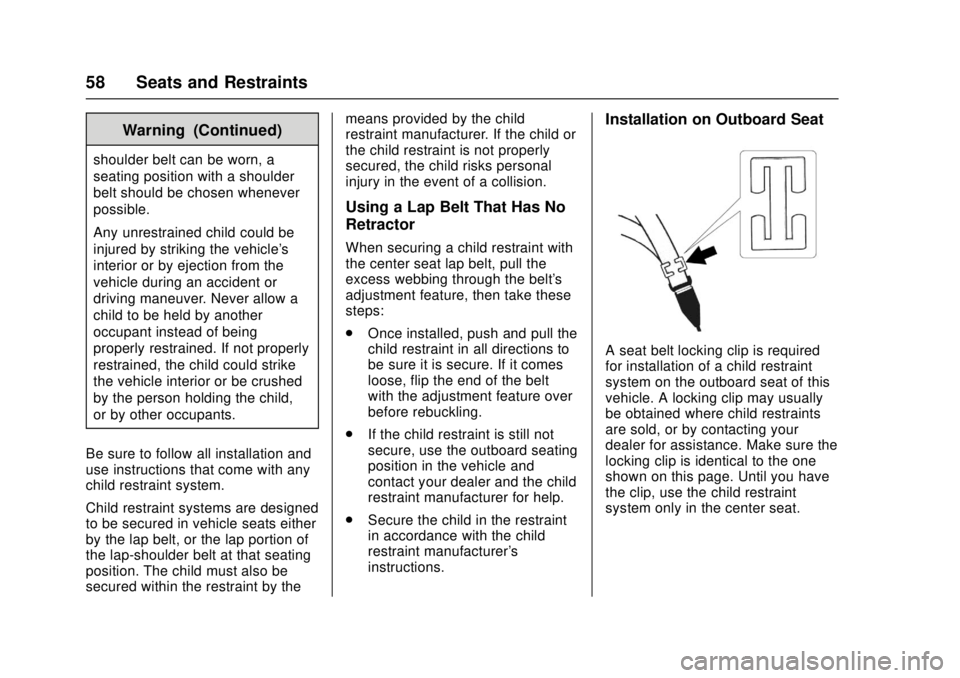
Installation on Outboard Seat
A seat belt locking clip is required
for installation of a child restraint
system on the outboard seat of this
vehicle. A locking clip may usually
be obtained where child restraints
are sold, or by contacting your
dealer for assistance. Make sure the
locking clip is identical to the one
shown on this page. Until you have
the clip, use the child restraint
system only in the center seat.
Page 60 of 414

Chevrolet Low Cab Forward Owner Manual (GMNA-Localizing-U.S.-
10716700) - 2017 - crc - 12/6/16
Seats and Restraints 59
{Warning
To help avoid personal injury or
death during a collision or sudden
maneuver, always thread both the
lap and shoulder belt through the
locking clip when securing a child
restraint on the outboard seat.
If the clip is not used or installed
properly, the child restraint may
move or tip over when your
vehicle turns or stops abruptly.
Secure the child restraint with the
lap belt portion (1) of the seat belt in
accordance with the restraintmanufacturer's instructions. Then
thread both the lap (1) and shoulder
belt (2) portions through the locking
clip. Push and pull the child restraint
in all directions to be sure it is
secure.
Locking Clip Attached to Seat Belt
–Side View
1. Lap Belt
2. Shoulder Belt
3. Locking Clip
When your child restraint is not
installed, remove the locking clip to
permit normal use of the lap-shoulder belt. Keep the locking
clip in the glove box to help prevent
its loss.
Child Restraint with Top Strap
{Warning
We do not recommend using a
child restraint that requires the
use of a top strap. There is no
appropriate place to attach a top
strap anchor behind the seat in
this vehicle.
Page 342 of 414
Chevrolet Low Cab Forward Owner Manual (GMNA-Localizing-U.S.-
10716700) - 2017 - crc - 12/6/16
Vehicle Care 341
Warning (Continued)
neutral detergent has been
dissolved to gently wipe the
safety belts.
Follow the manufacturer's advice
whenever cleaning agents or
other chemicals are used, inside
or outside the vehicle. Some
cleaners may be poisonous or
flammable, and improper use may
cause personal injury or damage.
When cleaning the inside or
outside of the vehicle, do not use
volatile cleaning solvents, such as
acetone, lacquer thinners, enamel
reducers, nail polish removers; or
such cleaning materials as
laundry soaps, bleaches or
reducing agents, except as noted
in the following fabric cleaning
advice on stain removal. Never
use carbon tetrachloride,
gasoline, benzene or naphtha for
any cleaning purpose.(Continued)
Warning (Continued)
Open all vehicle doors for
ventilation when ANY cleaning
agents or other chemicals are
used in the interior. Overexposure
to some vapors may result in a
health problem that is more likely
to occur in small, unventilated
spaces.
You and others could be seriously
injured.
The interior of the vehicle must
never be cleaned using acidic or
alkaline solvents, or petroleum
ether, gasoline, and other organic
solvents. Failure to observe this
precaution can result in
discoloration and staining. It should
be noted that certain types of
cleaning products contain these
compounds. Be sure to read
cleaning product labels carefully.
Air fresheners (liquid, solid, gel or
plate types) must not come into
direct contact with, or spill onto,
interior components such as the air conditioning or audio system.
Compounds contained in these
products can cause discoloration,
staining or peeling of paint.
Glass cleaners that contain these
compounds must not be used to
clean the inside of the windshield or
window glass. To clean the glass,
wipe it using a cloth wet with warm
or cold water.
To avoid possible permanent
discoloration of light colored seats,
Do not let materials with non-fast
colors come into contact with seat
trim materials until these materials
are totally dry. This includes certain
types of casual clothing, such as
colored denims, corduroys, leathers
and suedes; also decorative paper,
With the use of modern trim
materials, it is very important that
you use proper cleaning techniques
and cleaners. Failing to do this on
the first cleaning may result in water
spots, spot rings or setting of stains
or soilage - all of which are more
difficult to remove in a second
cleaning.
Page 354 of 414

Chevrolet Low Cab Forward Owner Manual (GMNA-Localizing-U.S.-
10716700) - 2017 - crc - 12/6/16
Service and Maintenance 353
If you have driven for a prolonged
period of time or in city traffic in hot
weather, wait until the fluid cools
down (Approx. 30 minutes) before
checking fluid level.
Single cab: Remove the dipstick
located at the rear right side of the
engine.
Crew cab: Remove the dipstick
located beneath the rear-of- engine
inspection panel. After unlatching
the A/T fluid inspection cover, the
dipstick will be visible.
Carefully touch the wet end of the
dipstick to find out if the fluid is cool,
warm or hot. Wipe it clean and push
it back in until the cap seats. Pull
out the dipstick and read the fluid
level.
If it felt cool, about room
temperature, the level should be in
the "C" range.
If it felt warm, about normal
operating temperature of 70 °C to
80 °C (158 °F to 176 °F), the level
should be in the "H" range.
16. ROTATE TIRES :To equalize
wear, rotate tires and adjust tire
pressures at every 12 000 km
(7,500 miles). See Tire Rotation
0 323.
17. BRAKE LINING AND PAD FOR
WEAR : Check drum brake linings
and disc brake pads for wear or
cracks at every 12 000 km
(7,500 miles). Check brakes
(including parking brake) more often
if conditions and habits result in
frequent braking.
Front disc brakes have built-in wear
indicators which are designed to
make a high pitched squeal or
cricket-like warning sound when the
brake pads are worn to the point
where new pads are needed. When the truck is in motion, the
sound may be constant or it may
come and go.
Pressing the brake pedal firmly may
cause the sound to stop.
Have the brake linings or the brake
pads replaced by your authorized
dealer as soon as possible after the
warning first becomes evident.
Failure to do so can result in
expensive damage to the brake
system or a serious accident.
18. BRAKE DRUM AND ROTOR
FOR WEAR AND DAMAGE :
Check brake drums (rear and
parking) and rotors for wear or
damage every 48 000 km
(30,000 miles) or 12 months
whichever occurs first.
19. BRAKE ELECTRIC VACUUM
PUMP (4500 Model) :
Inspect the
brake electric vacuum pump
operation every 12 000 km
(7,500 miles) or 12 months,
whichever occurs first.
Page 410 of 414

Chevrolet Low Cab Forward Owner Manual (GMNA-Localizing-U.S.-
10716700) - 2017 - crc - 12/6/16
Index 409
Diesel Engine (cont'd)High Idle System . . . . . . . . . . . . . 174
Diesel Exhaust Fluid . . . . . . . . 30, 189
Diesel Exhaust Fluid (DEF) Gauge . . . . . . . . . . . . . . . . . . . . . . . . . 83
Diesel Exhaust Fluid (DEF) Warning Light . . . . . . . . . . . . . . . . . . 90
Diesel Particulate Filter . . . . . . . . . 180
Distracted Driving . . . . . . . . . . . . . . . 133
Dome Lamps . . . . . . . . . . . . . . . . . . . 107
Door Locks . . . . . . . . . . . . . . . . . . . . . . . . . . . 36
Power Locks . . . . . . . . . . . . . . . . . . . . 39
Drive Belt Routing, Engine . . . . . . 396
Driver Behavior . . . . . . . . . . . . . . . . . 133
Driver Information
Center (DIC) . . . . . . . . . . . . . . . . . . . 93
Driving
Emergencies . . . . . . . . . . . . 148, 161
For Better Fuel Economy . . . . . . . 29
Hill and Mountain Roads . . . . . . 144
If the Vehicle is Stuck . . . . . . . . . 148
Wet Roads . . . . . . . . . . . . . . . . . . . 143
Winter . . . . . . . . . . . . . . . . . . . . . . . . 145
Driving the Vehicle . . . . . . . . . . . . . . . . 3
E
Electrical Equipment, Add-On . . . . . . . . . . . . . . . . . . . . . . . 241 Electrical System
Overload . . . . . . . . . . . . . . . . . . . . . 298
Emergencies . . . . . . . . . . . . . . 148, 161
Engine Air Cleaner/Filter . . . . . . . . . . . . . 263
Alarm and AutomaticShutdown . . . . . . . . . . . . . . . . . . . 174
Check Light (Malfunction Indicator) . . . . . . . . . . . . . . . . . . . . . . 84
Checks Before Operating . . . . . 175
Compartment Overview . . . . . . . 249
Coolant . . . . . . . . . . . . . . . . . . . . . . . 263
Coolant Temperature Gauge . . . . 82
Cover . . . . . . . . . . . . . . . . . . . . . . . . . 250
Drive Belt Routing . . . . . . . . . . . . 396
Exhaust . . . . . . . . . . . . . . . . . . . . . . 178
Heater . . . . . . . . . . . . . . . . . . . . . . . . 173
High Idle System . . . . . . . . . . . . . 174
Oil Pressure Light . . . . . . . . . . . . . . 89
Overheating . . . . . . . . . . . . . . . . . . 269
Reduced Power Light . . . . . . . . . . . 91
Running While Parked . . . . . . . . 179
Shutdown Warning Light . . . . . . . . 91
Engine Oil Level Indicator Light . . . . . . . . . . . . 90
Engines Diesel Fuel . . . . . . . . . . . . . . . . . . . 232
Exhaust Brake . . . . . . . . . . . . . . . . . . 222 Exhaust Brake Light . . . . . . . . . . . . . 88
Exhaust Fluid
Diesel . . . . . . . . . . . . . . . . . . . . . . . . 189
Extender, Seat Belt . . . . . . . . . . . . . . 55
Exterior Lamp Controls . . . . . . . . . 103
F
Filter . . . . . . . . . . . . . . . . . . . . . . . . . . . . 180 Fuel . . . . . . . . . . . . . . . . . . . . . . . . . . 282
Filter, Engine Air Cleaner . . . . . . . . . . . 263
Fixed Mast Antenna . . . . . . . . . . . . 113
Flash-to-Pass . . . . . . . . . . . . . . . . . . . 104
Flashers, Hazard Warning . . . . . . 105
Flat Tire . . . . . . . . . . . . . . . . . . . . . . . . 326
Fluid Automatic Transmission . . . . . . 260
Brakes . . . . . . . . . . . . . . . . . . . . . . . . 280
Diesel Exhaust . . . . . . . . . . . . . . . . . 30
Power Steering . . . . . . . . . . . . . . . 273
Washer . . . . . . . . . . . . . . . . . . . . . . . 274
Frequency Statement Radio . . . . . . . . . . . . . . . . . . . . . . . . . 404
Front Seat Position Seats Adjustment . . . . . . . . . . . . . . . . . . . . . 44
Fuel . . . . . . . . . . . . . . . . . . . . . . . . . . . . 231
Biodiesel . . . . . . . . . . . . . . . . . . . . . 233
Cold Weather Operation . . . . . . 235
Diesel Engines . . . . . . . . . . . . . . . 232