tire pressure CHEVROLET LOW CAB FORWARD 2017 User Guide
[x] Cancel search | Manufacturer: CHEVROLET, Model Year: 2017, Model line: LOW CAB FORWARD, Model: CHEVROLET LOW CAB FORWARD 2017Pages: 414, PDF Size: 7.97 MB
Page 310 of 414

Chevrolet Low Cab Forward Owner Manual (GMNA-Localizing-U.S.-
10716700) - 2017 - crc - 12/6/16
Vehicle Care 309
Tire Inflation
{Warning
To reduce the risk of loss of
vehicle control and personal
injury:
Tires must be properly inflated,
and your vehicle must not be
overloaded (see the information
onInformation on Loading the
Vehicle 064 and "Tire Load and
Inflation Table" under Tire
Pressure 0322).
Be sure to keep tires properly
inflated. A tire that is run while
seriously underinflated may
overheat to the point where the
tire may lose air suddenly and/or
catch fire, possibly resulting in
personal injury and/or property
damage.
See “Tire Load and Inflation Table”
under Tire Pressure 0322. In no case should the front or rear
tire load exceed the maximum
recommended gross axle weight
rating (front GAWR or rear GAWR).
The efficiency of the vehicle will be
upset if air pressure in the tires are
not equal. Balanced inflation results
when the tires on the same axle
carry the same air pressure.
A difference in pressure between
the front and rear tires may be
permissible within certain limitations,
however, there should not be a
difference in pressures between the
right and left tires on the same axle.
Always use a truck tire pressure
gauge (a pocket-type gauge is not
advised) when checking inflation
pressures. Visual inspection of tires
for inflation pressures is not enough,
especially in the case of radial tires.
Underinflated radial tires may look
similar to correctly inflated radial
tires. If the inflation pressure on a
tire is found to be low frequently,
have your dealer correct the cause.
Be sure to install the tire inflation
valve caps to prevent dirt and
moisture from getting into the valve core, which could cause air leakage.
An underinflated tire in a dual wheel
assembly is harder to notice than
one in a single wheel assembly. The
properly inflated dual tire carries its
own load plus that of the
underinflated tire. Both tires can
overheat, which may result in
property damage and/or personal
injury (see previous WARNING).
Tires Used or Stored for a Long
Period of Time
Tires are a rubber product and
degrade over time, even if they are
not being used. If any of your tires is
5 to 7 years old or more, please
have them inspected for safe
driving. For further information,
please check with the tire
manufacturer.
Dual Tire Operation
The outer tire of a pair on dual
wheel installations generally wears
faster than the inner tire. If this
occurs, reverse the position of the
tires to equalize wear and get better
tire life.
Page 311 of 414
Chevrolet Low Cab Forward Owner Manual (GMNA-Localizing-U.S.-
10716700) - 2017 - crc - 12/6/16
310 Vehicle Care
In addition, when trucks are driven
continuously on high-crown roads,
an increase in air pressure of
35 kPa (5 psi) in the outer tire of a
dual tire operation will prolong outer
tire life. Be sure not to exceed the
inflation pressure limits shown on
the“VIN and Weight Rating Plate”
for the 3.0L diesel engine, on the
“VIN, Weight Rating, and
Greenhouse Gas (GHG) Emissions
Plate” for the 5.2L diesel engine,
or the “Vehicle Certification and
Greenhouse Gas (GHG) Emissions
Plate” for gas engines. See Vehicle
Identification Number (VIN) 0383.
Wheel and Tire Balancing
Proper tire balancing provides the
best riding comfort and helps to
reduce tire tread wear.
Out-of-balance tires can cause
annoying vehicle vibration and
uneven tire wear, such as cupping
and flat spots. See your authorized
dealer for wheel balancing.
Front End Alignment
Proper front end alignment improves
tire tread mileage. Your vehicle's
front end suspension parts should be inspected often and aligned
when needed. (See the
Maintenance Schedule for more
information.) Improper alignment will
not cause the vehicle to vibrate;
however, improper toe-in alignment
will cause front tires to roll at an
angle that will result in faster tire
wear. Incorrect caster or camber
alignment will cause your front tires
to wear unevenly, and may cause
the vehicle to "pull" to the left or
right.
Tire Traction
A decrease in driving, cornering and
braking traction occurs when water,
snow, ice, gravel or other material is
on the road surface. Driving
practices and vehicle speed should
be adjusted to the road conditions.
When driving on wet or slushy
roads, it is possible for a wedge of
water to build up between the tire
and road surface. This is known as
hydroplaning, and may cause partial
or complete loss of traction, vehicle
control and stopping ability; this
condition is also more likely with
worn tires.
To reduce the chance of traction
loss, follow these tips:
.
Slow down during rainstorms or
when roads are slushy.
. Slow down if the road has
standing water or puddles.
. Replace tires when front tread
depth is 3.2 mm (4/32 in.) and
rear tread depth is 1.6 mm
(2/32 in.).
. Keep tires properly inflated.
Tire Replacement
Recommendations
{Warning
Do not mix different construction
types of tires on your vehicle such
as radial, bias and bias-belted
tires except in emergencies,
because vehicle handling could
be affected and may result in loss
of vehicle control, or personal
injury or death. (Continued)
Page 315 of 414

Chevrolet Low Cab Forward Owner Manual (GMNA-Localizing-U.S.-
10716700) - 2017 - crc - 12/6/16
314 Vehicle Care
Checking Tires
Air Pressure
Too low or too high a tire air
pressure not only affects the ride or
causes damage to the cargo but
also causes abnormal heat buildup,
premature wear, a tire puncture,
or may even cause the tire to burst.
Use an appropriate tire air pressure
gauge when measuring the air
pressure of a tire. Tire air pressure
should be measured when the tire is
cold, or before the vehicle is driven.
(After driving, tire air pressure
increases by about 10%.)As the tire air pressure varies
depending on the vehicle model and
tire size, refer to the VIN and weight
rating plate for the 3.0L diesel
engine, the
“VIN, Weight Rating,
and Greenhouse Gas (GHG)
Emissions Plate,” for the 5.2L diesel
engine, or the “Vehicle Certification
and Greenhouse Gas (GHG)
Emissions Plate” for gas engines on
the driver's door opening frame or
the tire air pressure information on
the following table.
Page 316 of 414

Chevrolet Low Cab Forward Owner Manual (GMNA-Localizing-U.S.-
10716700) - 2017 - crc - 12/6/16
Vehicle Care 315
3.0L Diesel Engine
Tire sizeTire air pressure
kPa (psi) GVW
kg (lb.)
Front RearFront Rear
LT215/85R16E LT215/85R16E 550 (80)550 (80) 5 897
(13,000)
5.2L Diesel Engine
Tire size Tire air pressure
kPa (psi) GVW
kg (lb.)
Front RearFront Rear
LT215/85R16E LT215/85R16E 550 (80)550 (80) 6 577
(14,500)
225/70R19.5F 225/70R19.5F 590 (85)590 (85) 7 258
(16,000)
225/70R19.5F 225/70R19.5F 620 (90)620 (90) 8 142
(17,950)
225/70R19.5F 225/70R19.5F 660 (95)660 (95) 8 845
(19,500)
Page 317 of 414

Chevrolet Low Cab Forward Owner Manual (GMNA-Localizing-U.S.-
10716700) - 2017 - crc - 12/6/16
316 Vehicle Care
Gas Engines
Tire sizeTire air pressure kPa (psi)
LT215/85R16E 480 (70)
225/70R19.5F 590 (85)
225/70R19.5G 590 (85)
For the 3.0L diesel engine, see “VIN
and Weight Rating Plate” under
Vehicle Identification Number (VIN)
0 383.
For the 5.2L diesel engine, see
“VIN, Weight Rating, and
Greenhouse Gas (GHG) Emissions
Plate” underVehicle Identification
Number (VIN) 0383.
For gas engines, see “Vehicle
Certification and Greenhouse Gas
(GHG) Emissions Plate” under
Vehicle Identification Number (VIN)
0 383.
See “Tire Load and Inflation Table”
under Tire Pressure 0322.
{Warning
Insufficiently inflated or worn-out
tires are highly dangerous as they
easily skid and can even burst.
Should they burst, the tires may
burn and this could cause a fire in
the vehicle.
If you drive on under-inflated or
flat tires, the wheel studs will be
placed under excessive stress.
Under such conditions, the bolts
may break and the wheel may
detach from the vehicle, possibly
causing an accident.
(Continued)
Warning (Continued)
Over-inflated tires result in a
harsh ride and are likely to cause
damage to the cargo.
Under-inflated tires build up heat
and could burst. Always keep the
tires of your vehicle adjusted at
the standard air pressures.
You and others could be seriously
injured.
There should not be a difference
tires on a dual-tire wheel.
It is not easy to visually identify an
under-inflated dual-wheel tire or low
aspect ratio tire (aspect ratio at
Page 318 of 414

Chevrolet Low Cab Forward Owner Manual (GMNA-Localizing-U.S.-
10716700) - 2017 - crc - 12/6/16
Vehicle Care 317
70%). Always use an appropriate
tire air pressure gauge to check the
air pressure of any tire.
If your vehicle is equipped with
aluminum wheels, use an extension
attached to the inner tire valve
together with a standard tire air
pressure gauge or use a special air
pressure gauge when checking the
air pressure of a dual-wheel's
inner tire.
Cracks and Other Damage
1. Sidewall surface
2. Gap between inner andouter tires
3. Tread
Check the tread and sidewall
surfaces of each tire for cracks or
other damage. Especially check the
tread for nails or other metal pieces
embedded in grooves and also the
gap between the inner and outer
tires of a dual-tire wheel for pebbles
lodged in it.
When checking tires, pay special
attention to: low air pressure;
pebbles or nails in tread grooves;
cracks or other damage on tire
surfaces; uneven wear; and pebbles
lodged in the gap between tires of
dual-wheel tires. Tread Depth and Abnormal Wear
Tread wear indicator position
mark (Example)
Tread wear indicator (Example)
1. Lug pattern
2. Rib pattern
Page 319 of 414

Chevrolet Low Cab Forward Owner Manual (GMNA-Localizing-U.S.-
10716700) - 2017 - crc - 12/6/16
318 Vehicle Care
Using worn-out tires is dangerous
because they might have an
increased chance of getting
punctured or bursting while driving.
Check all tires to see if tread wear
indicators appear on their treads
and also check their entire tread for
its depth with a depth gauge to
make sure that the grooves are
deeper than the specified depth.
A tire with tread wear indicators
appearing must be changed. Also,
check the tires for uneven or
otherwise abnormal wear.
{Warning
Tires with excessively shallow
tread grooves will increase the
chance of skidding and, when
driving at high speeds,
hydroplaning. You and others
could be seriously injured.
Hydroplaning occurs when a vehicle
is running at high speeds on a wet
road and a layer of water forms
between the road surface and tires
causing the tires to float on it.
Hydroplaning prevents the driver from steering correctly and from
slowing down the vehicle with the
brake pedal.
Use of Low Aspect Ratio Tires
1. Standard tire
2. Low aspect ratio tire
Low aspect ratio tires for truck
applications (aspect ratio at 70%)
have an air volume 20% to 30%
smaller than that of standard tires.
When air begins to leak, therefore,
low aspect ratio tires adversely
affect vehicle operation much faster
than standard tires. Check air
pressure of low aspect ratio tires
more often than standard tires using
a tire air pressure gauge.
Damaged Tires
{Warning
It is dangerous to mount the
wrong size tire on a wheel. If you
do so, the tire/wheel can explode
as air is being added. This
explosion may result in severe
personal injury or death. For the
3.0L diesel engine, to learn which
wheels and tires are correct, look
at the "VIN and Weight Rating
Plate" on the left side rear pillar
panel below the striker. For the
5.2L diesel engine, to learn which
wheels and tires are correct, look
at the "VIN, Weight Rating, and
Greenhouse Gas (GHG)
Emissions Plate" on the left side
rear pillar panel below the striker
(single cab) or on the left center
pillar panel beside the shoulder
seat belt anchor (crew cab).For
(Continued)
Page 321 of 414
Chevrolet Low Cab Forward Owner Manual (GMNA-Localizing-U.S.-
10716700) - 2017 - crc - 12/6/16
320 Vehicle Care
Warning (Continued)
wheels should be serviced
only by trained people using
the proper equipment.
. Never add air to your tires
unless an accurate pressure
gauge is also used. When
putting air in a tire on the
vehicle, stand to the side
and use a clip-on chuck and
hose extension. In choosing
the right tire pressure, be
careful not to exceed the
maximum pressure
capability shown on the tire;
see the tire pressure charts
at the end of this manual.
. Tire mounting or repair can
result in serious personal
injury or death, if not
performed correctly. This
section has detailed
instructions for proper wheel
and tire replacement, so be
sure to read and follow
them. Truck fleet owners
(Continued)
Warning (Continued)
and operators: You can get
written instructions on truck
tire demounting, repair and
mounting from Rubber
Manufacturers Association
(RMA), 1400 K Street N.W.,
Washington, D.C. 20005,
and also from many tire
stores.
Wheel Nut Torque
{Warning
Never use oil or grease on studs
or nuts. Use the torque specified
for the type of wheels on the
vehicle. Snug all wheel nuts and
then tighten to the specified
torque in the numerical sequence
shown. Improperly tightened
wheel nuts could eventually allow
the wheel to come off while the
vehicle is moving, possibly (Continued)
Warning (Continued)
causing loss of control and
personal injury and property
damage.
When the vehicle, wheel or
fasteners are new, have a
technician tighten wheel stud nuts
and rim clamp nuts with a torque
wrench at 1 040 km (650 mi). This is
necessary because the clamping
system used on the wheels must
seat before the fastener will hold a
uniform clamp load and remain fully
tightened. Also have a technician
tighten wheel stud nuts and rim
clamp nuts with a torque wrench
after installing any wheel.
For diesel engines, in addition, nut
tightness on all wheels should be
set with a torque wrench every
10 400 km (6,500 mi).
For gas engines, in addition, nut
tightness on all wheels should be
set with a torque wrench every
12 000 km (7,500 mi).
Page 323 of 414

Chevrolet Low Cab Forward Owner Manual (GMNA-Localizing-U.S.-
10716700) - 2017 - crc - 12/6/16
322 Vehicle Care
Tire Pressure
Tire Load and Inflation Table
Tire Load and Inflation Table—3.0L Diesel Engine
TIRES FOR VEHICLES IN HIGHWAY SERVICE
TIRE LOAD LIMITS AT VARIOUS COLD INFLATION PRESSURES
Tire Size Designation Cold Inflation Pressure (psi) 50 55 60 65 70 75 80 85 90 95
LT215/85R16E Dual 2470 Single (lbs) 2680
Tire Load and Inflation Table —5.2L Diesel Engine
TIRES FOR VEHICLES IN HIGHWAY SERVICE
TIRE LOAD LIMITS AT VARIOUS COLD INFLATION PRESSURES
Tire Size Designation Cold Inflation Pressure (psi) 50 55 60 65 70 75 80 85 90 95
LT215/85R16E Dual Single(lbs) 2470
2680
225/70R19.5F Dual Single(lbs) 3115
33153245
34503415
3640
Page 324 of 414
Chevrolet Low Cab Forward Owner Manual (GMNA-Localizing-U.S.-
10716700) - 2017 - crc - 12/6/16
Vehicle Care 323
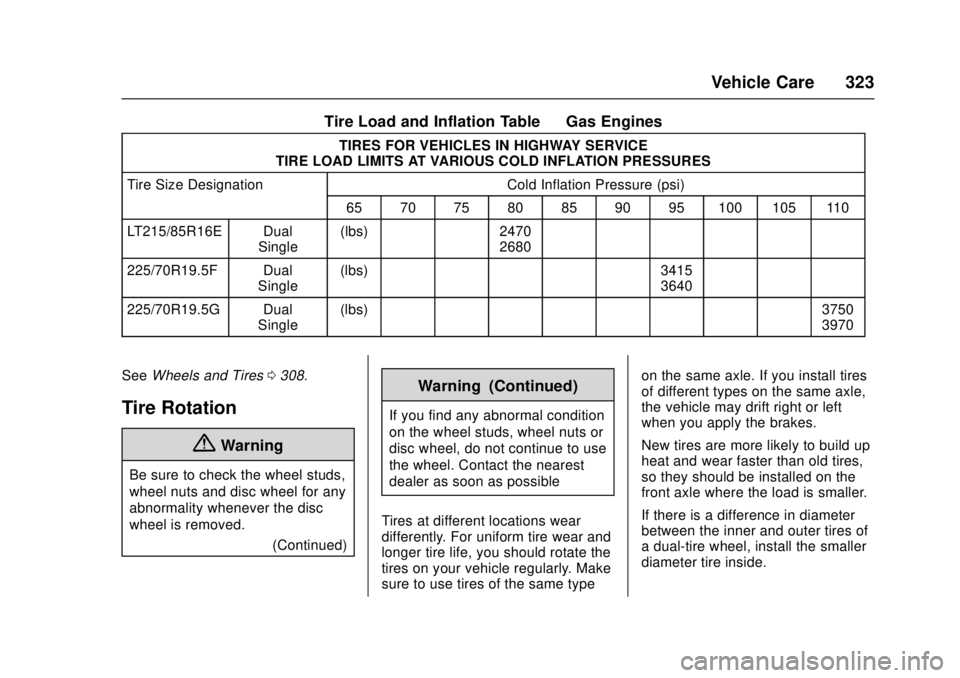
Tire Load and Inflation Table—Gas Engines
TIRES FOR VEHICLES IN HIGHWAY SERVICE
TIRE LOAD LIMITS AT VARIOUS COLD INFLATION PRESSURES
Tire Size Designation Cold Inflation Pressure (psi) 65 70 75 80 85 90 95 100 105 110
LT215/85R16E Dual Single(lbs) 2470
2680
225/70R19.5F Dual Single(lbs) 3415
3640
225/70R19.5G Dual Single(lbs)
3750
3970
See Wheels and Tires 0308.
Tire Rotation
{Warning
Be sure to check the wheel studs,
wheel nuts and disc wheel for any
abnormality whenever the disc
wheel is removed.
(Continued)
Warning (Continued)
If you find any abnormal condition
on the wheel studs, wheel nuts or
disc wheel, do not continue to use
the wheel. Contact the nearest
dealer as soon as possible
Tires at different locations wear
differently. For uniform tire wear and
longer tire life, you should rotate the
tires on your vehicle regularly. Make
sure to use tires of the same type on the same axle. If you install tires
of different types on the same axle,
the vehicle may drift right or left
when you apply the brakes.
New tires are more likely to build up
heat and wear faster than old tires,
so they should be installed on the
front axle where the load is smaller.
If there is a difference in diameter
between the inner and outer tires of
a dual-tire wheel, install the smaller
diameter tire inside.