cooling CHEVROLET LOW CAB FORWARD 2017 Owner's Guide
[x] Cancel search | Manufacturer: CHEVROLET, Model Year: 2017, Model line: LOW CAB FORWARD, Model: CHEVROLET LOW CAB FORWARD 2017Pages: 414, PDF Size: 7.97 MB
Page 270 of 414
Chevrolet Low Cab Forward Owner Manual (GMNA-Localizing-U.S.-
10716700) - 2017 - crc - 12/6/16
Vehicle Care 269
2. Fill the radiator to the base ofthe filler neck (2).
.Add enough engine coolant
to provide the required
cooling, freezing and
corrosion protection.
. Install the radiator cap.
3. Run the engine until the engine coolant temperature rises to
normal level, and idle the
engine for 10 minutes.
4. Turn off the engine. Make sure that the engine is cool.
Remove the radiator cap and
add engine coolant to the
radiator until it reaches the
base of the filler neck.
5. Install the radiator cap.
Check, replenish or change the
engine coolant only after the engine
has sufficiently cooled down.
When the engine is still hot, take
care to prevent engine coolant from
contact with the exhaust manifold.
Any such contact could result in
exhaust manifold damage. If you use the proper quality engine
coolant, there is no need to add
extra inhibitors or additives which
claim to improve the system. They
may be harmful to the proper
operation of the system.
Do not overfill the engine coolant
reserve tank.
If the level of engine coolant
changes rapidly, have your vehicle
inspected at your dealer.
Thermostat
The engine coolant temperature is
controlled by thermostat(s). The
thermostats stop engine coolant
flow through the radiator until a
preset temperature is reached. The
thermostats are installed in the
engine coolant outlet on the engine
block. The same thermostats are
used in both winter and summer.
When a replacement is needed,
genuine GM parts are
recommended.
Radiator Pressure Cap
The radiator cap, a 103 kPa (15 psi)
pressure type for gasoline vehicles
and a 108 kPa (16 psi) for dieselvehicles, must be installed tightly,
otherwise engine coolant may be
lost and damage to the engine may
result from overheating. The radiator
pressure cap should be checked
periodically for proper operation. If a
replacement is required, a genuine
GM part is recommended.
Engine Overheating
When the Engine Overheats
The engine cooling system may
overheat if the engine coolant level
is too low, if there is a sudden loss
of engine coolant (such as radiator
hose failure), or if other problems
occur. It may also temporarily
overheat during severe operating
conditions such as:
.
Climbing a long hill on a hot day.
. Stopping after high-speed
driving.
. Idling for long periods in traffic.
If engine power drops and the
needle on the engine coolant
temperature gauge goes up above
the upper limit of the safety zone
and enters the "H" zone, the engine
Page 272 of 414

Chevrolet Low Cab Forward Owner Manual (GMNA-Localizing-U.S.-
10716700) - 2017 - crc - 12/6/16
Vehicle Care 271
For Diesel Vehicle
If the engine coolant temperature
gauge shows an overheat condition,
or you have reason to suspect the
engine may be overheating, take
the following steps: 1. Operate the hazard warning flasher and pull the vehicle
immediately over to a safe
place that does not impede
traffic and park it.
2. For the gasoline engine, if there's no sign of steam,
push the accelerator pedal until
the engine speed is about
twice as fast as normal idle
speed. Bring the engine speed back to normal idle after 2 or
3 minutes. Idle the engine and
wait until the engine coolant
temperature drops to safety
zone. If your air conditioner is
on, turn it off. And turn on the
heater to help the engine
expel heat.
For the diesel engine, idle the
engine and wait until the
engine coolant temperature
drops to safety zone. If your air
conditioner (if equipped) is on,
turn it off. And turn on the
heater to help the engine
expel heat.
3. When the needle of the engine coolant temperature gauge
returns to the middle of the
safety zone, stop the engine.
If the needle of engine coolant
temperature gauge does not
drop inside into the safety
zone, turn the engine off and
have your vehicle serviced at
the nearest dealer.
When the cooling fan for the
radiator is not turning, turn off
the engine immediately.
{Warning
Even when the engine has been
stopped, the engine coolant in the
radiator remains under pressure.
Immediately removing the radiator
cap could cause steam or hot
water to blow out, and you could
be scalded as a result. The
engine coolant in the reserve tank
may also be hot. Immediately
removing the cap could cause hot
water to blow out, and possibly
scald you. Perform inspection,
refilling, and replacement of
coolant only when its temperature
has cooled.
When removing the radiator cap
and reserve tank cap, use a thick
cloth to cover the cap and turn it
little by little.
You and others could be seriously
injured.
Page 314 of 414
Chevrolet Low Cab Forward Owner Manual (GMNA-Localizing-U.S.-
10716700) - 2017 - crc - 12/6/16
Vehicle Care 313
If the original equipment tires are
low rolling tires, it is recommended
to use the LRRA tires shown in the
above table.
For gas engines, please refer to the
emission control identifiers on
Greenhouse Gas (GHG) emission
plate for your original equipment
tires. Also, please refer to“Vehicle
Certification and Greenhouse Gas
(GHG) Emissions Plate” for the
location of the Greenhouse Gas
(GHG) emission plate. See Vehicle
Identification Number (VIN) 0383.
For the 5.2L diesel engine, please
refer to the emission control
identifiers on Greenhouse Gas
(GHG) emission plate for your
original equipment tires. Also,
please refer to “VIN, Weight Rating,
and Greenhouse Gas (GHG)
Emissions Plate” for the location of
the Greenhouse Gas (GHG)
emission plate. See Vehicle
Identification Number (VIN) 0383. Wheel Replacement
Recommendations
Wheels must be replaced if they
become damaged (for example:
bent, heavily rusted, leak air) or if
wheel nuts often become loose. Do
not use bent wheels that have been
straightened and do not use inner
tubes in leaking wheels which are
designed for tubeless tires. Such
wheels may have structural damage
and could fail without warning.
When replacing wheels for any
reason, the new wheels should be
equal in load capacity, diameter,
width, offset and mounting types to
those originally installed in your
vehicle.
A wheel of the wrong size or type
may adversely affect wheel and
bearing life, brake cooling,
speedometer/odometer calibration,
stopping ability, headlight aim,
bumper height, vehicle ground
clearance and tire or tire chain
clearance on the body and chassis. Replacement with "used" wheels is
not advised. They may have been
subjected to harsh treatment or very
high mileage and could fail without
warning.
{Warning
Consult your dealer before
replacing wheels. Never use
wheels that are not designed for
the vehicle. Doing so would
impede safe vehicle operation.
The use of wheels and/or tires with
higher load carrying limits than
originally equipped on your vehicle
does not in itself increase the
GAWR or the GVWR of the vehicle.
Replacement wheels can be
obtained from the authorized dealer
or tire dealer.
Page 340 of 414

Chevrolet Low Cab Forward Owner Manual (GMNA-Localizing-U.S.-
10716700) - 2017 - crc - 12/6/16
Vehicle Care 339
Cooling efficiency is compromised
when there is dirt or dust plugging
air passages in the radiator core
and charge air cooler core (diesel).
This can also cause corrosion of
these cores. Wash the radiator core
with tap water every 24 months.
Make sure to turn the engine off and
remove the key from the engine
control switch before cleaning
cores.
The engine, exhaust pipe, and
radiator will be hot immediately after
the vehicle is driven. Be careful
around these parts to prevent burns.
Clean the engine when it is cold.
Do not clean the radiator, charge air
cooler (diesel) and their surrounding
areas using water that is supplied
under high pressure. Doing so may
cause damage.
When cleaning the radiator core (1)
and charge air cooler core (2) , do
not crush or damage the fins (3).
The fins are very fragile so be
careful not to bend them out of
shape. If they become deformed,
their cooling efficiency will be
impaired. Before cleaning, take
steps to ensure that no water will
splash onto the surrounding
electrical components and wires.
If stubborn dirt still remains even
after the radiator core and charge
air cooler core (diesel) have been
cleaned, have the vehicle inspected
and serviced.
Corrosion Protection
Your vehicle has been designed and
built to resist corrosion. Special
materials and protective finishes
were used on most parts of your
vehicle when it was built to help
maintain good appearance,
strength, and reliable operation.
However, some parts which
normally are not visible (such as
those under the vehicle and under
the hood) are such that surface rust
will not affect their reliability. So
corrosion protection is not needed
or used on these parts.
Sheet Metal Damage
If your vehicle is damaged and
requires sheet metal repair or
replacement, make sure the body
repair shop applies anti-corrosion
material to the parts repaired or
replaced so that corrosion protection
is restored. (Also see "Finish
Damage" which follows.)
Foreign Material Deposits
Calcium chloride and other salts,
ice-melting agents, road oil and tar,
tree sap, bird droppings, chemicals
Page 349 of 414
Chevrolet Low Cab Forward Owner Manual (GMNA-Localizing-U.S.-
10716700) - 2017 - crc - 12/6/16
348 Service and Maintenance
Maintenance Schedule Table (Gasoline Vehicles)
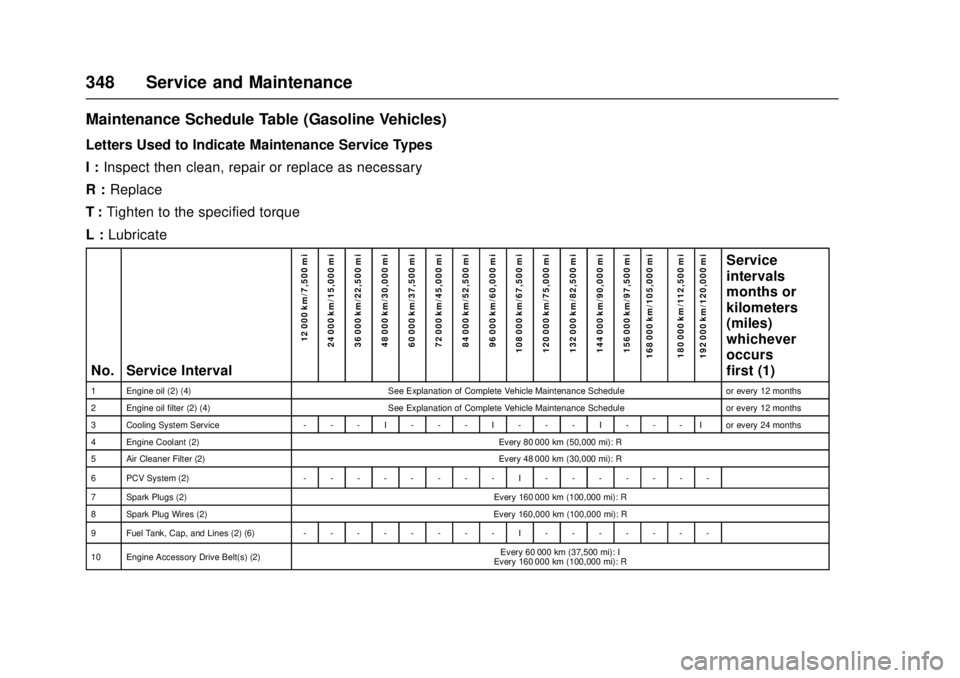
Letters Used to Indicate Maintenance Service Types
I :Inspect then clean, repair or replace as necessary
R : Replace
T : Tighten to the specified torque
L : Lubricate
No. Service Interval
12 000 km/7,500 mi
24 000 km/15,000 mi
36 000 km/22,500 mi
48 000 km/30,000 mi
60 000 km/37,500 mi
72 000 km/45,000 mi
84 000 km/52,500 mi
96 000 km/60,000 mi
108 000 km/67,500 mi
120 000 km/75,000 mi
132 000 km/82,500 mi
144 000 km/90,000 mi
156 000 km/97,500 mi
168 000 km/105,000 mi
180 000 km/112,500 mi
192 000 km/120,000 mi
Service
intervals
months or
kilometers
(miles)
whichever
occurs
first (1)
1 Engine oil (2) (4) See Explanation of Complete Vehicle Maintenance Schedule or every 12 months
2 Engine oil filter (2) (4) See Explanation of Complete Vehicle Maintenance Schedule or every 12 months
3 Cooling System Service - - - I - - - I - - - I - - - I or every 24 months
4 Engine Coolant (2) Every 80 000 km (50,000 mi): R
5 Air Cleaner Filter (2) Every 48 000 km (30,000 mi): R
6 PCV System (2) - - - - - - - - I - - - - - - -
7 Spark Plugs (2) Every 160 000 km (100,000 mi): R
8 Spark Plug Wires (2) Every 160,000 km (100,000 mi): R
9 Fuel Tank, Cap, and Lines (2) (6) - - - - - - - - I - - - - - - -
10 Engine Accessory Drive Belt(s) (2) Every 60 000 km (37,500 mi): I
Every 160 000 km (100,000 mi): R
Page 350 of 414

Chevrolet Low Cab Forward Owner Manual (GMNA-Localizing-U.S.-
10716700) - 2017 - crc - 12/6/16
Service and Maintenance 349
No. Service Interval
12 000 km/7,500 mi
24 000 km/15,000 mi
36 000 km/22,500 mi
48 000 km/30,000 mi
60 000 km/37,500 mi
72 000 km/45,000 mi
84 000 km/52,500 mi
96 000 km/60,000 mi
108 000 km/67,500 mi
120 000 km/75,000 mi
132 000 km/82,500 mi
144 000 km/90,000 mi
156 000 km/97,500 mi
168 000 km/105,000 mi
180 000 km/112,500 mi
192 000 km/120,000 mi
Service
intervals
months or
kilometers
(miles)
whichever
occurs
first (1)
11 Evaporative Control System (2) (6) - - - - - - - - I - - - - - - -
12 Shields and Underhood Insulation (5) - I - I - I - I - I - I - I - I
13 Air Intake System (5) - - - I - - - I - - - I - - - I
14 Thermostatically Controlled Engine
Cooling Fan (5) - I - I - I - I - I - I - I - I or every 12 months
15 Automatic Transmission Fluid I I I I I I R I I I I I I R I I
16 Rotate Tires Every 12 000 km (7,500 mi)
17 Brake Lining and Pad for Wear I I I I I I I I I I I I I I I I
18 Brake drum and rotor for wear and
damage
- - - I - - - I - - - I - - - I or every 12 months
19 Brake Electric Vacuum Pump (4500
Series)
I I I I I I I I I I I I I I I I or every 12 months
20 Brake Fluid I I I R I I I R I I I R I I I R or every 24 months
21 Brake Line and Hoses - - - I - - - I - - - I - - - I or every 12 months
22 Hydraulic Unit Every 10 Years: R
23 Differential Gear Oil I I I R I I I R I I I R I I I R or every 24 months
24 Power Steering Fluid - - - - R - - - - R - - - - R - or every 24 months
25 Steering Wheel Free Play (3) Every 10 400 km (6,500 mi): I
26 Steering Gear Box Torque - - - T - - - T - - - T - - - T or every 12 months
Page 352 of 414

Chevrolet Low Cab Forward Owner Manual (GMNA-Localizing-U.S.-
10716700) - 2017 - crc - 12/6/16
Service and Maintenance 351
Remarks
(1)In case this column is blank,
follow kilometers (miles).
(2) An Emission Control Service.
(3) Initial check at 1 040 km
(650 miles) is required.
(4) See Severe Driving Condition.
(5) A Noise Emission Control
Service.
(6) The California Air Resources
Board has determined that the
failure to perform this maintenance
item will not nullify the emission
warranty or limit recall liability prior
to the completion of vehicle useful
life. GM, however, urges that all
recommended maintenance
services be performed at the
indicated intervals.
Explanation of Complete
Vehicle Maintenance Schedule
(Gasoline Vehicles)
The following is a brief explanation
of each of the services listed in the
preceding Complete Vehicle
Maintenance Schedule for gasoline
vehicles. 1. ENGINE OIL :
Change at
intervals noted below depending
upon driving conditions.
• NORMAL SERVICE - Change
every 12 000 km (7,500 miles) or
12 months whichever occurs first.
• SEVERE SERVICE- Change every
4 800 km (3,000 miles) or 3 months
if you often drive under one or more
of these conditions (a) driving in
dusty areas, (b) frequent idling or
idling for long periods, (c) driving
6 km (4 miles) or less in freezing
weather, or other short trips in cold
weather, where the engine does not
thoroughly warm up. Change oil and
filter as soon as you can after
driving in a dust storm.
2. OIL FILTER : Change at intervals
noted below depending upon driving
conditions.
• NORMAL SERVICE - Change
every 12 000 km (7,500 miles) or
12 months whichever occurs first.
• SEVERE SERVICE- Change every
4 800 km (3,000 miles) or 3 months
whichever occurs first. 3. COOLING SYSTEM SERVICE :
At 24 months or 48 000 km
(30,000 miles) intervals, wash
radiator cap and filler neck with
clean water, pressure test system
and radiator cap for proper pressure
holding capacity, tighten hose
clamps and inspect condition of all
cooling and heater hoses. Replace
hoses if cracked, swollen or
otherwise deteriorated.
Also each 24 months or 48 000 km
(30,000 miles), clean exterior of
radiator core.
4. ENGINE COOLANT :
Every
80 000 km (50,000 miles), drain the
engine coolant by opening the drain
plug at the bottom of the radiator
core, flush and refill the engine
cooling system with a new 50/50
engine coolant solution.
5. AIR CLEANER FILTER : Change
every 48 000 km (30,000 miles).
6. POSITIVE CRANKCASE
VENTILATION (PCV) SYSTEM :
Check that PCV system works
properly. Replace the valve and any
worn, plugged or collapsed hoses
as necessary.
Page 353 of 414

Chevrolet Low Cab Forward Owner Manual (GMNA-Localizing-U.S.-
10716700) - 2017 - crc - 12/6/16
352 Service and Maintenance
7. SPARK PLUGS :Change every
160 000 km (100,000 miles).
8. SPARK PLUG WIRES : Clean
wires and inspect for burns, cracks
or other damage. Check the wire
boot fit at the coilpack and at the
spark plugs. And replace every
160 000 km (100,000 miles).
9. FUEL TANK, CAP AND LINES :
Inspect the fuel tank, cap and lines
for damage or leaks. Remove fuel
cap, inspect gasket for an even filler
neck imprint, and any damage.
Replace parts as needed.
10. ENGINE ACCESSORY DRIVE
BELT(S) : Inspect belts. Look for
cracks, fraying, wear, and proper
tension. Adjust or replace as
needed, and change every
160 000 km (100,000 miles).
11. EVAPORATIVE CONTROL
SYSTEM (ECS) : Visually check all
fuel and vapor lines and hoses for
proper hookup, routing, and
condition. Check that bowl vent and
purge valves work properly,
if equipped. Replace as needed. 12. SHIELDS AND UNDER HOOD
INSULATION :
Inspect shields and
under hood insulation for damage or
looseness. Adjust or replace as
required.
13. AIR INTAKE SYSTEM : Check
the air intake system installation to
see that gaskets are seated
properly and all hose connections,
fasteners, and other components
are tight. Also check to be sure that
the air cleaner housing is properly
seated, that the cover fits tightly,
and the wingnut(s) is/are tight.
Tighten connections and fasteners
or replace damaged parts as
required.
14. THERMOSTATICALLY
CONTROLLED ENGINE COOLING
FAN : With the engine off and below
normal operating temperature,
check to see that the fan can be
rotated by hand on fluid coupling or
viscous drives. Replace as
necessary. 15. AUTOMATIC TRANSMISSION
FLUID :
Check the automatic transmission
fluid level at each engine oil change
and replace fluid every 84 000 km
(52,500 miles). To check the fluid
level, first set the parking brake,
then start the engine in "P" position.
With the regular brakes applied,
move the selector lever through all
the gear positions, ending with "P".
You must check the fluid level with
the engine running at slow idle and
the truck must be on a level surface.
Page 358 of 414
Chevrolet Low Cab Forward Owner Manual (GMNA-Localizing-U.S.-
10716700) - 2017 - crc - 12/6/16
Service and Maintenance 357
No. Service Interval16 000 km/10,000 mi
24 000 km/15,000 mi
32 000 km/20,000 mi
48 000 km/30,000 mi
64 000 km/40,000 mi
72 000 km/45,000 mi
80 000 km/50,000 mi
96 000 km/60,000 mi
112 000 km/70,000 mi
120 000 km/75,000 mi
128 000 km/80,000 mi
144 000 km/90,000 mi
160 000 km/100,000 mi
168 000 km/105,000 mi
176 000 km/110,000 mi
Service intervals
months or
kilometers
(miles)
whichever
occurs first (1)
5 Pre-fuel filter/water
separator
- R - R - R - R - R - R - R - or every
24 months
6 Air cleaner filter - - - - - - - - - - - - - - - indicator (3)
7 Damage to air intake
ducts and hoses - I - I - I - I - I - I - I - or every
12 months
8 Drive belts I - I I I - I I I - I I I - I or every
12 months
9 Engine bolt torques - - - - - - I - - - - - I - -
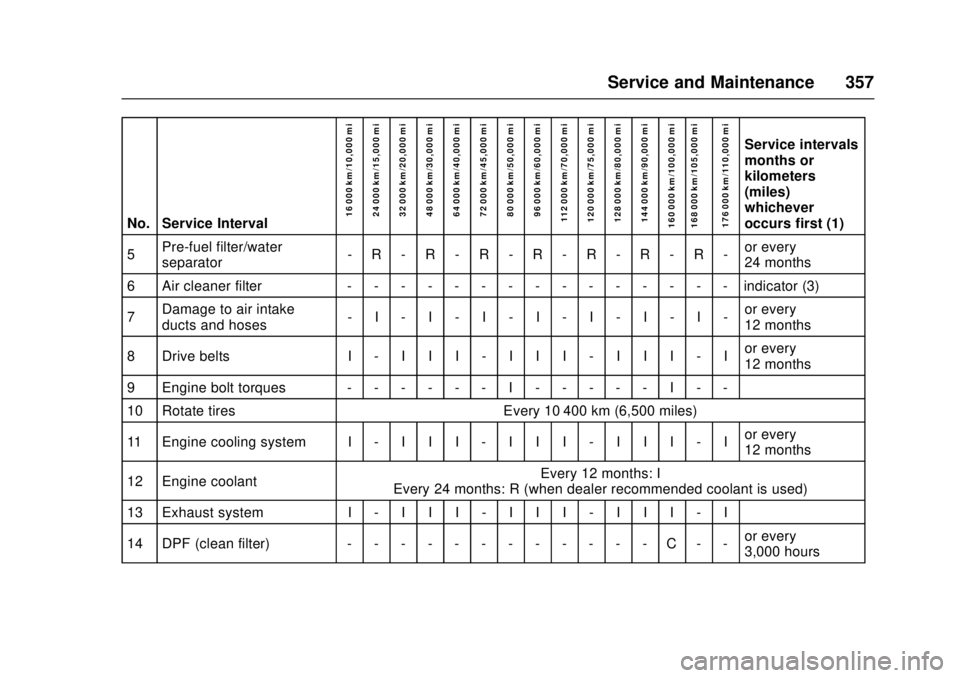
10 Rotate tires Every 10 400 km (6,500 miles)
11 Engine cooling system I - I I I - I I I - I I I - I or every
12 months
12 Engine coolant Every 12 months: I
Every 24 months: R (when dealer recommended coolant is used)
13 Exhaust system I - I I I - I I I - I I I - I
14 DPF (clean filter) - - - - - - - - - - - - C - - or every
3,000 hours
Page 364 of 414

Chevrolet Low Cab Forward Owner Manual (GMNA-Localizing-U.S.-
10716700) - 2017 - crc - 12/6/16
Service and Maintenance 363
Service IntervalMaintenance procedure
Engine
Every 16 000 km (10,000 miles) Inspect sound absorption materials for
tears, broken out sections or
attachment. Repair or replace as
necessary.
Cooling System
Every 16 000 km (10,000 miles) Inspect fan, shroud and radiator for
attachment, tears or cleanliness.
Replace as necessary.
Air intake system
Every 24 000 km (1,500 miles) Inspect all ducts, hoses and intake
silencers for leaks or chafing. Repair or
replace as necessary.
Exhaust system
Every 16 000 km (10,000 miles) Inspect silencer, pipes, gaskets, clamps
and mounting for exhaust gas leaks or
looseness. Repair or replace as
necessary.
Cab
Every 16 000 km (10,000 miles) Inspect sound absorption materials for
tears, broken out sections or
attachment. Repair or replace as
necessary.
2. Valve Lash : Incorrect valve
clearance will result in increased
engine noise and lower engine
output, thereby adversely affecting
engine performance. Retorque rocker shaft bracket nuts before
checking and adjusting valve
clearance.3.0L Diesel Engine: Check and
adjust valve clearance every
48 000 km (30,000 miles) or
12 months whichever occurs first.
5.2L Diesel Engine: Check and
adjust valve clearance every
80 000 km (50,000 miles) or
12 months whichever occurs first.
3. Engine Oil and Oil Filter :
Change at interval noted below
depending upon driving conditions.
•
Normal Service —Change every
16 000 km (10,000 miles) or
12 months whichever occurs first.
• Severe Service —Change every
8 000 km (5,000 miles) or 3 months
if you often drive under one or more
of these conditions: (a) driving in
dusty areas, (b) frequent idling or
idling for long periods, (c) driving
6 km (4 miles) or less in freezing
weather, or other short trips in cold
weather, where the engine does not
thoroughly warm up.
Change oil and filter as soon as you
can after driving in a dust storm.
When recommended oil is used, it