power steering CHEVROLET LOW CAB FORWARD 2017 Owner's Guide
[x] Cancel search | Manufacturer: CHEVROLET, Model Year: 2017, Model line: LOW CAB FORWARD, Model: CHEVROLET LOW CAB FORWARD 2017Pages: 414, PDF Size: 7.97 MB
Page 274 of 414

Chevrolet Low Cab Forward Owner Manual (GMNA-Localizing-U.S.-
10716700) - 2017 - crc - 12/6/16
Vehicle Care 273
Power Steering Fluid
The power steering fluid level must
be checked and it must be changed
according to the Maintenance
Schedule. SeeMaintenance
Schedule 0345.
When replenishing power steering
fluid or flushing the power steering
system, always use ATF
(Dexron
®-VI). Failure to use the
proper fluid may damage the power
steering system seals and hoses,
leading to fluid leakage.
Checking the Power Steering
Fluid Level
For the 3.0L diesel vehicles, the
fluid level is correct if it is between
the “MAX” and“MIN” lines on the
reserve tank. If the level is lower
that the “MIN”line, add fluid up to
the “MAX” line.
For the 5.2L diesel vehicles, the
fluid level is correct if it is between
the“MAX” and“MIN” lines on the
reserve tank. If the level is lower
that the “MIN”line, add fluid up to
the “MAX” line.
The reserve tank is located at the
rear of the engine compartment on
the right. When you have finished
checking the fluid level, securely
install the cap and cover.
For single cab gasoline vehicles, the
fluid level is correct if it is between
the "MAX" and "MIN" lines on the oil
dipstick. If the level is lower than the
"MIN" line, add fluid up to the
"MAX" line.
The reserve tank is located at the
front left side of the engine.
Page 275 of 414
Chevrolet Low Cab Forward Owner Manual (GMNA-Localizing-U.S.-
10716700) - 2017 - crc - 12/6/16
274 Vehicle Care
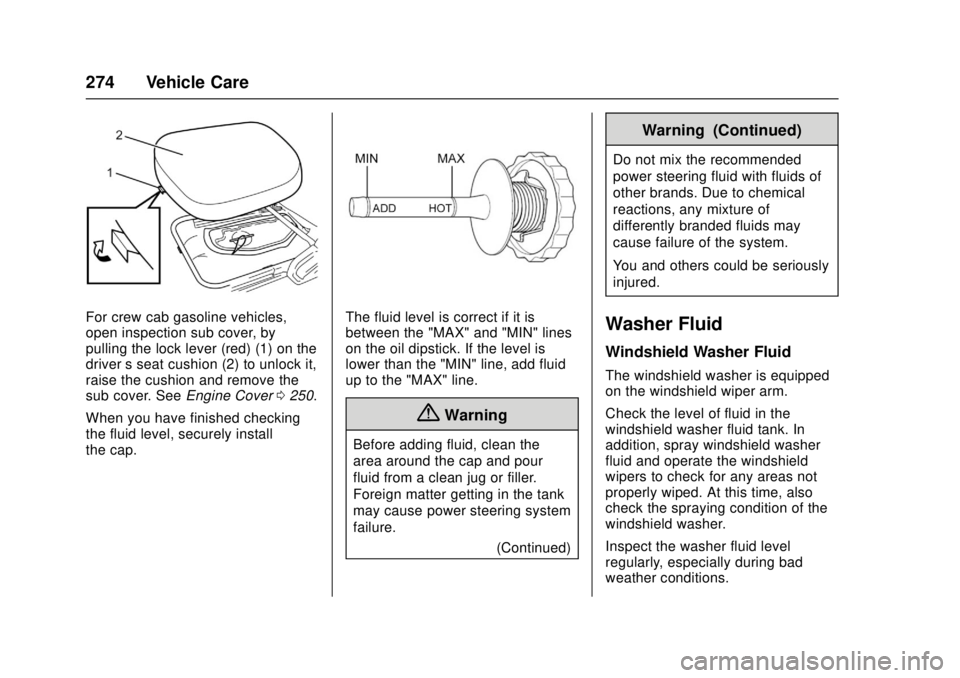
For crew cab gasoline vehicles,
open inspection sub cover, by
pulling the lock lever (red) (1) on the
driver’s seat cushion (2) to unlock it,
raise the cushion and remove the
sub cover. See Engine Cover0250.
When you have finished checking
the fluid level, securely install
the cap.The fluid level is correct if it is
between the "MAX" and "MIN" lines
on the oil dipstick. If the level is
lower than the "MIN" line, add fluid
up to the "MAX" line.
{Warning
Before adding fluid, clean the
area around the cap and pour
fluid from a clean jug or filler.
Foreign matter getting in the tank
may cause power steering system
failure. (Continued)
Warning (Continued)
Do not mix the recommended
power steering fluid with fluids of
other brands. Due to chemical
reactions, any mixture of
differently branded fluids may
cause failure of the system.
You and others could be seriously
injured.
Washer Fluid
Windshield Washer Fluid
The windshield washer is equipped
on the windshield wiper arm.
Check the level of fluid in the
windshield washer fluid tank. In
addition, spray windshield washer
fluid and operate the windshield
wipers to check for any areas not
properly wiped. At this time, also
check the spraying condition of the
windshield washer.
Inspect the washer fluid level
regularly, especially during bad
weather conditions.
Page 277 of 414

Chevrolet Low Cab Forward Owner Manual (GMNA-Localizing-U.S.-
10716700) - 2017 - crc - 12/6/16
276 Vehicle Care
Follow the recommendations for
brake checks in the Maintenance
Schedule.
GM replacement brake lining
material is recommended for this
vehicle to maintain the balance
between front and rear brake
performance. GM replacement
brake parts have been carefully
selected to provide the proper brake
balance for purposes of both
stopping distance and controllability
over the full range of operating
conditions. Installation of front or
rear brake lining material with
performance different from that of
the replacement parts
recommended for this vehicle can
change the intended brake balance
of this vehicle.
Checking the Brake Electric
Vacuum Pump (4500HD/
4500XD Series)
1. Turn the engine control switchto the "ON" position (do not
start the engine), and press the
brake pedal several times. 2. Check for the noisy sound of
the electric vacuum pump
inside the instrument panel at
the same time as vacuum
warning buzzer sound, and
check that the brake low
vacuum warning light
comes on.
3. Then, start the engine. The main vacuum pump driven by
the engine will start running.
If the electric vacuum pump
operation (noisy sound) and
the vacuum warning buzzer
stop, and the brake low
vacuum warning light goes off
thereafter, the operation is
normal.
4. If you cannot hear the noisy sound or the noisy sound stays
on all the time, have the
vehicle inspected by the
nearest dealer immediately.Hydraulic Brake Booster (HBB)
The 5500HD, 5500XD models are
equipped with a HBB system. HBB
is a brake booster device that utilizes hydraulic pressure from the
HBB pump integral with the power
steering pump.
If the brake booster warning light
comes on or a warning buzzer
continues to sound, there may be a
problem with the HBB.
If this warning light comes on while
driving, immediately stop your
vehicle at a safe place well clear of
traffic and promptly contact the
nearest dealer for inspection.
Hydraulic brake booster (HBB)
characteristics
In the 5500HD, 5500XD models, an
unusual sound from under the
instrument panel may be heard from
the hydraulic system while brakes
are used. It does not mean trouble.
It is not a sign of malfunction.
If you pump the brakes with the
engine off, a squeaking sound can
be heard. This comes from the
auxiliary accumulator. It is not a
malfunction. With the engine
running, a similar sound can be
heard during sudden braking.
Page 278 of 414

Chevrolet Low Cab Forward Owner Manual (GMNA-Localizing-U.S.-
10716700) - 2017 - crc - 12/6/16
Vehicle Care 277
Another characteristic of the HBB
system is that the brake pedal may
be depressed easily to the floor with
the vehicle at a stop. This is not a
sign of malfunction.
When the engine is running, the
system automatically charges the
accumulator whenever pressure has
been reduced after braking. Auto
charge may be activated without
braking, depending on temperature
changes in the accumulator. During
auto charge, a hissing and clicking
sound can be heard. This is not a
malfunction.
With the engine running, a booming
sound can be heard during hard
braking. This comes from the
brake-fluid pump. It is not a
malfunction.
Applying continuous hard braking
for a long time will lead to
considerable temperature rise in the
HBB pump. Such overworking of the
brakes is best avoided.Vacuum or hydraulic power
assisted brakes
If the engine stops, do not pump the
brakes. The system is designed to
stop the vehicle with reserve power
assist if the brake pedal is held
down. This reserve is greatly
reduced each time you apply and
release the brakes. If, when you
turn the steering wheel during
braking, the vehicle does not turn,
release some pressure from the
brake pedal.
In a Vehicle Equipped with a HBB,
Do Not Keep the Brake Pedal
Depressed for an Extended Period
Caution
Failure to follow the above
instruction will cause the oil inside
the HBB oil pump to get very hot.
This could damage the HBB tank
and deteriorate seals and also
could cause damage to the HBB
oil pump, HBB unit and/or HBB
hosing. Eventual leakage of HBB
(Continued)
Caution (Continued)
oil, sudden increase in brake
pedal resistance and fire could
unexpectedly result in an
accident.
Hydraulic Brake Booster (HBB)
Fluid (5500HD/5500XD Series)
The HBB system has been
designed to use ATF Dexron fluid is
used with this system, rubber
components may be damaged, oil
may leak and the system may
malfunction. It is important to
remember that the fluid used in the
hydro-booster is completely different
in characteristics from the brake
fluid used in the master and wheel
cylinders.
If hydro-booster fluid and brake fluid
from the master cylinder are
mistakenly mixed together and
used, rubber components will
deteriorate as a result of insufficient
lubrication. Any resultant oil leakage
or system malfunction can in turn
lead to dragging brakes or other
Page 334 of 414

Chevrolet Low Cab Forward Owner Manual (GMNA-Localizing-U.S.-
10716700) - 2017 - crc - 12/6/16
Vehicle Care 333
After Towing
After towing the vehicle, block the
rear wheels and install axle shafts
or driveshaft.
Apply the parking brake before
disconnecting from the towing
vehicle.
Front End Towing (All Wheels On
the Ground)
Your vehicle may be towed on all
wheels provided the steering is
operable. Remember that power
steering and brakes will not have
power assist. There must be a tow
bar installed between the tow
vehicle and the disabled vehicle.
Towing with all wheels on theground
1. Bumper
2. Tow Hook
3. Front Axle
4. Towing Guide
5. Towing Chain
To prepare a disabled vehicle for
front end towing with all wheels on
the ground, the following steps are
necessary:
.Block the rear wheels of the
disabled vehicle.
. For gasoline vehicles, move the
selector lever into "N" position,
vehicles can be towed at speeds below 48 km/h (30 mph) and up
to distances less than
80 km (50 mi).
. Disconnect the driveshaft at the
rear axle. Secure the driveshaft
to the frame or crossmember.
When towing, disconnect the
driveshaft at the rear axle to ensure
the transmission is not damaged.
The rear end of the driveshaft must
be disconnected and safely secured
if the 80 km (50 mi) or 48 km/h
(30 mph) is exceeded.
Provide wood blocking to prevent
towing chains and bar from coming
into contact with the bumper.
If there is damage or suspected
damage to the rear axle, remove the
axle shafts.
Cover the hub openings to prevent
the loss of lubricant or entry of dirt
or foreign objects.
After Towing
After towing the vehicle, block the
rear wheels and install axle shafts
or driveshaft.
Page 350 of 414

Chevrolet Low Cab Forward Owner Manual (GMNA-Localizing-U.S.-
10716700) - 2017 - crc - 12/6/16
Service and Maintenance 349
No. Service Interval
12 000 km/7,500 mi
24 000 km/15,000 mi
36 000 km/22,500 mi
48 000 km/30,000 mi
60 000 km/37,500 mi
72 000 km/45,000 mi
84 000 km/52,500 mi
96 000 km/60,000 mi
108 000 km/67,500 mi
120 000 km/75,000 mi
132 000 km/82,500 mi
144 000 km/90,000 mi
156 000 km/97,500 mi
168 000 km/105,000 mi
180 000 km/112,500 mi
192 000 km/120,000 mi
Service
intervals
months or
kilometers
(miles)
whichever
occurs
first (1)
11 Evaporative Control System (2) (6) - - - - - - - - I - - - - - - -
12 Shields and Underhood Insulation (5) - I - I - I - I - I - I - I - I
13 Air Intake System (5) - - - I - - - I - - - I - - - I
14 Thermostatically Controlled Engine
Cooling Fan (5) - I - I - I - I - I - I - I - I or every 12 months
15 Automatic Transmission Fluid I I I I I I R I I I I I I R I I
16 Rotate Tires Every 12 000 km (7,500 mi)
17 Brake Lining and Pad for Wear I I I I I I I I I I I I I I I I
18 Brake drum and rotor for wear and
damage
- - - I - - - I - - - I - - - I or every 12 months
19 Brake Electric Vacuum Pump (4500
Series)
I I I I I I I I I I I I I I I I or every 12 months
20 Brake Fluid I I I R I I I R I I I R I I I R or every 24 months
21 Brake Line and Hoses - - - I - - - I - - - I - - - I or every 12 months
22 Hydraulic Unit Every 10 Years: R
23 Differential Gear Oil I I I R I I I R I I I R I I I R or every 24 months
24 Power Steering Fluid - - - - R - - - - R - - - - R - or every 24 months
25 Steering Wheel Free Play (3) Every 10 400 km (6,500 mi): I
26 Steering Gear Box Torque - - - T - - - T - - - T - - - T or every 12 months
Page 355 of 414

Chevrolet Low Cab Forward Owner Manual (GMNA-Localizing-U.S.-
10716700) - 2017 - crc - 12/6/16
354 Service and Maintenance
How to check: This operation could
be difficult and you may choose to
have this done at your dealer
Service Department.
1. Turn the engine control switch to
the "ON" position (not to start the
engine), and press the brake pedal
several times.
2. Check for the noisy sound of the
electric vacuum pump inside the
instrument panel at the same time
as vacuum warning buzzer sound,
and check that the brake low
vacuum warning light comes on.
3. Then, after you start the engine,
the main vacuum pump driven by
the engine will start running. If the
electric vacuum pump operation
(noisy sound) and the vacuum
warning buzzer stop, and the brake
low vacuum warning light goes off
thereafter, the operation is normal.
4. If you cannot hear the noisy
sound of the electric vacuum pump,
check the electrical wiring and
repair as necessary. If it cannot be
repaired, replace the electric
vacuum pump.20. BRAKE FLUID :
Check the fluid
in the brake fluid reservoir every
12 000 km (7,500 miles) and replace
fluid every 48 000 km
(30,000 miles).
21. BRAKE LINE AND HOSES :
Check lines and hoses for proper
hook-up, binding, leaks, cracks,
chafing, etc. every 48 000 km
(30,000 miles). Any questionable
parts should be replaced or repaired
at once. When rubbing or wear is
noted on lines or hoses, the cause
must be corrected at once.
22. HYDRAULIC UNIT : Change
every 10 years.
23. DIFFERENTIAL GEAR OIL :
Replace lubricant every 48 000 km
(30,000 miles) or every 24 months.
Check lubricant level every
12 000 km (7,500 miles) or every
12 months, and add lubricant to
within 0 to 10 mm (0 to 0.4 inch) of
the bottom edge of the filler hole if
necessary. 24. POWER STEERING FLUID :
Replace power steering fluid every
24 months or 60 000 km
(37,500 miles), whichever occurs
first.
25. STEERING WHEEL FREE
PLAY :
Check steering wheel free
play after the first 1 040 km
(650 miles) and then every
10 400 km (6,500 miles).
Steering wheel free play
10-50 mm (0.39-1.97 in)
26. STEERING GEAR BOX
TORQUE : Retighten the fixing bolts
of the steering gear box to the
specified torque every 48 000 km
(30,000 miles). Specified tightening
torque.
Steering gear box tightening torque
102 Y(75 lb·ft)
27. DRIVESHAFT FLANGE
TORQUE : Check the fixing bolts of
driveshaft flange for looseness or
damage first 12 000 km
(7,500 miles). Retighten the fixing
Page 360 of 414

Chevrolet Low Cab Forward Owner Manual (GMNA-Localizing-U.S.-
10716700) - 2017 - crc - 12/6/16
Service and Maintenance 359
No. Service Interval16 000 km/10,000 mi
24 000 km/15,000 mi
32 000 km/20,000 mi
48 000 km/30,000 mi
64 000 km/40,000 mi
72 000 km/45,000 mi
80 000 km/50,000 mi
96 000 km/60,000 mi
112 000 km/70,000 mi
120 000 km/75,000 mi
128 000 km/80,000 mi
144 000 km/90,000 mi
160 000 km/100,000 mi
168 000 km/105,000 mi
176 000 km/110,000 mi
Service intervals
months or
kilometers
(miles)
whichever
occurs first (1)
22 Hydraulic brake booster
(HBB) fluid (5500HD
5500XD models) - - - R - - - R - - - R - - -
or every
24 months
23 Brake line and hoses - - I - I - - I - - I - I - I or every
12 months
24 Parking brake cable I - I I I - I I I - I I I - I or every
12 months
25 Automatic transmission
fluid
I - I R I - I R I - I R I - I or every
12 months
26 Differential gear oil I - I R I - I R I - I R I - I or every
24 months
27 Power steering fluid - - - R - - - R - - - R - - - or every
24 months
28 Power steering oil hoses - - - - - - R - - - - - R - - or every
24 months
29 Steering wheel free
play (4) Every 10 400 km (6,500 miles): I
Page 367 of 414

Chevrolet Low Cab Forward Owner Manual (GMNA-Localizing-U.S.-
10716700) - 2017 - crc - 12/6/16
366 Service and Maintenance
25. Automatic Transmission
Fluid :Check the automatic
transmission fluid level at each
engine oil change and replace fluid
every 48 000 km (30,000 miles). Do
not overfill.
26. Differential Gear Oil : Replace
lubricant every 48 000 km
(30,000 miles). Check lubricant level
every 16,000 km (10,000 miles) or
every 12 months, and add lubricant
to within 0 to 10 mm (0 to 0.4 inch)
of the bottom edge of the filler hole
if necessary.
27. Power Steering Fluid :
Replace power steering fluid every
24 months or 48 000 km
(30,000 miles), whichever occurs
first.
28. Power Steering Oil Hoses :
Replace power steering oil hoses
every 24 months or 80 000 km
(50,000 miles), whichever occurs
first.
29. Steering Wheel Free Play :
Check steering wheel free play after
the first 1 040 km (650 miles) and
then every 10 400 km (6,500 miles). Steering wheel free play
10-50 mm (0.39-1.97 in)
30. Steering Gear Box Torque :
Retighten the attaching bolts of the
steering gear box to the specified
torque every 12 months or every
32 000 km (20,000 miles) whichever
occurs first. Steering gear box tightening torque
103 Y(76 lb·ft)
31. Driveshaft Flange Torque :
Check the fixing bolts of driveshaft
flange for looseness or damage
after the first 16 000 km
(10,000 miles). Driveshaft flange tightening torque
103Y(76 lb·ft)
32. Driveshaft Lubrication :
Lubricate the grease fitting on the
center bearing, as well as each
universal joint and spline coupling
every 12 months or 16 000 km
(10,000 miles) whichever occurs
first. 33. Leaf Spring U-bolt Torque :
Tighten the U-Bolt nuts to the
specified torque after the first
1 040 km (650 miles), thereafter
every 16 000 km (10,000 miles).
Model Leaf spring U-bolt nut tightening torque
Front Rear
3500HD 127 Y
(94 lb·ft) 177
Y
(131 lb·ft)
4500HD 127 Y
(94 lb·ft) 177
Y
(131 lb·ft)
4500XD 196 Y
(145lb·ft) 177
Y
(131 lb·ft)
5500HD, 5500XD 196
Y
(145lb·ft) 284
Y
(209 lb·ft)
34. Wheel Nut Torque : Check tires
for excessive or abnormal wear,
or damage. Also check tire inflation
pressures and adjust.
Be sure wheels are not bent or
cracked and that wheel nuts have
been tightened to the specified
torque after the first 1,040 km
(650 miles) and then every
Page 369 of 414

Chevrolet Low Cab Forward Owner Manual (GMNA-Localizing-U.S.-
10716700) - 2017 - crc - 12/6/16
368 Service and Maintenance
required to buckle up the seat belts.
Adjust the positions of the steering
wheel and mirrors. Lock the doors.
Turn the power of the dome light or
accessories OFF before starting the
engine.
Engine Conditions
Checking the Engine for
Startability and Abnormal Noises1. Make sure the parking brake is securely engaged. Step firmly
on the brake pedal.
2. Make sure the selector lever is in "P" or "N" position.
For safety, firmly press the
brake pedal before starting the
engine.
3. Turn the engine control switch to start the engine.
Check that the engine starts
quickly with no abnormal
noises. Checking Condition of the Engine
at Low Speeds and during
Acceleration
1. Make sure the transmission is in the "P" or "N" position and
the parking brake is securely
engaged.
2. Turn the engine control switch to start the engine, and run it to
warm up.
3. Check that the engine is running at a speed within the
standard idle speed range.
For diesel vehicles, during
regeneration of the diesel
particulate filter (DPF), the
engine idle speed may
increase.
4. Drive the vehicle, making sure the accelerator pedal does not
stick when gradually
accelerating, the engine speed
rises smoothly and it does not
knock.
Recommended Daily
(Pre-operation) Inspections
These checks are in addition to, not
instead of, any legally required daily
inspections. See related topics
under "Maintenance Schedule",
especially if problems are found.
For safe and comfortable driving,
keep record of the distances driven
and the condition of the vehicle
during operation. Perform
inspections at appropriate intervals,
and perform maintenance in
accordance with the findings of the
inspections. If an inspection reveals
an abnormality or there was an
abnormality the previous time the
vehicle was driven, have the vehicle
repaired by the nearest dealer
before it is driven again.
1. Components that showed abnormalities during the
previous operation
.Check components that
showed abnormalities
during the previous
operation