wheel CHEVROLET LOW CAB FORWARD 2017 Repair Manual
[x] Cancel search | Manufacturer: CHEVROLET, Model Year: 2017, Model line: LOW CAB FORWARD, Model: CHEVROLET LOW CAB FORWARD 2017Pages: 414, PDF Size: 7.97 MB
Page 324 of 414
Chevrolet Low Cab Forward Owner Manual (GMNA-Localizing-U.S.-
10716700) - 2017 - crc - 12/6/16
Vehicle Care 323
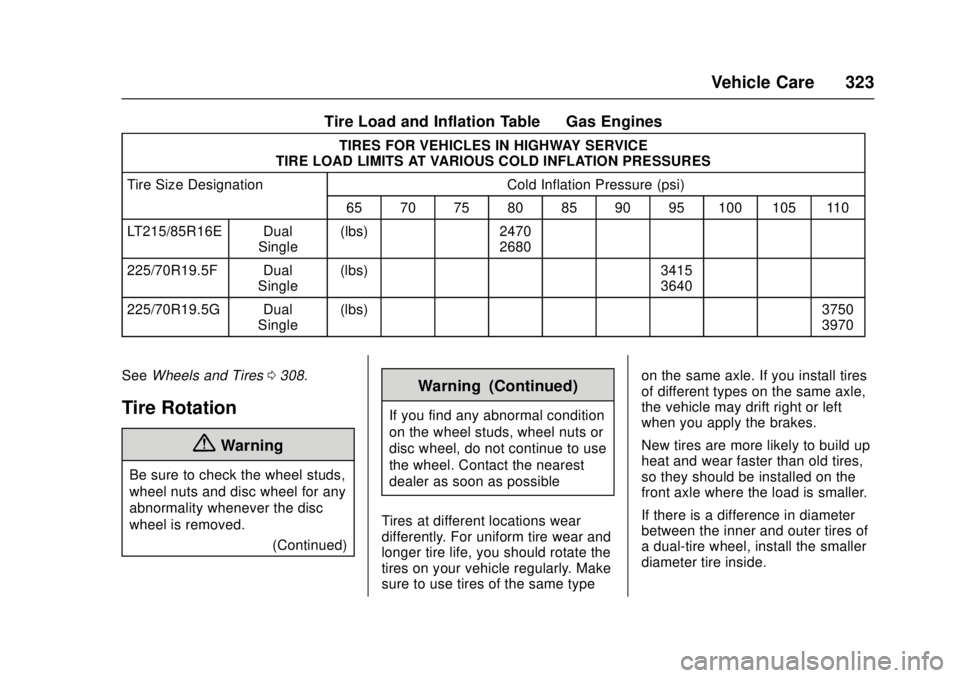
Tire Load and Inflation Table—Gas Engines
TIRES FOR VEHICLES IN HIGHWAY SERVICE
TIRE LOAD LIMITS AT VARIOUS COLD INFLATION PRESSURES
Tire Size Designation Cold Inflation Pressure (psi) 65 70 75 80 85 90 95 100 105 110
LT215/85R16E Dual Single(lbs) 2470
2680
225/70R19.5F Dual Single(lbs) 3415
3640
225/70R19.5G Dual Single(lbs)
3750
3970
See Wheels and Tires 0308.
Tire Rotation
{Warning
Be sure to check the wheel studs,
wheel nuts and disc wheel for any
abnormality whenever the disc
wheel is removed.
(Continued)
Warning (Continued)
If you find any abnormal condition
on the wheel studs, wheel nuts or
disc wheel, do not continue to use
the wheel. Contact the nearest
dealer as soon as possible
Tires at different locations wear
differently. For uniform tire wear and
longer tire life, you should rotate the
tires on your vehicle regularly. Make
sure to use tires of the same type on the same axle. If you install tires
of different types on the same axle,
the vehicle may drift right or left
when you apply the brakes.
New tires are more likely to build up
heat and wear faster than old tires,
so they should be installed on the
front axle where the load is smaller.
If there is a difference in diameter
between the inner and outer tires of
a dual-tire wheel, install the smaller
diameter tire inside.
Page 325 of 414

Chevrolet Low Cab Forward Owner Manual (GMNA-Localizing-U.S.-
10716700) - 2017 - crc - 12/6/16
324 Vehicle Care
The difference in diameter of the
tires for a dual-tire wheel should be
within the limit specified in the table
below. If the limit is exceeded, the
tires wear more rapidly than they
should.
Steel Wheels
Aluminum/Steel Wheels
Vehicles with the aluminum wheel
option may have steel wheels on
the inner rear position. These
wheels must only be mounted on
the inner rear positions and should
only be rotated from side to side.
{Warning
If differently sized tires are used
between the front and rear axles,
do not exchange tires between
the front and rear axles;
otherwise, the tires get loaded
beyond their limits. This is highly (Continued)
Warning (Continued)
dangerous because the tires and
disc wheels could break down
under an excessive load. You and
others could be seriously injured.
Permissible diameter difference
Radial tire Within 8 mm (0.31 in)
The tightening torque of the wheel
nuts may decrease after a tire
change due to their initial
settlement. Upon driving 50 to
100 km (31 to 62 mi) after a tire
change, retighten the wheel nuts to
the specified torques according to
the instructions in "Retightening
Wheel Nuts" following.
See Maintenance Schedule 0345.
Retightening Wheel Nuts
Check the wheel nuts to make sure
they are tightened to the specific
torque by using a torque wrench.
Use the following methods to check
loose wheel nuts. The tightening
torque of the wheel nuts may
Page 326 of 414

Chevrolet Low Cab Forward Owner Manual (GMNA-Localizing-U.S.-
10716700) - 2017 - crc - 12/6/16
Vehicle Care 325
decrease after a tire change or
rotation due to their initial
settlement. After driving 50 to
100 km (31 to 62 mi), be sure to
retighten the wheel nuts to the
specified torque.
SeeMaintenance Schedule 0345.
Tightening torque
500 N·m (362 lb·ft)
Single Tire
1. Left side tire
2. Right side tire
Turn the wheel nuts in the tightening
direction to the specified torque. Retightening of nuts on left rear
dual-tire wheel
Dual Tire
Of the nuts on the wheel studs,
loosen the outer wheel nuts.
Tighten the inner wheel nuts of the
same wheel to the specified torque.
Next, tighten the outer wheel nuts to
the specified torque.
Page 327 of 414

Chevrolet Low Cab Forward Owner Manual (GMNA-Localizing-U.S.-
10716700) - 2017 - crc - 12/6/16
326 Vehicle Care
{Warning
If you find any abnormal
conditions with the wheel nuts
such as frequent loosening of
retightened nuts, have your
vehicle checked or serviced at the
nearest dealer as soon as
possible.
Fully engage the wheel wrench on a
wheel nut in order to tighten the nut
to the specified torque. However, do
not use a pipe as a handle
extension or your foot to apply force
on the wrench. This would tighten
the nut more than required and
might damage components.
Both under-tightening and
over-tightening of wheel nuts may
cause broken wheel studs or
cracked disc wheels and could lead
to wheel detachment. Adhere to the
specified tightening torques.
When replacing a tire with a new
one, use only a tire of the same
type and size as the replaced tire;
otherwise, driving safety could be affected. Avoid mixed use of
different types or different size tires
at all costs.
If a Tire Goes Flat
When the tire goes flat while driving,
ease off the accelerator pedal, avoid
hard braking, hold on to the steering
wheel firmly, and stop the vehicle.
The tire should be changed in a
safe, open location to prevent
obstructing other vehicles or
pedestrians.
{Warning
If you continue to drive on a flat
tire, undue force will be applied to
the wheel studs, possibly causing
the studs to break and the wheel
to come off. You and others could
be seriously injured.
See “Tire Replacement
Recommendations” underWheels
and Tires 0308.
Jump Starting
Jump Starting - North
America
When the Battery is
Discharged
Use a jumper cable (sold
separately) and the battery of
another vehicle to start the engine in
the following sequence.
{Danger
Follow the precautions listed in
the jump starting instructions
when working on or near the
battery. Personal injury
(particularly to eyes) or property
damage may result from battery
explosion, battery fluid or
electrical (short circuit) burns.
If battery fluid should come in
contact with an eye, immediately
wash away using a large amount
of water and continue washing for
(Continued)
Page 333 of 414

Chevrolet Low Cab Forward Owner Manual (GMNA-Localizing-U.S.-
10716700) - 2017 - crc - 12/6/16
332 Vehicle Care
Towing the Vehicle
Consult your dealer or a
professional towing service if the
disabled vehicle must be towed.
Proper equipment must be used to
prevent damage to vehicles during
any towing. State and local laws
which apply to vehicles in tow must
be followed. Vehicles should not be
towed at speeds in excess of
88 km/h (55 mph).
Connect to the main structural parts
of the vehicle. Do not attach to
bumpers, tow hooks or brackets.
Use only equipment designed for
this purpose. Follow the instructions
of the wrecker manufacturer.
A safety chain system must
be used.
The procedures below must be
followed when towing to prevent
possible damage.Front End Towing (Front Wheels
Off Ground)
To prepare a disabled vehicle for
front end towing with front wheels
raised off theground, the following
steps are necessary:
.
Block the rear wheels of the
disabled vehicle.
. For gasoline vehicles, move the
selector lever into "N" position,
vehicles can be towed at speeds
below 48 km/h (30 mph) and up
to distances less than
80 km (50 mi).
. Disconnect the driveshaft at the
rear axle. Secure the driveshaft
to the frame or crossmember.
When towing, disconnect the
driveshaft at the rear axle to ensure
the transmission is not damaged.
The rear end of the driveshaft must
be disconnected and safely secured
if the 80 km (50 mi) or 48 km/h
(30 mph) is exceeded. If there is damage or suspected
damage to the rear axle, remove the
axle shafts. Cover the hub openings
to prevent the loss of lubricant or
entry of dirt or foreign objects.
Place a 10 cm (4 in) wood beam
against the towing guide behind the
bumper. (If no 10 cm (4 in) is
available, then remove the bumper.)
Ensure towing chains do not come
into contact with the horns or the
bumper. (If towing chains contact
the bumper, then remove the
bumper.)
1. Horns
2. Bumper
Page 334 of 414

Chevrolet Low Cab Forward Owner Manual (GMNA-Localizing-U.S.-
10716700) - 2017 - crc - 12/6/16
Vehicle Care 333
After Towing
After towing the vehicle, block the
rear wheels and install axle shafts
or driveshaft.
Apply the parking brake before
disconnecting from the towing
vehicle.
Front End Towing (All Wheels On
the Ground)
Your vehicle may be towed on all
wheels provided the steering is
operable. Remember that power
steering and brakes will not have
power assist. There must be a tow
bar installed between the tow
vehicle and the disabled vehicle.
Towing with all wheels on theground
1. Bumper
2. Tow Hook
3. Front Axle
4. Towing Guide
5. Towing Chain
To prepare a disabled vehicle for
front end towing with all wheels on
the ground, the following steps are
necessary:
.Block the rear wheels of the
disabled vehicle.
. For gasoline vehicles, move the
selector lever into "N" position,
vehicles can be towed at speeds below 48 km/h (30 mph) and up
to distances less than
80 km (50 mi).
. Disconnect the driveshaft at the
rear axle. Secure the driveshaft
to the frame or crossmember.
When towing, disconnect the
driveshaft at the rear axle to ensure
the transmission is not damaged.
The rear end of the driveshaft must
be disconnected and safely secured
if the 80 km (50 mi) or 48 km/h
(30 mph) is exceeded.
Provide wood blocking to prevent
towing chains and bar from coming
into contact with the bumper.
If there is damage or suspected
damage to the rear axle, remove the
axle shafts.
Cover the hub openings to prevent
the loss of lubricant or entry of dirt
or foreign objects.
After Towing
After towing the vehicle, block the
rear wheels and install axle shafts
or driveshaft.
Page 335 of 414

Chevrolet Low Cab Forward Owner Manual (GMNA-Localizing-U.S.-
10716700) - 2017 - crc - 12/6/16
334 Vehicle Care
Apply the parking brake before
disconnecting from the towing
vehicle. Check and fill rear axle with
oil, if required.
Rear End Towing
When towing a vehicle with rear
wheels raised, secure the steering
wheel to maintain straight-ahead
position. Make certain that the front
axle is not loaded beyond the front
axle gross axle weight rating
(GAWR) as indicated on the
vehicle's VIN and weight rating plate
(diesel) or the vehicle's "Vehicle
Certification and Greenhouse Gas
(GHG) Emissions Plate" (gasoline).
Special Towing Instructions1. All state and local laws regarding such items as
warning signals, night
illumination, speed, etc., must
be followed.
2. Safety chains must be used.
3. No vehicle should ever be towed over 88 km/h (55 mph). 4. Loose or protruding parts of
damaged vehicles should be
secured prior to moving.
5. A safety chain system completely independent of the
primary lifting and towing
attachment must be used.
6. Operators should refrain from going under a vehicle which is
being lifted by the towing
equipment unless the vehicle is
adequately supported by safety
stands.
7. No towing operation which for any reason jeopardizes the
safety of the wrecker operator
or any bystanders or other
motorists should be attempted.Appearance Care
Exterior Care
Exterior Finish
The paint finish on your vehicle
provides beauty, depth of color,
gloss retention and durability.
While cleaning the vehicle, do not
grip the roof marker lights to prevent
damage or water leakage.
Washing
The best way to preserve your
vehicle's finish is to keep it clean by
washing it often.
Wash the vehicle in lukewarm or
cold water. Do not use hot water or
wash your vehicle in the direct rays
of the sun. Do not use strong soap
or chemical detergents. All cleaning
agents should be flushed promptly
from the surface and not allowed to
dry on the finish.
These vehicles are designed to
operate under normal environmental
conditions to withstand natural
elements. However, unusual
Page 336 of 414

Chevrolet Low Cab Forward Owner Manual (GMNA-Localizing-U.S.-
10716700) - 2017 - crc - 12/6/16
Vehicle Care 335
conditions such as high-pressure
car washers may cause water to
enter inside the vehicle. If the
vehicle is operated with foreign
material adhering to the exterior,
this material may react chemically
with paint, resulting in staining,
discoloration, rusting or corrosion of
components. Also, the material may
become trapped within mechanical
components, adversely affecting
their functions or forming an
aerodynamic resistance. In the
following cases, therefore, the
vehicle must be washed and all
foreign matter removed.
.When soot, iron powder, dead
bugs, bird droppings, tree sap or
oily matter from coal tar and
smoke has adhered to painted
surfaces.
. When the vehicle has been
driven in coastal areas.
. When the vehicle has been
driven on roads where road
chemicals have been applied.
. When a large amount of mud or
dirt has adhered to the exterior. To wash the vehicle:
1. Fully turn on the tap, and wash out the undercarriage and
suspension.
2. Close all openings and wash the cab and cargo body panels
using a neutral detergent.
3. Clean wheels and tires using a brush and detergent.
4. After washing away all remaining detergent, use a
shammy or other clean cloth to
fully remove all moisture and
water droplets
{Warning
Follow the manufacturer's advice
whenever cleaning agents or
other chemicals are used, inside
or outside the vehicle. Some
cleaners may be poisonous or
flammable, and improper use may
cause personal injury or damage.
When cleaning the inside or
outside of the vehicle, do not use
volatile cleaning solvents, such as
(Continued)
Warning (Continued)
acetone, lacquer thinners, enamel
reducers, nail polish removers; or
such cleaning materials as
laundry soaps, bleaches or
reducing agents, except as noted
in the following fabric cleaning
advice on stain removal.
Never use carbon tetrachloride,
gasoline, benzene or naphtha for
any cleaning purpose. Open all
vehicle doors for ventilation when
ANY cleaning agents or other
chemicals are used in the interior.
Overexposure to some vapors
may result in a health problem
that is more likely to occur in
small, unventilated spaces.
You and others could be seriously
injured.
Do not apply water directly in order
to clean the cab interior. Failure to
observe this precaution can result in
malfunction or breakdown of
electronic control units and electrical
components, or in rusting of the cab
Page 350 of 414

Chevrolet Low Cab Forward Owner Manual (GMNA-Localizing-U.S.-
10716700) - 2017 - crc - 12/6/16
Service and Maintenance 349
No. Service Interval
12 000 km/7,500 mi
24 000 km/15,000 mi
36 000 km/22,500 mi
48 000 km/30,000 mi
60 000 km/37,500 mi
72 000 km/45,000 mi
84 000 km/52,500 mi
96 000 km/60,000 mi
108 000 km/67,500 mi
120 000 km/75,000 mi
132 000 km/82,500 mi
144 000 km/90,000 mi
156 000 km/97,500 mi
168 000 km/105,000 mi
180 000 km/112,500 mi
192 000 km/120,000 mi
Service
intervals
months or
kilometers
(miles)
whichever
occurs
first (1)
11 Evaporative Control System (2) (6) - - - - - - - - I - - - - - - -
12 Shields and Underhood Insulation (5) - I - I - I - I - I - I - I - I
13 Air Intake System (5) - - - I - - - I - - - I - - - I
14 Thermostatically Controlled Engine
Cooling Fan (5) - I - I - I - I - I - I - I - I or every 12 months
15 Automatic Transmission Fluid I I I I I I R I I I I I I R I I
16 Rotate Tires Every 12 000 km (7,500 mi)
17 Brake Lining and Pad for Wear I I I I I I I I I I I I I I I I
18 Brake drum and rotor for wear and
damage
- - - I - - - I - - - I - - - I or every 12 months
19 Brake Electric Vacuum Pump (4500
Series)
I I I I I I I I I I I I I I I I or every 12 months
20 Brake Fluid I I I R I I I R I I I R I I I R or every 24 months
21 Brake Line and Hoses - - - I - - - I - - - I - - - I or every 12 months
22 Hydraulic Unit Every 10 Years: R
23 Differential Gear Oil I I I R I I I R I I I R I I I R or every 24 months
24 Power Steering Fluid - - - - R - - - - R - - - - R - or every 24 months
25 Steering Wheel Free Play (3) Every 10 400 km (6,500 mi): I
26 Steering Gear Box Torque - - - T - - - T - - - T - - - T or every 12 months
Page 351 of 414

Chevrolet Low Cab Forward Owner Manual (GMNA-Localizing-U.S.-
10716700) - 2017 - crc - 12/6/16
350 Service and Maintenance
No. Service Interval
12 000 km/7,500 mi
24 000 km/15,000 mi
36 000 km/22,500 mi
48 000 km/30,000 mi
60 000 km/37,500 mi
72 000 km/45,000 mi
84 000 km/52,500 mi
96 000 km/60,000 mi
108 000 km/67,500 mi
120 000 km/75,000 mi
132 000 km/82,500 mi
144 000 km/90,000 mi
156 000 km/97,500 mi
168 000 km/105,000 mi
180 000 km/112,500 mi
192 000 km/120,000 mi
Service
intervals
months or
kilometers
(miles)
whichever
occurs
first (1)
27 Driveshaft Flange Torque I T - T - T - T - T - T - T - T or every 12 months
28 Leaf spring U-bolt torque (3) T - T - T - T - T - T - T - T -
29 Wheel Nut Torque (3) T T T T T T T T T T T T T T T T
30 King Pins L L L L L L L L L L L L L L L L or every 12 months
31 Driveshaft Lubrication - L - L - L - L - L - L - L - L or every 12 months
32 Wheel Hub Bearing Grease (Front) - - - R - - - R - - - R - - - R or every 24 months
33 Accessory Drive Belt Every 160 000 km (100,000 mi): Ror every 12 months
34 Air Conditioner Blower Filter Cleaned once a month