flat tire CHEVROLET LOW CAB FORWARD 2017 Owner's Manual
[x] Cancel search | Manufacturer: CHEVROLET, Model Year: 2017, Model line: LOW CAB FORWARD, Model: CHEVROLET LOW CAB FORWARD 2017Pages: 414, PDF Size: 7.97 MB
Page 67 of 414
Chevrolet Low Cab Forward Owner Manual (GMNA-Localizing-U.S.-
10716700) - 2017 - crc - 12/6/16
66 Storage
Maximum Front and Rear Axle
Weights
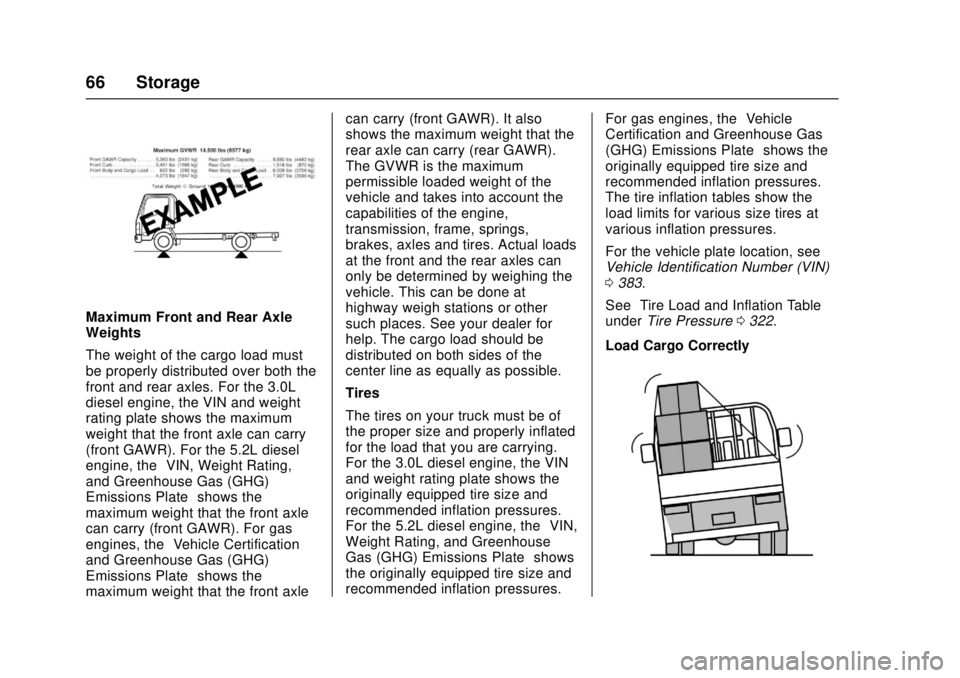
The weight of the cargo load must
be properly distributed over both the
front and rear axles. For the 3.0L
diesel engine, the VIN and weight
rating plate shows the maximum
weight that the front axle can carry
(front GAWR). For the 5.2L diesel
engine, the“VIN, Weight Rating,
and Greenhouse Gas (GHG)
Emissions Plate” shows the
maximum weight that the front axle
can carry (front GAWR). For gas
engines, the “Vehicle Certification
and Greenhouse Gas (GHG)
Emissions Plate” shows the
maximum weight that the front axle can carry (front GAWR). It also
shows the maximum weight that the
rear axle can carry (rear GAWR).
The GVWR is the maximum
permissible loaded weight of the
vehicle and takes into account the
capabilities of the engine,
transmission, frame, springs,
brakes, axles and tires. Actual loads
at the front and the rear axles can
only be determined by weighing the
vehicle. This can be done at
highway weigh stations or other
such places. See your dealer for
help. The cargo load should be
distributed on both sides of the
center line as equally as possible.
Tires
The tires on your truck must be of
the proper size and properly inflated
for the load that you are carrying.
For the 3.0L diesel engine, the VIN
and weight rating plate shows the
originally equipped tire size and
recommended inflation pressures.
For the 5.2L diesel engine, the
“VIN,
Weight Rating, and Greenhouse
Gas (GHG) Emissions Plate” shows
the originally equipped tire size and
recommended inflation pressures. For gas engines, the
“Vehicle
Certification and Greenhouse Gas
(GHG) Emissions Plate” shows the
originally equipped tire size and
recommended inflation pressures.
The tire inflation tables show the
load limits for various size tires at
various inflation pressures.
For the vehicle plate location, see
Vehicle Identification Number (VIN)
0 383.
See “Tire Load and Inflation Table”
under Tire Pressure 0322.
Load Cargo Correctly
Page 135 of 414
Chevrolet Low Cab Forward Owner Manual (GMNA-Localizing-U.S.-
10716700) - 2017 - crc - 12/6/16
134 Driving and Operating
Warning (Continued)
If a warning light comes on or a
buzzer sounds while you are
driving, immediately stop the
vehicle in a safe place and
perform checks.
Slow down sufficiently when
approaching a curve. Applying the
brakes or sharply turning the
steering wheel while turning the
curve could cause the cargo to
shift, the tires to slip and the
vehicle to tip onto its side.
Avoid scraping the tire sidewalls
against curbstones or driving over
dips and protrusions in the road
surface. You could damage the
tires, resulting in a blowout or
flat tire.
You and others could be seriously
injured.
Pulling Away After Stopping
and Parking
Before pulling away, check that
there are no children or obstructions
around the vehicle and confirm that
it is safe to pull away.
If you cannot see the area behind
your vehicle well enough to confirm
it is safe to back up, get out of the
vehicle and check behind it.
Make it a habit to look around and
confirm that it is safe to pull away
after a temporary stop (at traffic
lights, for example).
If the Windshield Fogs Up
Use the heater to blow hot air on the
windshield or dehumidify the cabin
using the air conditioner and place
the outlet selector knob in the
5or
4position.
Place the air selector lever in the
outside air position.
Nighttime Visibility
If there is an old film on the
windshield, the lights of oncoming
traffic will be reflected in many directions, making it hard for you to
see ahead. Use glass cleaner to
clean the glass and the wiper
blades.
Worn wiper blades cannot wipe the
windshield clean and thus cannot
maintain visibility. When the wiper
blades become worn, replace them
with new ones.
Do Not Attach Accessories to
the Windshield or Windows
{Warning
Do not attach ornaments, films or
other accessories to the
windshield or windows. They
would impair visibility. Also, any
plastic suction cups used to
attach accessories could cause a
fire or other accident by acting as
lenses.
You and others could be seriously
injured.
Page 137 of 414
Chevrolet Low Cab Forward Owner Manual (GMNA-Localizing-U.S.-
10716700) - 2017 - crc - 12/6/16
136 Driving and Operating
Warning (Continued)
exhaust pipe are extremely hot.
Be careful not to inadvertently
touch them when working near
them (for example, tilting the cab
or operating an attachment). You
and others could be seriously
injured.
Recommendations for Driving
in Hot Regions
The engine is more likely to
overheat in an environment where
the ambient temperature is high. To
prevent the engine from
overheating, pay attention to the
following points:
.If the engine does not contain
the appropriate concentration of
engine coolant, overheating is
likely to occur.
Refer to Engine Coolant 0263.
. Do not put well water, river water
or other hard water in the engine
cooling system. It would hasten
the formation of rust and scale. .
If foreign matter (insects, mud,
etc.) gets stuck in the radiator's
air passages, the cooling
system's performance will
deteriorate. Check the air
passages for clogging, and
remove any foreign matter using
water under low pressure.
Refer to Exterior Care 0334.
When Turning, the Rear
Wheels will Follow Tighter
Curves than the Front Wheels
Use the mirrors to confirm safety.
Sidewinds
If the vehicle catches a sidewind
and drifts sideways, firmly grip the
steering wheel, decelerate to a
speed that allows you to stay
completely in control, and make a
directional correction. The vehicle
may catch strong sidewinds in the
following situations:
.
Emerging from a tunnel
. Driving over a bridge
. Driving on an embankment
. Driving through a cutting .
Being overtaken by a large truck
or bus
. Overtaking a large truck or bus
Flat Tire
If a blowout or flat tire occurs while
you are driving, calmly grip the
steering wheel and gradually apply
the brakes to decelerate. (Hard
braking would be dangerous
because it could cause the steering
wheel to be pulled to one side.)
Stop the vehicle in a safe place, and
change the tire.
Hard Bump Under Vehicle
If the underside of the vehicle
receives a hard bump, stop in a safe
place where the vehicle will not
obstruct traffic and check for brake
fluid leakage, fuel leakage and
component damage. If any part of
the vehicle is damaged or broken,
promptly have the vehicle inspected
and repaired.
Highways
.Speeds on highways are higher
than those on regular roads, so
there is more danger. Also, a
Page 159 of 414

Chevrolet Low Cab Forward Owner Manual (GMNA-Localizing-U.S.-
10716700) - 2017 - crc - 12/6/16
158 Driving and Operating
SymptomCauseCorrective Action Reference
Uneven braking Unbalanced air pressure
in tires
Adjust to proper air
pressureSee
Wheels and
Tires 0308
Tire unevenly worn Replace tire See
Wheels and
Tires 0308
Drum brake out of
adjustment
4-
Poor wheel alignment
4-
Exhaust brake not working (Diesel) The electrical system is
faulty
4-
Steering wheel hard to turn Loaded too far forward Load properly -
Power steering fluid level
too low
Add fluidSee
Power
Steering Fluid
0 273
Insufficient air in front
tires Adjust to proper inflation
pressureSee
Wheels and
Tires 0308
Page 160 of 414

Chevrolet Low Cab Forward Owner Manual (GMNA-Localizing-U.S.-
10716700) - 2017 - crc - 12/6/16
Driving and Operating 159
SymptomCauseCorrective Action Reference
Excessive play in the steering wheel Wheel studs and nuts
loose
Tighten to the specified
torqueSee
Wheels and
Tires 0308
Unbalanced inflation
pressure in the tires Adjust to proper inflation
pressureSee
Wheels and
Tires 0308
Unbalanced tires
4-
Excessive steering
wheel free play
4-
Poor steering wheel return Poor lubrication in the
steering mechanisms
Lubricate the
mechanism
-
Poor wheel alignment
4-
Page 163 of 414

Chevrolet Low Cab Forward Owner Manual (GMNA-Localizing-U.S.-
10716700) - 2017 - crc - 12/6/16
162 Driving and Operating
If There is a Fuel Leak
{Danger
Leaking fuel from the vehicle is
dangerous due to possible
combustion or explosion. Stop the
engine immediately.
You or others could be seriously
injured or killed.
Starting and
Operating
New Vehicle Break-In
Good vehicle care begins with
proper break-in. While every new
vehicle goes through rigid factory
and dealer inspection and tests
before delivery, the care you give
your vehicle during the initial
break-in period can pay off in longer
life, better performance and more
economical operation.
It is therefore always recommended
that during the initial 1 000 km
(600 mile) break-in period, the
following few simple precautions are
carefully observed.
Follow the recommendations listed
below for gasoline and diesel
engines:
.Warm up the engine by driving
easily for the first few minutes
before placing it under load. .
Do not drive for extended
periods at any one constant
speed, either fast or slow, during
the first 800 km (500 miles).
. Use the correct gear to maintain
the desired road speed without
lugging the engine.
. Avoid racing the engine,
full-throttle starts and aggressive
application of brakes when
stopping.
. Keep tires properly inflated for
the load carried.
. Check lubricant levels in the
engine and transmission weekly.
. For vehicles with gasoline
engines, keep speeds below
121 km/h (75 MPH) for the first
800 km (500 miles).
Follow the additional diesel only
recommendations listed below:
. Keep speeds below 80 km/h
(50 MPH) for the first 800 km
(500 miles).
Page 245 of 414
Chevrolet Low Cab Forward Owner Manual (GMNA-Localizing-U.S.-
10716700) - 2017 - crc - 12/6/16
244 Vehicle Care
Vehicle Care
General Information
General Information . . . . . . . . . . 245
California Proposition65 Warning . . . . . . . . . . . . . . . . . 245
California Perchlorate Materials Requirements . . . . . 245
Accessories and Modifications . . . . . . . . . . . . . . . . 245
Vehicle Checks
Doing Your OwnService Work . . . . . . . . . . . . . . . 245
Cab Tilting . . . . . . . . . . . . . . . . . . . . 247
Engine Compartment Overview . . . . . . . . . . . . . . . . . . . . 249
Engine Cover . . . . . . . . . . . . . . . . . 250
Engine Oil (Diesel) . . . . . . . . . . . 251
Engine Oil (Gasoline) . . . . . . . . . 257
Automatic Transmission Fluid . . . . . . . . . . . . . . . . . . . . . . . . 260
Engine Air Cleaner/Filter . . . . . . 263
Engine Coolant . . . . . . . . . . . . . . . 263
Engine Overheating . . . . . . . . . . 269
Power Steering Fluid . . . . . . . . . 273
Washer Fluid . . . . . . . . . . . . . . . . . 274
Brakes . . . . . . . . . . . . . . . . . . . . . . . 275
Brake Fluid . . . . . . . . . . . . . . . . . . . 280
Battery . . . . . . . . . . . . . . . . . . . . . . . . 281 Fuel Filter . . . . . . . . . . . . . . . . . . . . 282
Rear Axle (Gear Oil Viscosity
Chart) . . . . . . . . . . . . . . . . . . . . . . . 283
Rear Axle (Oil Level Check) . . . . . . . . . . . . . . . . . . . . . . 283
Noise Control System . . . . . . . . 284
Automatic Transmission Shift Lock Control Function Check
(Diesel Only) . . . . . . . . . . . . . . . . 285
Wiper Blade Replacement . . . . 286
Headlamp Aiming
Headlamp Aiming . . . . . . . . . . . . 288
Bulb Replacement
Bulb Replacement . . . . . . . . . . . . 288
Headlamps and Front Turn Signal . . . . . . . . . . . . . . . . . . . . . . . 291
Roofmarker Lamps . . . . . . . . . . . 295
Sidemarker Lamps (Including Turn Signal and Cornering
Lamps) . . . . . . . . . . . . . . . . . . . . . . 295
Taillamps, Turn Signal, Stoplamps, and Back-Up
Lamps . . . . . . . . . . . . . . . . . . . . . . 297
License Plate Lamp . . . . . . . . . . 297
Interior Lamps . . . . . . . . . . . . . . . . 298
Electrical System
Electrical System Overload . . . 298
Wheels and Tires
Wheels and Tires . . . . . . . . . . . . . 308
Tire Pressure . . . . . . . . . . . . . . . . . 322
Tire Rotation . . . . . . . . . . . . . . . . . 323
If a Tire Goes Flat . . . . . . . . . . . . 326
Jump Starting
Jump Starting - North America . . . . . . . . . . . . . . . . . . . . . 326
Towing the Vehicle
Towing the Vehicle . . . . . . . . . . . 332
Appearance Care
Exterior Care . . . . . . . . . . . . . . . . . 334
Interior Care . . . . . . . . . . . . . . . . . . 340
Page 276 of 414

Chevrolet Low Cab Forward Owner Manual (GMNA-Localizing-U.S.-
10716700) - 2017 - crc - 12/6/16
Vehicle Care 275
Use a high quality premixed solvent
available at most dealers or service
stations.
Avoid hard water when mixing
windshield washer solvents. Hard
water contaminants may plug
orifices in the washer system and
reduce performance.
Do not use radiator antifreeze in the
windshield washer; it could cause
cab paint damage.
In cold weather, warm the
windshield with the defrosters
before using the washer, to help
prevent icing that may block the
driver's vision.Refilling Windshield Washer
Fluid
1. The windshield washer fluidtank (1) is located under the
instrument panel on the
passenger side.
2. Open the cap (2) and fill the tank with windshield washer
fluid.
Upon factory shipment, new
vehicles contain only tap water in
the washer fluid tank. Adjust the
concentration of the fluid to suit your
own usage. Follow the instructions provided with
the windshield washer fluid
regarding the ratio for mixing with
tap water.
Poor quality products, engine
coolant, and soapy water must not
be used. Failure to observe this
precaution can result in nozzle
blockage or damage to painted
surfaces.
The washer should never be used
while the tank is empty. Operating
the washer with the tank empty can
result in motor damage.Brakes
For the most effective braking and
for maximum life from brake system
components, follow these
suggestions:
.
Keep any obstructions from
interfering with brake pedal
travel.
. Keep tires properly inflated.
Improperly inflated tires can
reduce the efficiency of the
brakes.
Page 309 of 414

Chevrolet Low Cab Forward Owner Manual (GMNA-Localizing-U.S.-
10716700) - 2017 - crc - 12/6/16
308 Vehicle Care
{Warning
Always use fuses specified by the
dealer when replacing the
slow-blow fuse. Using fuses with
a rating other than that specified,
or using wire or tin foil, etc., could
result in fire or damage.
If the new fuses blow right away
and the cause is unknown,
contact your dealer.
Do not inspect or replace fuses
when the starter switch is in the
ON position. Doing so may lead
to an accident.
When inspecting fuses, be sure to
park the vehicle on flat, level
ground and apply chocks to the
wheels.
It is not necessary to open or close
the cover unless trouble is found. The relay box structure makes it
difficult for water to enter. If you
should spill water or a beverage of
the cover, however, wipe it off
before opening the cover.
The area around the cover will get
warm when the vehicle is being
driven, but this is not abnormal.
Wheels and Tires
The operating load and cold inflation
pressure on the rim and wheel must
not exceed the rim and wheel
manufacturer's recommendations
even though the tire may be
approved for a higher load or
inflation. Rim and wheel may be
identified (stamped) with maximum
load and maximum cold inflation
rating. For rims and wheels not so
identified or for service conditions
exceeding the rate capacities,
consult the rim and wheel
manufacturer to determine rim and
wheel capacities for the intended
service. The factory-installed tires
on this vehicle were selected to
provide the best all-around tire
performance for normal operation.
When inflated, as shown on the
vehicle, they have the load carrying
capacity to operate satisfactorily at
all loads up to and including the full
rated load specified for the vehicle.
For more information concerning the
differences in capacities of tires and
rims, refer to the
“Tire and Rim
Association Inc. Yearbook,” or your
authorized dealer or tire dealer.
Page 310 of 414

Chevrolet Low Cab Forward Owner Manual (GMNA-Localizing-U.S.-
10716700) - 2017 - crc - 12/6/16
Vehicle Care 309
Tire Inflation
{Warning
To reduce the risk of loss of
vehicle control and personal
injury:
Tires must be properly inflated,
and your vehicle must not be
overloaded (see the information
onInformation on Loading the
Vehicle 064 and "Tire Load and
Inflation Table" under Tire
Pressure 0322).
Be sure to keep tires properly
inflated. A tire that is run while
seriously underinflated may
overheat to the point where the
tire may lose air suddenly and/or
catch fire, possibly resulting in
personal injury and/or property
damage.
See “Tire Load and Inflation Table”
under Tire Pressure 0322. In no case should the front or rear
tire load exceed the maximum
recommended gross axle weight
rating (front GAWR or rear GAWR).
The efficiency of the vehicle will be
upset if air pressure in the tires are
not equal. Balanced inflation results
when the tires on the same axle
carry the same air pressure.
A difference in pressure between
the front and rear tires may be
permissible within certain limitations,
however, there should not be a
difference in pressures between the
right and left tires on the same axle.
Always use a truck tire pressure
gauge (a pocket-type gauge is not
advised) when checking inflation
pressures. Visual inspection of tires
for inflation pressures is not enough,
especially in the case of radial tires.
Underinflated radial tires may look
similar to correctly inflated radial
tires. If the inflation pressure on a
tire is found to be low frequently,
have your dealer correct the cause.
Be sure to install the tire inflation
valve caps to prevent dirt and
moisture from getting into the valve core, which could cause air leakage.
An underinflated tire in a dual wheel
assembly is harder to notice than
one in a single wheel assembly. The
properly inflated dual tire carries its
own load plus that of the
underinflated tire. Both tires can
overheat, which may result in
property damage and/or personal
injury (see previous WARNING).
Tires Used or Stored for a Long
Period of Time
Tires are a rubber product and
degrade over time, even if they are
not being used. If any of your tires is
5 to 7 years old or more, please
have them inspected for safe
driving. For further information,
please check with the tire
manufacturer.
Dual Tire Operation
The outer tire of a pair on dual
wheel installations generally wears
faster than the inner tire. If this
occurs, reverse the position of the
tires to equalize wear and get better
tire life.