weight CHEVROLET LOW CAB FORWARD 2017 Owner's Manual
[x] Cancel search | Manufacturer: CHEVROLET, Model Year: 2017, Model line: LOW CAB FORWARD, Model: CHEVROLET LOW CAB FORWARD 2017Pages: 414, PDF Size: 7.97 MB
Page 8 of 414
Chevrolet Low Cab Forward Owner Manual (GMNA-Localizing-U.S.-
10716700) - 2017 - crc - 12/6/16
Introduction 7
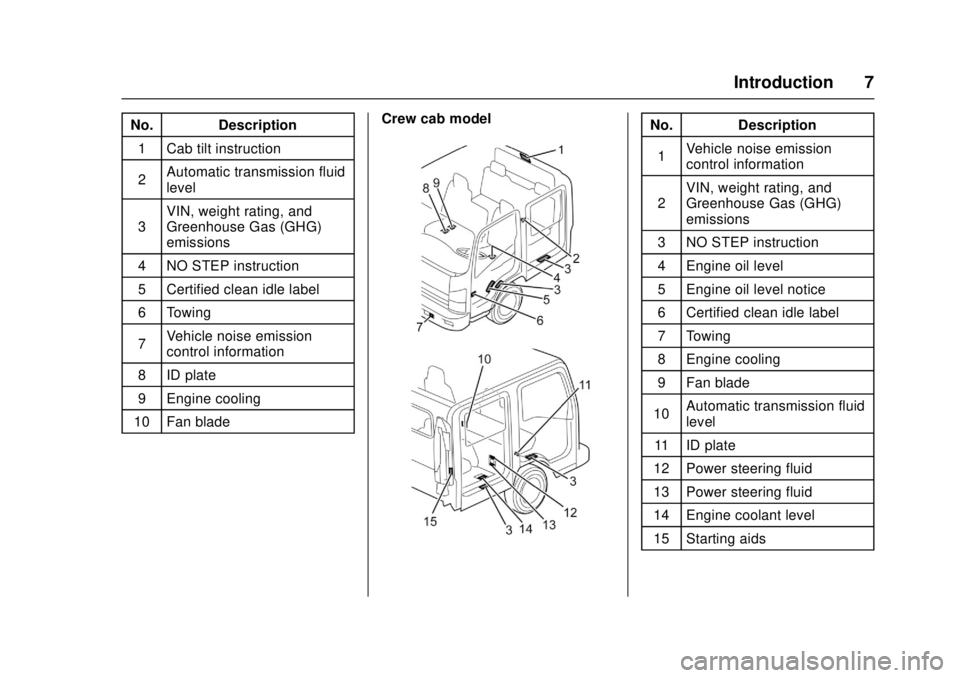
No. Description1 Cab tilt instruction
2 Automatic transmission fluid
level
3 VIN, weight rating, and
Greenhouse Gas (GHG)
emissions
4 NO STEP instruction
5 Certified clean idle label
6 Towing
7 Vehicle noise emission
control information
8 ID plate
9 Engine cooling
10 Fan blade Crew cab modelNo. Description
1 Vehicle noise emission
control information
2 VIN, weight rating, and
Greenhouse Gas (GHG)
emissions
3 NO STEP instruction
4 Engine oil level
5 Engine oil level notice
6 Certified clean idle label
7 Towing
8 Engine cooling
9 Fan blade
10 Automatic transmission fluid
level
11 ID plate
12 Power steering fluid
13 Power steering fluid
14 Engine coolant level
15 Starting aids
Page 48 of 414
Chevrolet Low Cab Forward Owner Manual (GMNA-Localizing-U.S.-
10716700) - 2017 - crc - 12/6/16
Seats and Restraints 47
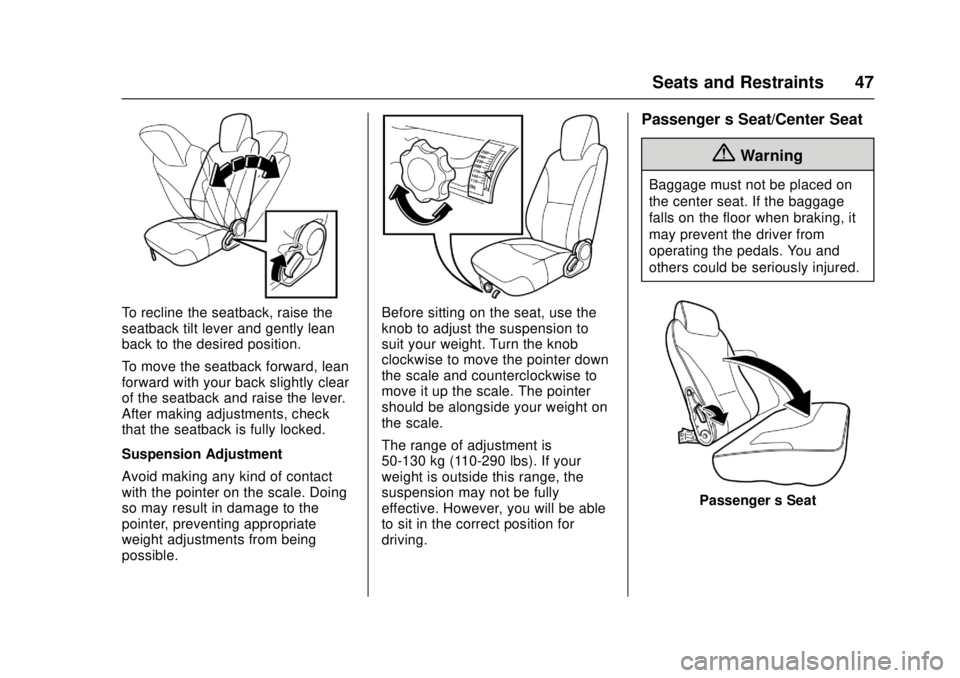
To recline the seatback, raise the
seatback tilt lever and gently lean
back to the desired position.
To move the seatback forward, lean
forward with your back slightly clear
of the seatback and raise the lever.
After making adjustments, check
that the seatback is fully locked.
Suspension Adjustment
Avoid making any kind of contact
with the pointer on the scale. Doing
so may result in damage to the
pointer, preventing appropriate
weight adjustments from being
possible.Before sitting on the seat, use the
knob to adjust the suspension to
suit your weight. Turn the knob
clockwise to move the pointer down
the scale and counterclockwise to
move it up the scale. The pointer
should be alongside your weight on
the scale.
The range of adjustment is
50-130 kg (110-290 lbs). If your
weight is outside this range, the
suspension may not be fully
effective. However, you will be able
to sit in the correct position for
driving.
Passenger’s Seat/Center Seat
{Warning
Baggage must not be placed on
the center seat. If the baggage
falls on the floor when braking, it
may prevent the driver from
operating the pedals. You and
others could be seriously injured.
Passenger ’s Seat
Page 58 of 414
Chevrolet Low Cab Forward Owner Manual (GMNA-Localizing-U.S.-
10716700) - 2017 - crc - 12/6/16
Seats and Restraints 57
If the belt is not winding and
unwinding correctly, or if inspection
reveals problems such as loose
mountings, metal parts deformation,
webbing damage, fraying or
discoloration, arrange for
replacement to be carried out by
your dealer.Child Restraints
Infants and Young
Children
{Warning
The vehicle's seat belts are
designed for adults. If a seat belt
touches a child's neck or chin,
or does not rest across his/her
hips, use a baby seat, child seat
or junior seat. If the seat belt were
used as it is, it could apply
intense pressure to the child's
abdomen in the event of a
collision. A small child who is not
able to sit up by him/herself must
be placed in a child seat.
Do not fit a baby seat, child seat
or junior seat on the center seat.
It could hinder your driving.
The appropriate type of baby seat,
child seat or junior seat and the
proper installation for it depend
upon the weight and height of the
child. It may not be possible to correctly fit certain child seats
depending on their shapes. Be sure
to use a child seat that is suitable
for the vehicle.
For detailed instructions, see the
instruction manual supplied with the
baby seat, child seat or junior seat.Child Restraint Systems
{Warning
Children small enough for child
restraints (as indicated on the
label of such restraints), including
booster seats, should always be
transported in them. Children who
have outgrown child restraint
systems should wear seat belts.
The lap belt should be snug and
positioned low on the abdomen
so that it is below the top of the
hipbone. Otherwise, the belt could
intrude into the child's abdomen
during an accident and cause
personal injury. When a child has
grown enough so that the
(Continued)
Page 64 of 414

Chevrolet Low Cab Forward Owner Manual (GMNA-Localizing-U.S.-
10716700) - 2017 - crc - 12/6/16
Storage 63
Do not place a cup that is too full in
the cupholder. Spillages could
cause damage to the radio and
other electrical circuits. If there is a
spill, wipe it up immediately with a
dry cloth.
Do not tilt the cab with a filled cup in
the cupholder. There may be a
danger of the cupholder breaking if
the weight on each holder exceeds
0.75 kg (1.65 lbs). Doing so may
also result in damage to the radio or
other electronic components.
Use the cupholders for storing small
articles or cups.Rear Storage
Single Cab Model Only
{Warning
Do not use the back panel tray to
hold any object that may fly or fall
out during vehicle operation.
Doing so would be dangerous.
Items may fly or fall out when the
cab is tilted.
You and others could be seriously
injured.The center area of the back panel
tray can be used as a storage
receptacle. The warning triangle and
fire extinguisher can be carried in
both sides.
Page 65 of 414
Chevrolet Low Cab Forward Owner Manual (GMNA-Localizing-U.S.-
10716700) - 2017 - crc - 12/6/16
64 Storage
Additional Storage
Features
Shopping Bag Hooks
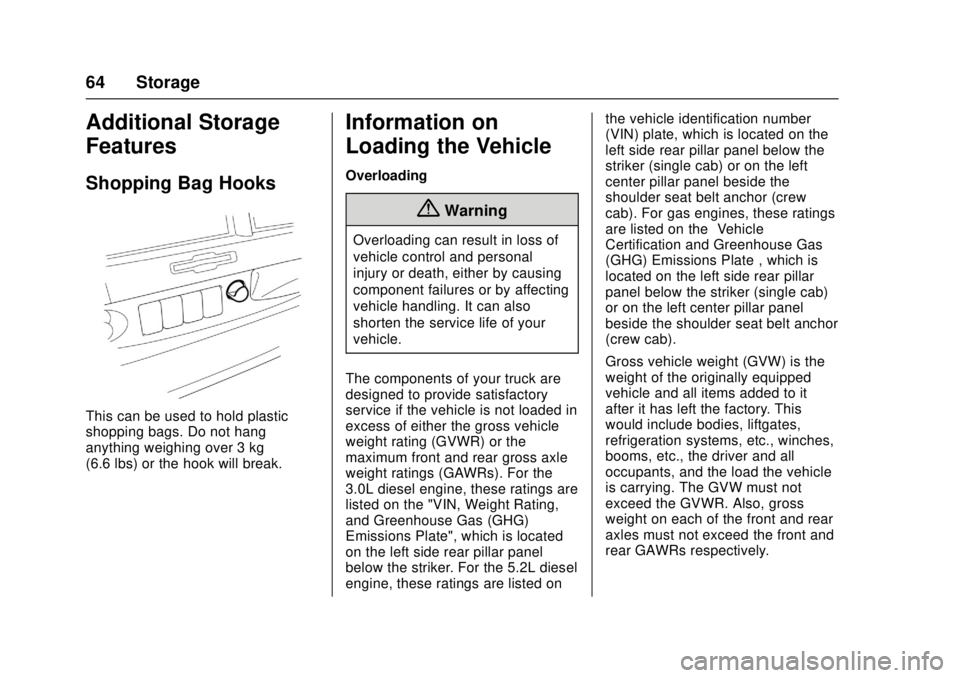
This can be used to hold plastic
shopping bags. Do not hang
anything weighing over 3 kg
(6.6 lbs) or the hook will break.
Information on
Loading the Vehicle
Overloading
{Warning
Overloading can result in loss of
vehicle control and personal
injury or death, either by causing
component failures or by affecting
vehicle handling. It can also
shorten the service life of your
vehicle.
The components of your truck are
designed to provide satisfactory
service if the vehicle is not loaded in
excess of either the gross vehicle
weight rating (GVWR) or the
maximum front and rear gross axle
weight ratings (GAWRs). For the
3.0L diesel engine, these ratings are
listed on the "VIN, Weight Rating,
and Greenhouse Gas (GHG)
Emissions Plate", which is located
on the left side rear pillar panel
below the striker. For the 5.2L diesel
engine, these ratings are listed on the vehicle identification number
(VIN) plate, which is located on the
left side rear pillar panel below the
striker (single cab) or on the left
center pillar panel beside the
shoulder seat belt anchor (crew
cab). For gas engines, these ratings
are listed on the
“Vehicle
Certification and Greenhouse Gas
(GHG) Emissions Plate”, which is
located on the left side rear pillar
panel below the striker (single cab)
or on the left center pillar panel
beside the shoulder seat belt anchor
(crew cab).
Gross vehicle weight (GVW) is the
weight of the originally equipped
vehicle and all items added to it
after it has left the factory. This
would include bodies, liftgates,
refrigeration systems, etc., winches,
booms, etc., the driver and all
occupants, and the load the vehicle
is carrying. The GVW must not
exceed the GVWR. Also, gross
weight on each of the front and rear
axles must not exceed the front and
rear GAWRs respectively.
Page 66 of 414

Chevrolet Low Cab Forward Owner Manual (GMNA-Localizing-U.S.-
10716700) - 2017 - crc - 12/6/16
Storage 65
Your dealer can advise you of the
proper loading conditions for your
vehicle. Using selected heavier
suspension components for added
durability may not increase any of
the weight ratings shown on the VIN
and weight rating plate for diesel
engines and on the“Vehicle
Certification and Greenhouse Gas
(GHG) Emissions Plate” for gas
engines.3.0L Diesel Engine
Maximum GVWR kg (lb.) Front GAWR Capacity
kg (lb.) Rear GAWR Capacity
kg (lb.)
5 897 (13,000) 2 431 (5,360)4 482 (9,880)
5.2L Diesel Engine
Model Maximum
GVWR
kg (lb.) Front GAWR
Capacitykg (lb.) Rear GAWR
Capacitykg (lb.)
4500HD 6 577 (14,500) 2 431 (5,360) 4 482 (9,880) 4500XD 7 258 (16,000) 3 007 (6,630) 4 998 (11,020)
5500HD 8 142 (17,950) 3 098 (6,830) 5 888 (12,980) 5500XD 8 845 (19,500) 3 300 (7,275) 6 196 (13,660)
Gas Engine
Model Maximum GVWR
kg (lb.) Front GAWR
Capacitykg (lb.) Rear GAWR
Capacitykg (lb.)
3500 5 443 (12,000) 2 204 (4,860) 4 010 (8,840)
4500 6 577 (14,500) 3 007 (6,630) 4 482 (9,880)
Page 67 of 414
Chevrolet Low Cab Forward Owner Manual (GMNA-Localizing-U.S.-
10716700) - 2017 - crc - 12/6/16
66 Storage
Maximum Front and Rear Axle
Weights
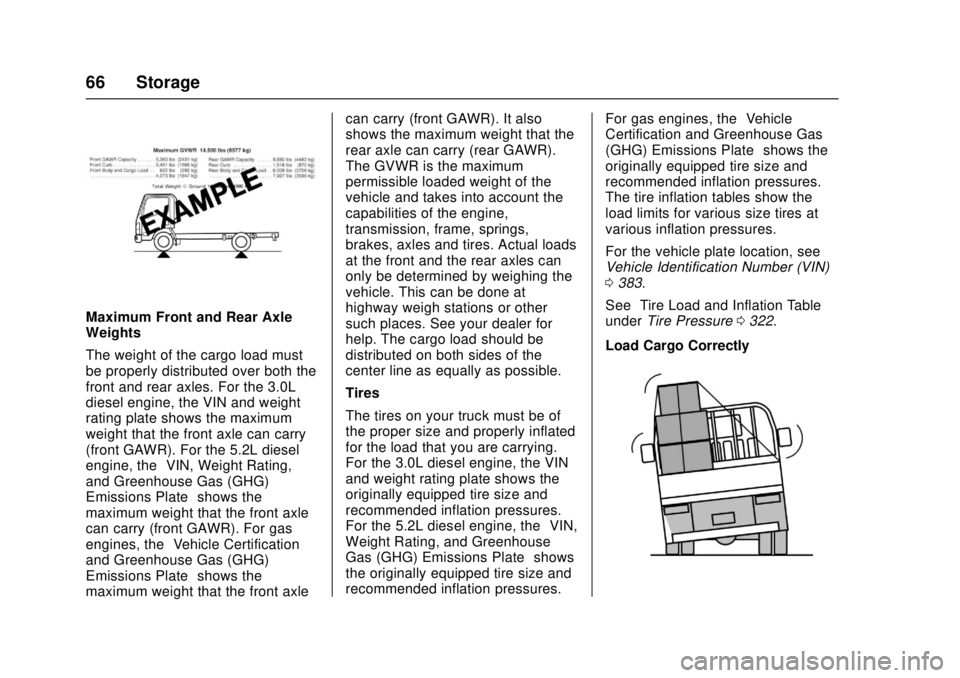
The weight of the cargo load must
be properly distributed over both the
front and rear axles. For the 3.0L
diesel engine, the VIN and weight
rating plate shows the maximum
weight that the front axle can carry
(front GAWR). For the 5.2L diesel
engine, the“VIN, Weight Rating,
and Greenhouse Gas (GHG)
Emissions Plate” shows the
maximum weight that the front axle
can carry (front GAWR). For gas
engines, the “Vehicle Certification
and Greenhouse Gas (GHG)
Emissions Plate” shows the
maximum weight that the front axle can carry (front GAWR). It also
shows the maximum weight that the
rear axle can carry (rear GAWR).
The GVWR is the maximum
permissible loaded weight of the
vehicle and takes into account the
capabilities of the engine,
transmission, frame, springs,
brakes, axles and tires. Actual loads
at the front and the rear axles can
only be determined by weighing the
vehicle. This can be done at
highway weigh stations or other
such places. See your dealer for
help. The cargo load should be
distributed on both sides of the
center line as equally as possible.
Tires
The tires on your truck must be of
the proper size and properly inflated
for the load that you are carrying.
For the 3.0L diesel engine, the VIN
and weight rating plate shows the
originally equipped tire size and
recommended inflation pressures.
For the 5.2L diesel engine, the
“VIN,
Weight Rating, and Greenhouse
Gas (GHG) Emissions Plate” shows
the originally equipped tire size and
recommended inflation pressures. For gas engines, the
“Vehicle
Certification and Greenhouse Gas
(GHG) Emissions Plate” shows the
originally equipped tire size and
recommended inflation pressures.
The tire inflation tables show the
load limits for various size tires at
various inflation pressures.
For the vehicle plate location, see
Vehicle Identification Number (VIN)
0 383.
See “Tire Load and Inflation Table”
under Tire Pressure 0322.
Load Cargo Correctly
Page 68 of 414
Chevrolet Low Cab Forward Owner Manual (GMNA-Localizing-U.S.-
10716700) - 2017 - crc - 12/6/16
Storage 67
{Warning
Overloading can result in an
accident because it places too
much strain on the wheel studs
with the result that they break and
the wheels come off.
The weight of the payload must
be limited within the gross vehicle
weight (GVW) rating and
distributed over the front and rear
axles so as not to exceed the
axle capacities.
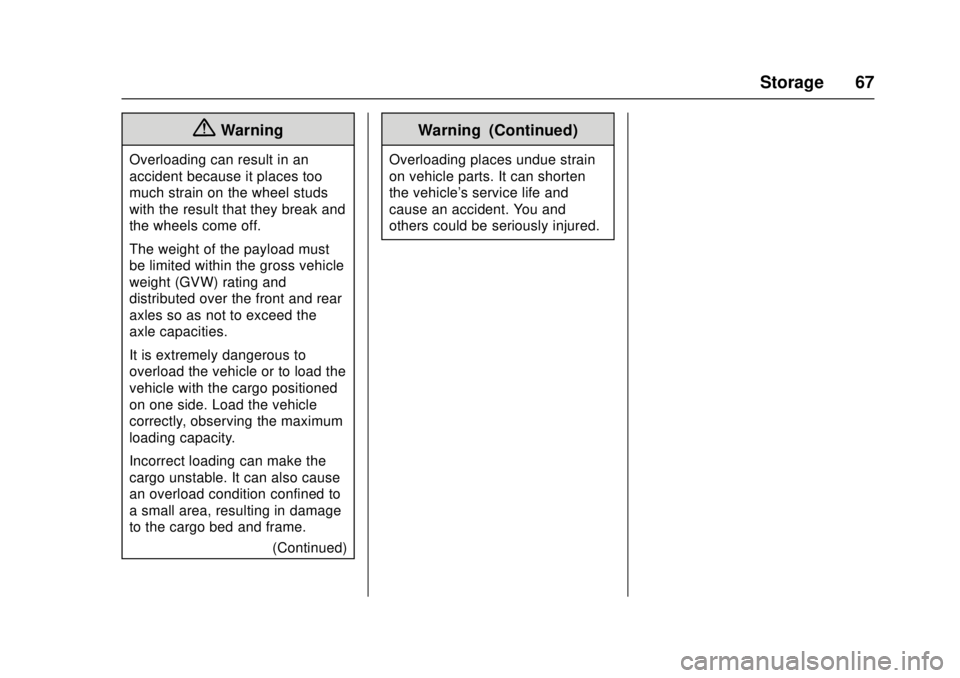
It is extremely dangerous to
overload the vehicle or to load the
vehicle with the cargo positioned
on one side. Load the vehicle
correctly, observing the maximum
loading capacity.
Incorrect loading can make the
cargo unstable. It can also cause
an overload condition confined to
a small area, resulting in damage
to the cargo bed and frame.(Continued)
Warning (Continued)
Overloading places undue strain
on vehicle parts. It can shorten
the vehicle's service life and
cause an accident. You and
others could be seriously injured.
Page 70 of 414

Chevrolet Low Cab Forward Owner Manual (GMNA-Localizing-U.S.-
10716700) - 2017 - crc - 12/6/16
Storage 69
Cargo loading cautionIncorrectCorrect
Avoid loading cargo too high. It can cause the vehicle to tip sideways
when it catches sidewinds and when turning the vehicle.
Loading Farm Equipment
Do not load farm equipment from
the rear of the cargo bed. The frame
may become deformed when farm
equipment is loaded from the rear of
the cargo bed. In addition, the frame may become deformed even when
loading farm equipment that has a
weight under the maximum loading
capacity.
When loading farming equipment, a
device for securing the cargo bed is
required. Use a car carrier or attach
a rear support stand. If you have
any questions, contact your dealer.
Make Sure There is No Flammable
Material between the Cab and
Cargo Bed
Caution
Be careful not to allow the ends of
ropes or edges of tarpaulins to
come lower than the heat
protector at the back of the cab.
During vehicle operation, the
engine's heat could set them on
fire. Carefully secure the ends of
ropes and edges of tarpaulins.
Page 138 of 414
Chevrolet Low Cab Forward Owner Manual (GMNA-Localizing-U.S.-
10716700) - 2017 - crc - 12/6/16
Driving and Operating 137
breakdown on a highway
represents a hazard to other
vehicles and can cause an
accident. Concentrate on safe
driving. Remember to perform
daily pre-operation inspections
and use highway driving
techniques. When performing
daily pre-operation inspections,
perform the checks shown in the
table on the left with particularly
great care.
Refer toOwner Checks and
Services 0367.
. When merging with traffic on a
highway, use the turn signal
lights to indicate your intentions
ahead of time. Speed up
sufficiently when you are in the
acceleration lane. Pay attention
to vehicles behind you and to
conditions in the lane you are
joining. Merge in such a way that
you do not obstruct vehicles in
the lane.
. Your sense of how fast you are
traveling becomes distorted on
long highway drives. Constantly keep an eye on the
speedometer, and maintain a
suitable headway distance.
. During high-speed driving, even
a little turn of the steering wheel
causes a big movement of the
vehicle. Turn the steering wheel
slowly.
. Excessive use of the brake
pedal is extremely dangerous
because it rapidly wears the
brake linings and causes brake
fade. Make effective use of the
engine brake and the exhaust
brake when you want to
decelerate.
. When you want to turn off a
highway, use the turn signal
lights to indicate your intentions
ahead of time. Paying attention
to vehicles behind you, turn off
the highway smoothly so as not
to obstruct other vehicles.
Brake Fade : Frequent use of the
brakes can cause the brakes to
overheat so that the frictional force
of the brake linings decreases and the brakes become less effective
than normal. This phenomenon is
called brake fade.
Braking
Brake Operation
The brakes give strong braking
force with only light pressure on the
pedal. Do not press the brake pedal
hard except in the event of an
emergency.
Actual stopping distances vary
greatly. Your ability to stop safely
will be greatly affected by the
surface of the road, whether it is
pavement or gravel; the condition of
the road, whether it is wet, dry or
icy; tire tread; the condition of the
brakes; the weight of the vehicle;
the weight of the load; and the
amount of brake force applied.
Please allow for realistic stopping
distances to avoid unnecessary
heavy braking. That means better
braking, longer brake life and safer
driving.