lock CHEVROLET LOW CAB FORWARD 2018 Owner's Manual
[x] Cancel search | Manufacturer: CHEVROLET, Model Year: 2018, Model line: LOW CAB FORWARD, Model: CHEVROLET LOW CAB FORWARD 2018Pages: 358, PDF Size: 6.32 MB
Page 292 of 358
Chevrolet Low Cab Forward Owner Manual (GMNA-Localizing-U.S.-
11254764) - 2018 - crc - 12/5/16
Vehicle Care 291
7. If the engine in the disabledvehicle starts, remove the
jumper cables in the reverse
sequence as they were
connected.Towing the Vehicle
Consult your dealer or a
professional towing service if the
disabled vehicle must be towed.
Proper equipment must be used to
prevent damage to vehicles during
any towing. State and local laws
which apply to vehicles in tow must
be followed. Vehicles should not be
towed at speeds in excess of
88 km/h (55 mph).
Connect to the main structural parts
of the vehicle. Do not attach to
bumpers, tow hooks or brackets.
Use only equipment designed for
this purpose. Follow the instructions
of the wrecker manufacturer.
A safety chain system must
be used.
The procedures below must be
followed when towing to prevent
possible damage. Front End Towing (Front Wheels
Off Ground)
To prepare a disabled vehicle for
front end towing with front wheels
raised off the ground, the following
steps are necessary:
.
Block the rear wheels of the
disabled vehicle.
. Disconnect the driveshaft at the
rear axle. Secure the driveshaft
to the frame or crossmember.
When towing, disconnect the
driveshaft at the rear axle to ensure
the transmission is not damaged.
The rear end of the driveshaft must
be disconnected and safely secured
if the 80 km (50 mi) or 48 km/h
(30 mph) is exceeded.
If there is damage or suspected
damage to the rear axle, remove the
axle shafts. Cover the hub openings
to prevent the loss of lubricant or
entry of dirt or foreign objects.
Place a 10 cm (4 in) wood beam
against the towing guide behind the
bumper. (If no 10 cm (4 in) is
available, then remove the bumper.)
Ensure towing chains do not come
Page 293 of 358
Chevrolet Low Cab Forward Owner Manual (GMNA-Localizing-U.S.-
11254764) - 2018 - crc - 12/5/16
292 Vehicle Care
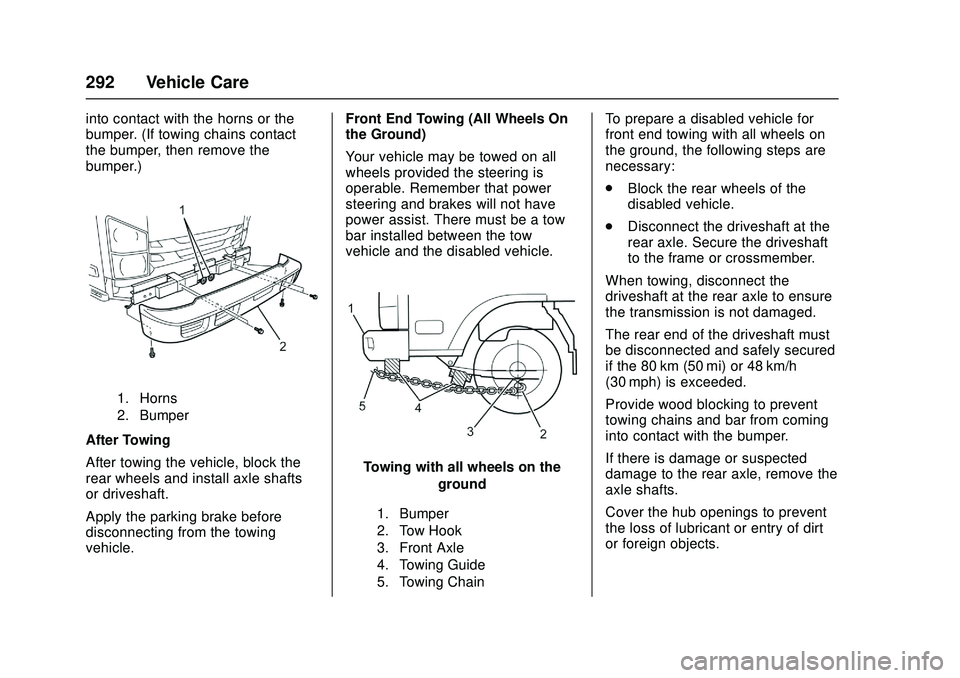
into contact with the horns or the
bumper. (If towing chains contact
the bumper, then remove the
bumper.)
1. Horns
2. Bumper
After Towing
After towing the vehicle, block the
rear wheels and install axle shafts
or driveshaft.
Apply the parking brake before
disconnecting from the towing
vehicle.Front End Towing (All Wheels On
the Ground)
Your vehicle may be towed on all
wheels provided the steering is
operable. Remember that power
steering and brakes will not have
power assist. There must be a tow
bar installed between the tow
vehicle and the disabled vehicle.
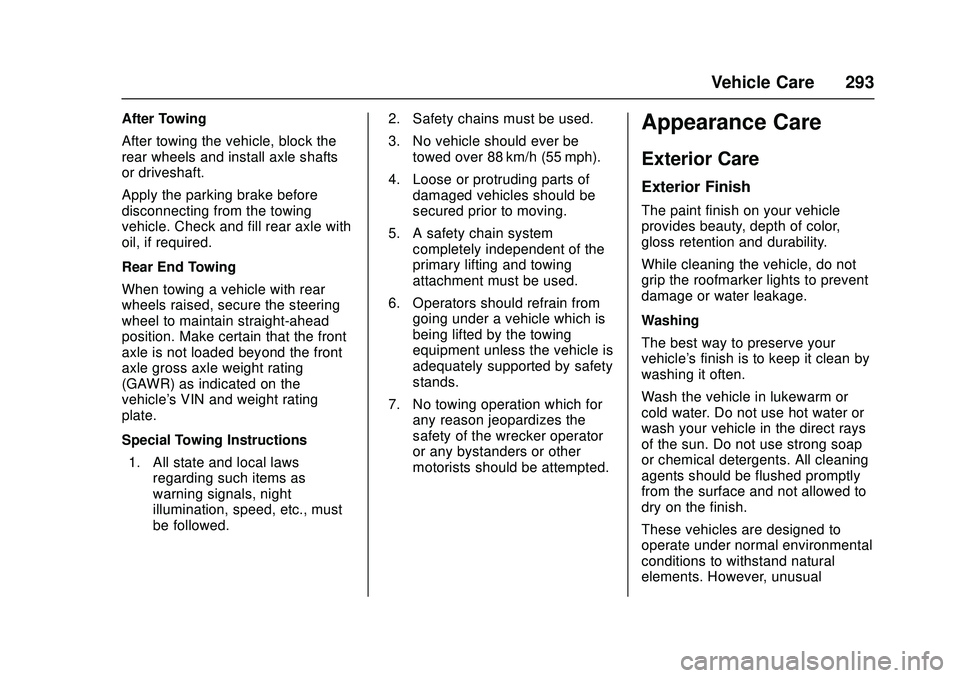
Towing with all wheels on the
ground
1. Bumper
2. Tow Hook
3. Front Axle
4. Towing Guide
5. Towing Chain
To prepare a disabled vehicle for
front end towing with all wheels on
the ground, the following steps are
necessary:
.Block the rear wheels of the
disabled vehicle.
. Disconnect the driveshaft at the
rear axle. Secure the driveshaft
to the frame or crossmember.
When towing, disconnect the
driveshaft at the rear axle to ensure
the transmission is not damaged.
The rear end of the driveshaft must
be disconnected and safely secured
if the 80 km (50 mi) or 48 km/h
(30 mph) is exceeded.
Provide wood blocking to prevent
towing chains and bar from coming
into contact with the bumper.
If there is damage or suspected
damage to the rear axle, remove the
axle shafts.
Cover the hub openings to prevent
the loss of lubricant or entry of dirt
or foreign objects.
Page 294 of 358
Chevrolet Low Cab Forward Owner Manual (GMNA-Localizing-U.S.-
11254764) - 2018 - crc - 12/5/16
Vehicle Care 293
After Towing
After towing the vehicle, block the
rear wheels and install axle shafts
or driveshaft.
Apply the parking brake before
disconnecting from the towing
vehicle. Check and fill rear axle with
oil, if required.
Rear End Towing
When towing a vehicle with rear
wheels raised, secure the steering
wheel to maintain straight-ahead
position. Make certain that the front
axle is not loaded beyond the front
axle gross axle weight rating
(GAWR) as indicated on the
vehicle's VIN and weight rating
plate.
Special Towing Instructions1. All state and local laws regarding such items as
warning signals, night
illumination, speed, etc., must
be followed. 2. Safety chains must be used.
3. No vehicle should ever be
towed over 88 km/h (55 mph).
4. Loose or protruding parts of damaged vehicles should be
secured prior to moving.
5. A safety chain system completely independent of the
primary lifting and towing
attachment must be used.
6. Operators should refrain from going under a vehicle which is
being lifted by the towing
equipment unless the vehicle is
adequately supported by safety
stands.
7. No towing operation which for any reason jeopardizes the
safety of the wrecker operator
or any bystanders or other
motorists should be attempted.Appearance Care
Exterior Care
Exterior Finish
The paint finish on your vehicle
provides beauty, depth of color,
gloss retention and durability.
While cleaning the vehicle, do not
grip the roofmarker lights to prevent
damage or water leakage.
Washing
The best way to preserve your
vehicle's finish is to keep it clean by
washing it often.
Wash the vehicle in lukewarm or
cold water. Do not use hot water or
wash your vehicle in the direct rays
of the sun. Do not use strong soap
or chemical detergents. All cleaning
agents should be flushed promptly
from the surface and not allowed to
dry on the finish.
These vehicles are designed to
operate under normal environmental
conditions to withstand natural
elements. However, unusual
Page 318 of 358

Chevrolet Low Cab Forward Owner Manual (GMNA-Localizing-U.S.-
11254764) - 2018 - crc - 12/5/16
Service and Maintenance 317
Owner Checks and
Services
Before Driving
Proper care and driving is important
not only for extended service life of
your vehicle, but also for improved
fuel and oil economy. Drive carefully
and defensively. Be sure you know
how to use your truck and its
equipment before operating it.
Starting and Operating
Proper care and operation will not
only extend the service life of your
vehicle but also improve fuel
economy.
Check Around the Vehicle Before
Starting the Engine
Before pulling away, perform a
thorough safety check, making sure
there are no children or obstructions
around the vehicle.
Take off the chocks after confirming
that the parking brake is securely
applied. Sit behind the wheel, adjust
the seat position, and buckle up the
seat belt. The passengers are alsorequired to buckle up the seat belts.
Adjust the positions of the steering
wheel and mirrors. Lock the doors.
Turn the power of the dome light or
accessories OFF before starting the
engine.
Engine Conditions
Checking the Engine for
Startability and Abnormal Noises
1. Make sure the parking brake is securely engaged. Step firmly
on the brake pedal.
2. Make sure the selector lever is in "P" or "N" position.
For safety, firmly press the
brake pedal before starting the
engine.
3. Turn the engine control switch to start the engine.
Check that the engine starts
quickly with no abnormal
noises. Checking Condition of the Engine
at Low Speeds and during
Acceleration
1. Make sure the transmission is in the "P" or "N" position and
the parking brake is securely
engaged.
2. Turn the engine control switch to start the engine, and run it to
warm up.
3. Check that the engine is running at a speed within the
standard idle speed range.
During regeneration of the
diesel particulate filter (DPF),
the engine idle speed may
increase.
4. Drive the vehicle, making sure the accelerator pedal does not
stick when gradually
accelerating, the engine speed
rises smoothly and it does not
knock.
Page 319 of 358

Chevrolet Low Cab Forward Owner Manual (GMNA-Localizing-U.S.-
11254764) - 2018 - crc - 12/5/16
318 Service and Maintenance
Recommended Daily
(Pre-operation) Inspections
These checks are in addition to, not
instead of, any legally required daily
inspections. See related topics
under "Maintenance Schedule",
especially if problems are found.
For safe and comfortable driving,
keep record of the distances driven
and the condition of the vehicle
during operation. Perform
inspections at appropriate intervals,
and perform maintenance in
accordance with the findings of the
inspections. If an inspection reveals
an abnormality or there was an
abnormality the previous time the
vehicle was driven, have the vehicle
repaired by the nearest dealer
before it is driven again.1. Components that showed abnormalities during the
previous operation
.Check components that
showed abnormalities
during the previous
operation 2. Checks performed at the
engine
.Fan belt looseness and
damage
. Engine oil level
. Engine coolant level
. Power steering fluid level
3. Checks performed from the driver's seat
.Brake fluid level
. Brake pedal free play
. Operation of meters,
gauges and warning/
indicator lights
. Engine startability,
abnormal noise and color of
exhaust gases
. Parking brake lever stroke
. Windshield washer fluid
spray condition and
windshield wiper
effectiveness
. Windshield washer fluid
level .
Steering wheel position and
free play
. Operation of horn and turn
signal lights
. Door lock operation
4. Checks performed during a walk around the vehicle
.Illumination, flashing,
contamination, damage and
obstruction of lights
. Contamination, damage ad
obstruction of windows,
mirrors and reflectors
. Leaf spring damage
. Oil, engine coolant, fuel,
brake fluid and power
steering fluid leaks
. Water separator
5. Checking wheels and tires .Air pressure
. Cracks and other damage
. Abnormal wear
. Tread depth
. Mounting condition of all
wheel nuts
Page 325 of 358
Chevrolet Low Cab Forward Owner Manual (GMNA-Localizing-U.S.-
11254764) - 2018 - crc - 12/5/16
324 Service and Maintenance
one side, unusual sounds when
braking, increased brake pedal
travel or harder pedal. The front and
rear brakes are attached to an auto
adjuster mechanism. If there are no
defects, as the pedal travel is
properly maintained, adjustments
are not necessary. Check regularly
that the brake fluid reservoir
(left-hand side of the instrument
panel) or HBB reservoir (5500HD,
5500XD models: left side behind the
cab) is properly filled and check for
fluid leaks. Any of these conditions
could indicate the need for brake
system inspection and/or service.
G: Exhaust System :Be alert for
any changes in the sound of the
exhaust system or any smell of
fumes. These are signs the system
may be leaking. Have it checked
and/or repaired at once. (Refer to
"Engine Exhaust Emissions Caution
(Carbon Monoxide)" under Engine
Exhaust 0159).
H: Windshield Wipers and
Washers : Check operation and
condition of the wiper blades. Check
the flow of the washer spray. I: Defroster :
Turn the outlet
selector knob to "Defroster" and the
fan speed control knob to the fully
clockwise position. Then check the
airflow from the ducts at the inside
base of the windshield.
J: Rearview Mirrors and Sun
Visors : Check that friction joints
hold mirrors and sun visors in place.
K: Horn : Sound the horn, now and
then, to be sure it works.
L: Lap-Shoulder Belts : Check the
seat belt system (including webbing,
buckles, latch plates and anchors)
for proper operation, and for
damage.
M: Seat Adjusters : When
adjusting the driver's manual seat,
be sure the seat adjusters latch by
pushing the seat forward and
backward. Do not attempt to adjust
the seat when the vehicle is in
motion.
N: Lamps : Check panel lighting,
warning lamps, indicator lamps and
interior lamps. On the outside,
check: license plate lamps, side
marker lamps, reflectors on outside mirrors, headlamps, parking lamps,
identification and clearance lamps,
taillights, brake lamps, turn signals,
cornering lamps, backup lamps and
hazard warning flashers. Have
headlamp aim checked immediately
if beams seem improperly aimed.
O: Glass, Mirrors, Lights and/or
Reflectors Condition :
Look for
broken, scratched, dirty or damaged
glass, mirrors, lamps or reflectors
that could reduce the view or
visibility, or cause injury. Replace,
clean or repair promptly.
P: Door Latches : Check that doors
close, latch and lock tightly. Check
for broken, damaged or missing
parts that might prevent tight
latching.
Q :Tilt Cab (Driving Position) : Be
sure the tilt lever is down and
locked.
R: Fluid Leaks : Check for fuel,
water, oil or other fluid leaks by
looking at the surface beneath the
vehicle after it has been parked for
a while. If you notice diesel fumes or
fluid at any time, have the cause
found and corrected at once.
Page 335 of 358

Chevrolet Low Cab Forward Owner Manual (GMNA-Localizing-U.S.-
11254764) - 2018 - crc - 12/5/16
334 Technical Data
12: Model CombinationF: 3500HD/4JJ1 Diesel/13,000lbs
K: 4500XD/4HK1 Diesel/16,000lbs
0: 4500HD/4HK1 Diesel/14,500lbs
E: GM Chevrolet 5500HD/5500XD
3: 5500XD/4HK1 Diesel/19,500lbs
8: 3500 & 4500/Gas
9: 5500HD/4HK1 Diesel/17,950lbs
13–17: Sequence Number Positions 13 through 17 represent the number sequentially assigned by the manufacturer in the production
process.
Interpretation of the VIN may differ
depending on the vehicle. For
further details, please ask your
dealer.
Engine NumberThe engine number is located on
the left-side rear part of the engine
block and the right-side front part of
the oil pan.
Page 337 of 358
Chevrolet Low Cab Forward Owner Manual (GMNA-Localizing-U.S.-
11254764) - 2018 - crc - 12/5/16
336 Technical Data
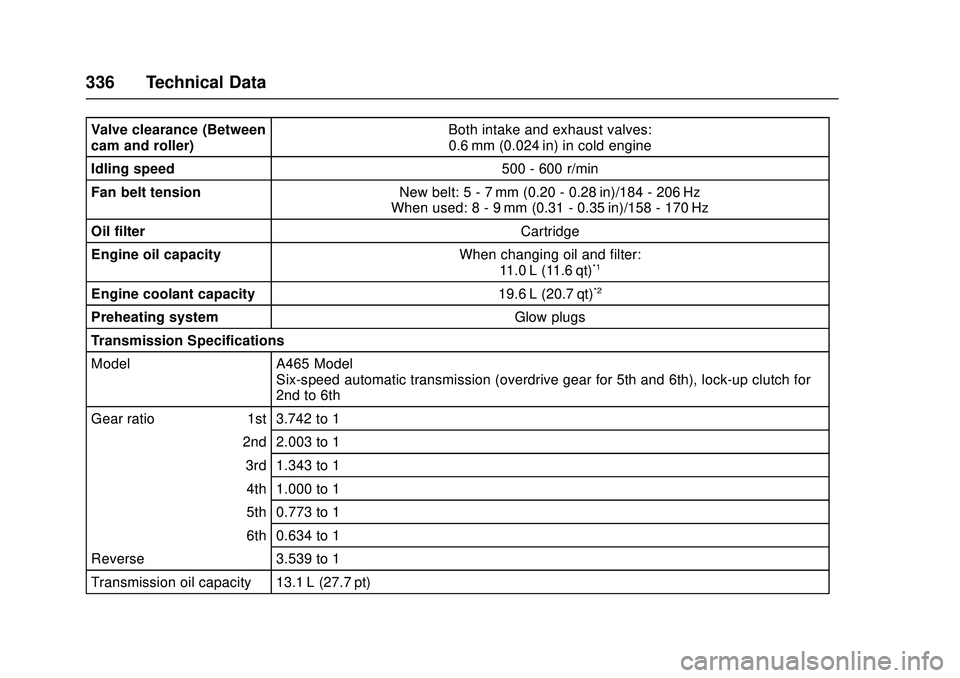
Valve clearance (Between
cam and roller)Both intake and exhaust valves:
0.6 mm (0.024 in) in cold engine
Idling speed 500 - 600 r/min
Fan belt tension New belt: 5 - 7 mm (0.20 - 0.28 in)/184 - 206 Hz
When used: 8 - 9 mm (0.31 - 0.35 in)/158 - 170 Hz
Oil filter Cartridge
Engine oil capacity When changing oil and filter:
11.0 L (11.6 qt)
*1
Engine coolant capacity 19.6 L (20.7 qt)*2
Preheating system Glow plugs
Transmission Specifications
Model A465 Model Six-speed automatic transmission (overdrive gear for 5th and 6th), lock-up clutch for
2nd to 6th
Gear ratio 1st 3.742 to 1 2nd 2.003 to 13rd 1.343 to 1
4th 1.000 to 1
5th 0.773 to 1
6th 0.634 to 1
Reverse 3.539 to 1
Transmission oil capacity 13.1 L (27.7 pt)
Page 350 of 358
Chevrolet Low Cab Forward Owner Manual (GMNA-Localizing-U.S.-
11254764) - 2018 - crc - 12/5/16
Customer Information 349
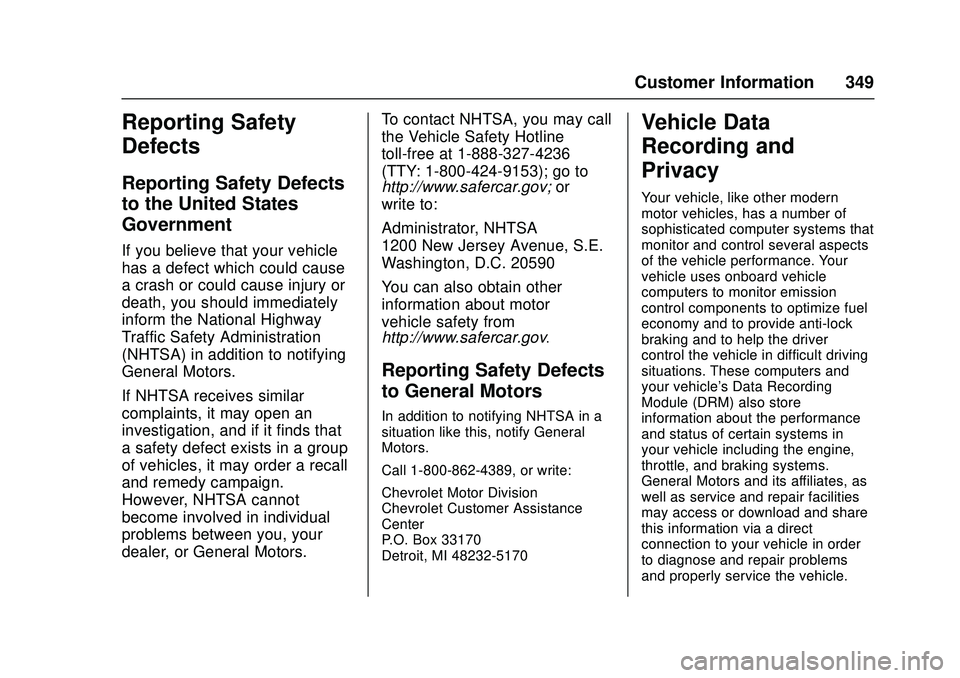
Reporting Safety
Defects
Reporting Safety Defects
to the United States
Government
If you believe that your vehicle
has a defect which could cause
a crash or could cause injury or
death, you should immediately
inform the National Highway
Traffic Safety Administration
(NHTSA) in addition to notifying
General Motors.
If NHTSA receives similar
complaints, it may open an
investigation, and if it finds that
a safety defect exists in a group
of vehicles, it may order a recall
and remedy campaign.
However, NHTSA cannot
become involved in individual
problems between you, your
dealer, or General Motors.To contact NHTSA, you may call
the Vehicle Safety Hotline
toll-free at 1-888-327-4236
(TTY: 1-800-424-9153); go to
http://www.safercar.gov;
or
write to:
Administrator, NHTSA
1200 New Jersey Avenue, S.E.
Washington, D.C. 20590
You can also obtain other
information about motor
vehicle safety from
http://www.safercar.gov
.
Reporting Safety Defects
to General Motors
In addition to notifying NHTSA in a
situation like this, notify General
Motors.
Call 1-800-862-4389, or write:
Chevrolet Motor Division
Chevrolet Customer Assistance
Center
P.O. Box 33170
Detroit, MI 48232-5170
Vehicle Data
Recording and
Privacy
Your vehicle, like other modern
motor vehicles, has a number of
sophisticated computer systems that
monitor and control several aspects
of the vehicle performance. Your
vehicle uses onboard vehicle
computers to monitor emission
control components to optimize fuel
economy and to provide anti-lock
braking and to help the driver
control the vehicle in difficult driving
situations. These computers and
your vehicle's Data Recording
Module (DRM) also store
information about the performance
and status of certain systems in
your vehicle including the engine,
throttle, and braking systems.
General Motors and its affiliates, as
well as service and repair facilities
may access or download and share
this information via a direct
connection to your vehicle in order
to diagnose and repair problems
and properly service the vehicle.
Page 352 of 358

Chevrolet Low Cab Forward Owner Manual (GMNA-Localizing-U.S.-
11254764) - 2018 - crc - 12/5/16
Index 351
IndexA
Accessories and Modifica-tions . . . . . . . . . . . . . . . . . . . . . . . . . . 218
Add-On Electrical Equipment . . . 215
Additional Maintenance and Care . . . . . . . . . . . . . . . . . . . . . . 323
Adjustments Seat, Initial Drive . . . . . . . . . . . . . . . 38
Agreements Trademarks and License . . . . . .114
Air Cleaner/Filter, Engine . . . . . . . 231
Air Conditioning . . . . . . . . . . . . . . . . 115
Air Filter, Passenger Com- partment . . . . . . . . . . . . . . . . . . . . . . 119
Air Vents . . . . . . . . . . . . . . . . . . . . . . . 118
AM-FM Radio . . . . . . . . . . . . . . . . . . . . 97
Antenna Fixed Mast . . . . . . . . . . . . . . . . . . . 102
Antilock Brake System (ABS) . . . 196
Warning Light . . . . . . . . . . . . . . . . . . . 77
Appearance Care Exterior . . . . . . . . . . . . . . . . . . . . . . . 293
Interior . . . . . . . . . . . . . . . . . . . . . . . . 299
Ashtrays . . . . . . . . . . . . . . . . . . . . . . . . . 68
Assistance Program,
Roadside . . . . . . . . . . . . . . . . . . . . . . 344
Audio Players CD . . . . . . . . . . . . . . . . . . . . . . . . . . . 103 Automatic
Transmission . . . . . . . . . . . . . . . . . 185
Transmission Fluid . . . . . . . . . . . 229
Automatic Transmission Selector Lever . . . . . . . . . . . . . . . . 194
Shift Lock Control FunctionCheck . . . . . . . . . . . . . . . . . . . . . . . 251
Automatic Transmission Fluid Temperature Warning Light . . . . . 78
Automatic Transmission Overdrive Off . . . . . . . . . . . . . . . . . . 195
Auxiliary Devices . . . . . . . . . . . . . . . . . . . . . . . .113
Axle, Rear . . . . . . . . . . . . . . . . . . . . . . 249
B
Battery . . . . . . . . . . . . . . . . . . . . . . . . . 247
Battery - North America . . . . . . . . . 287
Battery Warning Light . . . . . . . . . . . . 73
Biodiesel . . . . . . . . . . . . . . . . . . . . . . . 207
Blade Replacement, Wiper . . . . . 252
Brake Exhaust . . . . . . . . . . . . . . . . . . . . . . 201
System Warning Light . . . . . . . . . . 75
Brakes . . . . . . . . . . . . . . . . . . . . . . . . . . 242 Antilock . . . . . . . . . . . . . . . . . . . . . . . 196
Exhaust Light . . . . . . . . . . . . . . . . . . . 78
Fluid . . . . . . . . . . . . . . . . . . . . . . . . . . 246
Parking . . . . . . . . . . . . . . . . . . . . . . . 200