warning CHEVROLET LOW CAB FORWARD 2018 Owner's Manual
[x] Cancel search | Manufacturer: CHEVROLET, Model Year: 2018, Model line: LOW CAB FORWARD, Model: CHEVROLET LOW CAB FORWARD 2018Pages: 358, PDF Size: 6.32 MB
Page 234 of 358

Chevrolet Low Cab Forward Owner Manual (GMNA-Localizing-U.S.-
11254764) - 2018 - crc - 12/5/16
Vehicle Care 233
Warning (Continued)
Engine coolant is flammable, and
therefore, it must be kept away
from flames and other heat
sources. Engine coolant also
could ignite if it comes in contact
with a hot surface, such as the
exhaust manifold. Exercise
caution to prevent this from
happening.
You and others could be seriously
injured.
Preparing Engine Coolant
To prevent engine damage due to
freezing of the engine coolant and
to protect the cooling system from
corrosion, use a mixture of the
recommended type antifreeze and
water. If the engine of the vehicle is
at −30 °C (−22 °F) or above, the
coolant concentration should be
50%. Direct use of “50/50
Pre-diluted” product which is already
diluted to 50% concentration is
recommended. If the outside
temperature engine or vehicle is used at
−30 °C (−22 °F) or below,
coolant concentration of 55% is
recommended.
It is the owner ’s responsibility to:
. Maintain the engine cooling
system freeze protection at or
above −30 °C (−22 °F) (at or
below −30 °C (−22 °F) in colder
climates to ensure protection
against corrosion and loss of
engine coolant from boiling.
A 50/50 (55/45 for colder
climates) mixture of the
recommended type antifreeze
and water will provide freeze
protection to at or above −30 °C
(−22 °F), (at or below −30 °C
(−22 °F) in colder climates) and
boil protection to 128 °C
(262 °F). Periodic replacement
of engine coolant is needed to
replenish the anticorrosion
additives that wear out with use.
Engine coolant that has become
dark in color shows that it needs
to be changed.
. Use only the recommended
coolant. See Recommended
Fluids and Lubricants 0326. .
Do not use methanol-base
antifreeze, alcohol or plain water
alone in your vehicle at any time.
They will boil at a lower point
than that at which the engine
coolant temperature gauge will
warn of overheating, and they do
not provide proper protection
against corrosion.
Engine Coolant Quantity
For the quantity of engine coolant,
see Capacities and Specifications
0 335. After changing the engine
coolant, check that the engine
coolant is up to the specified level.
{Warning
For storage, close the cap of
coolant container securely and
keep it in a place inaccessible to
children.
You and others could be seriously
injured.
Using any coolant other than that
recommended by your dealer could
cause damage to the engine,
Page 238 of 358

Chevrolet Low Cab Forward Owner Manual (GMNA-Localizing-U.S.-
11254764) - 2018 - crc - 12/5/16
Vehicle Care 237
may be lost and damage to the
engine may result from overheating.
The radiator pressure cap should be
checked periodically for proper
operation. If a replacement is
required, a genuine GM part is
recommended.
Engine Overheating
When the Engine Overheats
The engine cooling system may
overheat if the engine coolant level
is too low, if there is a sudden loss
of engine coolant (such as radiator
hose failure), or if other problems
occur. It may also temporarily
overheat during severe operating
conditions such as:
.Climbing a long hill on a hot day.
. Stopping after high-speed
driving.
. Idling for long periods in traffic.
If engine power drops and the
needle on the engine coolant
temperature gauge goes up above
the upper limit of the safety zone
and enters the "H" zone, the engine
is overheating. The engine overheat warning light will come on and the
warning buzzer will sound. Either
steam or boiling engine coolant will
squirt out of the radiator. The
vehicle will also have an
“OVER
HEAT” message displayed. Take the
following corrective actions
immediately.
{Warning
To help avoid being burned:
Do not tilt the cab or open the
engine access cover if you see or
hear steam or engine coolant
escaping from the engine
compartment. Wait until no steam
or engine coolant can be seen or
heard before tilting the cab or
opening the engine cover.
Do not remove the radiator cap or
engine coolant reserve tank cap if
the engine coolant in the tank is
boiling. Also do not remove the
radiator cap while the engine and
radiator are still hot. Scalding fluid
(Continued)
Warning (Continued)
and steam can be blown out
under pressure if either cap is
taken off too soon.
You and others could be seriously
injured.
If Steam Is Coming from the
Engine Compartment
{Warning
If the engine coolant temperature
gauge shows an overheat
condition or you have other
reasons to suspect the engine
may be overheating, continued
operation of the engine (other
than as described here) even for
a short period of time may cause
a fire and the result in personal
injury and severe vehicle
damage. Take immediate action
as outlined.
You and others could be seriously
injured.
Page 239 of 358

Chevrolet Low Cab Forward Owner Manual (GMNA-Localizing-U.S.-
11254764) - 2018 - crc - 12/5/16
238 Vehicle Care
If you see or hear escaping steam
or have any other reason to suspect
there is a serious overheat
condition, stop and park the vehicle
as soon as it is safe to do so, turn
on the hazard warning flasher and
then turn off the engine immediately
and safely exit the vehicle.
If Steam Is Not Coming from the
Engine Compartment
If the engine coolant temperature
gauge shows an overheat condition,
or you have reason to suspect the
engine may be overheating, take
the following steps:1. Operate the hazard warning flasher and pull the vehicle
immediately over to a safe
place that does not impede
traffic and park it.
2. Idle the engine and wait until the engine coolant temperature
drops to safety zone. If your air
conditioner (if equipped) is on,
turn it off. And turn on the
heater to help the engine
expel heat. 3. When the needle of the engine
coolant temperature gauge
returns to the middle of the
safety zone, stop the engine.
If the needle of engine coolant
temperature gauge does not
drop inside into the safety
zone, turn the engine off and
have your vehicle serviced at
the nearest dealer.
When the cooling fan for the
radiator is not turning, turn off
the engine immediately.
{Warning
Even when the engine has been
stopped, the engine coolant in the
radiator remains under pressure.
Immediately removing the radiator
cap could cause steam or hot
water to blow out, and you could
be scalded as a result. The
engine coolant in the reserve tank
may also be hot. Immediately
removing the cap could cause hot
water to blow out, and possibly
scald you. Perform inspection,
(Continued)
Page 240 of 358
Chevrolet Low Cab Forward Owner Manual (GMNA-Localizing-U.S.-
11254764) - 2018 - crc - 12/5/16
Vehicle Care 239
Warning (Continued)
refilling, and replacement of
coolant only when its temperature
has cooled.
When removing the radiator cap
and reserve tank cap, use a thick
cloth to cover the cap and turn it
little by little.
You and others could be seriously
injured.
4. If no steam or engine coolant can be seen or heard from the
engine compartment:
.Tilt the cab or open the
engine access cover.
‐If the engine coolant is
boiling, wait until it stops
before proceeding.
‐ Look at the see-through
reserve tank. The
engine coolant level
should be between the
"MAX" and "MIN" lines
on the reserve tank. ‐
If necessary, pour
engine coolant (See
Engine Coolant 0231
for the proper coolant
and water mixture) into
the reserve tank only,
not directly into the
radiator. Also, do not
check engine coolant
level at the radiator.
. Make sure the fan belts are
not broken, or off the
pulleys, and that the fan
turns when the engine is
started. Make sure the fan
blade and pulleys are not
broken.
. Check the radiator hoses
and connections, heater
hoses and connections,
radiator, water pump, EGR
cooler, and SCR system
and hoses for leakage.
If you do not find a leak or
other problem, carefully add
engine coolant to the
reserve tank. If the engine coolant level in
the reserve tank is at the
correct level but there is still
an indication on the
instrument panel of an
overheat condition:
You must let the engine
cool first. You may then add
engine coolant directly to
the radiator. See
“Adding
Engine Coolant” under
Engine Coolant 0231.
5. Inspect to see if there is any dirt, etc. attached to the front
surface of the radiator. Also,
inspect to see if there is
anything blocking the core.
If there is anything attached,
clean and remove it.
6. After the inspection, regardless of the vehicle condition, please
contact the nearest dealer.
Once the engine coolant
temperature gauge no longer
signals an overheat condition, you
can resume driving at a reduced
speed. Return to normal driving
Page 241 of 358

Chevrolet Low Cab Forward Owner Manual (GMNA-Localizing-U.S.-
11254764) - 2018 - crc - 12/5/16
240 Vehicle Care
after about 10 minutes if the gauge
pointer does not again show an
overheat condition.
When tap water only has been used
for engine coolant in an emergency,
change the engine coolant as soon
as possible.
Engine damage may be caused if
an overheating engine is suddenly
refilled with water. Instead, refill
slowly.
Power Steering Fluid
The power steering fluid level must
be checked and it must be changed
according to the Maintenance
Schedule. SeeMaintenance
Schedule 0303.
When replenishing power steering
fluid or flushing the power steering
system, always use ATF
(Dexron
®-VI). Failure to use the
proper fluid may damage the power
steering system seals and hoses,
leading to fluid leakage.
Checking the Power Steering
Fluid Level
The fluid level is correct if it is
between the “MAX”and“MIN” lines
on the reserve tank. If the level is
lower that the “MIN”line, add fluid
up to the “MAX”line.
The reserve tank is located at the
rear of the engine compartment on
the right. When you have finished
checking the fluid level, securely
install the cap and cover.
When you have finished checking
the fluid level, securely install
the cap.
The fluid level is correct if it is
between the "MAX" and "MIN" lines
on the oil dipstick. If the level is
lower than the "MIN" line, add fluid
up to the "MAX" line.
{Warning
Before adding fluid, clean the
area around the cap and pour
fluid from a clean jug or filler.
Foreign matter getting in the tank
may cause power steering system
failure. (Continued)
Page 242 of 358

Chevrolet Low Cab Forward Owner Manual (GMNA-Localizing-U.S.-
11254764) - 2018 - crc - 12/5/16
Vehicle Care 241
Warning (Continued)
Do not mix the recommended
power steering fluid with fluids of
other brands. Due to chemical
reactions, any mixture of
differently branded fluids may
cause failure of the system.
You and others could be seriously
injured.
Washer Fluid
Windshield Washer Fluid
The windshield washer is equipped
on the windshield wiper arm.
Check the level of fluid in the
windshield washer fluid tank. In
addition, spray windshield washer
fluid and operate the windshield
wipers to check for any areas not
properly wiped. At this time, also
check the spraying condition of the
windshield washer.Inspect the washer fluid level
regularly, especially during bad
weather conditions.
Use a high quality premixed solvent
available at most dealers or service
stations.
Avoid hard water when mixing
windshield washer solvents. Hard
water contaminants may plug
orifices in the washer system and
reduce performance.
Do not use radiator antifreeze in the
windshield washer; it could cause
cab paint damage.
In cold weather, warm the
windshield with the defrosters
before using the washer, to help
prevent icing that may block the
driver's vision.
Refilling Windshield Washer
Fluid
1. The windshield washer fluid
tank (1) is located under the
instrument panel on the
passenger side.
2. Open the cap (2) and fill the tank with windshield washer
fluid.
Upon factory shipment, new
vehicles contain only tap water in
the washer fluid tank. Adjust the
concentration of the fluid to suit your
own usage.
Page 243 of 358

Chevrolet Low Cab Forward Owner Manual (GMNA-Localizing-U.S.-
11254764) - 2018 - crc - 12/5/16
242 Vehicle Care
Follow the instructions provided with
the windshield washer fluid
regarding the ratio for mixing with
tap water.
Poor quality products, engine
coolant, and soapy water must not
be used. Failure to observe this
precaution can result in nozzle
blockage or damage to painted
surfaces.
The washer should never be used
while the tank is empty. Operating
the washer with the tank empty can
result in motor damage.
Brakes
For the most effective braking and
for maximum life from brake system
components, follow these
suggestions:
.Keep any obstructions from
interfering with brake pedal
travel.
. Keep tires properly inflated.
Improperly inflated tires can
reduce the efficiency of the
brakes. Follow the recommendations for
brake checks in the Maintenance
Schedule.
GM replacement brake lining
material is recommended for this
vehicle to maintain the balance
between front and rear brake
performance. GM replacement
brake parts have been carefully
selected to provide the proper brake
balance for purposes of both
stopping distance and controllability
over the full range of operating
conditions. Installation of front or
rear brake lining material with
performance different from that of
the replacement parts
recommended for this vehicle can
change the intended brake balance
of this vehicle.
Checking the Brake Electric
Vacuum Pump (4500HD/
4500XD Series)
1. Turn the engine control switch
to the "ON" position (do not
start the engine), and press the
brake pedal several times. 2. Check for the noisy sound of
the electric vacuum pump
inside the instrument panel at
the same time as vacuum
warning buzzer sound, and
check that the brake low
vacuum warning light
comes on.
3. Then, start the engine. The main vacuum pump driven by
the engine will start running.
If the electric vacuum pump
operation (noisy sound) and
the vacuum warning buzzer
stop, and the brake low
vacuum warning light goes off
thereafter, the operation is
normal.
4. If you cannot hear the noisy sound or the noisy sound stays
on all the time, have the
vehicle inspected by the
nearest dealer immediately.Hydraulic Brake Booster (HBB)
The 5500HD, 5500XD models are
equipped with an HBB system. HBB
is a brake booster device that
Page 244 of 358

Chevrolet Low Cab Forward Owner Manual (GMNA-Localizing-U.S.-
11254764) - 2018 - crc - 12/5/16
Vehicle Care 243
utilizes hydraulic pressure from the
HBB pump integral with the power
steering pump.
If the brake booster warning light
comes on or a warning buzzer
continues to sound, there may be a
problem with the HBB.
If this warning light comes on while
driving, immediately stop your
vehicle at a safe place well clear of
traffic and promptly contact the
nearest dealer for inspection.
Hydraulic brake booster (HBB)
characteristics
In the 5500HD, 5500XD models, an
unusual sound from under the
instrument panel may be heard from
the hydraulic system while brakes
are used. It does not mean trouble.
It is not a sign of malfunction.
If you pump the brakes with the
engine off, a squeaking sound can
be heard. This comes from the
auxiliary accumulator. It is not a
malfunction. With the engine
running, a similar sound can be
heard during sudden braking.Another characteristic of the HBB
system is that the brake pedal may
be pressed easily to the floor with
the vehicle at a stop. This is not a
sign of malfunction.
When the engine is running, the
system automatically charges the
accumulator whenever pressure has
been reduced after braking. Auto
charge may be activated without
braking, depending on temperature
changes in the accumulator. During
auto charge, a hissing and clicking
sound can be heard. This is not a
malfunction.
With the engine running, a booming
sound can be heard during hard
braking. This comes from the
brake-fluid pump. It is not a
malfunction.
Applying continuous hard braking
for a long time will lead to
considerable temperature rise in the
HBB pump. Such overworking of the
brakes is best avoided.
Vacuum or hydraulic power
assisted brakes
If the engine stops, do not pump the
brakes. The system is designed to
stop the vehicle with reserve power
assist if the brake pedal is held
down. This reserve is greatly
reduced each time you apply and
release the brakes. If, when you
turn the steering wheel during
braking, the vehicle does not turn,
release some pressure from the
brake pedal.
In a Vehicle Equipped with an
HBB, Do Not Keep the Brake
Pedal Pressed for an Extended
Period
Caution
Failure to follow the above
instruction will cause the oil inside
the HBB oil pump to get very hot.
This could damage the HBB tank
and deteriorate seals and also
could cause damage to the HBB
oil pump, HBB unit and/or HBB
(Continued)
Page 247 of 358
Chevrolet Low Cab Forward Owner Manual (GMNA-Localizing-U.S.-
11254764) - 2018 - crc - 12/5/16
246 Vehicle Care
If your vehicle's brakes squeak
during normal driving or braking, the
cause may be one of the following.
‐Brake pad wear
Brake pads are about to wear
out. If this happens, have your
vehicle inspected at the nearest
dealer as soon as possible.
‐ Adherence of sand, grit or mud
If sand, grit or mud adheres to
the brakes, a screeching sound
may be emitted upon contact with
rotating components. If this
happens, wash the vehicle to
remove all such adhering matter.
If cleaning alone does not
eliminate the squeaking sound,
have your vehicle inspected at
the nearest dealer.
Brake Hoses and Pipes
Inspection
With the steering wheel turned fully
to the left, check the left front brake
hose and pipe visually and by
touch, making sure that they are
free of scratches, cracks and
bulging. Also make sure that the hose and pipe do not interfere with
any chassis part or wheel, and that
their joints are not leaking and are
free of any type of damage. Check
the right front brake hose and pipe
in the same way. The rear left and
right brake hoses and pipes should
also be checked in the same
manner.
Disc Brakes and Drum Brakes
If the brake pads and shoe linings
wear out beyond their usable limit,
not only will the brake performance
be impaired, but brake components
could also fail.
{Warning
Do not drive with brake pads and
shoe linings worn out beyond the
limit. Excessively worn brake
pads and shoe linings may cause
breakdown of brake components
and poor braking performance.
You and others could be seriously
injured.
Caution
The pad has an embedded wear
indicator. A squeaking noise from
the indicator means that the pad
is approaching the usable limit.
If the squeaking noise from the
indicator can be heard, contact
the nearest dealer for inspection
or replacement.
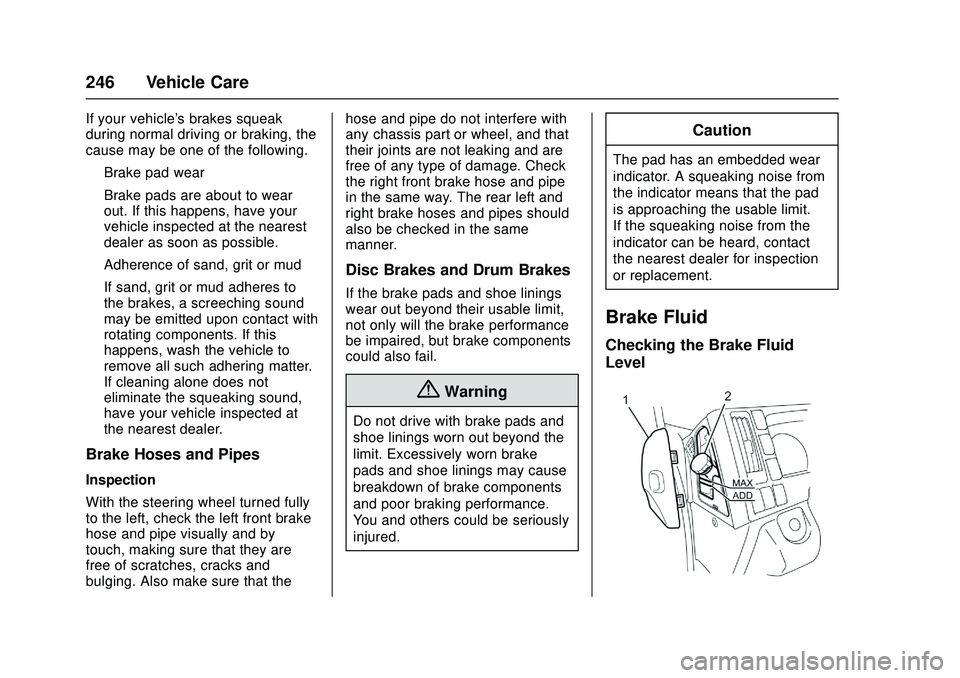
Brake Fluid
Checking the Brake Fluid
Level
Page 249 of 358

Chevrolet Low Cab Forward Owner Manual (GMNA-Localizing-U.S.-
11254764) - 2018 - crc - 12/5/16
248 Vehicle Care
Danger (Continued)
battery. Personal injury
(particularly to eyes) or property
damage may result from battery
explosion, battery fluid or
electrical (short circuit) burns. You
and others could be seriously
injured or killed.
If the negative cable is disconnected
from the negative terminal on the
battery within 3 minutes after turning
the engine control switch to the
"LOCK" position, the engine control
module may malfunction.
Checking the Battery
Your new vehicle is equipped with
DELKOR batteries. They need no
periodic electrolyte level
maintenance. Its top is permanently
sealed (except for two small vent
holes) and has no filler caps. You
will never have to add water.
Remember to check and recharge
the battery as necessary, as well as
keep connection clean. The hydrometer (green-eye test
indicator) in the top of each battery
(if equipped) provides information
for testing purposes only.
If the vehicle is not going to be
driven for 30 days or longer,
disconnect the ground cable from
the negative (–) terminal of the
batteries to prevent discharge.
For full power needs at replacement
time, a battery with the same
specifications, as shown on the
original battery's label, is
recommended.
{Warning
Battery posts, terminals and
related accessories contain lead
and lead compounds, chemicals
known to the State of California to
cause cancer and reproductive
harm. Wash hands after handling.
You and others could be seriously
injured.
Fuel Filter
Change the fuel filter in accordance
with the Maintenance Schedule or
when the fuel filter indicator light
(amber) comes on.
Drain the water when the water
separator (fuel filter) warning light
comes on. (Drain the water from the
chassis-side fuel filter and
engine-side fuel filter.)
Failure to replace the fuel filter when
needed may lead to fuel system
damage. Your authorized dealer can
inspect your fuel filter and replace
your fuel filter, if needed.