ABS CHEVROLET LOW CAB FORWARD 2018 User Guide
[x] Cancel search | Manufacturer: CHEVROLET, Model Year: 2018, Model line: LOW CAB FORWARD, Model: CHEVROLET LOW CAB FORWARD 2018Pages: 358, PDF Size: 6.32 MB
Page 199 of 358
Chevrolet Low Cab Forward Owner Manual (GMNA-Localizing-U.S.-
11254764) - 2018 - crc - 12/5/16
198 Driving and Operating
ABS Operation Indications and
Signs
ABS warning light
Operation Indications of ABS
When the engine control switch is
placed into the "ON" position, the
ABS warning light comes on and
then goes out in approx. 3 seconds.
The ABS is normal if the warning
light goes out.
Operation Signs of ABS
When ABS is activated, slight
vibration is generated on the brake
pedal (hydraulic brake model) and
steering wheel, and an operating
sound can be heard from the ABS
equipment.
If the ABS warning light does any of
the following, the ABS may be
faulty. Please contact the nearest
dealer. ‐
If the ABS warning light comes
on during driving
‐ The light does not come on when
the engine control switch is
placed into the "ON" position
See Antilock Brake System
(ABS) Warning Light 077.
Even if a problem has occurred with
the ABS, the regular brakes will still
work normally. However, ABS will
not operate.
Precautions for Driving an
ABS-Equipped Vehicle
ABS is not a device that enables
driving and stopping under
conditions exceeding safe driving
limits. Always drive safely.
{Warning
When braking suddenly, continue
pressing brake pedal hard so that
the ABS can take effect. (Continued)
Warning (Continued)
When braking suddenly, do not
pump the brakes (pushing and
releasing the brake pedal little by
little). Pumping brakes will
increase the braking distance.
The braking distance on slippery
road surfaces is longer than that
on a normal dry paved road even
with an ABS-equipped vehicle.
When ABS is activated in the
following road surface conditions,
the braking distance may be
slightly longer compared to that of
vehicles not equipped with an
ABS. Therefore, always be aware
of the road and tire condition (tire
type and wear condition), observe
safe driving habits and drive the
vehicle while keeping a safe
following distance.
‐ When driving on a gravel
road, or a road with a deep
snow covering.
‐ When tire chains are used.
(Continued)
Page 200 of 358

Chevrolet Low Cab Forward Owner Manual (GMNA-Localizing-U.S.-
11254764) - 2018 - crc - 12/5/16
Driving and Operating 199
Warning (Continued)
‐When driving over road
joints or bumps such as
light reflectors on the road.
‐ When driving on a bumpy
road, stone-paved road or
track.
‐ When driving over an iron
plate or manhole lid.
ABS does not work for wheel skid
during a standing start,
acceleration and cornering which
do not involve braking. On a very
slippery icy road, tires may lose
grip and steering wheel operation
may not be able to control the
vehicle's direction, resulting in
very unstable driving. Always
drive the vehicle observing a safe
speed well matched with both
road surface and tire conditions,
and avoid sudden braking.
If powerful engine braking is
applied on a very slippery icy
road, the drive wheels may be (Continued)
Warning (Continued)
locked (the ABS then does not
work), resulting in loss of vehicle
control.
When ABS is activated, a slight
vibration (especially when the
road surface is different between
right and left wheels) and pulling
may be felt on the brake pedal
and steering wheel. In addition,
an operating sound is produced
from the ABS actuators. This
does not indicate any abnormal
condition. Stay calm and operate
the steering wheel properly.
Electronic Braking force
Distribution (EBD)
EBD is a function that uses the ABS
to distribute braking force ideally
between the front and rear wheels
in order to compensate for changes
in load conditions or any shift of the
load due to acceleration or
deceleration, thus preventing
premature locking of the rear
wheels.
{Warning
If a problem should occur with the
EBD function, the ABS warning
light and the brake system
warning light will come on
simultaneously.
The rear wheels will lock more
easily if there is a problem with
the EBD function. Have it
checked and serviced at the
nearest dealer as soon as
possible. You and others could be
seriously injured.
When the EBD operates, the brake
pedal may push back slightly or you
may hear a sound similar to that
generated by the ABS when
operational. Neither of them
indicates any abnormal condition.
Page 202 of 358

Chevrolet Low Cab Forward Owner Manual (GMNA-Localizing-U.S.-
11254764) - 2018 - crc - 12/5/16
Driving and Operating 201
Inspection
Pull the parking brake lever slowly
from the fully released position while
counting the clicks produced as the
lever engages ratchet plate notches
to check that it can be raised the
proper amount and the lever is held
firmly.
If the number of notches is not
within the standard value range
below, adjust it to the standard
value. Lever stroke is 6 to 8
notches.
Number of notches before parking
brake is set when lever is pulled
slowly from released position withpull force of about 147 N
(15 kgf/33 lbs).
See
Maintenance Schedule 0303
and Additional Maintenance and
Care 0323.
Exhaust Brake
Exhaust Brake Switch
When turned on, the system
increases the amount of power
absorbed by the engine while
coasting in gear. Whenever slowing
down the vehicle, such as on down
grades, in city traffic or approaching
stop signals, this brake system may
be used.
To turn on the exhaust brake system
while driving, pull the lever
backward. The exhaust brake
indicator light comes on. The
exhaust brake will engage
automatically when the accelerator
pedal is released and vehicle speed
is above 10 km/h (6.5 MPH).
The exhaust brake will disengage
when the accelerator pedal or brake
pedal is pressed. Releasing the
pedal reengages the exhaust brake.
Push the lever forward to turn the
exhaust brake off during idling.
{Warning
It is extremely dangerous to apply
the exhaust brake on slippery
roads as the tires can skid.
You and others could be seriously
injured.
Page 203 of 358

Chevrolet Low Cab Forward Owner Manual (GMNA-Localizing-U.S.-
11254764) - 2018 - crc - 12/5/16
202 Driving and Operating
Even if the selector lever is placed
in the N position, the exhaust brake
does not disengage until the engine
is warmed up if the warm-up system
is on.
Conditions for Inoperable Exhaust
Brake
Under the following conditions, the
exhaust brake does not engage
even if the exhaust brake indicator
light comes on:
.The accelerator pedal is
pressed.
. The selector lever is in the N
position.
. The vehicle is traveling at
5 km/h (3 MPH) or lower speeds.
If your vehicle is equipped with an
anti-lock brake system (ABS), the
exhaust brake may disengage
during ABS operation even when
the exhaust brake switch is in the
ON position and the exhaust brake
indicator light is on. The exhaust
brake may disengage temporarily as
the vehicle passes over a bump
even when the brake pedal is not
pressed. It is advisable to operate the
exhaust brake when descending a
slope or when stop and go driving is
involved.
The selection of transmission gears
and engine speed when operating
the brake system is important. The
exhaust brake is more effective in
the lower gears and at the higher
engine speeds. See
Exhaust Brake
Light 078.Cruise Control
The cruise control function allows
you to drive the vehicle at a
constant speed without operating
the accelerator pedal. Use this
function when the vehicle speed is
between 40 to 160 km/h (25 to 100
MPH). This function should only be
used when driving without frequent
starts and stops.
{Warning
Cruise control can be dangerous
where you cannot drive safely at
a steady speed. Do not use
cruise control on winding roads or
in heavy traffic. You and others
could be seriously injured.
Cruise control can be dangerous
on slippery roads. On such roads,
fast changes in tire traction can
cause needless wheel spinning,
and you could lose control. Do
not use cruise control on slippery
roads. You and others could be
seriously injured.
Page 248 of 358
Chevrolet Low Cab Forward Owner Manual (GMNA-Localizing-U.S.-
11254764) - 2018 - crc - 12/5/16
Vehicle Care 247
Remove the inspection cover (1) on
the left- hand side of the instrument
panel by turning it with your fingers.
Check that the fluid level in the
reservoir is between the "MAX" and
"ADD" lines.
If the fluid surface cannot easily be
seen, rock the vehicle gently.
Adding Brake Fluid
If the level of brake fluid has
dropped below the "ADD" line,
remove the cap (2) and add fluid.
Take care to avoid filling beyond the
"MAX" line.
Tighten the cap securely after the
fluid has been added.
When adding brake fluid to the tank,
take care to prevent dirt and water
from entering it. Any dirt or water in
the system could cause the vehicle
to lose braking functions.
Inspect and change brake fluid
according to the Maintenance
Schedule.
Use the recommended brake fluid
when adding brake fluid.Never mix the specified brake fluid
with fluids of another brand.
Be careful not to spill brake fluid
onto painted surfaces or to let it
come in contact with skin. If fluid is
spilled onto a painted surface or
comes in contact with skin, wash
away the fluid with water and
immediately wipe the area clean.
Brake fluid readily absorbs moisture.
Therefore, it is necessary to close
the brake fluid container tightly for
storage.
If the brake fluid level decreases
rapidly, there may be a problem in
the brake system or brake pads or
shoe linings may have worn out.
Have your vehicle inspected by the
nearest dealer immediately.
Battery
Working Near Battery
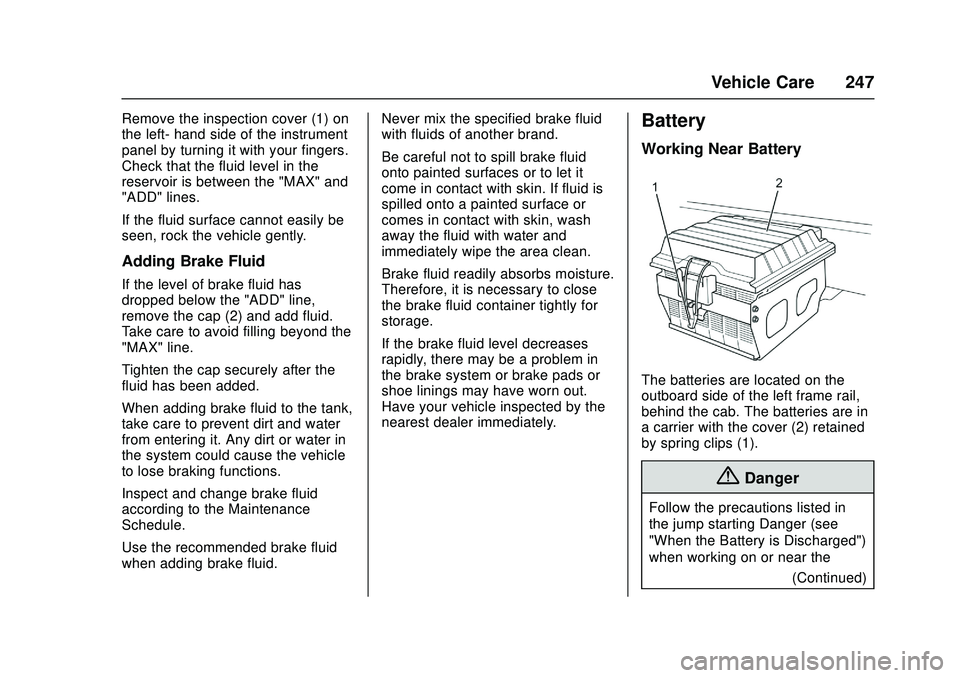
The batteries are located on the
outboard side of the left frame rail,
behind the cab. The batteries are in
a carrier with the cover (2) retained
by spring clips (1).
{Danger
Follow the precautions listed in
the jump starting Danger (see
"When the Battery is Discharged")
when working on or near the
(Continued)
Page 258 of 358
Chevrolet Low Cab Forward Owner Manual (GMNA-Localizing-U.S.-
11254764) - 2018 - crc - 12/5/16
Vehicle Care 257
Contact your dealer when replacing
lights that are not listed here.
Headlamps and Front
Turn Signal
Replacing the Headlamps
When the bulb has blown out,
replace it with a bulb of the
specified wattage. Be careful not to
excessively tighten the mounting
screws when replacing the
headlamp bulbs.
Do not replace a bulb with other
than the specified wattage.
Proper aiming of the headlamps is
important to ensure sufficient
illumination of the highway without
blinding other motorists. When
replacing headlamp bulbs, have the
headlamp aim adjusted at your
dealer.
When replacing a bulb, make sure
the light switch is“OFF”.
See Bulb Replacement 0254.
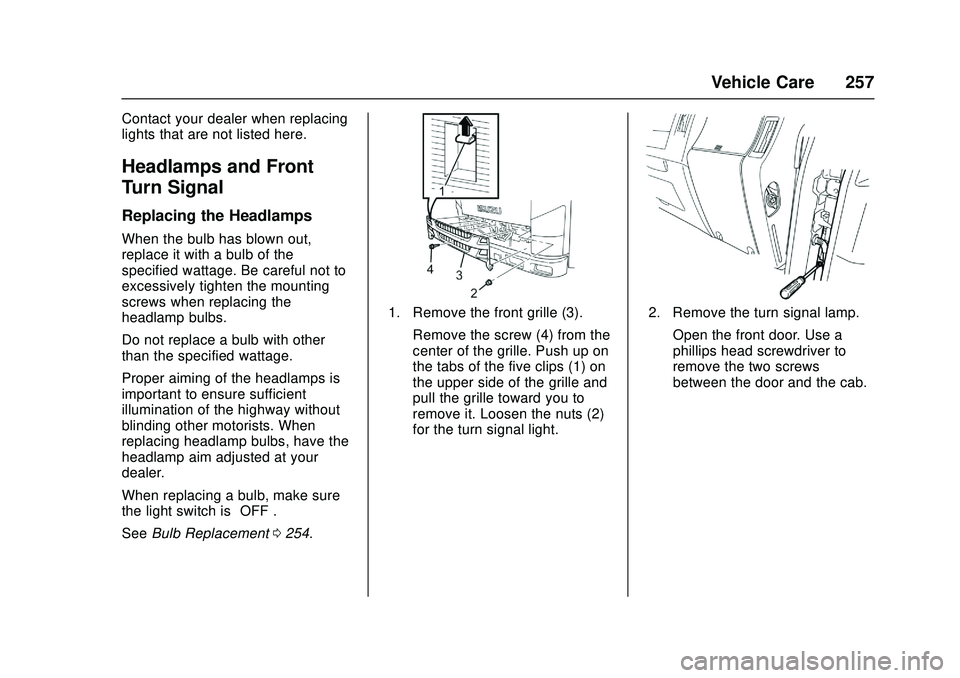
1. Remove the front grille (3).
Remove the screw (4) from the
center of the grille. Push up on
the tabs of the five clips (1) on
the upper side of the grille and
pull the grille toward you to
remove it. Loosen the nuts (2)
for the turn signal light.2. Remove the turn signal lamp.Open the front door. Use a
phillips head screwdriver to
remove the two screws
between the door and the cab.
Page 268 of 358

Chevrolet Low Cab Forward Owner Manual (GMNA-Localizing-U.S.-
11254764) - 2018 - crc - 12/5/16
Vehicle Care 267
Fuse and Relay Location–Cab InteriorFuse locations:
No. Description Rating
1 RR P / WINDOW 25A
2 – –
3 ROOM LAMP, AUDIO 10A
4 DOOR LOCK 15A
5 TRAILER BRAKE 15A
6 P/ WINDOW 25A
7 ABS 10A
8 WIPER 25A
9 H / LAMP LO (LH) 10A
10 LAMPS (BATT) 10A 11 H / LAMP LO (RH) 10A
12 BRAKE LAMPS 10A
13 STARTER 10A
14 H / LAMP HI (LH) 10A
15 H / LAMP HI (RH) 10A
Page 301 of 358
Chevrolet Low Cab Forward Owner Manual (GMNA-Localizing-U.S.-
11254764) - 2018 - crc - 12/5/16
300 Vehicle Care
cleaning products contain these
compounds. Be sure to read
cleaning product labels carefully.
Air fresheners (liquid, solid, gel or
plate types) must not come into
direct contact with, or spill onto,
interior components such as the air
conditioning or audio system.
Compounds contained in these
products can cause discoloration,
staining or peeling of paint.
Glass cleaners that contain these
compounds must not be used to
clean the inside of the windshield or
window glass. To clean the glass,
wipe it using a cloth wet with warm
or cold water.
To avoid possible permanent
discoloration of light colored seats,
Do not let materials with non-fast
colors come into contact with seat
trim materials until these materials
are totally dry. This includes certain
types of casual clothing, such as
colored denims, corduroys, leathers
and suedes; also decorative paper,
With the use of modern trim
materials, it is very important that
you use proper cleaning techniquesand cleaners. Failing to do this on
the first cleaning may result in water
spots, spot rings or setting of stains
or soilage - all of which are more
difficult to remove in a second
cleaning.
Dust and loose dirt that collect on
interior fabric should be removed
often with a vacuum cleaner or soft
bristle brush. Wipe vinyl or leather
trim regularly with a clean, damp
cloth. Normal trim soils, spots or
stains can be cleaned with these
cleaners.
Remember these basic steps before
cleaning:
.
Remove stains as quickly as
possible before they
become "set".
. Use a clean cloth or sponge,
and change to a clean area
often. A soft brush maybe used
if stains persist.
. Use solvent-type cleaners only
in a well ventilated area: also, do
not saturate the stained area. .
If a ring forms after spot
cleaning, clean the entire area
immediately.
. Follow specific instructions on
cleaner labels.
General Cleaning of Soiled or
Water Spotted Fabric Type
Trim with Foam Type Cleaner
Vacuum the area thoroughly to
remove any loose dirt.
Always clean a whole trim panel or
section. Mask surrounding trim
along stitch or welt lines.
Use suds on a clean sponge. Do
not brush wet suede. Do not
saturate the material or rub it
harshly. Immediately after cleaning,
remove suds with a sponge and
rinse with a clean wet sponge. Wipe
off remaining residue with a slightly
damp absorbent towel or cloth.
Important —Immediately after
wiping, force-dry the fabric with an
air hose. A heat dryer or heat lamp
may be used. Use caution with a
heat dryer or lamp to help prevent
damage.
Page 313 of 358

Chevrolet Low Cab Forward Owner Manual (GMNA-Localizing-U.S.-
11254764) - 2018 - crc - 12/5/16
312 Service and Maintenance
Remarks
(1)In case this column is blank,
follow kilometers (miles).
(2) Use of oils other than CK-4 may
require shorter maintenance
intervals and may cause
nonconformity to regulations. (CJ-4
can be used while it is available.)
Use of oils with other viscosity than
*W-40 may also require shorter
maintenance intervals and may
cause a problem with engine
durability.
(3) Refer to "Air Cleaner Indicator
Light" under Engine Air Cleaner/
Filter 0231.
(4) Initial check at 1 040 km
(650 miles) is required.
(5) Be sure to discard used grease
seal, and always use new grease
seal for installation.
Explanation of Complete
Vehicle Maintenance Schedule
The following is a brief explanation
of each of the services listed in the
preceding Complete Vehicle
Maintenance Schedule. 1. Engine Noise :
These
components have an effect on the
control of noise emissions.
Service Interval Maintenance procedureEngine
Every 16 000 km (10,000 miles) Inspect sound absorption materials for
tears, broken out sections or
attachment. Repair or replace as
necessary.
Cooling System
Every 16 000 km (10,000 miles) Inspect fan, shroud and radiator for
attachment, tears or cleanliness.
Replace as necessary.
Air intake system
Every 24 000 km (1,500 miles) Inspect all ducts, hoses and intake
silencers for leaks or chafing. Repair or
replace as necessary.
Exhaust system
Every 16 000 km (10,000 miles) Inspect silencer, pipes, gaskets, clamps
and mounting for exhaust gas leaks or
looseness. Repair or replace as
necessary.
Cab
Every 16 000 km (10,000 miles) Inspect sound absorption materials for
tears, broken out sections or
attachment. Repair or replace as
necessary.
2. Valve Lash : Incorrect valve
clearance will result in increased
engine noise and lower engine output, thereby adversely affecting
engine performance. Retorque
Page 352 of 358

Chevrolet Low Cab Forward Owner Manual (GMNA-Localizing-U.S.-
11254764) - 2018 - crc - 12/5/16
Index 351
IndexA
Accessories and Modifica-tions . . . . . . . . . . . . . . . . . . . . . . . . . . 218
Add-On Electrical Equipment . . . 215
Additional Maintenance and Care . . . . . . . . . . . . . . . . . . . . . . 323
Adjustments Seat, Initial Drive . . . . . . . . . . . . . . . 38
Agreements Trademarks and License . . . . . .114
Air Cleaner/Filter, Engine . . . . . . . 231
Air Conditioning . . . . . . . . . . . . . . . . 115
Air Filter, Passenger Com- partment . . . . . . . . . . . . . . . . . . . . . . 119
Air Vents . . . . . . . . . . . . . . . . . . . . . . . 118
AM-FM Radio . . . . . . . . . . . . . . . . . . . . 97
Antenna Fixed Mast . . . . . . . . . . . . . . . . . . . 102
Antilock Brake System (ABS) . . . 196
Warning Light . . . . . . . . . . . . . . . . . . . 77
Appearance Care Exterior . . . . . . . . . . . . . . . . . . . . . . . 293
Interior . . . . . . . . . . . . . . . . . . . . . . . . 299
Ashtrays . . . . . . . . . . . . . . . . . . . . . . . . . 68
Assistance Program,
Roadside . . . . . . . . . . . . . . . . . . . . . . 344
Audio Players CD . . . . . . . . . . . . . . . . . . . . . . . . . . . 103 Automatic
Transmission . . . . . . . . . . . . . . . . . 185
Transmission Fluid . . . . . . . . . . . 229
Automatic Transmission Selector Lever . . . . . . . . . . . . . . . . 194
Shift Lock Control FunctionCheck . . . . . . . . . . . . . . . . . . . . . . . 251
Automatic Transmission Fluid Temperature Warning Light . . . . . 78
Automatic Transmission Overdrive Off . . . . . . . . . . . . . . . . . . 195
Auxiliary Devices . . . . . . . . . . . . . . . . . . . . . . . .113
Axle, Rear . . . . . . . . . . . . . . . . . . . . . . 249
B
Battery . . . . . . . . . . . . . . . . . . . . . . . . . 247
Battery - North America . . . . . . . . . 287
Battery Warning Light . . . . . . . . . . . . 73
Biodiesel . . . . . . . . . . . . . . . . . . . . . . . 207
Blade Replacement, Wiper . . . . . 252
Brake Exhaust . . . . . . . . . . . . . . . . . . . . . . 201
System Warning Light . . . . . . . . . . 75
Brakes . . . . . . . . . . . . . . . . . . . . . . . . . . 242 Antilock . . . . . . . . . . . . . . . . . . . . . . . 196
Exhaust Light . . . . . . . . . . . . . . . . . . . 78
Fluid . . . . . . . . . . . . . . . . . . . . . . . . . . 246
Parking . . . . . . . . . . . . . . . . . . . . . . . 200