coolant level CHEVROLET LOW CAB FORWARD 2018 User Guide
[x] Cancel search | Manufacturer: CHEVROLET, Model Year: 2018, Model line: LOW CAB FORWARD, Model: CHEVROLET LOW CAB FORWARD 2018Pages: 358, PDF Size: 6.32 MB
Page 171 of 358

Chevrolet Low Cab Forward Owner Manual (GMNA-Localizing-U.S.-
11254764) - 2018 - crc - 12/5/16
170 Driving and Operating
the selectable (switch) regeneration
required warning light (red) is
displayed on the DIC.
Continued driving without
performing DPF regeneration will
cause the check engine malfunction
indicator light and reduced engine
power indicator light to come on, an
engine power reduction, and may
cause damage to the DPF filter. See
Vehicle Messages086.
The time needed to complete
regeneration differs depending on
the outside temperature.
The exhaust brake is activated
during DPF regeneration. The
exhaust brake starting to operate or
being disengaged will produce a
sound, but this does not indicate a
failure.
During regeneration, white smoke
may be temporarily produced from
the exhaust pipe. This results from
combustion of PM, it does not
indicate a failure.
Regeneration is finished earlier
immediately after driving than when
the engine is cold. The engine coolant temperature
may rise during regeneration.
DPF Regeneration during
Prolonged Idling
DPF regeneration may be initiated
automatically during prolonged
idling. If regeneration is initiated, the
regeneration in progress indicator
light (amber) comes on but this is
normal and does not indicate a
failure.
If driving is started or the PTO is
connected during DPF regeneration
by prolonged idling, the selectable
(switch) regeneration required
warning light (amber) comes on and
regeneration is suspended. Perform
Switch regeneration procedure in
order to complete the DPF
regeneration.
Prolonged idling may require more
frequent DPF regeneration.
See
Driver Information Center (DIC)
0 82.Diesel Exhaust Fluid
Diesel exhaust fluid (DEF) is used
exclusively for the selective catalytic
reduction (SCR) system. Be sure to
use only API certified DEF. When
the SCR system detects DEF level
is nearly empty or incorrect fluids
(such as water or low concentrated
DEF.) are added, the SCR system
will turn on warning and indicator
lights and reduce engine power in
progressive stages to encourage
you to have the condition corrected.
Continuing to drive for too long after
these lights come on will eventually
result in a severe vehicle speed
limitation. See Vehicle Messages
0 86
The DEF freezes below −11 °C
(12 °F). The SCR system is
equipped with a heating function
which utilizes the engine coolant, so
the engine can be started even
when DEF is frozen.
Page 174 of 358

Chevrolet Low Cab Forward Owner Manual (GMNA-Localizing-U.S.-
11254764) - 2018 - crc - 12/5/16
Driving and Operating 173
Warning (Continued)
Do not add substances such as
gasoline or diesel fuel to the DEF
tank. You and others could be
seriously injured.
Caution
When opening the DEF tank cap,
be careful not to let dirt or other
foreign matter enter inside the
DEF tank. Intrusion of foreign
matter can cause a clogging of
the filter or affect the quality of
DEF, which may result in a SCR
system failure.
If DEF is spilled on the body or
frame, it may cause generation of
rust, so wipe it off and then rinse
it away with water.
When DEF dries it will leave a
crystalline residue, this condition is
normal. Wash with water or wipe
away the residue to prevent it from
entering the DEF tank. Adding DEF in Cold Weather
DEF freezes at low temperature but
the engine coolant circulates to
thaw the DEF tank and to prevent
DEF from freezing. Vehicle can be
driven normally when DEF is frozen.
If the refill diesel exhaust fluid (DEF)
warning light is on and the
remaining DEF in the DEF tank is
frozen, the warning lights, indicator
lights and restriction will not be
canceled until the DEF thaws even
if the DEF tank is refilled.
It is not recommended parking the
vehicle for long periods with the refill
diesel exhaust fluid (DEF) warning
light on in cold weather. The DEF
gauge will not register correctly
should the DEF freeze in this
condition causing the DEF low level
warning system not to reset when
DEF is added. Take the following
actions to avoid this condition in
cold weather:
1. Refill the DEF as soon as possible after parking the
vehicle. 2. Turn the engine control switch
to the ON position from the
LOCK position.
3. Wait for the warning buzzers and warning lights to turn off.
4. If the buzzer does not stop, return the engine control switch
back to the LOCK position and
add more DEF, and then start
over from step (2) above.
5. Turn the engine control switch to the LOCK position.
The DEF freezes at approximately
−11 °C (12 °F).
In cold weather, when the vehicle is
left without performing these actions
and the DEF tank freezes, the low
DEF level warnings and indicators
may not turn off when DEF is added
until after the tank defrosts.
Make sure to stop the engine before
adding the DEF. See Warning
Buzzers 091.
When DEF Freezes
Engine coolant circulates through
the DEF tank to thaw it when frozen
and prevent it from freezing while
Page 213 of 358
Chevrolet Low Cab Forward Owner Manual (GMNA-Localizing-U.S.-
11254764) - 2018 - crc - 12/5/16
212 Driving and Operating
Running Out of Fuel
When the Fuel Tank is Empty
When the fuel tank is empty, air will
enter the fuel system, so refueling
alone will not be enough to restart
the engine. Use the following
methods to bleed the fuel system.
Bleeding the Fuel System
Steps for Refueling1. Follow the directions in "Parking Brake Lever" under
Parking Brake 0200. 2. Select the correct fuel (See
"Diesel Fuel Requirement and
Fuel System"). Follow any
posted safety rules. Stand to
the side, never above or
opposite the filler opening.
3. Check that the fuel cap is tight, and see to it that engine oil,
engine coolant in the reservoir,
and washer fluid, etc. are at
proper levels. Then do the
Driver Daily Checklist.
See Owner Checks and Services
0 317.
Driving your vehicle until the fuel
tank is empty may activate the
check engine malfunction indicator
light. You do not need to have your
vehicle checked. After refueling,
perform the following:
. Bleed the fuel system.
. Start, turn off and restart the
engine three or four times.
. The check engine malfunction
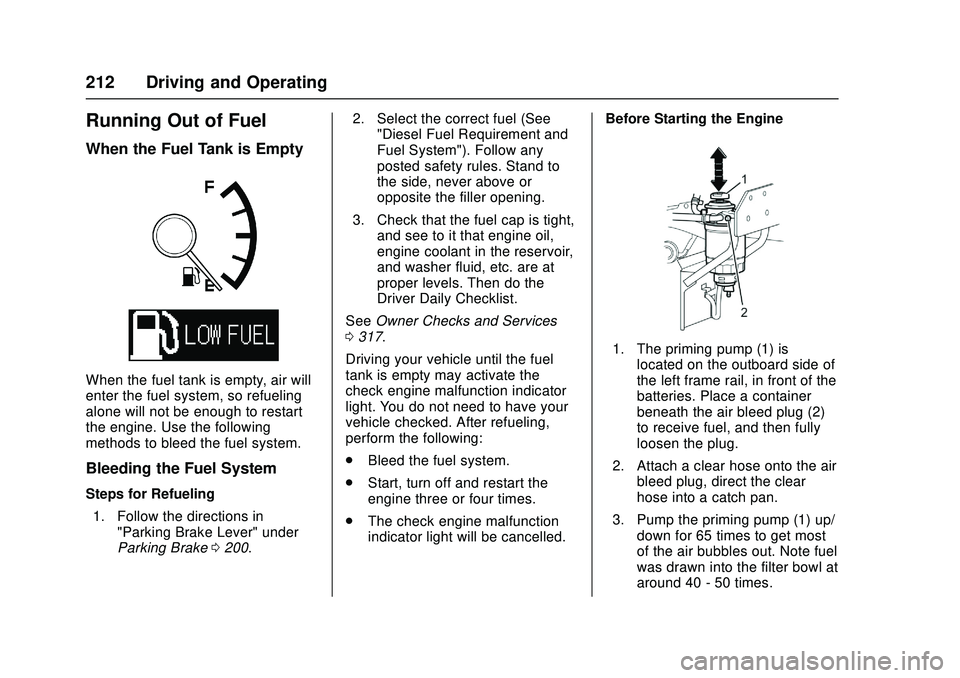
indicator light will be cancelled. Before Starting the Engine
1. The priming pump (1) is
located on the outboard side of
the left frame rail, in front of the
batteries. Place a container
beneath the air bleed plug (2)
to receive fuel, and then fully
loosen the plug.
2. Attach a clear hose onto the air bleed plug, direct the clear
hose into a catch pan.
3. Pump the priming pump (1) up/ down for 65 times to get most
of the air bubbles out. Note fuel
was drawn into the filter bowl at
around 40 - 50 times.
Page 218 of 358

Chevrolet Low Cab Forward Owner Manual (GMNA-Localizing-U.S.-
11254764) - 2018 - crc - 12/5/16
Vehicle Care 217
Vehicle Care
General Information
General Information . . . . . . . . . . 218
California Proposition65 Warning . . . . . . . . . . . . . . . . . 218
California Perchlorate Materials Requirements . . . . . 218
Accessories and Modifications . . . . . . . . . . . . . . . . 218
Vehicle Checks
Doing Your OwnService Work . . . . . . . . . . . . . . . 218
Cab Tilting . . . . . . . . . . . . . . . . . . . . 220
Engine Compartment Overview . . . . . . . . . . . . . . . . . . . . 222
Engine Cover . . . . . . . . . . . . . . . . . 222
Engine Oil . . . . . . . . . . . . . . . . . . . . 223
Automatic Transmission Fluid . . . . . . . . . . . . . . . . . . . . . . . . 229
Engine Air Cleaner/Filter . . . . . . 231
Engine Coolant . . . . . . . . . . . . . . . 231
Engine Overheating . . . . . . . . . . 237
Power Steering Fluid . . . . . . . . . 240
Washer Fluid . . . . . . . . . . . . . . . . . 241
Brakes . . . . . . . . . . . . . . . . . . . . . . . 242
Brake Fluid . . . . . . . . . . . . . . . . . . . 246
Battery . . . . . . . . . . . . . . . . . . . . . . . . 247
Fuel Filter . . . . . . . . . . . . . . . . . . . . 248 Rear Axle (Gear Oil Viscosity
Chart) . . . . . . . . . . . . . . . . . . . . . . . 249
Rear Axle (Oil Level Check) . . . . . . . . . . . . . . . . . . . . . . 249
Noise Control System . . . . . . . . 250
Automatic Transmission Shift
Lock Control Function
Check . . . . . . . . . . . . . . . . . . . . . . . 251
Wiper Blade Replacement . . . . 252
Headlamp Aiming
Headlamp Aiming . . . . . . . . . . . . 254
Bulb Replacement
Bulb Replacement . . . . . . . . . . . . 254
Headlamps and Front Turn Signal . . . . . . . . . . . . . . . . . . . . . . . 257
Roofmarker Lamps . . . . . . . . . . . 261
Sidemarker Lamps (Including Turn Signal and Cornering
Lamps) . . . . . . . . . . . . . . . . . . . . . . 261
Taillamps, Turn Signal, Stoplamps, and Back-Up
Lamps . . . . . . . . . . . . . . . . . . . . . . 263
License Plate Lamp . . . . . . . . . . 263
Interior Lamps . . . . . . . . . . . . . . . . 264
Electrical System
Electrical System Overload . . . 264
Wheels and Tires
Wheels and Tires . . . . . . . . . . . . . 272 Tire Pressure . . . . . . . . . . . . . . . . . 284
Tire Rotation . . . . . . . . . . . . . . . . . 284
If a Tire Goes Flat . . . . . . . . . . . . 287
Jump Starting
Jump Starting - North
America . . . . . . . . . . . . . . . . . . . . . 287
Towing the Vehicle
Towing the Vehicle . . . . . . . . . . . 291
Appearance Care
Exterior Care . . . . . . . . . . . . . . . . . 293
Interior Care . . . . . . . . . . . . . . . . . . 299
Page 220 of 358

Chevrolet Low Cab Forward Owner Manual (GMNA-Localizing-U.S.-
11254764) - 2018 - crc - 12/5/16
Vehicle Care 219
Warning (Continued)
vehicle or its equipment. If you
have any questions about
carrying out some service, have
the work done by a skilled
technician.
To prevent personal injury, keep
hands, tools and clothing clear of
the engine cooling fan when the
engine is running.
The engine, exhaust pipe and
radiator will be hot immediately
after the vehicle is driven. Be
careful around these parts to
prevent burns. Perform all checks
when the engine is cold.
Do not perform work near an
open flame or other heat sources.
Do not let the engine run in poorly
ventilated garages or sheds. This
could cause carbon monoxide
poisoning.(Continued)
Warning (Continued)
Performing maintenance work on
a truck or chassis can be
dangerous. In trying to do some
jobs, you can be seriously injured.
Do your own maintenance work
only if you have the required
know-how and the proper tools
and equipment for the job. If you
have any doubts, contact your
dealer.
You and others could be seriously
injured.
Pull firmly on the parking brake
lever and move the selector lever to
"P" and make sure the shift indicator
displays "P".
Make sure to turn off the engine and
remove the key from the engine
control switch before performing any
checks.
Select a place with a solid and level
surface to perform the checking and
maintenance work. Make sure to chock the wheels. It would be very
dangerous if the vehicle started
to move.
When performing work on the
electrical system, begin by turning
the engine control switch to the
"LOCK" position, wait at least
3 minutes, and then disconnect the
negative cable from the negative
terminal on battery. If the negative
cable is disconnected within
3 minutes, the engine control
module may malfunction.
When working on the fuel line or
fuel filter, remove the fuel tank filler
cap. The fuel system is under
pressure and the fuel will overspill
unless the pressure is relieved,
possibly leading to combustion or
a fire.
Do not make engine adjustments
yourself. Be sure to consult your
dealer.
Use only appropriate tools.
Oils, brake fluid and engine coolant
have lubrication, cooling and rust
prevention functions. If these liquids
deteriorate through loss or
Page 224 of 358
Chevrolet Low Cab Forward Owner Manual (GMNA-Localizing-U.S.-
11254764) - 2018 - crc - 12/5/16
Vehicle Care 223
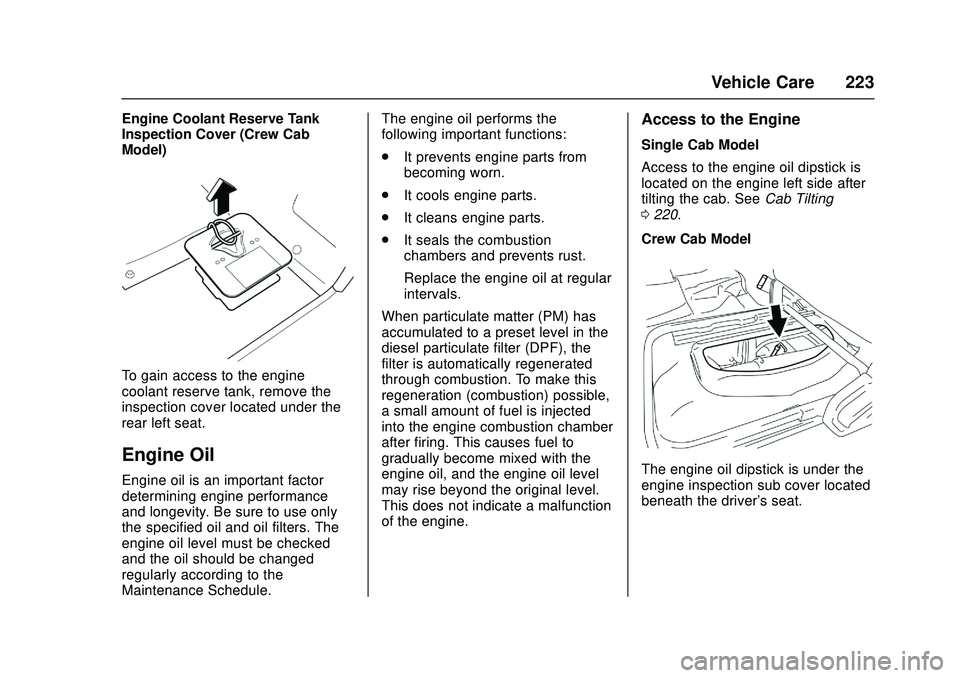
Engine Coolant Reserve Tank
Inspection Cover (Crew Cab
Model)
To gain access to the engine
coolant reserve tank, remove the
inspection cover located under the
rear left seat.
Engine Oil
Engine oil is an important factor
determining engine performance
and longevity. Be sure to use only
the specified oil and oil filters. The
engine oil level must be checked
and the oil should be changed
regularly according to the
Maintenance Schedule.The engine oil performs the
following important functions:
.
It prevents engine parts from
becoming worn.
. It cools engine parts.
. It cleans engine parts.
. It seals the combustion
chambers and prevents rust.
Replace the engine oil at regular
intervals.
When particulate matter (PM) has
accumulated to a preset level in the
diesel particulate filter (DPF), the
filter is automatically regenerated
through combustion. To make this
regeneration (combustion) possible,
a small amount of fuel is injected
into the engine combustion chamber
after firing. This causes fuel to
gradually become mixed with the
engine oil, and the engine oil level
may rise beyond the original level.
This does not indicate a malfunction
of the engine.
Access to the Engine
Single Cab Model
Access to the engine oil dipstick is
located on the engine left side after
tilting the cab. See Cab Tilting
0 220.
Crew Cab Model
The engine oil dipstick is under the
engine inspection sub cover located
beneath the driver's seat.
Page 229 of 358
Chevrolet Low Cab Forward Owner Manual (GMNA-Localizing-U.S.-
11254764) - 2018 - crc - 12/5/16
228 Vehicle Care
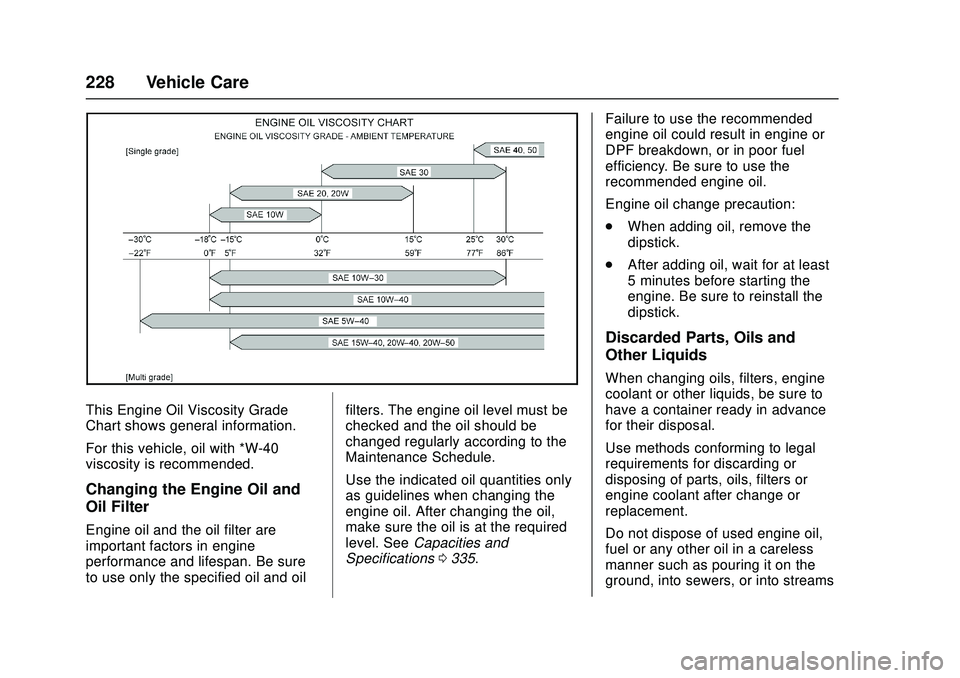
This Engine Oil Viscosity Grade
Chart shows general information.
For this vehicle, oil with *W-40
viscosity is recommended.
Changing the Engine Oil and
Oil Filter
Engine oil and the oil filter are
important factors in engine
performance and lifespan. Be sure
to use only the specified oil and oilfilters. The engine oil level must be
checked and the oil should be
changed regularly according to the
Maintenance Schedule.
Use the indicated oil quantities only
as guidelines when changing the
engine oil. After changing the oil,
make sure the oil is at the required
level. See
Capacities and
Specifications 0335. Failure to use the recommended
engine oil could result in engine or
DPF breakdown, or in poor fuel
efficiency. Be sure to use the
recommended engine oil.
Engine oil change precaution:
.
When adding oil, remove the
dipstick.
. After adding oil, wait for at least
5 minutes before starting the
engine. Be sure to reinstall the
dipstick.
Discarded Parts, Oils and
Other Liquids
When changing oils, filters, engine
coolant or other liquids, be sure to
have a container ready in advance
for their disposal.
Use methods conforming to legal
requirements for discarding or
disposing of parts, oils, filters or
engine coolant after change or
replacement.
Do not dispose of used engine oil,
fuel or any other oil in a careless
manner such as pouring it on the
ground, into sewers, or into streams
Page 230 of 358
Chevrolet Low Cab Forward Owner Manual (GMNA-Localizing-U.S.-
11254764) - 2018 - crc - 12/5/16
Vehicle Care 229
or bodies of water. Instead, recycle
it by taking it to a used oil collection
facility which may be found in your
community.
Automatic Transmission
Fluid
{Warning
Overfilling of the automatic
transmission can cause the fluid
to be "PURGED" out of the
breather hose onto the hot engine
parts and can cause a fire.
You and others could be seriously
injured.
Both quality and quantity of fluid are
important factors that have a
significant influence on the
performance and durability of the
automatic transmission. Be sure to
use only the dealer recommended
fluid for replenishment, and observe
the specified fluid level. Too much or too little transmission
oil could damage your transmission.
Too much could cause your
transmission to overheat and fluid to
spill out from the breather hose. Be
sure to get an accurate reading if
you check your transmission fluid.
When cleaning around the dipstick
and guide tube, make sure that you
thoroughly wipe away all of the dirt
and dust etc. Failure to do so may
cause a fault in the transmission.
Do not let coolants (ethylene glycol
type), water based substances,
or other fluids etc., mix with the
fluid. Otherwise, degraded
performance and faulty operation of
the system will result.
Checking the Automatic
Transmission Oil level
This operation could be difficult and
you may choose to have this done
at your dealer.
If you choose to do it yourself, then
be sure to follow all the instructions
below or you could get a false
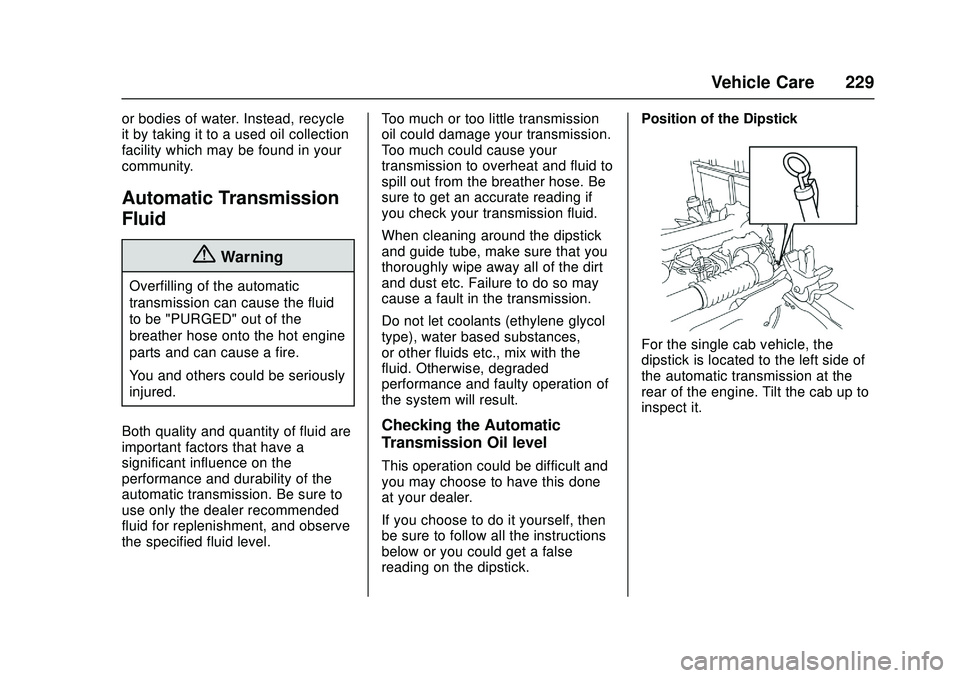
reading on the dipstick.Position of the Dipstick
For the single cab vehicle, the
dipstick is located to the left side of
the automatic transmission at the
rear of the engine. Tilt the cab up to
inspect it.
Page 232 of 358

Chevrolet Low Cab Forward Owner Manual (GMNA-Localizing-U.S.-
11254764) - 2018 - crc - 12/5/16
Vehicle Care 231
.Dipstick H (HOT) —
Transmission fluid
temperature Approx.
70 - 80 °C (158 - 176 °F).
. The “C (COLD)” range on
the dipstick is a guide used
by your dealer for
specialized equipment used
to replace or service the
automatic transmission
fluid. When performing your
own inspections, always
use the “H (HOT)” range
after warming up the
vehicle.
The fluid must be hot to
ensure an accurate check.
The fluid level rises as
temperature increases.
6. If the fluid level is too low, add the specified fluid through the
dipstick guide tube. Also, check
whether there are no fluid
leaks.
7. Insert the dipstick securely into position.{Warning
Be extremely careful not to burn
yourself when checking the oil
level if the engine temperature is
high. Protect yourself with
gloves etc.
You and others could be seriously
injured.
Discarded parts, oil, grease and
fluids could have an adverse effect
on the environment. It is difficult to
dispose of these, so have your
dealer handle all checks and
replacements.
Engine Air Cleaner/Filter
Air Cleaner
Use of clogged air cleaner element
not only causes a deterioration in
the engine output but also increased
fuel consumption and dark exhaust
smoke. Be sure to use a genuine air cleaner
element. If other air cleaner element
is used, it may cause the sensor to
output a wrong signal.
See
Maintenance Schedule 0303.
Air Cleaner Indicator Light
When the air cleaner indicator light
comes on, check the air cleaner
element. If the air cleaner element is
clogged, replace the air cleaner
element.
See Vehicle Messages 086.
See Maintenance Schedule 0303.
Engine Coolant
Protection of Engine Against
Overcooling
Overcooling of the engine not only
accelerates wear of the vital engine
parts but also hurts fuel economy.
Engine Coolant in Cold
Weather
To prevent the engine damage due
to freezing of the engine coolant,
mix the coolant and water at the
ratio of 50/50.
Page 234 of 358

Chevrolet Low Cab Forward Owner Manual (GMNA-Localizing-U.S.-
11254764) - 2018 - crc - 12/5/16
Vehicle Care 233
Warning (Continued)
Engine coolant is flammable, and
therefore, it must be kept away
from flames and other heat
sources. Engine coolant also
could ignite if it comes in contact
with a hot surface, such as the
exhaust manifold. Exercise
caution to prevent this from
happening.
You and others could be seriously
injured.
Preparing Engine Coolant
To prevent engine damage due to
freezing of the engine coolant and
to protect the cooling system from
corrosion, use a mixture of the
recommended type antifreeze and
water. If the engine of the vehicle is
at −30 °C (−22 °F) or above, the
coolant concentration should be
50%. Direct use of “50/50
Pre-diluted” product which is already
diluted to 50% concentration is
recommended. If the outside
temperature engine or vehicle is used at
−30 °C (−22 °F) or below,
coolant concentration of 55% is
recommended.
It is the owner ’s responsibility to:
. Maintain the engine cooling
system freeze protection at or
above −30 °C (−22 °F) (at or
below −30 °C (−22 °F) in colder
climates to ensure protection
against corrosion and loss of
engine coolant from boiling.
A 50/50 (55/45 for colder
climates) mixture of the
recommended type antifreeze
and water will provide freeze
protection to at or above −30 °C
(−22 °F), (at or below −30 °C
(−22 °F) in colder climates) and
boil protection to 128 °C
(262 °F). Periodic replacement
of engine coolant is needed to
replenish the anticorrosion
additives that wear out with use.
Engine coolant that has become
dark in color shows that it needs
to be changed.
. Use only the recommended
coolant. See Recommended
Fluids and Lubricants 0326. .
Do not use methanol-base
antifreeze, alcohol or plain water
alone in your vehicle at any time.
They will boil at a lower point
than that at which the engine
coolant temperature gauge will
warn of overheating, and they do
not provide proper protection
against corrosion.
Engine Coolant Quantity
For the quantity of engine coolant,
see Capacities and Specifications
0 335. After changing the engine
coolant, check that the engine
coolant is up to the specified level.
{Warning
For storage, close the cap of
coolant container securely and
keep it in a place inaccessible to
children.
You and others could be seriously
injured.
Using any coolant other than that
recommended by your dealer could
cause damage to the engine,