engine overheat CHEVROLET LOW CAB FORWARD 2018 User Guide
[x] Cancel search | Manufacturer: CHEVROLET, Model Year: 2018, Model line: LOW CAB FORWARD, Model: CHEVROLET LOW CAB FORWARD 2018Pages: 358, PDF Size: 6.32 MB
Page 131 of 358

Chevrolet Low Cab Forward Owner Manual (GMNA-Localizing-U.S.-
11254764) - 2018 - crc - 12/5/16
130 Driving and Operating
1. Hold the regular brake pedaldown with your right foot and
apply the parking brake all the
way before shifting the
transmission. Follow the
Parking Brake instructions in
this manual for your vehicle.
2. To move the selector lever to "P" (Park), hold in the button
on the lever and push the lever
all the way toward the front of
your vehicle.
3. Turn the key to "LOCK".
4. Remove the key and take it with you.
5. Before you leave the driver's seat, be sure the vehicle is not
moving, or check that your
vehicle is in Park by trying to
pull the selector lever out of "P"
(Park) by pulling the selector
lever toward you without
pushing the button. If you can
do this, it means that the
selector lever was not fully
locked into "P" (Park).Driving Down a Long Slope
When driving down a long slope,
use the exhaust brake together with
the foot brakes. Using the exhaust
brake and low-gears reduces the
work load on the foot brakes and
yields greater braking force. Even
so, use the foot brakes
appropriately to prevent the engine
over-revving.
Frequent use of the foot brakes can
cause vapor lock and brake fade,
resulting in reduced brake
effectiveness.
Brake Fade : Frequent use of the
brakes can cause the brakes to
overheat so that the frictional force
of the brake linings decreases and
the brakes become less effective
than normal. This phenomenon is
called brake fade.
Vapor Lock : If the brakes overheat
due to frequent use, the heat can
cause the brake fluid to boil so that
air bubbles are created in the brake
fluid. Pressing the brake pedal
simply compresses the air bubbles;
pressure is not transmitted to the
wheel cylinders, so the brakes' effectiveness sharply deteriorates.
This phenomenon is called
vapor lock.
Even so, you should be very careful
when using engine braking in a low
gear because the engine is likely to
over-rev.
See
Exhaust Brake 0201 and
Selector Lever 0194.
Do not adjust the exhaust brake
valve.
The engine should never be allowed
to exceed the governed speed.
Supplement the exhaust brake with
vehicle service brakes intermittently
and/or shift to higher transmission
gear to prevent engine overspeed.
A rule of thumb for gear selection is
that the vehicle should be driven
down a grade in the same gear that
would be used to climb that grade.
{Warning
To reduce the risk of personal
injury, before going down a steep
or long grade, reduce speed, turn (Continued)
Page 142 of 358

Chevrolet Low Cab Forward Owner Manual (GMNA-Localizing-U.S.-
11254764) - 2018 - crc - 12/5/16
Driving and Operating 141
SymptomCauseCorrective Action Reference
Black exhaust smoke Engine Control system
faulty
4-
The air cleaner clogged
4-
Fuel system faulty
4-
Exhaust system clogged
4-
Exhaust injector
4-
Diesel particulate filter
(DPF) faulty
4-
Engine is overheating No engine coolant Add engine coolant
See
Engine
Coolant 0231
Front of radiator is
clogged with dirt Wash clean with tap
waterSee
Exterior Care
0 293
Radiator cap not
sufficiently tightened Make sure it is firmly
tightened or replace the
radiator cap
-
Fan belt loose Adjust the tension or
replace the beltSee
Engine Drive
Belt Routing 0341
Engine coolant dirty
4-
Fan clutch is faulty
4-
Radiator cap dirty or
faulty Clean or replace -
Page 151 of 358

Chevrolet Low Cab Forward Owner Manual (GMNA-Localizing-U.S.-
11254764) - 2018 - crc - 12/5/16
150 Driving and Operating
Before pulling away, perform a
thorough safety check, making sure
there are no children or obstructions
around the vehicle. Take off the
chocks after confirming that the
parking brake is securely applied.
Sit behind the wheel, adjust the seat
position, and buckle up the seat
belt. The passengers are also
required to buckle up the seat belts.
Adjust the positions of the steering
wheel and mirrors. Lock the doors.
Turn the power of the dome light or
accessories OFF before starting the
engine. SeeSeat Position 038,
Seat Belts 043, Steering Wheel
Adjustment 065, and Mirrors033.
Keep the Floor Around the
Driver's Seat Clean and Tidy
{Warning
It is extremely dangerous to have
empty cans, empty bottles or
other items rolling around on the
floor because they could get
trapped under the brake pedal (Continued)
Warning (Continued)
and prevent brake application.
For proper pedal operation, it is
also essential to lay floor mats
properly. Incorrectly installed floor
mats would hinder free movement
of the pedals.
Do not use the dashboard pocket
or the top of the dashboard as a
place to put items that could roll,
which could interfere with your
driving. You and others could be
seriously injured.
Choose Your Footwear Suitable
for Driving
{Warning
Choose footwear that ensures
proper operation of pedals when
driving the vehicle. Use of
footwear unsuitable for driving
may cause an accident. Starting the Engine
Do not keep the engine control
switch in the START position for
more than about 10 seconds.
Operating the starter for too long
might cause starter and battery
failure or may result in overheating.
When the engine does not start,
wait for 20 to 30 seconds and then
turn the engine control switch again.
Before starting the engine sit in the
driver seat, check that the parking
brake is firmly engaged, the selector
lever is in the P or N (P is preferred)
position and the shift indicator also
shows P or N, and firmly press the
brake pedal to start the engine.
When stopped on a slope, start the
engine with the selector lever in the
P position. See
Ignition Positions
0 148.
1. Make sure that the selector lever is in the P or N position
and firmly press the brake
pedal.
Page 155 of 358
Chevrolet Low Cab Forward Owner Manual (GMNA-Localizing-U.S.-
11254764) - 2018 - crc - 12/5/16
154 Driving and Operating
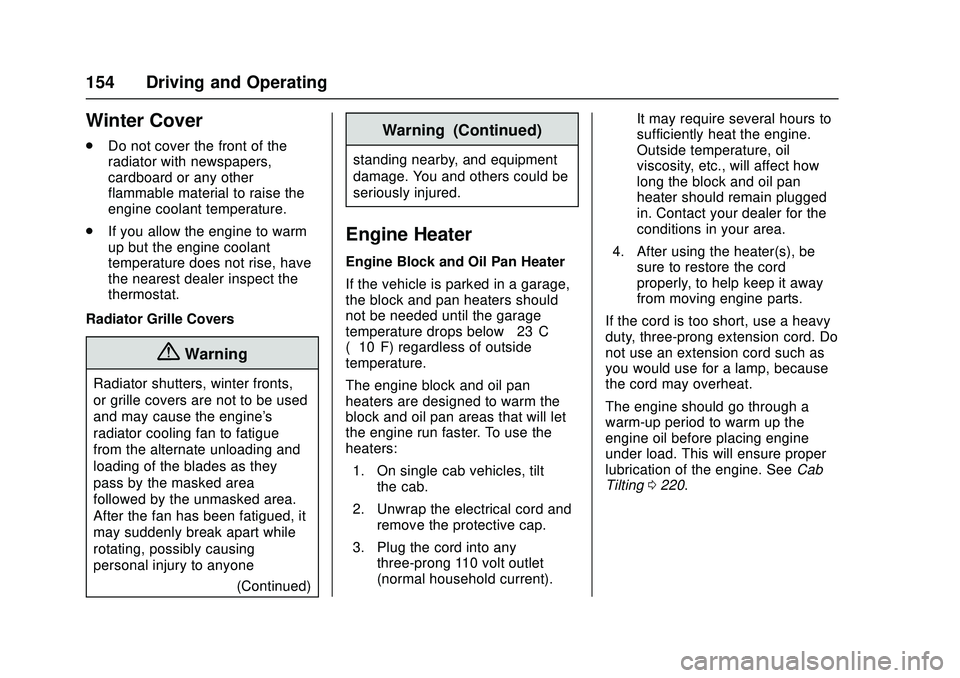
Winter Cover
.Do not cover the front of the
radiator with newspapers,
cardboard or any other
flammable material to raise the
engine coolant temperature.
. If you allow the engine to warm
up but the engine coolant
temperature does not rise, have
the nearest dealer inspect the
thermostat.
Radiator Grille Covers
{Warning
Radiator shutters, winter fronts,
or grille covers are not to be used
and may cause the engine's
radiator cooling fan to fatigue
from the alternate unloading and
loading of the blades as they
pass by the masked area
followed by the unmasked area.
After the fan has been fatigued, it
may suddenly break apart while
rotating, possibly causing
personal injury to anyone (Continued)
Warning (Continued)
standing nearby, and equipment
damage. You and others could be
seriously injured.
Engine Heater
Engine Block and Oil Pan Heater
If the vehicle is parked in a garage,
the block and pan heaters should
not be needed until the garage
temperature drops below −23°C
(−10°F) regardless of outside
temperature.
The engine block and oil pan
heaters are designed to warm the
block and oil pan areas that will let
the engine run faster. To use the
heaters:
1. On single cab vehicles, tilt the cab.
2. Unwrap the electrical cord and remove the protective cap.
3. Plug the cord into any three-prong 110 volt outlet
(normal household current). It may require several hours to
sufficiently heat the engine.
Outside temperature, oil
viscosity, etc., will affect how
long the block and oil pan
heater should remain plugged
in. Contact your dealer for the
conditions in your area.
4. After using the heater(s), be sure to restore the cord
properly, to help keep it away
from moving engine parts.
If the cord is too short, use a heavy
duty, three-prong extension cord. Do
not use an extension cord such as
you would use for a lamp, because
the cord may overheat.
The engine should go through a
warm-up period to warm up the
engine oil before placing engine
under load. This will ensure proper
lubrication of the engine. See Cab
Tilting 0220.
Page 157 of 358

Chevrolet Low Cab Forward Owner Manual (GMNA-Localizing-U.S.-
11254764) - 2018 - crc - 12/5/16
156 Driving and Operating
Activating High Idle Mode
Follow the below procedure to
activate the high idle mode:1. Set the parking brake.
2. Set the selector lever in P (Park) or N (Neutral) position.
3. Do not press the brake pedal. 4. Press the cruise control main
switch to set it to ON. At this
time, the operation indicating
light will turn to green.
5. Turn and hold the cruise control set switch in the SET
position. After approximately
3 seconds the cruise control
set indicator light will begin to
flash slowly and the engine idle
will increase to 1,200 r/min.
Canceling High Idle Mode
Any of the following actions will
cancel high idle mode.
. The cruise control main switch is
set to OFF.
. The brake pedal is pressed.
. The parking brake is released.
. The selector lever is moved from
P (Park) or N (Neutral) position.
. The accelerator pedal is
pressed, accelerating the engine
beyond the engine speed
threshold.
The cruise set indicator light will
stop flashing and the engine speed
will return to normal.
Engine Checks Before
Operating
Checks Before Operating
Allow the engine to warm up before
placing the engine under heavy load
driving. While the engine is warming
up under light load, the following
checks should be made:
1. Observe the red engine oil pressure warning light. The
light should go out when the
engine is running. If it stays on,
shut the engine off and find the
cause.
2. Look at the engine coolant temperature gauge. If the
gauge reaches the H (HOT)
area, stop the engine and find
the cause of the overheating.
3. Check that the battery warning light has gone out. The light
should go off and stay off at
normal idle speeds. If the light
does not go out or comes on
during normal operation, have
the charging system checked.
Page 158 of 358
Chevrolet Low Cab Forward Owner Manual (GMNA-Localizing-U.S.-
11254764) - 2018 - crc - 12/5/16
Driving and Operating 157
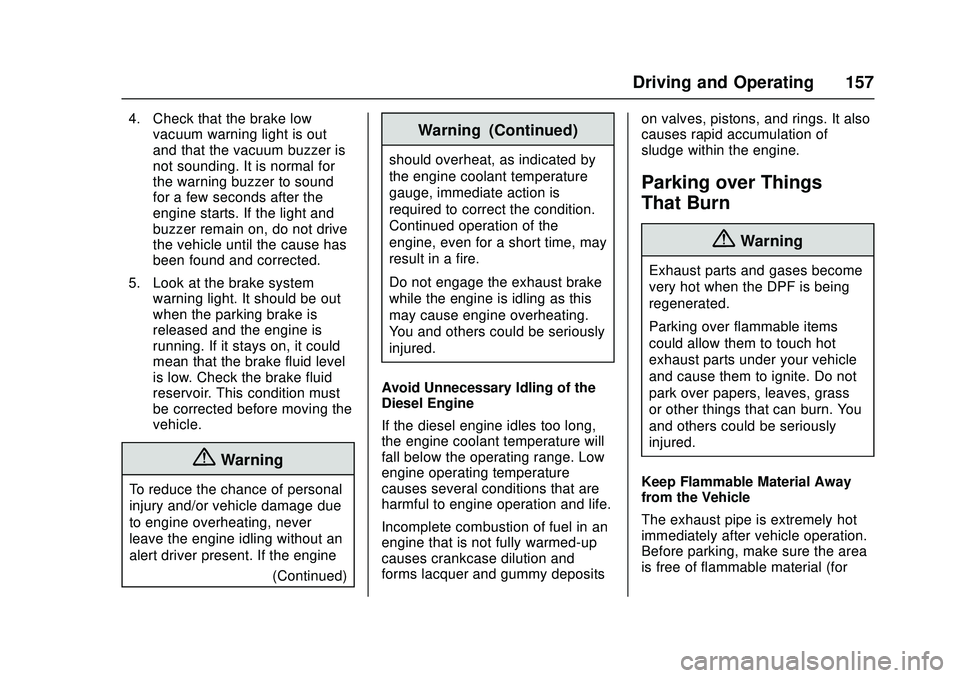
4. Check that the brake lowvacuum warning light is out
and that the vacuum buzzer is
not sounding. It is normal for
the warning buzzer to sound
for a few seconds after the
engine starts. If the light and
buzzer remain on, do not drive
the vehicle until the cause has
been found and corrected.
5. Look at the brake system warning light. It should be out
when the parking brake is
released and the engine is
running. If it stays on, it could
mean that the brake fluid level
is low. Check the brake fluid
reservoir. This condition must
be corrected before moving the
vehicle.
{Warning
To reduce the chance of personal
injury and/or vehicle damage due
to engine overheating, never
leave the engine idling without an
alert driver present. If the engine
(Continued)
Warning (Continued)
should overheat, as indicated by
the engine coolant temperature
gauge, immediate action is
required to correct the condition.
Continued operation of the
engine, even for a short time, may
result in a fire.
Do not engage the exhaust brake
while the engine is idling as this
may cause engine overheating.
You and others could be seriously
injured.
Avoid Unnecessary Idling of the
Diesel Engine
If the diesel engine idles too long,
the engine coolant temperature will
fall below the operating range. Low
engine operating temperature
causes several conditions that are
harmful to engine operation and life.
Incomplete combustion of fuel in an
engine that is not fully warmed-up
causes crankcase dilution and
forms lacquer and gummy deposits on valves, pistons, and rings. It also
causes rapid accumulation of
sludge within the engine.
Parking over Things
That Burn
{Warning
Exhaust parts and gases become
very hot when the DPF is being
regenerated.
Parking over flammable items
could allow them to touch hot
exhaust parts under your vehicle
and cause them to ignite. Do not
park over papers, leaves, grass
or other things that can burn. You
and others could be seriously
injured.
Keep Flammable Material Away
from the Vehicle
The exhaust pipe is extremely hot
immediately after vehicle operation.
Before parking, make sure the area
is free of flammable material (for
Page 161 of 358

Chevrolet Low Cab Forward Owner Manual (GMNA-Localizing-U.S.-
11254764) - 2018 - crc - 12/5/16
160 Driving and Operating
Warning (Continued)
or corroded exhaust system or
cab. Do not run the engine in
confined areas (such as garages,
next to a building or near another
stopped vehicles with engine
running) any more than needed to
move the vehicle.
When the vehicle has to be
stopped in an unconfined area
with the engine running for any
more than a few minutes, take the
following steps:. Adjust the heating or cooling
system to force outside air
into the cab.
. With temperature and outlet
selector knob in any
position:
. Set the air selector lever to
the fresh air position.
. Set the fan speed control
knob to the maximum speed
position.
(Continued)
Warning (Continued)
.Keep the exhaust tailpipe
area clear of snow and
other material to help
reduce the buildup of
exhaust gases under the
vehicle.
This is particularly important when
parked in blizzard conditions. You
and others could be seriously
injured.
See Climate Control Systems 0115
and Maintenance Schedule 0303.
Running the Vehicle
While Parked
Caution
To reduce the chance of personal
injury and/or vehicle damage due
to engine overheating, never
leave the engine idling without an
alert driver present. If the engine
(Continued)
Caution (Continued)
should overheat, as indicated by
the engine coolant temperature
gauge, immediate action is
required to correct the condition.
Continued operation of the
engine, even for a short time, may
result in a fire. Do not engage the
exhaust brake while the engine is
idling as this may cause engine
overheating.
Avoid Unnecessary Idling of the
Diesel Engine
If the engine idles too long, the
engine coolant temperature will fall
below the operating range. Low
engine operating temperature
causes several conditions that are
harmful to engine operation and life.
Incomplete combustion of fuel in an
engine that is not fully warmed-up
causes crankcase dilution and
forms lacquer and gummy deposits
on valves, pistons, and rings. It also
causes rapid accumulation of
sludge within the engine.
Page 188 of 358

Chevrolet Low Cab Forward Owner Manual (GMNA-Localizing-U.S.-
11254764) - 2018 - crc - 12/5/16
Driving and Operating 187
Warning (Continued)
When pulling away from a
standstill, you must control the
speed using only the accelerator
pedal. Operate the accelerator
pedal carefully.
Do not operate the selector lever
while pressing the accelerator
pedal. The vehicle may make a
sudden start, possibly causing an
accident.
You and others could be seriously
injured.
When pulling away, visually check
the position of the selector lever.
If you always press the push button
while operating the selector lever,
the lever may occasionally move to
the other gear position against your
intentions.
Practice operating the selector lever
between the N and D without
pressing the push button. Do not operate the selector lever
while pressing the accelerator
pedal. Doing so is dangerous
because the vehicle would
suddenly move.
Do not operate the automatic
transmission at or near stall
condition for more than
five seconds. Stall condition is when
the transmission is in one of the
driving ranges, the engine is running
at high speed, but the drive wheels
are unable to move. This condition
might occur if the vehicle is stuck in
deep sand or is pushing against a
fixed barrier. Operating the
transmission at stall condition will
result in overheating and damage.
Do not hold your vehicle on an
upgrade with the accelerator pedal.
Doing so will result in automatic
transmission overheating and
damage. Use the parking brake or
foot brake to hold the vehicle on an
upgrade.
Even if you plan to move only a
short distance, sit in the correct
driving position and make sure you
can firmly press the brake and
accelerator pedals.
When you reverse, you twist to look
rearward so pedal operation
becomes difficult. Firmly press the
brake pedal. Also, practice returning
the selector lever immediately to the
N position after reversing. When
pulling away, visually check the
selector lever position and the shift
indicator.
When the vehicle is stopped, do not
keep pressing the accelerator pedal
with the selector lever in a forward
gear or R position while pressing
the brake pedal. Doing so may
cause a breakdown.
Sit in the correct driving position,
and use your right foot to operate
the brake and accelerator pedals.
To avoid accidentally pressing the
wrong pedal, check the pedal
positions and practice putting your
foot on the desired pedal.
Page 190 of 358
Chevrolet Low Cab Forward Owner Manual (GMNA-Localizing-U.S.-
11254764) - 2018 - crc - 12/5/16
Driving and Operating 189
accelerator pedal the engine may
automatically shift down in
accordance to the current speed
(shifts to a lower speed gear),
increasing the engine speed and
increasing vehicle speed.
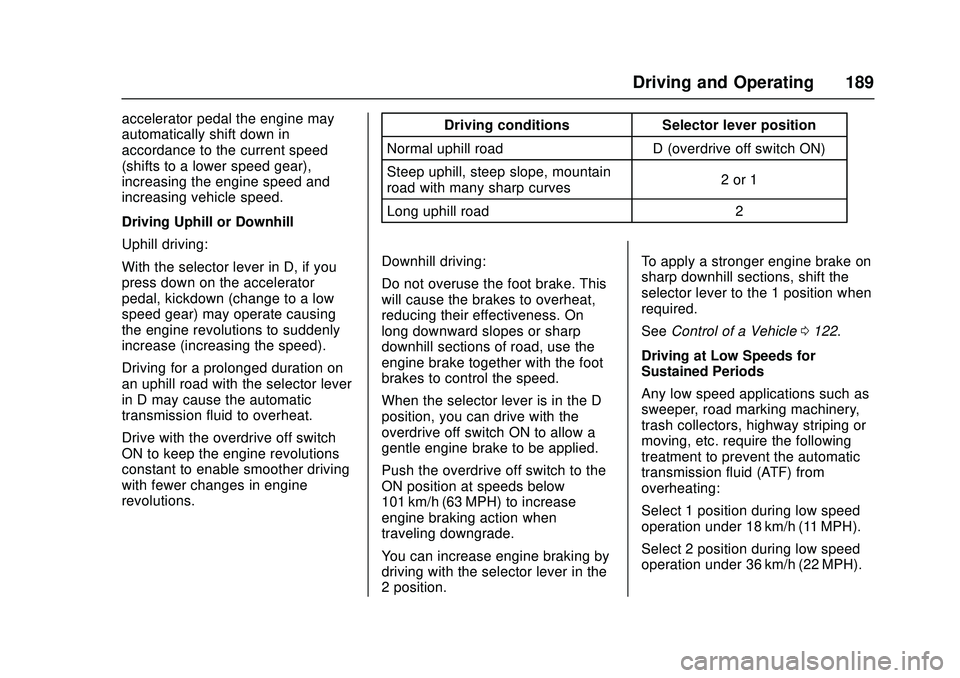
Driving Uphill or Downhill
Uphill driving:
With the selector lever in D, if you
press down on the accelerator
pedal, kickdown (change to a low
speed gear) may operate causing
the engine revolutions to suddenly
increase (increasing the speed).
Driving for a prolonged duration on
an uphill road with the selector lever
in D may cause the automatic
transmission fluid to overheat.
Drive with the overdrive off switch
ON to keep the engine revolutions
constant to enable smoother driving
with fewer changes in engine
revolutions.Driving conditions Selector lever position
Normal uphill road D (overdrive off switch ON)
Steep uphill, steep slope, mountain
road with many sharp curves 2 or 1
Long uphill road 2
Downhill driving:
Do not overuse the foot brake. This
will cause the brakes to overheat,
reducing their effectiveness. On
long downward slopes or sharp
downhill sections of road, use the
engine brake together with the foot
brakes to control the speed.
When the selector lever is in the D
position, you can drive with the
overdrive off switch ON to allow a
gentle engine brake to be applied.
Push the overdrive off switch to the
ON position at speeds below
101 km/h (63 MPH) to increase
engine braking action when
traveling downgrade.
You can increase engine braking by
driving with the selector lever in the
2 position. To apply a stronger engine brake on
sharp downhill sections, shift the
selector lever to the 1 position when
required.
See
Control of a Vehicle 0122.
Driving at Low Speeds for
Sustained Periods
Any low speed applications such as
sweeper, road marking machinery,
trash collectors, highway striping or
moving, etc. require the following
treatment to prevent the automatic
transmission fluid (ATF) from
overheating:
Select 1 position during low speed
operation under 18 km/h (11 MPH).
Select 2 position during low speed
operation under 36 km/h (22 MPH).
Page 194 of 358
Chevrolet Low Cab Forward Owner Manual (GMNA-Localizing-U.S.-
11254764) - 2018 - crc - 12/5/16
Driving and Operating 193
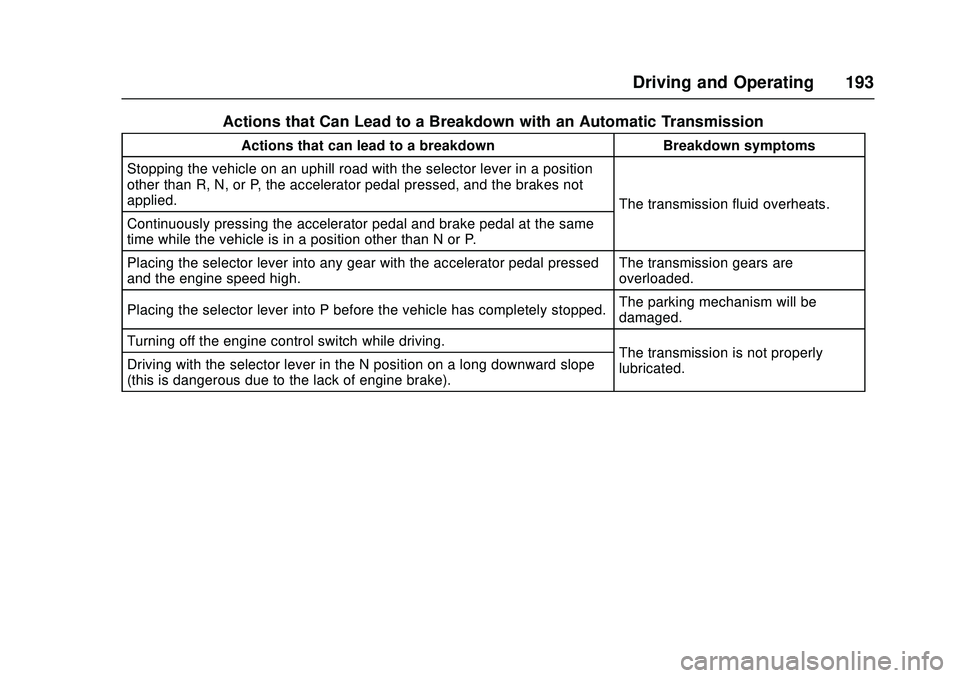
Actions that Can Lead to a Breakdown with an Automatic Transmission
Actions that can lead to a breakdownBreakdown symptoms
Stopping the vehicle on an uphill road with the selector lever in a position
other than R, N, or P, the accelerator pedal pressed, and the brakes not
applied. The transmission fluid overheats.
Continuously pressing the accelerator pedal and brake pedal at the same
time while the vehicle is in a position other than N or P.
Placing the selector lever into any gear with the accelerator pedal pressed
and the engine speed high. The transmission gears are
overloaded.
Placing the selector lever into P before the vehicle has completely stopped. The parking mechanism will be
damaged.
Turning off the engine control switch while driving. The transmission is not properly
lubricated.
Driving with the selector lever in the N position on a long downward slope
(this is dangerous due to the lack of engine brake).