maintenance schedule CHEVROLET LOW CAB FORWARD 2018 User Guide
[x] Cancel search | Manufacturer: CHEVROLET, Model Year: 2018, Model line: LOW CAB FORWARD, Model: CHEVROLET LOW CAB FORWARD 2018Pages: 358, PDF Size: 6.32 MB
Page 241 of 358

Chevrolet Low Cab Forward Owner Manual (GMNA-Localizing-U.S.-
11254764) - 2018 - crc - 12/5/16
240 Vehicle Care
after about 10 minutes if the gauge
pointer does not again show an
overheat condition.
When tap water only has been used
for engine coolant in an emergency,
change the engine coolant as soon
as possible.
Engine damage may be caused if
an overheating engine is suddenly
refilled with water. Instead, refill
slowly.
Power Steering Fluid
The power steering fluid level must
be checked and it must be changed
according to the Maintenance
Schedule. SeeMaintenance
Schedule 0303.
When replenishing power steering
fluid or flushing the power steering
system, always use ATF
(Dexron
®-VI). Failure to use the
proper fluid may damage the power
steering system seals and hoses,
leading to fluid leakage.
Checking the Power Steering
Fluid Level
The fluid level is correct if it is
between the “MAX”and“MIN” lines
on the reserve tank. If the level is
lower that the “MIN”line, add fluid
up to the “MAX”line.
The reserve tank is located at the
rear of the engine compartment on
the right. When you have finished
checking the fluid level, securely
install the cap and cover.
When you have finished checking
the fluid level, securely install
the cap.
The fluid level is correct if it is
between the "MAX" and "MIN" lines
on the oil dipstick. If the level is
lower than the "MIN" line, add fluid
up to the "MAX" line.
{Warning
Before adding fluid, clean the
area around the cap and pour
fluid from a clean jug or filler.
Foreign matter getting in the tank
may cause power steering system
failure. (Continued)
Page 243 of 358

Chevrolet Low Cab Forward Owner Manual (GMNA-Localizing-U.S.-
11254764) - 2018 - crc - 12/5/16
242 Vehicle Care
Follow the instructions provided with
the windshield washer fluid
regarding the ratio for mixing with
tap water.
Poor quality products, engine
coolant, and soapy water must not
be used. Failure to observe this
precaution can result in nozzle
blockage or damage to painted
surfaces.
The washer should never be used
while the tank is empty. Operating
the washer with the tank empty can
result in motor damage.
Brakes
For the most effective braking and
for maximum life from brake system
components, follow these
suggestions:
.Keep any obstructions from
interfering with brake pedal
travel.
. Keep tires properly inflated.
Improperly inflated tires can
reduce the efficiency of the
brakes. Follow the recommendations for
brake checks in the Maintenance
Schedule.
GM replacement brake lining
material is recommended for this
vehicle to maintain the balance
between front and rear brake
performance. GM replacement
brake parts have been carefully
selected to provide the proper brake
balance for purposes of both
stopping distance and controllability
over the full range of operating
conditions. Installation of front or
rear brake lining material with
performance different from that of
the replacement parts
recommended for this vehicle can
change the intended brake balance
of this vehicle.
Checking the Brake Electric
Vacuum Pump (4500HD/
4500XD Series)
1. Turn the engine control switch
to the "ON" position (do not
start the engine), and press the
brake pedal several times. 2. Check for the noisy sound of
the electric vacuum pump
inside the instrument panel at
the same time as vacuum
warning buzzer sound, and
check that the brake low
vacuum warning light
comes on.
3. Then, start the engine. The main vacuum pump driven by
the engine will start running.
If the electric vacuum pump
operation (noisy sound) and
the vacuum warning buzzer
stop, and the brake low
vacuum warning light goes off
thereafter, the operation is
normal.
4. If you cannot hear the noisy sound or the noisy sound stays
on all the time, have the
vehicle inspected by the
nearest dealer immediately.Hydraulic Brake Booster (HBB)
The 5500HD, 5500XD models are
equipped with an HBB system. HBB
is a brake booster device that
Page 245 of 358
Chevrolet Low Cab Forward Owner Manual (GMNA-Localizing-U.S.-
11254764) - 2018 - crc - 12/5/16
244 Vehicle Care
Caution (Continued)
hosing. Eventual leakage of HBB
oil, sudden increase in brake
pedal resistance and fire could
unexpectedly result in an
accident.
Hydraulic Brake Booster (HBB)
Fluid (5500HD/5500XD Series)
The HBB system has been
designed to use Dexron VI ATF
fluid. If any other fluid is used with
this system, rubber components
may be damaged, oil may leak and
the system may malfunction. It is
important to remember that the fluid
used in the hydro-booster is
completely different in
characteristics from the brake fluid
used in the master and wheel
cylinders.
If hydro-booster fluid and brake fluid
from the master cylinder are
mistakenly mixed together and
used, rubber components will
deteriorate as a result of insufficient
lubrication. Any resultant oil leakage or system malfunction can in turn
lead to dragging brakes or other
major brake problems. As such,
mixing of these two fluids can
ultimately lead to vehicle fire or
other serious accidents.
When the pump operates while the
engine is running, the fluid in the
hydro-booster will become hot.
During normal braking, the
temperature in piping and within
the hydro-booster can rise above
100 °C (212 °F). For this reason,
special care will be required when
working with hydro-booster
components. If the hydro-booster is
to be removed from the vehicle,
shut off the engine and then allow at
least 30 minutes for it to cool down
before beginning this operation.
Even when the engine is stopped,
the hydro-booster's accumulator will
remain in a highly-pressurized
condition for a significant period of
time. Before removing the
hydro-booster or piping from the
vehicle, stop the engine and press
the brake pedal at least 10 times in
order to lower the accumulator
pressure to atmospheric pressure.This is of particular importance
when removing components such
as the accumulator or pressure
switch from the hydro-booster.
If these operations are attempted
while the accumulator is still at a
high pressure, hydro-booster fluid
may spray out.
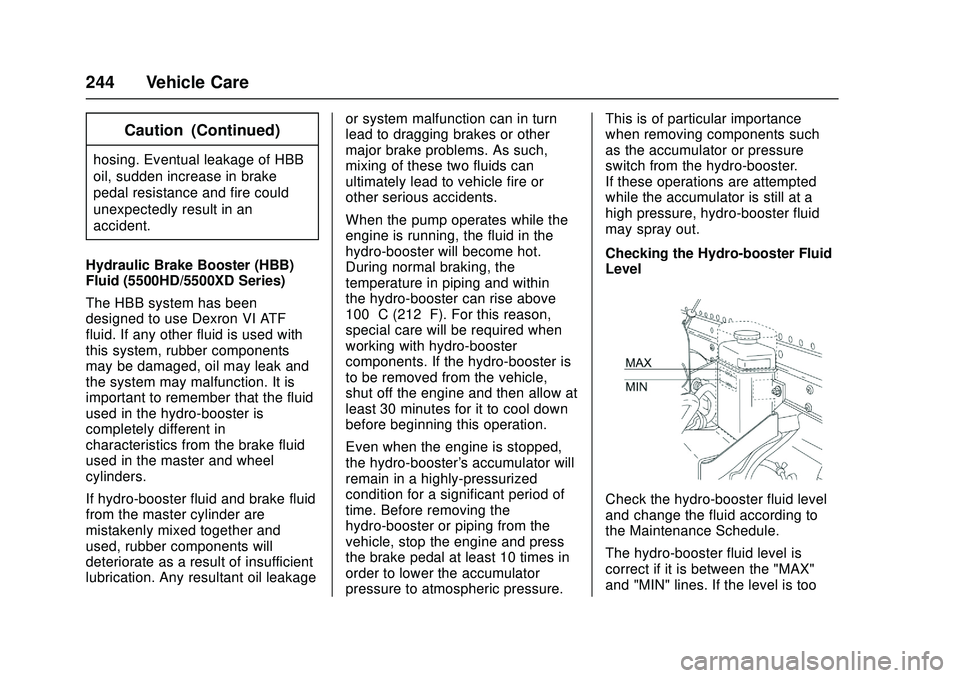
Checking the Hydro-booster Fluid
Level
Check the hydro-booster fluid level
and change the fluid according to
the Maintenance Schedule.
The hydro-booster fluid level is
correct if it is between the "MAX"
and "MIN" lines. If the level is too
Page 248 of 358
Chevrolet Low Cab Forward Owner Manual (GMNA-Localizing-U.S.-
11254764) - 2018 - crc - 12/5/16
Vehicle Care 247
Remove the inspection cover (1) on
the left- hand side of the instrument
panel by turning it with your fingers.
Check that the fluid level in the
reservoir is between the "MAX" and
"ADD" lines.
If the fluid surface cannot easily be
seen, rock the vehicle gently.
Adding Brake Fluid
If the level of brake fluid has
dropped below the "ADD" line,
remove the cap (2) and add fluid.
Take care to avoid filling beyond the
"MAX" line.
Tighten the cap securely after the
fluid has been added.
When adding brake fluid to the tank,
take care to prevent dirt and water
from entering it. Any dirt or water in
the system could cause the vehicle
to lose braking functions.
Inspect and change brake fluid
according to the Maintenance
Schedule.
Use the recommended brake fluid
when adding brake fluid.Never mix the specified brake fluid
with fluids of another brand.
Be careful not to spill brake fluid
onto painted surfaces or to let it
come in contact with skin. If fluid is
spilled onto a painted surface or
comes in contact with skin, wash
away the fluid with water and
immediately wipe the area clean.
Brake fluid readily absorbs moisture.
Therefore, it is necessary to close
the brake fluid container tightly for
storage.
If the brake fluid level decreases
rapidly, there may be a problem in
the brake system or brake pads or
shoe linings may have worn out.
Have your vehicle inspected by the
nearest dealer immediately.
Battery
Working Near Battery
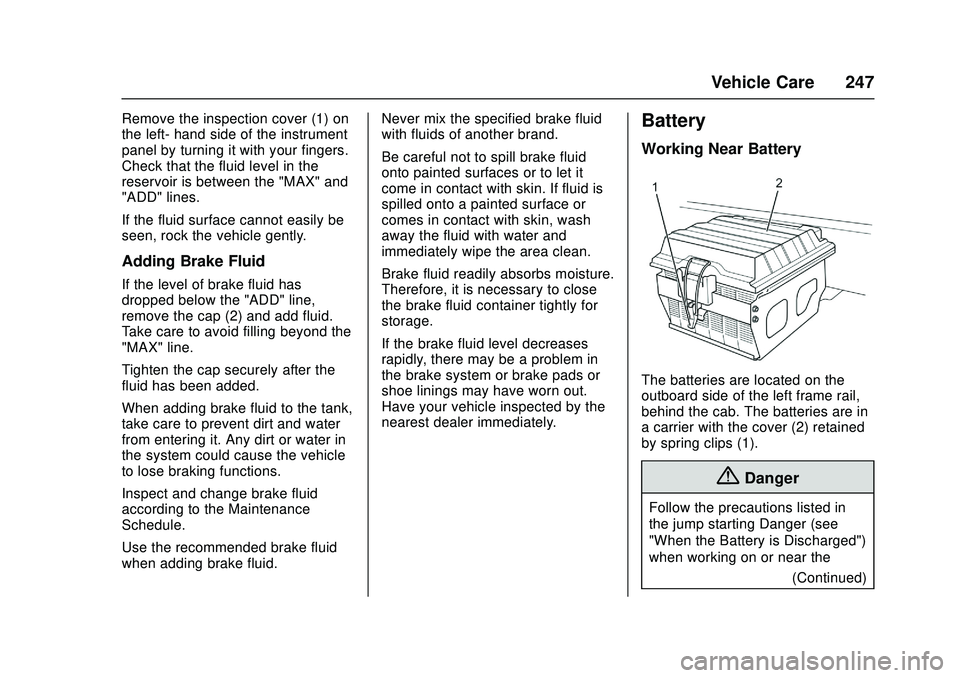
The batteries are located on the
outboard side of the left frame rail,
behind the cab. The batteries are in
a carrier with the cover (2) retained
by spring clips (1).
{Danger
Follow the precautions listed in
the jump starting Danger (see
"When the Battery is Discharged")
when working on or near the
(Continued)
Page 249 of 358

Chevrolet Low Cab Forward Owner Manual (GMNA-Localizing-U.S.-
11254764) - 2018 - crc - 12/5/16
248 Vehicle Care
Danger (Continued)
battery. Personal injury
(particularly to eyes) or property
damage may result from battery
explosion, battery fluid or
electrical (short circuit) burns. You
and others could be seriously
injured or killed.
If the negative cable is disconnected
from the negative terminal on the
battery within 3 minutes after turning
the engine control switch to the
"LOCK" position, the engine control
module may malfunction.
Checking the Battery
Your new vehicle is equipped with
DELKOR batteries. They need no
periodic electrolyte level
maintenance. Its top is permanently
sealed (except for two small vent
holes) and has no filler caps. You
will never have to add water.
Remember to check and recharge
the battery as necessary, as well as
keep connection clean. The hydrometer (green-eye test
indicator) in the top of each battery
(if equipped) provides information
for testing purposes only.
If the vehicle is not going to be
driven for 30 days or longer,
disconnect the ground cable from
the negative (–) terminal of the
batteries to prevent discharge.
For full power needs at replacement
time, a battery with the same
specifications, as shown on the
original battery's label, is
recommended.
{Warning
Battery posts, terminals and
related accessories contain lead
and lead compounds, chemicals
known to the State of California to
cause cancer and reproductive
harm. Wash hands after handling.
You and others could be seriously
injured.
Fuel Filter
Change the fuel filter in accordance
with the Maintenance Schedule or
when the fuel filter indicator light
(amber) comes on.
Drain the water when the water
separator (fuel filter) warning light
comes on. (Drain the water from the
chassis-side fuel filter and
engine-side fuel filter.)
Failure to replace the fuel filter when
needed may lead to fuel system
damage. Your authorized dealer can
inspect your fuel filter and replace
your fuel filter, if needed.
Page 250 of 358
Chevrolet Low Cab Forward Owner Manual (GMNA-Localizing-U.S.-
11254764) - 2018 - crc - 12/5/16
Vehicle Care 249
Rear Axle (Gear Oil Viscosity Chart)
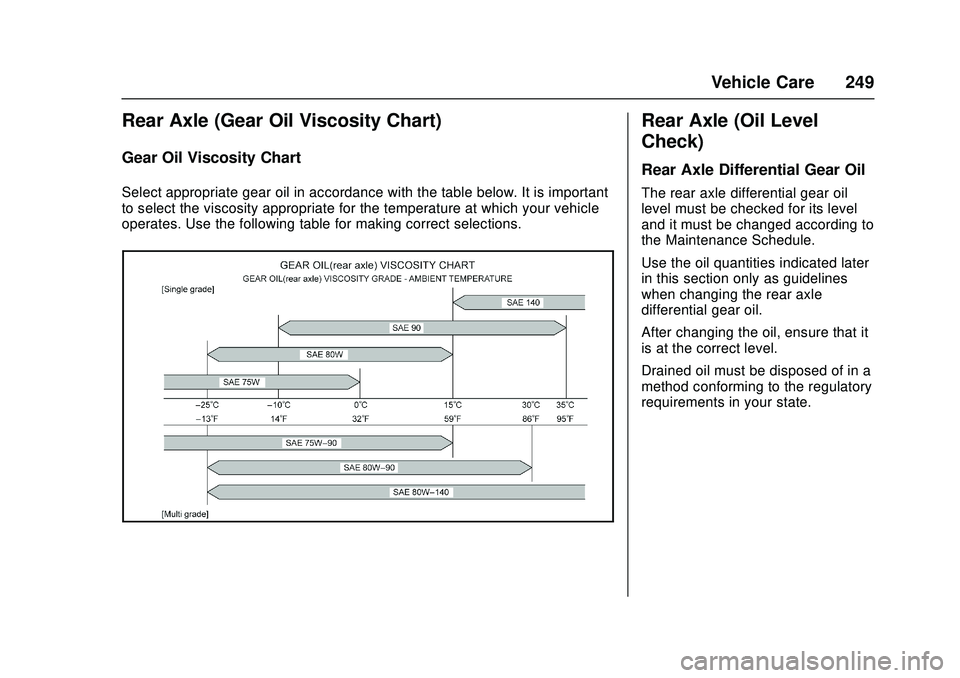
Gear Oil Viscosity Chart
Select appropriate gear oil in accordance with the table below. It is important
to select the viscosity appropriate for the temperature at which your vehicle
operates. Use the following table for making correct selections.
Rear Axle (Oil Level
Check)
Rear Axle Differential Gear Oil
The rear axle differential gear oil
level must be checked for its level
and it must be changed according to
the Maintenance Schedule.
Use the oil quantities indicated later
in this section only as guidelines
when changing the rear axle
differential gear oil.
After changing the oil, ensure that it
is at the correct level.
Drained oil must be disposed of in a
method conforming to the regulatory
requirements in your state.
Page 251 of 358
Chevrolet Low Cab Forward Owner Manual (GMNA-Localizing-U.S.-
11254764) - 2018 - crc - 12/5/16
250 Vehicle Care
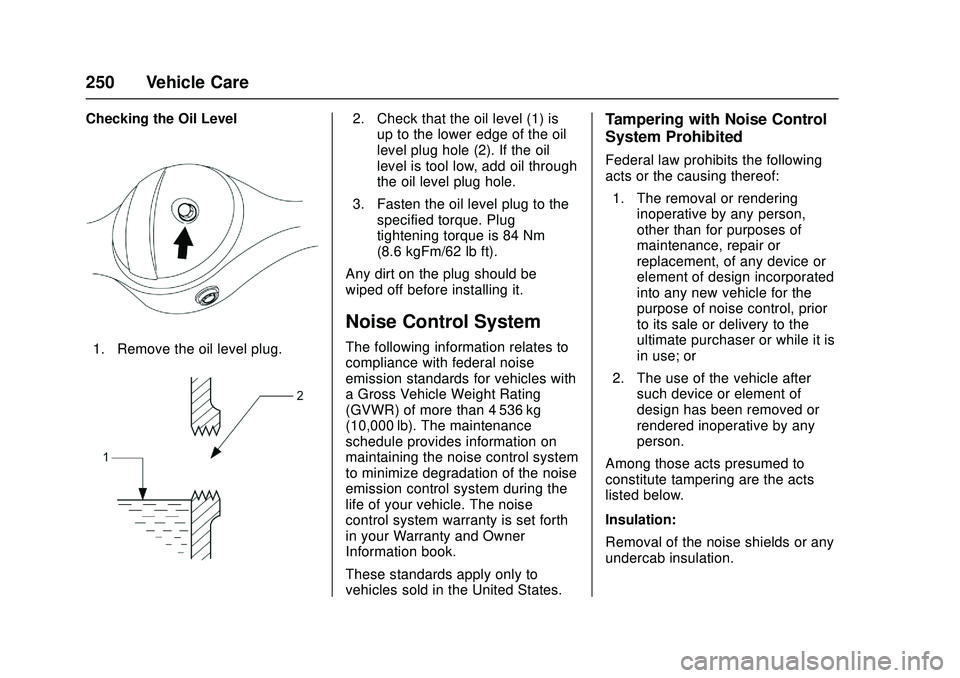
Checking the Oil Level
1. Remove the oil level plug.
2. Check that the oil level (1) isup to the lower edge of the oil
level plug hole (2). If the oil
level is tool low, add oil through
the oil level plug hole.
3. Fasten the oil level plug to the specified torque. Plug
tightening torque is 84 Nm
(8.6 kgFm/62 lb ft).
Any dirt on the plug should be
wiped off before installing it.
Noise Control System
The following information relates to
compliance with federal noise
emission standards for vehicles with
a Gross Vehicle Weight Rating
(GVWR) of more than 4 536 kg
(10,000 lb). The maintenance
schedule provides information on
maintaining the noise control system
to minimize degradation of the noise
emission control system during the
life of your vehicle. The noise
control system warranty is set forth
in your Warranty and Owner
Information book.
These standards apply only to
vehicles sold in the United States.
Tampering with Noise Control
System Prohibited
Federal law prohibits the following
acts or the causing thereof: 1. The removal or rendering inoperative by any person,
other than for purposes of
maintenance, repair or
replacement, of any device or
element of design incorporated
into any new vehicle for the
purpose of noise control, prior
to its sale or delivery to the
ultimate purchaser or while it is
in use; or
2. The use of the vehicle after such device or element of
design has been removed or
rendered inoperative by any
person.
Among those acts presumed to
constitute tampering are the acts
listed below.
Insulation:
Removal of the noise shields or any
undercab insulation.
Page 275 of 358
Chevrolet Low Cab Forward Owner Manual (GMNA-Localizing-U.S.-
11254764) - 2018 - crc - 12/5/16
274 Vehicle Care
In addition, when trucks are driven
continuously on high-crown roads,
an increase in air pressure of
35 kPa (5 psi) in the outer tire of a
dual tire operation will prolong outer
tire life. Be sure not to exceed the
inflation pressure limits shown on
the“VIN, Weight Rating, and
Greenhouse Gas (GHG) Emissions
Plate.” SeeVehicle Identification
Number (VIN) 0330.
Wheel and Tire Balancing
Proper tire balancing provides the
best riding comfort and helps to
reduce tire tread wear.
Out-of-balance tires can cause
annoying vehicle vibration and
uneven tire wear, such as cupping
and flat spots. See your authorized
dealer for wheel balancing.
Front End Alignment
Proper front end alignment improves
tire tread mileage. Your vehicle's
front end suspension parts should
be inspected often and aligned
when needed. (See the
Maintenance Schedule for more
information.) Improper alignment will
not cause the vehicle to vibrate; however, improper toe-in alignment
will cause front tires to roll at an
angle that will result in faster tire
wear. Incorrect caster or camber
alignment will cause your front tires
to wear unevenly, and may cause
the vehicle to "pull" to the left or
right.
Tire Traction
A decrease in driving, cornering and
braking traction occurs when water,
snow, ice, gravel or other material is
on the road surface. Driving
practices and vehicle speed should
be adjusted to the road conditions.
When driving on wet or slushy
roads, it is possible for a wedge of
water to build up between the tire
and road surface. This is known as
hydroplaning, and may cause partial
or complete loss of traction, vehicle
control and stopping ability; this
condition is also more likely with
worn tires.
To reduce the chance of traction
loss, follow these tips:
.
Slow down during rainstorms or
when roads are slushy. .
Slow down if the road has
standing water or puddles.
. Replace tires when front tread
depth is 3.2 mm (4/32 in.) and
rear tread depth is 1.6 mm
(2/32 in.).
. Keep tires properly inflated.
Tire Replacement
Recommendations
{Warning
Do not mix different construction
types of tires on your vehicle such
as radial, bias and bias-belted
tires except in emergencies,
because vehicle handling could
be affected and may result in loss
of vehicle control, or personal
injury or death.
Consult your dealer before
replacing wheels. Never use
wheels that are not designed for
the vehicle. Doing so would
impede safe vehicle operation.
Page 286 of 358
Chevrolet Low Cab Forward Owner Manual (GMNA-Localizing-U.S.-
11254764) - 2018 - crc - 12/5/16
Vehicle Care 285
The difference in diameter of the
tires for a dual-tire wheel should be
within the limit specified in the table
below. If the limit is exceeded, the
tires wear more rapidly than they
should.
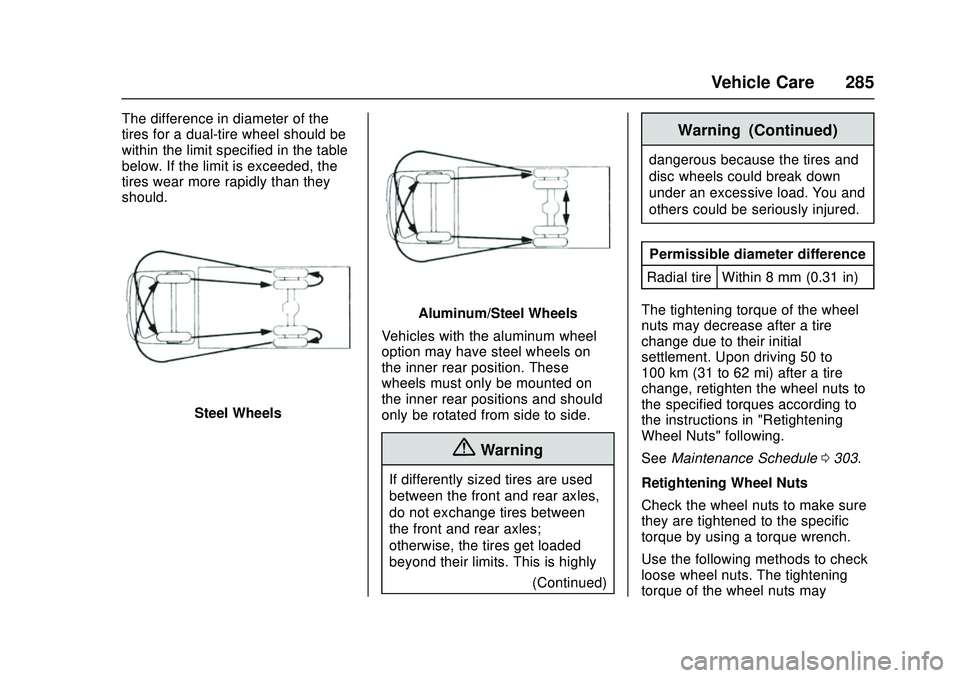
Steel Wheels
Aluminum/Steel Wheels
Vehicles with the aluminum wheel
option may have steel wheels on
the inner rear position. These
wheels must only be mounted on
the inner rear positions and should
only be rotated from side to side.
{Warning
If differently sized tires are used
between the front and rear axles,
do not exchange tires between
the front and rear axles;
otherwise, the tires get loaded
beyond their limits. This is highly (Continued)
Warning (Continued)
dangerous because the tires and
disc wheels could break down
under an excessive load. You and
others could be seriously injured.
Permissible diameter difference
Radial tire Within 8 mm (0.31 in)
The tightening torque of the wheel
nuts may decrease after a tire
change due to their initial
settlement. Upon driving 50 to
100 km (31 to 62 mi) after a tire
change, retighten the wheel nuts to
the specified torques according to
the instructions in "Retightening
Wheel Nuts" following.
See Maintenance Schedule 0303.
Retightening Wheel Nuts
Check the wheel nuts to make sure
they are tightened to the specific
torque by using a torque wrench.
Use the following methods to check
loose wheel nuts. The tightening
torque of the wheel nuts may
Page 287 of 358
Chevrolet Low Cab Forward Owner Manual (GMNA-Localizing-U.S.-
11254764) - 2018 - crc - 12/5/16
286 Vehicle Care
decrease after a tire change or
rotation due to their initial
settlement. After driving 50 to
100 km (31 to 62 mi), be sure to
retighten the wheel nuts to the
specified torque.
SeeMaintenance Schedule 0303.
Tightening torque
500 N·m (362 lb·ft)
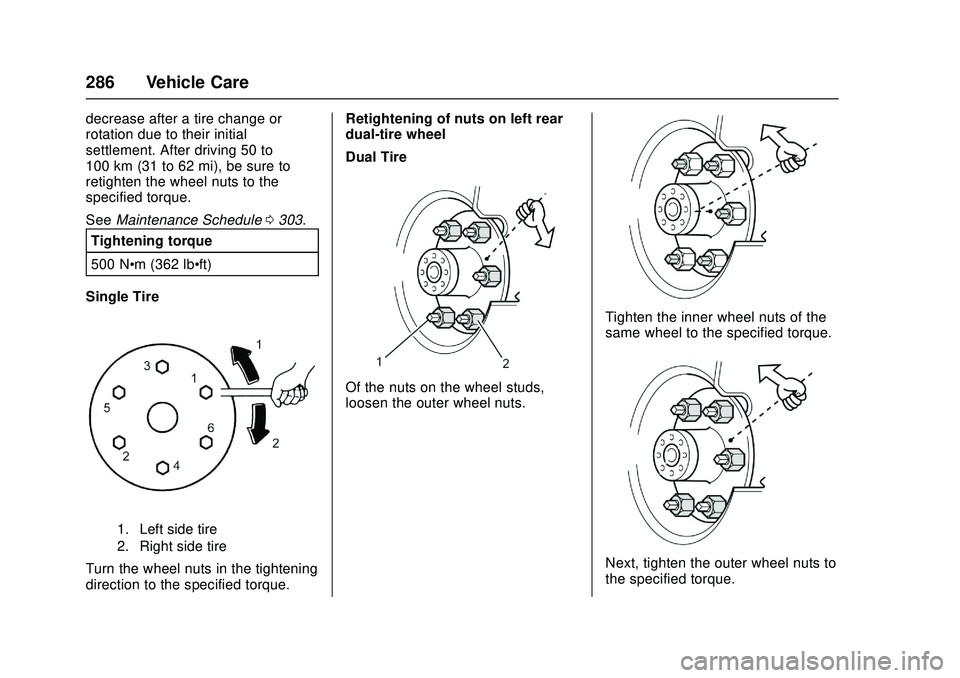
Single Tire
1. Left side tire
2. Right side tire
Turn the wheel nuts in the tightening
direction to the specified torque. Retightening of nuts on left rear
dual-tire wheel
Dual Tire
Of the nuts on the wheel studs,
loosen the outer wheel nuts.
Tighten the inner wheel nuts of the
same wheel to the specified torque.
Next, tighten the outer wheel nuts to
the specified torque.