oil CHEVROLET LOW CAB FORWARD 2018 User Guide
[x] Cancel search | Manufacturer: CHEVROLET, Model Year: 2018, Model line: LOW CAB FORWARD, Model: CHEVROLET LOW CAB FORWARD 2018Pages: 358, PDF Size: 6.32 MB
Page 131 of 358

Chevrolet Low Cab Forward Owner Manual (GMNA-Localizing-U.S.-
11254764) - 2018 - crc - 12/5/16
130 Driving and Operating
1. Hold the regular brake pedaldown with your right foot and
apply the parking brake all the
way before shifting the
transmission. Follow the
Parking Brake instructions in
this manual for your vehicle.
2. To move the selector lever to "P" (Park), hold in the button
on the lever and push the lever
all the way toward the front of
your vehicle.
3. Turn the key to "LOCK".
4. Remove the key and take it with you.
5. Before you leave the driver's seat, be sure the vehicle is not
moving, or check that your
vehicle is in Park by trying to
pull the selector lever out of "P"
(Park) by pulling the selector
lever toward you without
pushing the button. If you can
do this, it means that the
selector lever was not fully
locked into "P" (Park).Driving Down a Long Slope
When driving down a long slope,
use the exhaust brake together with
the foot brakes. Using the exhaust
brake and low-gears reduces the
work load on the foot brakes and
yields greater braking force. Even
so, use the foot brakes
appropriately to prevent the engine
over-revving.
Frequent use of the foot brakes can
cause vapor lock and brake fade,
resulting in reduced brake
effectiveness.
Brake Fade : Frequent use of the
brakes can cause the brakes to
overheat so that the frictional force
of the brake linings decreases and
the brakes become less effective
than normal. This phenomenon is
called brake fade.
Vapor Lock : If the brakes overheat
due to frequent use, the heat can
cause the brake fluid to boil so that
air bubbles are created in the brake
fluid. Pressing the brake pedal
simply compresses the air bubbles;
pressure is not transmitted to the
wheel cylinders, so the brakes' effectiveness sharply deteriorates.
This phenomenon is called
vapor lock.
Even so, you should be very careful
when using engine braking in a low
gear because the engine is likely to
over-rev.
See
Exhaust Brake 0201 and
Selector Lever 0194.
Do not adjust the exhaust brake
valve.
The engine should never be allowed
to exceed the governed speed.
Supplement the exhaust brake with
vehicle service brakes intermittently
and/or shift to higher transmission
gear to prevent engine overspeed.
A rule of thumb for gear selection is
that the vehicle should be driven
down a grade in the same gear that
would be used to climb that grade.
{Warning
To reduce the risk of personal
injury, before going down a steep
or long grade, reduce speed, turn (Continued)
Page 132 of 358

Chevrolet Low Cab Forward Owner Manual (GMNA-Localizing-U.S.-
11254764) - 2018 - crc - 12/5/16
Driving and Operating 131
Warning (Continued)
on the exhaust brake and shift the
transmission to the next lower
gear. This will help control your
speed. Do not hold the brake
pedal down too long or too often
while going down a steep or long
grade. This could cause the
brakes to get hot and not to work
as well. As a result, the truck will
not slow down at the usual rate.
Failure to take these steps could
result in loss of vehicle control.
You and others could be seriously
injured.
Brake Effectiveness When the
Vehicle Has Been Driven on a
Flooded Road or Washed
{Warning
When the vehicle is driven on a
flooded road, parked on a flooded
road or washed, water can get(Continued)
Warning (Continued)
into the brakes and reduce their
effectiveness. If the brakes do not
work well afterward, drive slowly
and gently press the brake pedal
several times until the brakes dry
out and start working normally.
Always do this after driving
through water or washing the
vehicle to help reduce the risk of
personal injury. Before parking
the vehicle in winter, press the
brake pedal several times in the
same way to get rid of moisture in
the brakes. Otherwise, the
moisture in the brakes may freeze
and make the vehicle immovable.
You and others could be seriously
injured.
If the vehicle must be driven on a
flooded road or is parked in an area
that becomes flooded, promptly
perform a check for the following
points:
. Effectiveness of the brakes .
Water-ingress or damage to
drum brakes, disc brakes
. Engine damage due to
water-ingress
. Shorting of electrical
components
. Oil level and degradation
(cloudiness) of the engine,
transmission, differential
. Greasing of each components
(lubrication)
Steering
Do Not Leave the Steering
Wheel Fully Turned for a
Long Time
{Warning
If you leave the steering wheel
fully turned for a long time, the oil
in the power steering oil pump will
become extremely hot. This
would cause poor lubrication, oil
tank damage and seal
deterioration, leading to power
(Continued)
Page 133 of 358
Chevrolet Low Cab Forward Owner Manual (GMNA-Localizing-U.S.-
11254764) - 2018 - crc - 12/5/16
132 Driving and Operating
Warning (Continued)
steering oil pump damage, power
steering unit damage and power
steering hose damage. As a
result the steering wheel could
become extremely hard to turn
and a fire or other accident could
occur.
You and others could be seriously
injured.
Steering Wheel
If the steering parts have excess
play or looseness or if any abnormal
condition is noted, have the steering
system checked immediately.
Driving on Wet Roads
Driving on Slippery Surface or
Driving in Bad Weather (Rain,
Icy Roads, Snowy Roads, etc.)
In bad weather, visibility is reduced
and slippery road surfaces increase
stopping distances. Drive more
slowly than you would in good
weather. Also, avoid sharp turns ofthe steering wheel and hard
braking. Use engine brakes together
with the foot brakes to decelerate.
Using the exhaust brake on a
slippery road surface could cause
the tires to slip.
You may not realize the surface is
slippery until the vehicle is skidding.
Learn to recognize warning clues—
such as enough water or ice on the
road to make a "mirrored surface"—
and slow down when there is any
doubt.
There is a risk of hydroplaning,
particularly where water tends to
collect on the road surface. Drive at
speeds that allow you to stay in
complete control.
If you cannot avoid driving on a
flooded road, first check the depth
of the water and then drive through
the water at a slow, constant speed.
There is a risk that water will get
into the engine's cylinders and
cause engine damage (water
hammering). Keep your speed
down, and drive with great care.
Hydroplaning :
If a vehicle is driven
at high speed on a road that is
covered with water, a layer of water
can form between the tires and road
surface, causing the tires to lose
their grip and slide across the water.
This phenomenon is called
hydroplaning. It is dangerous
because it makes the steering
wheel and brakes useless.
Refer to Wheels and Tires 0272.
Hill and Mountain Roads
Narrow or Congested Roads
When passing or overtaking a
vehicle on a narrow mountain road
or on a narrow or congested urban
road, pay careful attention to
obstacles on either side and to the
condition of the shoulder of
the road.
When turning, the rear wheels will
follow tighter curves than the front
wheels. Use the mirrors to confirm
safety.
Page 134 of 358

Chevrolet Low Cab Forward Owner Manual (GMNA-Localizing-U.S.-
11254764) - 2018 - crc - 12/5/16
Driving and Operating 133
Driving Uphill or Downhill
Downshifts are performed for two
main purposes:
.For engine braking on a steep
and/or long downward slope
. For responsiveness and
economy on an uphill slope
Drive at a speed that does not
cause the tachometer needle to
enter the red zone.
Uphill
Shift down well ahead of time in
order to avoid a heavy load to the
engine. Downhill
.
Be careful not to drive too fast
on a downhill road.
. Use the same gear(s) that you
used to drive up the hill. Also,
use the exhaust brake in order
to avoid going too fast.
. Do not let the engine overrun.
. When going down on a steep
slope, avoid driving the vehicle
backward as much as possible.
Drive it forward slowly on the
down slope.
. Compared with forward
movement, the braking distance
of backward movement is longer,
and the steering response of
that is worse.
. If you must drive the vehicle
backward, drive it very carefully
and gradually by moving and
stopping repeatedly in order to
stop it any time.
Engine Brake : Engine brake is the
braking effect that occurs when you
release the accelerator pedal while
driving. The lower the gear, the
stronger the engine brake. Exhaust Brake :
The exhaust brake
is a system that closes the exhaust
pipe and uses the force of the
exhaust emissions to enhance the
effectiveness of engine brake.
Overrunning : An engine overrun is
an engine-speed increase that
causes the tachometer needle to
enter the red zone. It is dangerous
because it can cause engine failure.
Winter Driving
Recommendations for Driving
in Cold Regions
The following recommendations
apply to snowbound regions and to
mountainous regions, ski resorts
and other areas of extreme cold
and/or snowfall. Please follow them
also for reference in winter in other
regions.
For the sake of your vehicle, make
the winter preparations described in
the links below. Also have these
preparations made before driving to
a cold region.
See Engine Oil 0223.
Page 139 of 358
Chevrolet Low Cab Forward Owner Manual (GMNA-Localizing-U.S.-
11254764) - 2018 - crc - 12/5/16
138 Driving and Operating
SymptomCauseCorrective Action Reference
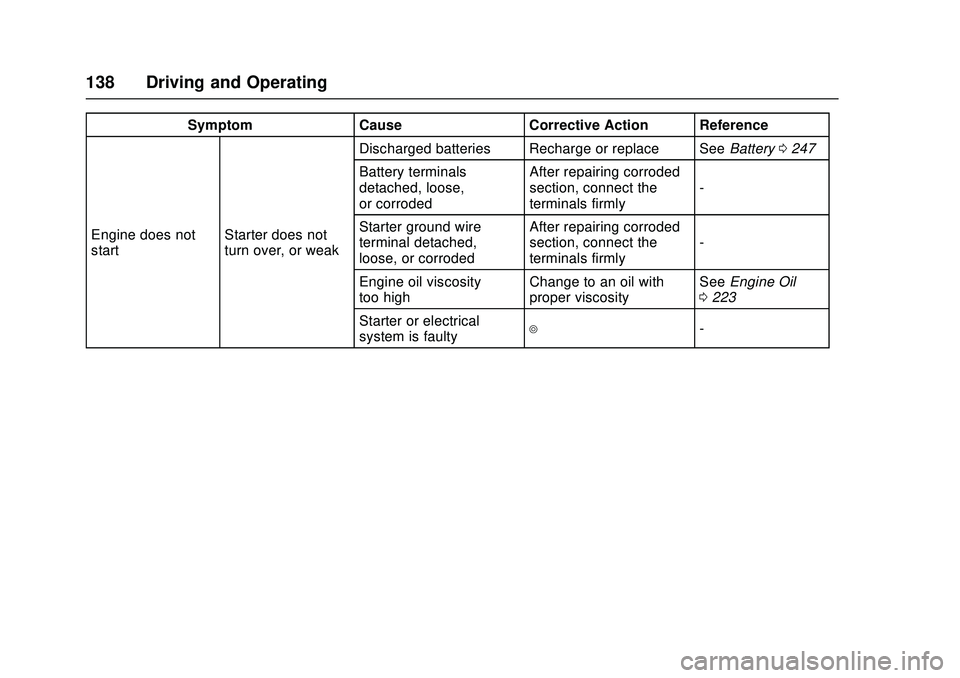
Engine does not
start Starter does not
turn over, or weak Discharged batteries Recharge or replace See
Battery0247
Battery terminals
detached, loose,
or corroded After repairing corroded
section, connect the
terminals firmly
-
Starter ground wire
terminal detached,
loose, or corroded After repairing corroded
section, connect the
terminals firmly
-
Engine oil viscosity
too high Change to an oil with
proper viscositySee
Engine Oil
0 223
Starter or electrical
system is faulty
4-
Page 141 of 358

Chevrolet Low Cab Forward Owner Manual (GMNA-Localizing-U.S.-
11254764) - 2018 - crc - 12/5/16
140 Driving and Operating
SymptomCauseCorrective Action Reference
Unsteady engine speed There is water or air in
the fuel system
Drain water from fuel
filter or bleed the systemSee
Running Out
of Fuel 0212 or
Water in Fuel
0 209
Fuel system is faulty
4-
White exhaust smoke Engine not sufficiently
warming up
Allow the engine to
warm up
-
Too much engine oil Correct the oil level See
Engine Oil
0 223
Engine Control system
faulty
4-
Fuel system faulty
4-
Exhaust injector
4-
Continuous idling for a
long period (more than
two hours) With the vehicle
stationary in a place
where it will not obstruct
traffic, hold down the
accelerator pedal and
check that white smoke
is not emitted
-
Page 143 of 358
Chevrolet Low Cab Forward Owner Manual (GMNA-Localizing-U.S.-
11254764) - 2018 - crc - 12/5/16
142 Driving and Operating
SymptomCauseCorrective Action Reference
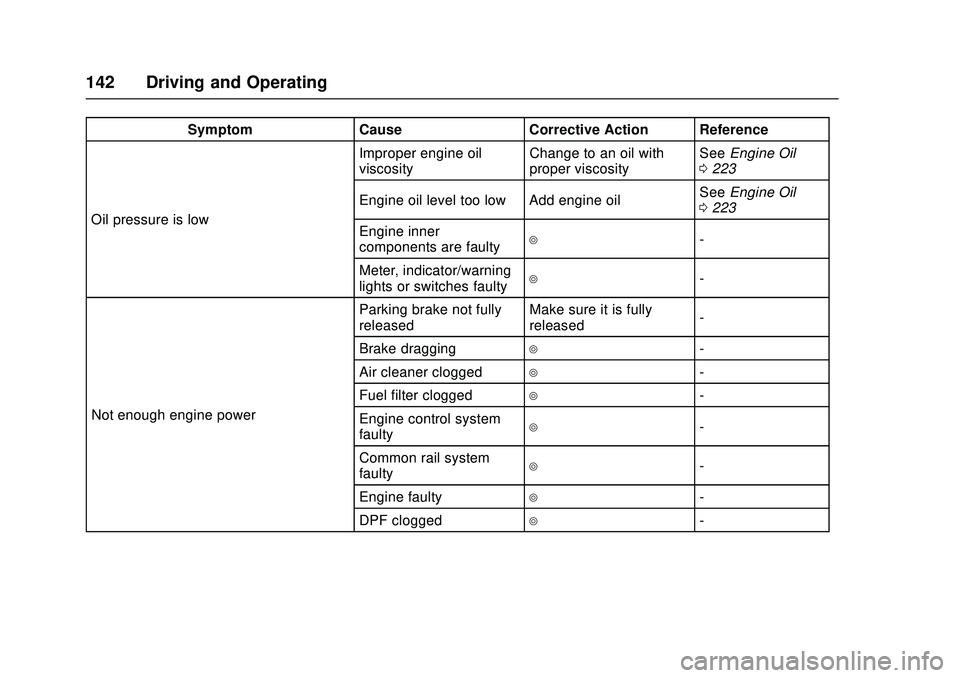
Oil pressure is low Improper engine oil
viscosity
Change to an oil with
proper viscositySee
Engine Oil
0 223
Engine oil level too low Add engine oil See
Engine Oil
0 223
Engine inner
components are faulty
4-
Meter, indicator/warning
lights or switches faulty
4-
Not enough engine power Parking brake not fully
released
Make sure it is fully
released
-
Brake dragging
4-
Air cleaner clogged
4-
Fuel filter clogged
4-
Engine control system
faulty
4-
Common rail system
faulty
4-
Engine faulty
4-
DPF clogged
4-
Page 146 of 358
Chevrolet Low Cab Forward Owner Manual (GMNA-Localizing-U.S.-
11254764) - 2018 - crc - 12/5/16
Driving and Operating 145
SymptomCauseCorrective Action Reference
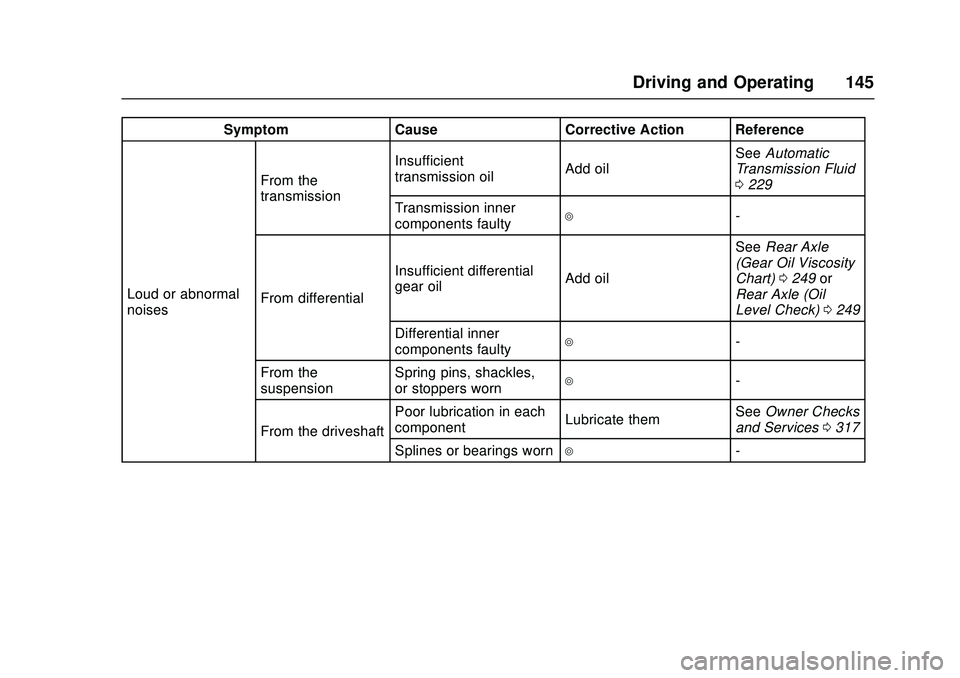
Loud or abnormal
noises From the
transmission
Insufficient
transmission oil
Add oilSee
Automatic
Transmission Fluid
0 229
Transmission inner
components faulty
4-
From differential Insufficient differential
gear oil
Add oilSee
Rear Axle
(Gear Oil Viscosity
Chart) 0249 or
Rear Axle (Oil
Level Check) 0249
Differential inner
components faulty
4-
From the
suspension Spring pins, shackles,
or stoppers worn
4-
From the driveshaft Poor lubrication in each
component
Lubricate themSee
Owner Checks
and Services 0317
Splines or bearings worn
4-
Page 152 of 358

Chevrolet Low Cab Forward Owner Manual (GMNA-Localizing-U.S.-
11254764) - 2018 - crc - 12/5/16
Driving and Operating 151
2. When the engine control switchis turned to the ON position,
the wait-to-start light comes on
and it goes out in about
1 second when the engine is
warm, to about 10 seconds
when the engine is cold.
3. After confirming that the wait-to-start light has gone out,
turn the engine control switch
to the START position to start
the engine. Release the engine
control switch as soon as the
engine starts.
4. Do not crank the engine for more than 10 seconds at a
time. If the engine does not
start, wait 20 to 30 seconds
with the engine control switch
in the LOCK or ACC position
before trying to start again. It is normal for the vacuum warning
buzzer to sound for a few seconds
after the engine has started.
After the engine has started, check
to be sure the selector lever is still
in the P position.
This engine has an automatic
warm-up system that increases
engine idle speed and applies the
exhaust brake. Allow sufficient time
to let the engine circulate lubricant
oil before driving. This usually
requires 30 seconds to 2 minutes
depending on ambient conditions.
See
Brake System Warning Light
(Parking Brake Light) 075.
The turbocharged engine should be
started in a way which ensures the
bearings supporting the rotating
parts of the turbocharger are
sufficiently lubricated. Do not race a
cold engine.
At low ambient temperatures, a cold
engine may emit more smoke than
usual.
Do not drive the truck until the
engine has had sufficient time to
circulate the lubricant oil. This usually requires 30 seconds to
2 minutes depending on ambient
conditions. This will help reduce
white start-up smoke.
Preheating :
Diesel engines are
compression ignited, which makes
them difficult to start when they are
cold because the compression
alone cannot create a temperature
high enough for fuel to ignite.
Preheating means warming the
compressed air inside the
combustion chambers to facilitate
engine starting. Be sure to start the
engine after the wait-to-start light
has gone out.
Start : Do not press the accelerator
pedal at the engine start. The
accelerator opening degree at the
engine start is electronically
controlled.
Warm-up : Do not race the engine
to speed warm-up.
Page 153 of 358
Chevrolet Low Cab Forward Owner Manual (GMNA-Localizing-U.S.-
11254764) - 2018 - crc - 12/5/16
152 Driving and Operating
Cold Weather Starting
If you plan ahead for cold weather,
starting and driving your vehicle
should be no problem. The following
tips will help ensure good starting in
cold weather.
Oil gets thicker as it gets colder,
which slows down the engine
cranking speed. The diesel engine
functions by the heat of
compression (and glow plugs when
cold), rather than through the use of
spark plugs as in a gasoline engine.
So, your engine must crank faster
than a gasoline engine before it will
start.
To be sure the engine can turn fast
enough to start, use SAE 10W-40
viscosity engine oil when prevailing
temperatures drop below 0 °C
(32 °F). See the oil quality and oil
viscosity recommendations. Using
the proper viscosity oil will make
starting easier down to -23 °C
(-10 °F). When prevailing
temperatures drop below -23 °C
(-10 °F), the engine block heater
may be needed for starting. See
Engine Heater0154. Maintenance Items to Aid Cold
Weather Starting
Since the basic principle of diesel
engine ignition is based on
compression, the diesel engine is
somewhat harder to start than a
gasoline engine when the
temperature is below freezing.
To help prevent hard starting
problems, special attention should
be given to following normal
maintenance items:
1. Neglecting to have the fuel filter and water separator
serviced can be one of the
major contributors to hard
starting. If water is permitted to
accumulate in the primary filter,
it will freeze and make starting
the engine impossible.
2. Make sure the fuel tank vent is open.
3. Always refuel at the end of a day's operation. Moisture will
condense in an empty tank;
therefore, the tank should be filled before leaving the vehicle
standing for an extended
period.
Do not use starting aids in the air
intake system. Such aids can cause
immediate engine damage. See
Fuel for Diesel Engines 0206.
Stopping the Engine
When stopping the engine, take the
following steps: 1. Bring the vehicle to a complete stop.
2. Firmly apply the parking brake.
3. Move the selector lever to the P position and make sure that
the shift indicator shows P.
4. Allow the engine to idle for approximately 3 minutes.
5. Turn the engine control switch to the ACC or LOCK position.
Do not shut down the engine
immediately after driving the vehicle.
Otherwise, a seizure or other
failures may result.