radiator CHEVROLET LOW CAB FORWARD 2018 User Guide
[x] Cancel search | Manufacturer: CHEVROLET, Model Year: 2018, Model line: LOW CAB FORWARD, Model: CHEVROLET LOW CAB FORWARD 2018Pages: 358, PDF Size: 6.32 MB
Page 238 of 358

Chevrolet Low Cab Forward Owner Manual (GMNA-Localizing-U.S.-
11254764) - 2018 - crc - 12/5/16
Vehicle Care 237
may be lost and damage to the
engine may result from overheating.
The radiator pressure cap should be
checked periodically for proper
operation. If a replacement is
required, a genuine GM part is
recommended.
Engine Overheating
When the Engine Overheats
The engine cooling system may
overheat if the engine coolant level
is too low, if there is a sudden loss
of engine coolant (such as radiator
hose failure), or if other problems
occur. It may also temporarily
overheat during severe operating
conditions such as:
.Climbing a long hill on a hot day.
. Stopping after high-speed
driving.
. Idling for long periods in traffic.
If engine power drops and the
needle on the engine coolant
temperature gauge goes up above
the upper limit of the safety zone
and enters the "H" zone, the engine
is overheating. The engine overheat warning light will come on and the
warning buzzer will sound. Either
steam or boiling engine coolant will
squirt out of the radiator. The
vehicle will also have an
“OVER
HEAT” message displayed. Take the
following corrective actions
immediately.
{Warning
To help avoid being burned:
Do not tilt the cab or open the
engine access cover if you see or
hear steam or engine coolant
escaping from the engine
compartment. Wait until no steam
or engine coolant can be seen or
heard before tilting the cab or
opening the engine cover.
Do not remove the radiator cap or
engine coolant reserve tank cap if
the engine coolant in the tank is
boiling. Also do not remove the
radiator cap while the engine and
radiator are still hot. Scalding fluid
(Continued)
Warning (Continued)
and steam can be blown out
under pressure if either cap is
taken off too soon.
You and others could be seriously
injured.
If Steam Is Coming from the
Engine Compartment
{Warning
If the engine coolant temperature
gauge shows an overheat
condition or you have other
reasons to suspect the engine
may be overheating, continued
operation of the engine (other
than as described here) even for
a short period of time may cause
a fire and the result in personal
injury and severe vehicle
damage. Take immediate action
as outlined.
You and others could be seriously
injured.
Page 239 of 358

Chevrolet Low Cab Forward Owner Manual (GMNA-Localizing-U.S.-
11254764) - 2018 - crc - 12/5/16
238 Vehicle Care
If you see or hear escaping steam
or have any other reason to suspect
there is a serious overheat
condition, stop and park the vehicle
as soon as it is safe to do so, turn
on the hazard warning flasher and
then turn off the engine immediately
and safely exit the vehicle.
If Steam Is Not Coming from the
Engine Compartment
If the engine coolant temperature
gauge shows an overheat condition,
or you have reason to suspect the
engine may be overheating, take
the following steps:1. Operate the hazard warning flasher and pull the vehicle
immediately over to a safe
place that does not impede
traffic and park it.
2. Idle the engine and wait until the engine coolant temperature
drops to safety zone. If your air
conditioner (if equipped) is on,
turn it off. And turn on the
heater to help the engine
expel heat. 3. When the needle of the engine
coolant temperature gauge
returns to the middle of the
safety zone, stop the engine.
If the needle of engine coolant
temperature gauge does not
drop inside into the safety
zone, turn the engine off and
have your vehicle serviced at
the nearest dealer.
When the cooling fan for the
radiator is not turning, turn off
the engine immediately.
{Warning
Even when the engine has been
stopped, the engine coolant in the
radiator remains under pressure.
Immediately removing the radiator
cap could cause steam or hot
water to blow out, and you could
be scalded as a result. The
engine coolant in the reserve tank
may also be hot. Immediately
removing the cap could cause hot
water to blow out, and possibly
scald you. Perform inspection,
(Continued)
Page 240 of 358
Chevrolet Low Cab Forward Owner Manual (GMNA-Localizing-U.S.-
11254764) - 2018 - crc - 12/5/16
Vehicle Care 239
Warning (Continued)
refilling, and replacement of
coolant only when its temperature
has cooled.
When removing the radiator cap
and reserve tank cap, use a thick
cloth to cover the cap and turn it
little by little.
You and others could be seriously
injured.
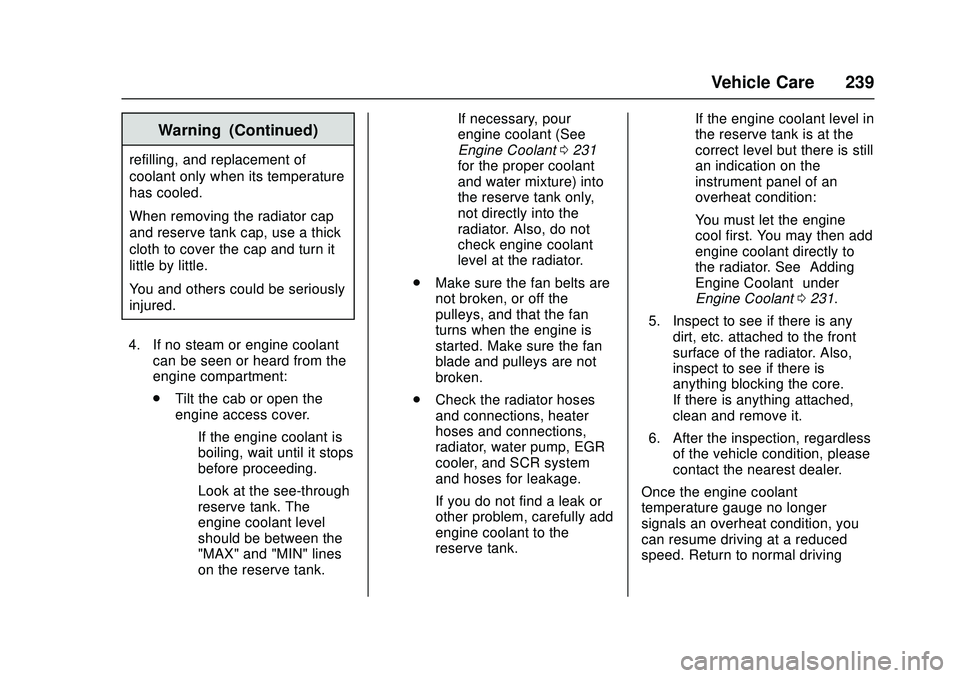
4. If no steam or engine coolant can be seen or heard from the
engine compartment:
.Tilt the cab or open the
engine access cover.
‐If the engine coolant is
boiling, wait until it stops
before proceeding.
‐ Look at the see-through
reserve tank. The
engine coolant level
should be between the
"MAX" and "MIN" lines
on the reserve tank. ‐
If necessary, pour
engine coolant (See
Engine Coolant 0231
for the proper coolant
and water mixture) into
the reserve tank only,
not directly into the
radiator. Also, do not
check engine coolant
level at the radiator.
. Make sure the fan belts are
not broken, or off the
pulleys, and that the fan
turns when the engine is
started. Make sure the fan
blade and pulleys are not
broken.
. Check the radiator hoses
and connections, heater
hoses and connections,
radiator, water pump, EGR
cooler, and SCR system
and hoses for leakage.
If you do not find a leak or
other problem, carefully add
engine coolant to the
reserve tank. If the engine coolant level in
the reserve tank is at the
correct level but there is still
an indication on the
instrument panel of an
overheat condition:
You must let the engine
cool first. You may then add
engine coolant directly to
the radiator. See
“Adding
Engine Coolant” under
Engine Coolant 0231.
5. Inspect to see if there is any dirt, etc. attached to the front
surface of the radiator. Also,
inspect to see if there is
anything blocking the core.
If there is anything attached,
clean and remove it.
6. After the inspection, regardless of the vehicle condition, please
contact the nearest dealer.
Once the engine coolant
temperature gauge no longer
signals an overheat condition, you
can resume driving at a reduced
speed. Return to normal driving
Page 242 of 358

Chevrolet Low Cab Forward Owner Manual (GMNA-Localizing-U.S.-
11254764) - 2018 - crc - 12/5/16
Vehicle Care 241
Warning (Continued)
Do not mix the recommended
power steering fluid with fluids of
other brands. Due to chemical
reactions, any mixture of
differently branded fluids may
cause failure of the system.
You and others could be seriously
injured.
Washer Fluid
Windshield Washer Fluid
The windshield washer is equipped
on the windshield wiper arm.
Check the level of fluid in the
windshield washer fluid tank. In
addition, spray windshield washer
fluid and operate the windshield
wipers to check for any areas not
properly wiped. At this time, also
check the spraying condition of the
windshield washer.Inspect the washer fluid level
regularly, especially during bad
weather conditions.
Use a high quality premixed solvent
available at most dealers or service
stations.
Avoid hard water when mixing
windshield washer solvents. Hard
water contaminants may plug
orifices in the washer system and
reduce performance.
Do not use radiator antifreeze in the
windshield washer; it could cause
cab paint damage.
In cold weather, warm the
windshield with the defrosters
before using the washer, to help
prevent icing that may block the
driver's vision.
Refilling Windshield Washer
Fluid
1. The windshield washer fluid
tank (1) is located under the
instrument panel on the
passenger side.
2. Open the cap (2) and fill the tank with windshield washer
fluid.
Upon factory shipment, new
vehicles contain only tap water in
the washer fluid tank. Adjust the
concentration of the fluid to suit your
own usage.
Page 298 of 358
Chevrolet Low Cab Forward Owner Manual (GMNA-Localizing-U.S.-
11254764) - 2018 - crc - 12/5/16
Vehicle Care 297
form when rinsing with water. Clean
the blade by wiping with a cloth
soaked in a solution of one-half
water and one-half methanol
alcohol. Then rinse the blade with
water.
The windshield wiper arms may be
swung out, away from the glass, to
provide easy access for cleaning.
Do not hang on to the roofmarker
lights while cleaning the windshield
or damage may occur (resulting in
possible water leakage).
External Diesel Engine
Cleaning
The engine does not need periodic
cleaning, nor is it recommended.
If you insist on cleaning the engine,
clean it only when it is cold, never
when it is warm or hot, and never
when the engine is running.
Spraying or pouring water or other
fluids on your engine when it is
warm or hot, or when it is running,
can cause serious damage to the
engine and its components,
particularly the fuel supply pump.
Handling the Radiator and
Charge Air Cooler
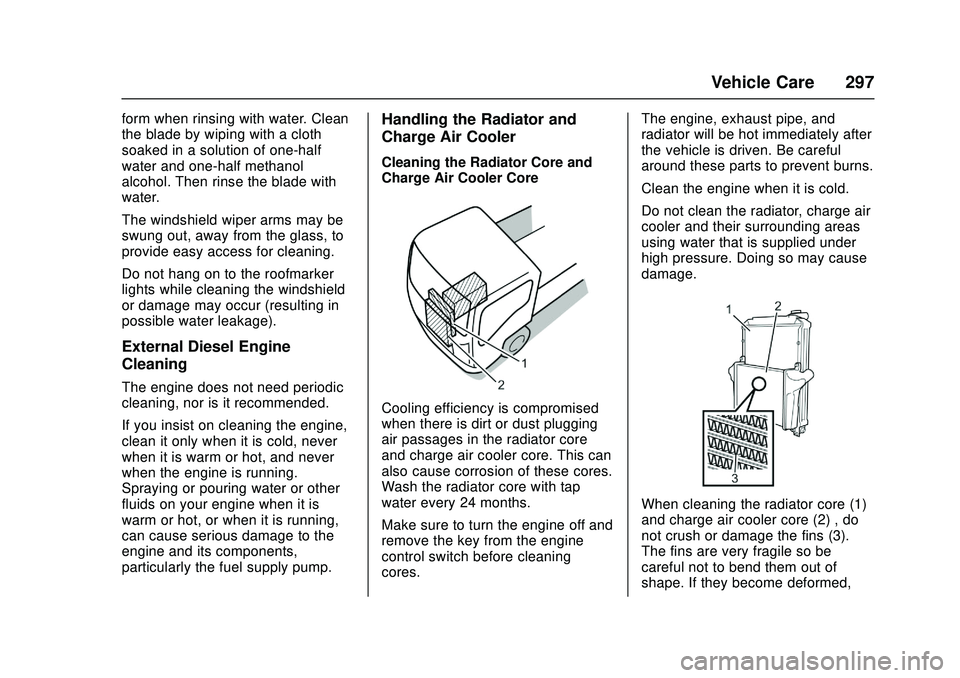
Cleaning the Radiator Core and
Charge Air Cooler Core
Cooling efficiency is compromised
when there is dirt or dust plugging
air passages in the radiator core
and charge air cooler core. This can
also cause corrosion of these cores.
Wash the radiator core with tap
water every 24 months.
Make sure to turn the engine off and
remove the key from the engine
control switch before cleaning
cores.The engine, exhaust pipe, and
radiator will be hot immediately after
the vehicle is driven. Be careful
around these parts to prevent burns.
Clean the engine when it is cold.
Do not clean the radiator, charge air
cooler and their surrounding areas
using water that is supplied under
high pressure. Doing so may cause
damage.
When cleaning the radiator core (1)
and charge air cooler core (2) , do
not crush or damage the fins (3).
The fins are very fragile so be
careful not to bend them out of
shape. If they become deformed,
Page 299 of 358
Chevrolet Low Cab Forward Owner Manual (GMNA-Localizing-U.S.-
11254764) - 2018 - crc - 12/5/16
298 Vehicle Care
their cooling efficiency will be
impaired. Before cleaning, take
steps to ensure that no water will
splash onto the surrounding
electrical components and wires.
If stubborn dirt still remains even
after the radiator core and charge
air cooler core have been cleaned,
have the vehicle inspected and
serviced.
Corrosion Protection
Your vehicle has been designed and
built to resist corrosion. Special
materials and protective finishes
were used on most parts of your
vehicle when it was built to help
maintain good appearance,
strength, and reliable operation.
However, some parts which
normally are not visible (such as
those under the vehicle and under
the hood) are such that surface rust
will not affect their reliability. So
corrosion protection is not needed
or used on these parts.Sheet Metal Damage
If your vehicle is damaged and
requires sheet metal repair or
replacement, make sure the body
repair shop applies anti-corrosion
material to the parts repaired or
replaced so that corrosion protection
is restored. (Also see "Finish
Damage" which follows.)
Foreign Material Deposits
Calcium chloride and other salts,
ice-melting agents, road oil and tar,
tree sap, bird droppings, chemicals
from industrial chimneys and other
foreign matter may damage vehicle
finishes if left on painted surfaces.
Prompt washing may not completely
remove all of these deposits. Other
cleaners may be needed. When
using chemical cleaners, be sure
they are safe for use on painted
surfaces.
Finish Damage
Any stone chips, fractures or deep
scratches in the finish should be
repaired promptly. Bare metal will
corrode quickly and may develop
into major repair expense. Minorchips and scratches can be repaired
with touch up materials available
from your authorized dealer or other
service outlets. Larger areas of
finish damage can be corrected in
your dealer's body and paint shop.
Underbody Maintenance
Corrosive materials used for ice and
snow removal, and dust control can
collect on the underbody. If these
materials are not removed,
accelerated corrosion (rust) can
occur on underbody parts such as
fuel lines, frames, floor pan and
exhaust system even though they
have been provided with corrosion
protection.
At least every spring, flush these
materials from the underbody with
plain water. Take care to clean well
any areas where mud and other
debris can collect. Sediment packed
in closed areas of the frame should
be loosened before being flushed.
If desired, your authorized dealer
can do this for you.
Page 313 of 358

Chevrolet Low Cab Forward Owner Manual (GMNA-Localizing-U.S.-
11254764) - 2018 - crc - 12/5/16
312 Service and Maintenance
Remarks
(1)In case this column is blank,
follow kilometers (miles).
(2) Use of oils other than CK-4 may
require shorter maintenance
intervals and may cause
nonconformity to regulations. (CJ-4
can be used while it is available.)
Use of oils with other viscosity than
*W-40 may also require shorter
maintenance intervals and may
cause a problem with engine
durability.
(3) Refer to "Air Cleaner Indicator
Light" under Engine Air Cleaner/
Filter 0231.
(4) Initial check at 1 040 km
(650 miles) is required.
(5) Be sure to discard used grease
seal, and always use new grease
seal for installation.
Explanation of Complete
Vehicle Maintenance Schedule
The following is a brief explanation
of each of the services listed in the
preceding Complete Vehicle
Maintenance Schedule. 1. Engine Noise :
These
components have an effect on the
control of noise emissions.
Service Interval Maintenance procedureEngine
Every 16 000 km (10,000 miles) Inspect sound absorption materials for
tears, broken out sections or
attachment. Repair or replace as
necessary.
Cooling System
Every 16 000 km (10,000 miles) Inspect fan, shroud and radiator for
attachment, tears or cleanliness.
Replace as necessary.
Air intake system
Every 24 000 km (1,500 miles) Inspect all ducts, hoses and intake
silencers for leaks or chafing. Repair or
replace as necessary.
Exhaust system
Every 16 000 km (10,000 miles) Inspect silencer, pipes, gaskets, clamps
and mounting for exhaust gas leaks or
looseness. Repair or replace as
necessary.
Cab
Every 16 000 km (10,000 miles) Inspect sound absorption materials for
tears, broken out sections or
attachment. Repair or replace as
necessary.
2. Valve Lash : Incorrect valve
clearance will result in increased
engine noise and lower engine output, thereby adversely affecting
engine performance. Retorque
Page 314 of 358

Chevrolet Low Cab Forward Owner Manual (GMNA-Localizing-U.S.-
11254764) - 2018 - crc - 12/5/16
Service and Maintenance 313
rocker shaft bracket nuts before
checking and adjusting valve
clearance.
Check and adjust valve clearance
every 80 000 km (50,000 miles) or
12 months whichever occurs first.
3. Engine Oil and Oil Filter :
Change at interval noted below
depending upon driving conditions.
•Normal Service —Change every
16 000 km (10,000 miles) or
12 months whichever occurs first.
• Severe Service —Change every
8 000 km (5,000 miles) or 3 months
if you often drive under one or more
of these conditions: (a) driving in
dusty areas, (b) frequent idling or
idling for long periods, (c) driving
6 km (4 miles) or less in freezing
weather, or other short trips in cold
weather, where the engine does not
thoroughly warm up.
Change oil and filter as soon as you
can after driving in a dust storm.
When recommended oil is used, it
conforms to this maintenance
schedule. (Recommended oil: CK-4
(API designations)) 4. Fuel Filter :
Replace the fuel
filter every 24 000 km (15,000 miles)
or more frequently if clogged or
replace when the fuel filter indicator
light comes on (if equipped).
5. Pre-Fuel Filter/Water
separator : Replace the fuel filter
every 24 000 km (15,000 miles) or
more frequently if clogged or
replace when the fuel filter indicator
light comes on (if equipped).
6. Air Cleaner Filter : The level of
dirt in the air cleaner element can
be checked against the indicator.
Replace the air cleaner filter when
the Driver Information Center (DIC)
shows "CHECK AIR FILTER".
7. Damage to Air Intake Ducts and
Hoses : Check for damage of air
intake ducts and hoses and that
those are correctly installed every
24 000 km (15,000 miles) or
12 months. Replace or adjust those
if necessary. 8. Drive Belts :
Check belt driving
the fan, alternator or A/C
compressor every 16 000 km
(10,000 miles). Look for cracks,
fraying, wear, and proper tension.
9. Engine Bolt Torques : Loosened
bolts result in lower engine output.
Check and adjust manifold
mounting, and injectors to correct
torque every 80 000 km
(50,000 miles).
10. Rotate Tires : To equalize wear,
rotate tires and adjust tire pressures
every 10 400 km (6,500 miles). See
Tire Rotation 0284.
11. Engine Cooling System : At
12 months or 16 000 km
(10,000 miles) intervals, wash
radiator cap and filler neck with
clean water, pressure test system
and radiator cap for proper pressure
holding capacity, tighten hose
clamps and inspect condition of all
cooling and heater hoses. Replace
hoses if cracked, swollen or
otherwise deteriorated. Have the
hoses replaced by your authorized
dealer.
Page 315 of 358

Chevrolet Low Cab Forward Owner Manual (GMNA-Localizing-U.S.-
11254764) - 2018 - crc - 12/5/16
314 Service and Maintenance
12. Engine Coolant :Inspect the
engine coolant every 12 months.
Replace the engine coolant every
24 months, drain the engine coolant
by opening the drain plug at the
bottom of the radiator core, flush
and refill the engine cooling system
with a new engine coolant. Refer to
"Preparing Engine Coolant" in
Engine Coolant 0231. Have the
Engine Coolant replaced by your
authorized dealer.
13. Exhaust System : Check the
complete exhaust system every
16 000 km (10,000 miles). Check
body areas near the exhaust
system. Look for broken, damaged,
missing, or out-of-position parts.
Also inspect for open seams, holes,
loose connections, or other
conditions which could cause heat
build-up at the rear body floor pan,
or could let exhaust fumes seep into
the passenger compartment. Dust
or water in the cabin may indicate a
leak in that area. Required repairs
should be made at once. 14. DPF (Clean Filter) :
Clean the
filter every 160 000 km
(100,000 miles) or 3,000 hours
whichever occurs first.
15. DPF (Pressure Difference
Sensor 0 Point Adjustment) :
Adjust the sensor every 160 000 km
(100,000 miles) or 3,000 hours
whichever occurs first.
16. DPF (Pressure Difference
Sensor Hose) : Inspect the sensor
hose every 160 000 km
(100,000 miles) or 3,000 hours
whichever occurs first. Replace the
sensor hose every 400 000 km
(250,000 miles).
17. Fuel Line System : Inspect the
fuel tank, cap and lines for damage
which could cause leakage every
16 000 km (10,000 miles). Inspect
fuel cap for correct sealing ability
and indications of physical damage.
Replace any damaged or
malfunctioning parts.
18. Brake Lining and Pad for
Wear : Check drum brake lining and
disc brake pad for wear or cracks
every 16 000 km (10,000 miles).
Check brakes (including parking brake) more often if operating
conditions or driving habits result in
frequent braking.
Front disc brakes have built-in wear
noise indicators which are designed
to make a high pitched squeal or
cricket-like warning sound when the
brake pads are worn to the point
where new pads are needed.
When the truck is in motion, the
sound may be constant or it may
come and go. Pressing the brake
pedal firmly may cause the sound
to stop.
Have the brake linings or the brake
pads replaced by your authorized
dealer as soon as possible after the
warning first becomes evident.
Failure to do so can result in
expensive damage to the brake
system or a serious accident.
19. Brake Drum and Rotor for
Wear and Damage :
Check brake
drums (rear and parking) and rotors
(front) for wear or damage every
32 000 km (20,000 miles) or
12 months whichever occurs first.
Page 338 of 358

Chevrolet Low Cab Forward Owner Manual (GMNA-Localizing-U.S.-
11254764) - 2018 - crc - 12/5/16
Technical Data 337
Weights
Axle weight rating : Front 4500HD: 2431 kg (5,360 lb)4500XD: 3007 kg (6,630 lb)
5500HD: 3098 kg (6,830 lb) 5500XD: 3300 kg (7,275 lb)
Engine Oil Service
Engine oil capacity When changing oil only: 9.5 L (10.0 qt)
*1
When changing oil and filter: 11.0 L (11.6 qt)*1
Engine Cooling System Service
Capacity 19.6 L (20.7 qt)
Engine oil Thermostat:
Starts to open 82-85 °C (180-185 °F)
Radiator pressure 108 kPa (16 psi)
Transmission Service
Transmission oil capacity 13.1 L (27.7 qt)
*3
Rear Axle Service
Differential gear oil
capacity 4500HD/4500XD:
9.0 L (19.0 qt)
*4
5500HD/5500XD:10.0 L (21.1 qt)*4
Limited slip differential
lubricant additive 4500HD/4500XD:
0.5 L (1.06 qt)*5
5500HD/5500XD:0.6 L (1.27 qt)*5