check oil CHEVROLET LOW CAB FORWARD 2018 Owner's Guide
[x] Cancel search | Manufacturer: CHEVROLET, Model Year: 2018, Model line: LOW CAB FORWARD, Model: CHEVROLET LOW CAB FORWARD 2018Pages: 358, PDF Size: 6.32 MB
Page 221 of 358

Chevrolet Low Cab Forward Owner Manual (GMNA-Localizing-U.S.-
11254764) - 2018 - crc - 12/5/16
220 Vehicle Care
contamination, it will cause a
decline in the performance of the
parts and such problems as seizure
or malfunctioning. Replenish or
change these liquids when
performing the checks (daily and
periodic checks) as required by the
relevant regulations or in
accordance with the Maintenance
Schedule (when either the specified
driving distance or period of time,
whichever comes first, has expired).
Confirm that all systems and
components are normal after
performing the work.
Do not leave the removed parts or
tools in the engine compartment.
They could damage the equipment if
caught in the belts or other moving
components.
Dirty water, dirt and other impurities
seriously impair the effectiveness of
the oil, grease and fluids, and
damage the parts. Exercise all due
caution to prevent waste or other
refuse from coming in contact with
parts or materials that have been
removed when changing or
replenishing them.Do not step on the engine or climb
onto it. You could cause an engine
failure by, for example, damaging
the cylinder head cover or various
connectors.
Electric Welding
Careless electric welding of vehicle
parts can cause welding current to
flow back through the vehicle’s
ground circuit and damage electrical
and electronic parts so that they do
not function normally. Whenever
electric welding is necessary,
consult your dealer.
Cab Tilting
Before Tilting the Cab (Single Cab
Model)
{Warning
To help avoid personal injury and
property damage:
(Continued)
Warning (Continued)
.Park the vehicle on level
ground and check that there
is enough space in front of
and above the cab.
. Set the parking brake firmly
and block the front wheels.
. Move the selector lever in
the "P" position.
. Secure loose articles in
the cab.
. Stop the engine.
. Close the cab door.
. Keep the area surrounding
the cab clear.
You and others could be seriously
injured.
Tilting the Cab 1. Check that all personnel are clear of the cab.
2. Read the label on the rear of the cab.
Page 224 of 358
Chevrolet Low Cab Forward Owner Manual (GMNA-Localizing-U.S.-
11254764) - 2018 - crc - 12/5/16
Vehicle Care 223
Engine Coolant Reserve Tank
Inspection Cover (Crew Cab
Model)
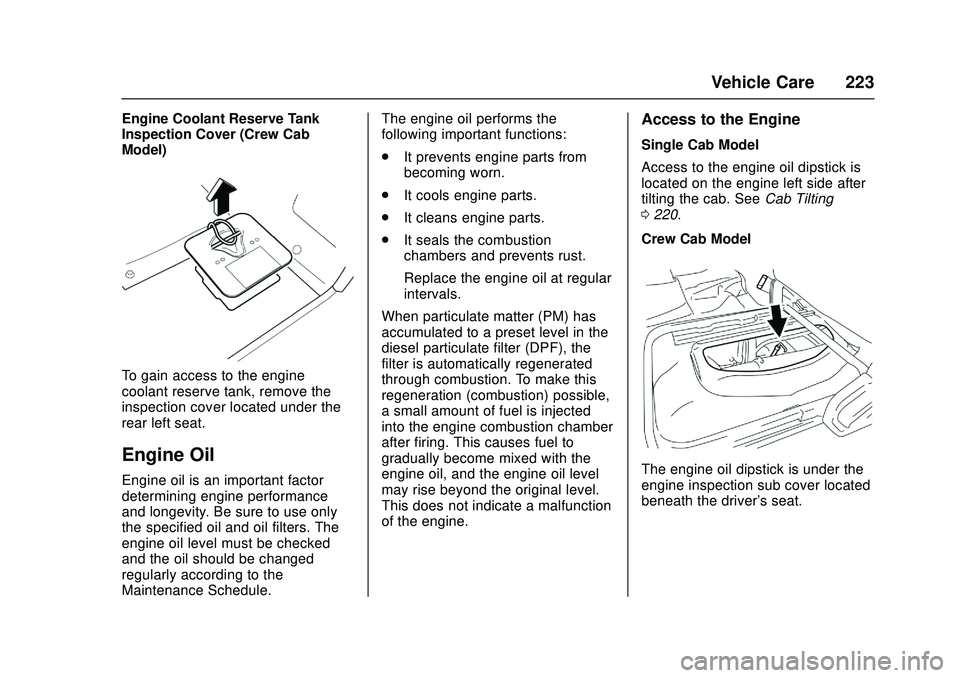
To gain access to the engine
coolant reserve tank, remove the
inspection cover located under the
rear left seat.
Engine Oil
Engine oil is an important factor
determining engine performance
and longevity. Be sure to use only
the specified oil and oil filters. The
engine oil level must be checked
and the oil should be changed
regularly according to the
Maintenance Schedule.The engine oil performs the
following important functions:
.
It prevents engine parts from
becoming worn.
. It cools engine parts.
. It cleans engine parts.
. It seals the combustion
chambers and prevents rust.
Replace the engine oil at regular
intervals.
When particulate matter (PM) has
accumulated to a preset level in the
diesel particulate filter (DPF), the
filter is automatically regenerated
through combustion. To make this
regeneration (combustion) possible,
a small amount of fuel is injected
into the engine combustion chamber
after firing. This causes fuel to
gradually become mixed with the
engine oil, and the engine oil level
may rise beyond the original level.
This does not indicate a malfunction
of the engine.
Access to the Engine
Single Cab Model
Access to the engine oil dipstick is
located on the engine left side after
tilting the cab. See Cab Tilting
0 220.
Crew Cab Model
The engine oil dipstick is under the
engine inspection sub cover located
beneath the driver's seat.
Page 225 of 358
Chevrolet Low Cab Forward Owner Manual (GMNA-Localizing-U.S.-
11254764) - 2018 - crc - 12/5/16
224 Vehicle Care
Checking the Engine Oil Level
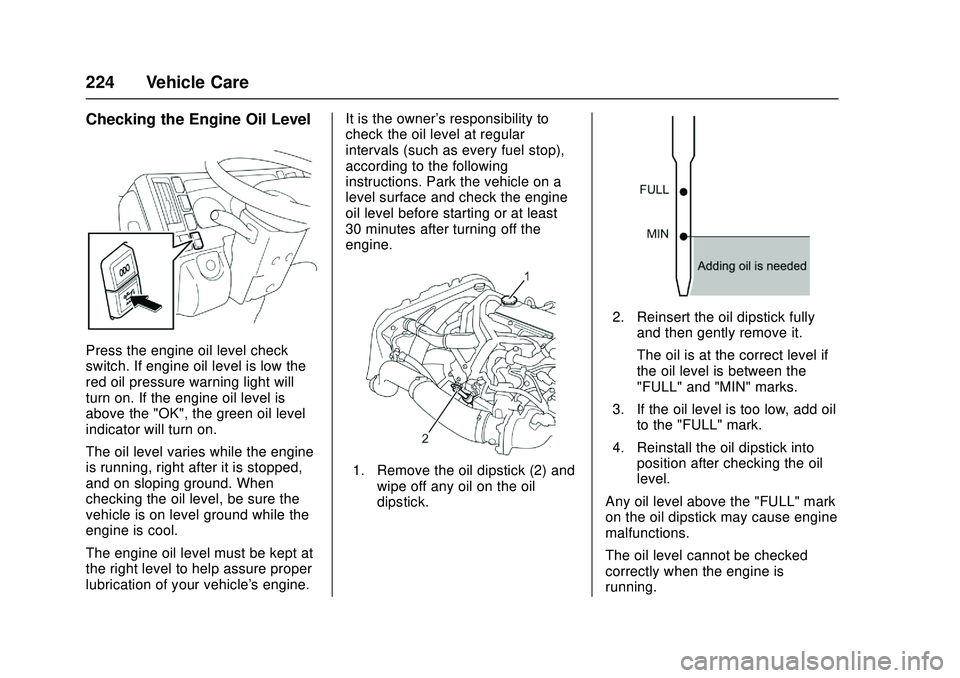
Press the engine oil level check
switch. If engine oil level is low the
red oil pressure warning light will
turn on. If the engine oil level is
above the "OK", the green oil level
indicator will turn on.
The oil level varies while the engine
is running, right after it is stopped,
and on sloping ground. When
checking the oil level, be sure the
vehicle is on level ground while the
engine is cool.
The engine oil level must be kept at
the right level to help assure proper
lubrication of your vehicle's engine.It is the owner's responsibility to
check the oil level at regular
intervals (such as every fuel stop),
according to the following
instructions. Park the vehicle on a
level surface and check the engine
oil level before starting or at least
30 minutes after turning off the
engine.
1. Remove the oil dipstick (2) and
wipe off any oil on the oil
dipstick.
2. Reinsert the oil dipstick fullyand then gently remove it.
The oil is at the correct level if
the oil level is between the
"FULL" and "MIN" marks.
3. If the oil level is too low, add oil to the "FULL" mark.
4. Reinstall the oil dipstick into position after checking the oil
level.
Any oil level above the "FULL" mark
on the oil dipstick may cause engine
malfunctions.
The oil level cannot be checked
correctly when the engine is
running.
Page 226 of 358

Chevrolet Low Cab Forward Owner Manual (GMNA-Localizing-U.S.-
11254764) - 2018 - crc - 12/5/16
Vehicle Care 225
If the engine has been running, wait
at least 30 minutes before checking.
Adding the Engine Oil
When the engine oil level is near or
below the "MIN" mark on the oil
dipstick, remove the oil filler cap (1)
and add the oil. Remove the oil
dipstick (2) at this time. Use only the
specified engine oil.
Caution
When adding oil, be careful not to
spill any, but keep a workshop rag
handy just in case there are any
spills. If any oil should spill onto
the engine, carefully wipe it away.
If this precaution is not taken, the
spilled oil could ignite and a fire
could spread.
Do not leave flammable items,
such as rags or gloves, in the
engine compartment. They could
cause a fire. You and others could
be seriously injured.
Engine oil lubricates and cools the
engine's internal components. The
quality of the oil is degraded and the
quantity of oil is reduced by
evaporation, discharge and
combustion during the operation of
the engine. Continually using the
same oil without checking the level,
or without replenishing and
changing it could cause seizure or
damage to the engine. Prevent dirt from entering the filler
port when adding the oil. If foreign
matter mixes with the oil, it could
damage the engine.
Adding oil above the "FULL" mark
on the oil dipstick could result in
faulty engine operation. Be sure to
check the oil level by using the oil
dipstick.
Failure to use the recommended
engine oil could result in engine or
DPF breakdown, or in poor fuel
efficiency. Be sure to use the
recommended engine oil.
Choosing the Right Quality Oil
If you do not use the oil intended for
a vehicle equipped with a Diesel
Particulate Filter (DPF), both the
engine and the DPF may break
down and fuel economy may
decrease. Be sure, therefore, to use
the oil intended for vehicles
equipped with DPF.
GM recommends engine oil that
supports DPF (Low ash oil). Use of
engine oil that does not support low
ash will increase the PM produced
by engine combustion.
Page 229 of 358
Chevrolet Low Cab Forward Owner Manual (GMNA-Localizing-U.S.-
11254764) - 2018 - crc - 12/5/16
228 Vehicle Care
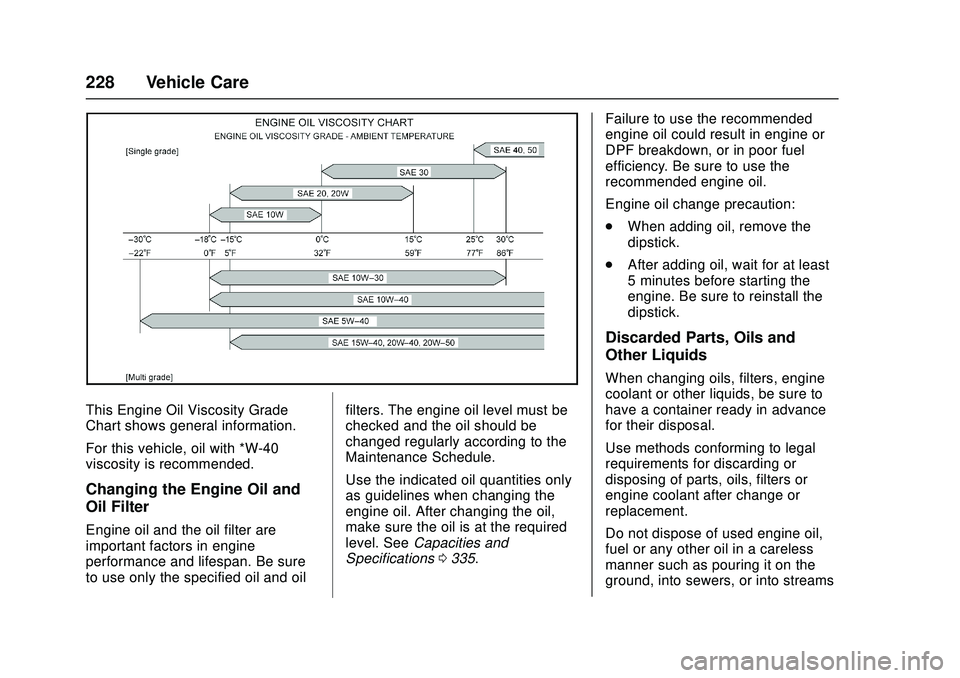
This Engine Oil Viscosity Grade
Chart shows general information.
For this vehicle, oil with *W-40
viscosity is recommended.
Changing the Engine Oil and
Oil Filter
Engine oil and the oil filter are
important factors in engine
performance and lifespan. Be sure
to use only the specified oil and oilfilters. The engine oil level must be
checked and the oil should be
changed regularly according to the
Maintenance Schedule.
Use the indicated oil quantities only
as guidelines when changing the
engine oil. After changing the oil,
make sure the oil is at the required
level. See
Capacities and
Specifications 0335. Failure to use the recommended
engine oil could result in engine or
DPF breakdown, or in poor fuel
efficiency. Be sure to use the
recommended engine oil.
Engine oil change precaution:
.
When adding oil, remove the
dipstick.
. After adding oil, wait for at least
5 minutes before starting the
engine. Be sure to reinstall the
dipstick.
Discarded Parts, Oils and
Other Liquids
When changing oils, filters, engine
coolant or other liquids, be sure to
have a container ready in advance
for their disposal.
Use methods conforming to legal
requirements for discarding or
disposing of parts, oils, filters or
engine coolant after change or
replacement.
Do not dispose of used engine oil,
fuel or any other oil in a careless
manner such as pouring it on the
ground, into sewers, or into streams
Page 230 of 358
Chevrolet Low Cab Forward Owner Manual (GMNA-Localizing-U.S.-
11254764) - 2018 - crc - 12/5/16
Vehicle Care 229
or bodies of water. Instead, recycle
it by taking it to a used oil collection
facility which may be found in your
community.
Automatic Transmission
Fluid
{Warning
Overfilling of the automatic
transmission can cause the fluid
to be "PURGED" out of the
breather hose onto the hot engine
parts and can cause a fire.
You and others could be seriously
injured.
Both quality and quantity of fluid are
important factors that have a
significant influence on the
performance and durability of the
automatic transmission. Be sure to
use only the dealer recommended
fluid for replenishment, and observe
the specified fluid level. Too much or too little transmission
oil could damage your transmission.
Too much could cause your
transmission to overheat and fluid to
spill out from the breather hose. Be
sure to get an accurate reading if
you check your transmission fluid.
When cleaning around the dipstick
and guide tube, make sure that you
thoroughly wipe away all of the dirt
and dust etc. Failure to do so may
cause a fault in the transmission.
Do not let coolants (ethylene glycol
type), water based substances,
or other fluids etc., mix with the
fluid. Otherwise, degraded
performance and faulty operation of
the system will result.
Checking the Automatic
Transmission Oil level
This operation could be difficult and
you may choose to have this done
at your dealer.
If you choose to do it yourself, then
be sure to follow all the instructions
below or you could get a false
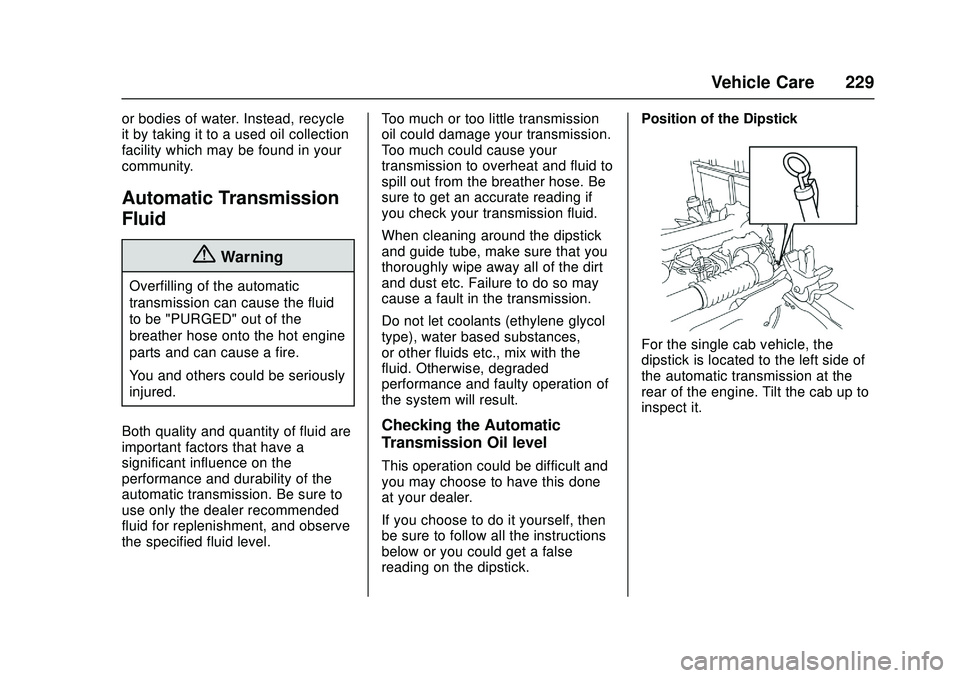
reading on the dipstick.Position of the Dipstick
For the single cab vehicle, the
dipstick is located to the left side of
the automatic transmission at the
rear of the engine. Tilt the cab up to
inspect it.
Page 232 of 358

Chevrolet Low Cab Forward Owner Manual (GMNA-Localizing-U.S.-
11254764) - 2018 - crc - 12/5/16
Vehicle Care 231
.Dipstick H (HOT) —
Transmission fluid
temperature Approx.
70 - 80 °C (158 - 176 °F).
. The “C (COLD)” range on
the dipstick is a guide used
by your dealer for
specialized equipment used
to replace or service the
automatic transmission
fluid. When performing your
own inspections, always
use the “H (HOT)” range
after warming up the
vehicle.
The fluid must be hot to
ensure an accurate check.
The fluid level rises as
temperature increases.
6. If the fluid level is too low, add the specified fluid through the
dipstick guide tube. Also, check
whether there are no fluid
leaks.
7. Insert the dipstick securely into position.{Warning
Be extremely careful not to burn
yourself when checking the oil
level if the engine temperature is
high. Protect yourself with
gloves etc.
You and others could be seriously
injured.
Discarded parts, oil, grease and
fluids could have an adverse effect
on the environment. It is difficult to
dispose of these, so have your
dealer handle all checks and
replacements.
Engine Air Cleaner/Filter
Air Cleaner
Use of clogged air cleaner element
not only causes a deterioration in
the engine output but also increased
fuel consumption and dark exhaust
smoke. Be sure to use a genuine air cleaner
element. If other air cleaner element
is used, it may cause the sensor to
output a wrong signal.
See
Maintenance Schedule 0303.
Air Cleaner Indicator Light
When the air cleaner indicator light
comes on, check the air cleaner
element. If the air cleaner element is
clogged, replace the air cleaner
element.
See Vehicle Messages 086.
See Maintenance Schedule 0303.
Engine Coolant
Protection of Engine Against
Overcooling
Overcooling of the engine not only
accelerates wear of the vital engine
parts but also hurts fuel economy.
Engine Coolant in Cold
Weather
To prevent the engine damage due
to freezing of the engine coolant,
mix the coolant and water at the
ratio of 50/50.
Page 233 of 358

Chevrolet Low Cab Forward Owner Manual (GMNA-Localizing-U.S.-
11254764) - 2018 - crc - 12/5/16
232 Vehicle Care
Replace rubber hoses whenever
they crack or are damaged; even
minor cracks allow engine coolant
solution to leak.
{Warning
If your engine cooling system
overheats, seeEngine
Overheating 0237. Continued
operation of the engine even for a
short time may result in a fire and
the possibility of personal injury
and/or severe vehicle damage.
You and others could be seriously
injured.
Your vehicle has an engine coolant
recovery system, expansion bottle
and/or an engine coolant reserve
tank system. Engine coolant in the
system expands with heat and
overflows into the reserve tank.
When the system cools, engine
coolant is drawn back into the
radiator.
The engine cooling system has
been filled at the factory with a
quality engine coolant. It is important to use proper engine
coolant to prevent damage to
engine cooling system components.
The engine cooling system is
designed to use engine coolant
rather than plain water. See
Recommended Fluids and
Lubricants
0326.
See the Maintenance Schedule to
find out when the engine coolant
must be replaced. Note that
changing the engine coolant is
needed to replenish the rust
inhibitors to make certain that all
parts of the engine cooling system
work well.
{Warning
Check, replenish or change the
engine coolant only after the
engine has sufficiently
cooled down.
Do not loosen or remove the cap
of the radiator or engine coolant
reserve tank cap when the engine (Continued)
Warning (Continued)
coolant is still hot. Hot vapor or
boiling water may burst out and
cause a burn.
When removing the radiator cap
or engine coolant reserve tank
cap, use a thick cloth to cover the
cap and turn it slowly.
Engine coolant is toxic and must
not be ingested. If the engine
coolant is mistakenly ingested,
seek prompt medical attention.
If the engine coolant gets in your
eyes, rinse your eyes immediately
with a large amount of water for
15 minutes or longer. Also, if your
eyes are still irritated or otherwise
feel abnormal, seek immediate
medical attention.
If the engine coolant gets on your
skin, rinse it off using a soap with
a large amount of water. Also,
if abnormality is seen, seek
medical attention.(Continued)
Page 234 of 358

Chevrolet Low Cab Forward Owner Manual (GMNA-Localizing-U.S.-
11254764) - 2018 - crc - 12/5/16
Vehicle Care 233
Warning (Continued)
Engine coolant is flammable, and
therefore, it must be kept away
from flames and other heat
sources. Engine coolant also
could ignite if it comes in contact
with a hot surface, such as the
exhaust manifold. Exercise
caution to prevent this from
happening.
You and others could be seriously
injured.
Preparing Engine Coolant
To prevent engine damage due to
freezing of the engine coolant and
to protect the cooling system from
corrosion, use a mixture of the
recommended type antifreeze and
water. If the engine of the vehicle is
at −30 °C (−22 °F) or above, the
coolant concentration should be
50%. Direct use of “50/50
Pre-diluted” product which is already
diluted to 50% concentration is
recommended. If the outside
temperature engine or vehicle is used at
−30 °C (−22 °F) or below,
coolant concentration of 55% is
recommended.
It is the owner ’s responsibility to:
. Maintain the engine cooling
system freeze protection at or
above −30 °C (−22 °F) (at or
below −30 °C (−22 °F) in colder
climates to ensure protection
against corrosion and loss of
engine coolant from boiling.
A 50/50 (55/45 for colder
climates) mixture of the
recommended type antifreeze
and water will provide freeze
protection to at or above −30 °C
(−22 °F), (at or below −30 °C
(−22 °F) in colder climates) and
boil protection to 128 °C
(262 °F). Periodic replacement
of engine coolant is needed to
replenish the anticorrosion
additives that wear out with use.
Engine coolant that has become
dark in color shows that it needs
to be changed.
. Use only the recommended
coolant. See Recommended
Fluids and Lubricants 0326. .
Do not use methanol-base
antifreeze, alcohol or plain water
alone in your vehicle at any time.
They will boil at a lower point
than that at which the engine
coolant temperature gauge will
warn of overheating, and they do
not provide proper protection
against corrosion.
Engine Coolant Quantity
For the quantity of engine coolant,
see Capacities and Specifications
0 335. After changing the engine
coolant, check that the engine
coolant is up to the specified level.
{Warning
For storage, close the cap of
coolant container securely and
keep it in a place inaccessible to
children.
You and others could be seriously
injured.
Using any coolant other than that
recommended by your dealer could
cause damage to the engine,
Page 238 of 358

Chevrolet Low Cab Forward Owner Manual (GMNA-Localizing-U.S.-
11254764) - 2018 - crc - 12/5/16
Vehicle Care 237
may be lost and damage to the
engine may result from overheating.
The radiator pressure cap should be
checked periodically for proper
operation. If a replacement is
required, a genuine GM part is
recommended.
Engine Overheating
When the Engine Overheats
The engine cooling system may
overheat if the engine coolant level
is too low, if there is a sudden loss
of engine coolant (such as radiator
hose failure), or if other problems
occur. It may also temporarily
overheat during severe operating
conditions such as:
.Climbing a long hill on a hot day.
. Stopping after high-speed
driving.
. Idling for long periods in traffic.
If engine power drops and the
needle on the engine coolant
temperature gauge goes up above
the upper limit of the safety zone
and enters the "H" zone, the engine
is overheating. The engine overheat warning light will come on and the
warning buzzer will sound. Either
steam or boiling engine coolant will
squirt out of the radiator. The
vehicle will also have an
“OVER
HEAT” message displayed. Take the
following corrective actions
immediately.
{Warning
To help avoid being burned:
Do not tilt the cab or open the
engine access cover if you see or
hear steam or engine coolant
escaping from the engine
compartment. Wait until no steam
or engine coolant can be seen or
heard before tilting the cab or
opening the engine cover.
Do not remove the radiator cap or
engine coolant reserve tank cap if
the engine coolant in the tank is
boiling. Also do not remove the
radiator cap while the engine and
radiator are still hot. Scalding fluid
(Continued)
Warning (Continued)
and steam can be blown out
under pressure if either cap is
taken off too soon.
You and others could be seriously
injured.
If Steam Is Coming from the
Engine Compartment
{Warning
If the engine coolant temperature
gauge shows an overheat
condition or you have other
reasons to suspect the engine
may be overheating, continued
operation of the engine (other
than as described here) even for
a short period of time may cause
a fire and the result in personal
injury and severe vehicle
damage. Take immediate action
as outlined.
You and others could be seriously
injured.