heating CHEVROLET LOW CAB FORWARD 2018 Owner's Guide
[x] Cancel search | Manufacturer: CHEVROLET, Model Year: 2018, Model line: LOW CAB FORWARD, Model: CHEVROLET LOW CAB FORWARD 2018Pages: 358, PDF Size: 6.32 MB
Page 210 of 358
Chevrolet Low Cab Forward Owner Manual (GMNA-Localizing-U.S.-
11254764) - 2018 - crc - 12/5/16
Driving and Operating 209
To reduce the risk of poor quality
fuel, purchase biodiesel blends from
a fuel supplier or fueling station
which sells BQ-9000 certified
biodiesel. See www.bq-9000.org for
a list of certified marketers.
Biodiesel Blends in Canada
Biodiesel blends that meet the CAN/
CGSB-3.522 specifications up to
20% (B20) can be used. Do not use
biodiesel blends above 20%, as
they may damage the engine and
fuel system.
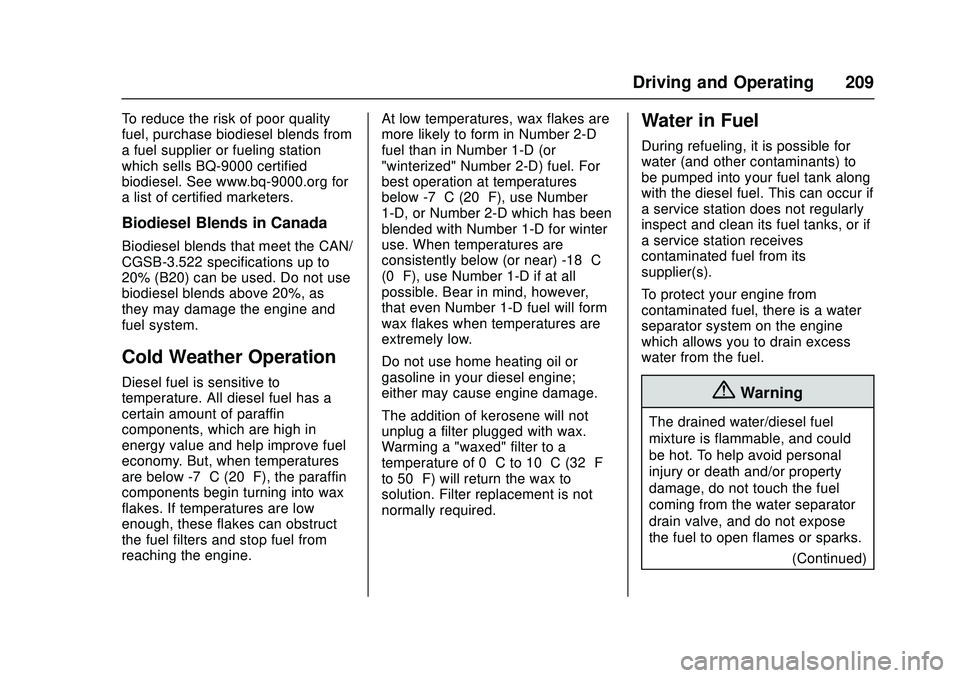
Cold Weather Operation
Diesel fuel is sensitive to
temperature. All diesel fuel has a
certain amount of paraffin
components, which are high in
energy value and help improve fuel
economy. But, when temperatures
are below -7 °C (20 °F), the paraffin
components begin turning into wax
flakes. If temperatures are low
enough, these flakes can obstruct
the fuel filters and stop fuel from
reaching the engine.At low temperatures, wax flakes are
more likely to form in Number 2-D
fuel than in Number 1-D (or
"winterized" Number 2-D) fuel. For
best operation at temperatures
below -7 °C (20 °F), use Number
1-D, or Number 2-D which has been
blended with Number 1-D for winter
use. When temperatures are
consistently below (or near) -18 °C
(0 °F), use Number 1-D if at all
possible. Bear in mind, however,
that even Number 1-D fuel will form
wax flakes when temperatures are
extremely low.
Do not use home heating oil or
gasoline in your diesel engine;
either may cause engine damage.
The addition of kerosene will not
unplug a filter plugged with wax.
Warming a "waxed" filter to a
temperature of 0 °C to 10 °C (32 °F
to 50 °F) will return the wax to
solution. Filter replacement is not
normally required.
Water in Fuel
During refueling, it is possible for
water (and other contaminants) to
be pumped into your fuel tank along
with the diesel fuel. This can occur if
a service station does not regularly
inspect and clean its fuel tanks, or if
a service station receives
contaminated fuel from its
supplier(s).
To protect your engine from
contaminated fuel, there is a water
separator system on the engine
which allows you to drain excess
water from the fuel.
{Warning
The drained water/diesel fuel
mixture is flammable, and could
be hot. To help avoid personal
injury or death and/or property
damage, do not touch the fuel
coming from the water separator
drain valve, and do not expose
the fuel to open flames or sparks.
(Continued)
Page 218 of 358

Chevrolet Low Cab Forward Owner Manual (GMNA-Localizing-U.S.-
11254764) - 2018 - crc - 12/5/16
Vehicle Care 217
Vehicle Care
General Information
General Information . . . . . . . . . . 218
California Proposition65 Warning . . . . . . . . . . . . . . . . . 218
California Perchlorate Materials Requirements . . . . . 218
Accessories and Modifications . . . . . . . . . . . . . . . . 218
Vehicle Checks
Doing Your OwnService Work . . . . . . . . . . . . . . . 218
Cab Tilting . . . . . . . . . . . . . . . . . . . . 220
Engine Compartment Overview . . . . . . . . . . . . . . . . . . . . 222
Engine Cover . . . . . . . . . . . . . . . . . 222
Engine Oil . . . . . . . . . . . . . . . . . . . . 223
Automatic Transmission Fluid . . . . . . . . . . . . . . . . . . . . . . . . 229
Engine Air Cleaner/Filter . . . . . . 231
Engine Coolant . . . . . . . . . . . . . . . 231
Engine Overheating . . . . . . . . . . 237
Power Steering Fluid . . . . . . . . . 240
Washer Fluid . . . . . . . . . . . . . . . . . 241
Brakes . . . . . . . . . . . . . . . . . . . . . . . 242
Brake Fluid . . . . . . . . . . . . . . . . . . . 246
Battery . . . . . . . . . . . . . . . . . . . . . . . . 247
Fuel Filter . . . . . . . . . . . . . . . . . . . . 248 Rear Axle (Gear Oil Viscosity
Chart) . . . . . . . . . . . . . . . . . . . . . . . 249
Rear Axle (Oil Level Check) . . . . . . . . . . . . . . . . . . . . . . 249
Noise Control System . . . . . . . . 250
Automatic Transmission Shift
Lock Control Function
Check . . . . . . . . . . . . . . . . . . . . . . . 251
Wiper Blade Replacement . . . . 252
Headlamp Aiming
Headlamp Aiming . . . . . . . . . . . . 254
Bulb Replacement
Bulb Replacement . . . . . . . . . . . . 254
Headlamps and Front Turn Signal . . . . . . . . . . . . . . . . . . . . . . . 257
Roofmarker Lamps . . . . . . . . . . . 261
Sidemarker Lamps (Including Turn Signal and Cornering
Lamps) . . . . . . . . . . . . . . . . . . . . . . 261
Taillamps, Turn Signal, Stoplamps, and Back-Up
Lamps . . . . . . . . . . . . . . . . . . . . . . 263
License Plate Lamp . . . . . . . . . . 263
Interior Lamps . . . . . . . . . . . . . . . . 264
Electrical System
Electrical System Overload . . . 264
Wheels and Tires
Wheels and Tires . . . . . . . . . . . . . 272 Tire Pressure . . . . . . . . . . . . . . . . . 284
Tire Rotation . . . . . . . . . . . . . . . . . 284
If a Tire Goes Flat . . . . . . . . . . . . 287
Jump Starting
Jump Starting - North
America . . . . . . . . . . . . . . . . . . . . . 287
Towing the Vehicle
Towing the Vehicle . . . . . . . . . . . 291
Appearance Care
Exterior Care . . . . . . . . . . . . . . . . . 293
Interior Care . . . . . . . . . . . . . . . . . . 299
Page 233 of 358

Chevrolet Low Cab Forward Owner Manual (GMNA-Localizing-U.S.-
11254764) - 2018 - crc - 12/5/16
232 Vehicle Care
Replace rubber hoses whenever
they crack or are damaged; even
minor cracks allow engine coolant
solution to leak.
{Warning
If your engine cooling system
overheats, seeEngine
Overheating 0237. Continued
operation of the engine even for a
short time may result in a fire and
the possibility of personal injury
and/or severe vehicle damage.
You and others could be seriously
injured.
Your vehicle has an engine coolant
recovery system, expansion bottle
and/or an engine coolant reserve
tank system. Engine coolant in the
system expands with heat and
overflows into the reserve tank.
When the system cools, engine
coolant is drawn back into the
radiator.
The engine cooling system has
been filled at the factory with a
quality engine coolant. It is important to use proper engine
coolant to prevent damage to
engine cooling system components.
The engine cooling system is
designed to use engine coolant
rather than plain water. See
Recommended Fluids and
Lubricants
0326.
See the Maintenance Schedule to
find out when the engine coolant
must be replaced. Note that
changing the engine coolant is
needed to replenish the rust
inhibitors to make certain that all
parts of the engine cooling system
work well.
{Warning
Check, replenish or change the
engine coolant only after the
engine has sufficiently
cooled down.
Do not loosen or remove the cap
of the radiator or engine coolant
reserve tank cap when the engine (Continued)
Warning (Continued)
coolant is still hot. Hot vapor or
boiling water may burst out and
cause a burn.
When removing the radiator cap
or engine coolant reserve tank
cap, use a thick cloth to cover the
cap and turn it slowly.
Engine coolant is toxic and must
not be ingested. If the engine
coolant is mistakenly ingested,
seek prompt medical attention.
If the engine coolant gets in your
eyes, rinse your eyes immediately
with a large amount of water for
15 minutes or longer. Also, if your
eyes are still irritated or otherwise
feel abnormal, seek immediate
medical attention.
If the engine coolant gets on your
skin, rinse it off using a soap with
a large amount of water. Also,
if abnormality is seen, seek
medical attention.(Continued)
Page 234 of 358

Chevrolet Low Cab Forward Owner Manual (GMNA-Localizing-U.S.-
11254764) - 2018 - crc - 12/5/16
Vehicle Care 233
Warning (Continued)
Engine coolant is flammable, and
therefore, it must be kept away
from flames and other heat
sources. Engine coolant also
could ignite if it comes in contact
with a hot surface, such as the
exhaust manifold. Exercise
caution to prevent this from
happening.
You and others could be seriously
injured.
Preparing Engine Coolant
To prevent engine damage due to
freezing of the engine coolant and
to protect the cooling system from
corrosion, use a mixture of the
recommended type antifreeze and
water. If the engine of the vehicle is
at −30 °C (−22 °F) or above, the
coolant concentration should be
50%. Direct use of “50/50
Pre-diluted” product which is already
diluted to 50% concentration is
recommended. If the outside
temperature engine or vehicle is used at
−30 °C (−22 °F) or below,
coolant concentration of 55% is
recommended.
It is the owner ’s responsibility to:
. Maintain the engine cooling
system freeze protection at or
above −30 °C (−22 °F) (at or
below −30 °C (−22 °F) in colder
climates to ensure protection
against corrosion and loss of
engine coolant from boiling.
A 50/50 (55/45 for colder
climates) mixture of the
recommended type antifreeze
and water will provide freeze
protection to at or above −30 °C
(−22 °F), (at or below −30 °C
(−22 °F) in colder climates) and
boil protection to 128 °C
(262 °F). Periodic replacement
of engine coolant is needed to
replenish the anticorrosion
additives that wear out with use.
Engine coolant that has become
dark in color shows that it needs
to be changed.
. Use only the recommended
coolant. See Recommended
Fluids and Lubricants 0326. .
Do not use methanol-base
antifreeze, alcohol or plain water
alone in your vehicle at any time.
They will boil at a lower point
than that at which the engine
coolant temperature gauge will
warn of overheating, and they do
not provide proper protection
against corrosion.
Engine Coolant Quantity
For the quantity of engine coolant,
see Capacities and Specifications
0 335. After changing the engine
coolant, check that the engine
coolant is up to the specified level.
{Warning
For storage, close the cap of
coolant container securely and
keep it in a place inaccessible to
children.
You and others could be seriously
injured.
Using any coolant other than that
recommended by your dealer could
cause damage to the engine,
Page 235 of 358

Chevrolet Low Cab Forward Owner Manual (GMNA-Localizing-U.S.-
11254764) - 2018 - crc - 12/5/16
234 Vehicle Care
radiator or heater core. In particular,
use of coolants containing borate
salts or silicates may result in
engine or radiator corrosion,
causing engine coolant leaks and
other problems.
To dilute the coolant, use distilled
water or deionized water.
Do not use the coolant at any
coolant concentration other than
that specified. If the coolant
concentration is 60% or higher,
overheating is likely to occur, while
if it is 30% or lower, anti-corrosion
function is not provided sufficiently.
Using coolant at any coolant
concentration other than that
specified may reduce anti-freezing
performance, and engine coolant
may freeze.
If the engine coolant decreases
rapidly, go immediately to the
nearest dealer for a check and
repair.Checking the Engine Coolant
Level
For the single cab model, the
engine coolant reserve tank is
located behind the front-right wheel.
SeeCab Tilting 0220.
For the crew cab model, the engine
coolant reserve tank is under the
access panel beneath the left rear
seat. See Engine Cover 0222.
When the engine has cooled down,
make sure that the fluid level in the
engine coolant reserve tank is no
lower than the “MIN”line. In
addition, carefully remove the
radiator cap and check to see if it is
damaged. Check that the engine
coolant is full to the filler neck.
Check the engine coolant level only
when it is cold.
Page 238 of 358

Chevrolet Low Cab Forward Owner Manual (GMNA-Localizing-U.S.-
11254764) - 2018 - crc - 12/5/16
Vehicle Care 237
may be lost and damage to the
engine may result from overheating.
The radiator pressure cap should be
checked periodically for proper
operation. If a replacement is
required, a genuine GM part is
recommended.
Engine Overheating
When the Engine Overheats
The engine cooling system may
overheat if the engine coolant level
is too low, if there is a sudden loss
of engine coolant (such as radiator
hose failure), or if other problems
occur. It may also temporarily
overheat during severe operating
conditions such as:
.Climbing a long hill on a hot day.
. Stopping after high-speed
driving.
. Idling for long periods in traffic.
If engine power drops and the
needle on the engine coolant
temperature gauge goes up above
the upper limit of the safety zone
and enters the "H" zone, the engine
is overheating. The engine overheat warning light will come on and the
warning buzzer will sound. Either
steam or boiling engine coolant will
squirt out of the radiator. The
vehicle will also have an
“OVER
HEAT” message displayed. Take the
following corrective actions
immediately.
{Warning
To help avoid being burned:
Do not tilt the cab or open the
engine access cover if you see or
hear steam or engine coolant
escaping from the engine
compartment. Wait until no steam
or engine coolant can be seen or
heard before tilting the cab or
opening the engine cover.
Do not remove the radiator cap or
engine coolant reserve tank cap if
the engine coolant in the tank is
boiling. Also do not remove the
radiator cap while the engine and
radiator are still hot. Scalding fluid
(Continued)
Warning (Continued)
and steam can be blown out
under pressure if either cap is
taken off too soon.
You and others could be seriously
injured.
If Steam Is Coming from the
Engine Compartment
{Warning
If the engine coolant temperature
gauge shows an overheat
condition or you have other
reasons to suspect the engine
may be overheating, continued
operation of the engine (other
than as described here) even for
a short period of time may cause
a fire and the result in personal
injury and severe vehicle
damage. Take immediate action
as outlined.
You and others could be seriously
injured.
Page 239 of 358

Chevrolet Low Cab Forward Owner Manual (GMNA-Localizing-U.S.-
11254764) - 2018 - crc - 12/5/16
238 Vehicle Care
If you see or hear escaping steam
or have any other reason to suspect
there is a serious overheat
condition, stop and park the vehicle
as soon as it is safe to do so, turn
on the hazard warning flasher and
then turn off the engine immediately
and safely exit the vehicle.
If Steam Is Not Coming from the
Engine Compartment
If the engine coolant temperature
gauge shows an overheat condition,
or you have reason to suspect the
engine may be overheating, take
the following steps:1. Operate the hazard warning flasher and pull the vehicle
immediately over to a safe
place that does not impede
traffic and park it.
2. Idle the engine and wait until the engine coolant temperature
drops to safety zone. If your air
conditioner (if equipped) is on,
turn it off. And turn on the
heater to help the engine
expel heat. 3. When the needle of the engine
coolant temperature gauge
returns to the middle of the
safety zone, stop the engine.
If the needle of engine coolant
temperature gauge does not
drop inside into the safety
zone, turn the engine off and
have your vehicle serviced at
the nearest dealer.
When the cooling fan for the
radiator is not turning, turn off
the engine immediately.
{Warning
Even when the engine has been
stopped, the engine coolant in the
radiator remains under pressure.
Immediately removing the radiator
cap could cause steam or hot
water to blow out, and you could
be scalded as a result. The
engine coolant in the reserve tank
may also be hot. Immediately
removing the cap could cause hot
water to blow out, and possibly
scald you. Perform inspection,
(Continued)
Page 241 of 358

Chevrolet Low Cab Forward Owner Manual (GMNA-Localizing-U.S.-
11254764) - 2018 - crc - 12/5/16
240 Vehicle Care
after about 10 minutes if the gauge
pointer does not again show an
overheat condition.
When tap water only has been used
for engine coolant in an emergency,
change the engine coolant as soon
as possible.
Engine damage may be caused if
an overheating engine is suddenly
refilled with water. Instead, refill
slowly.
Power Steering Fluid
The power steering fluid level must
be checked and it must be changed
according to the Maintenance
Schedule. SeeMaintenance
Schedule 0303.
When replenishing power steering
fluid or flushing the power steering
system, always use ATF
(Dexron
®-VI). Failure to use the
proper fluid may damage the power
steering system seals and hoses,
leading to fluid leakage.
Checking the Power Steering
Fluid Level
The fluid level is correct if it is
between the “MAX”and“MIN” lines
on the reserve tank. If the level is
lower that the “MIN”line, add fluid
up to the “MAX”line.
The reserve tank is located at the
rear of the engine compartment on
the right. When you have finished
checking the fluid level, securely
install the cap and cover.
When you have finished checking
the fluid level, securely install
the cap.
The fluid level is correct if it is
between the "MAX" and "MIN" lines
on the oil dipstick. If the level is
lower than the "MIN" line, add fluid
up to the "MAX" line.
{Warning
Before adding fluid, clean the
area around the cap and pour
fluid from a clean jug or filler.
Foreign matter getting in the tank
may cause power steering system
failure. (Continued)
Page 337 of 358
Chevrolet Low Cab Forward Owner Manual (GMNA-Localizing-U.S.-
11254764) - 2018 - crc - 12/5/16
336 Technical Data
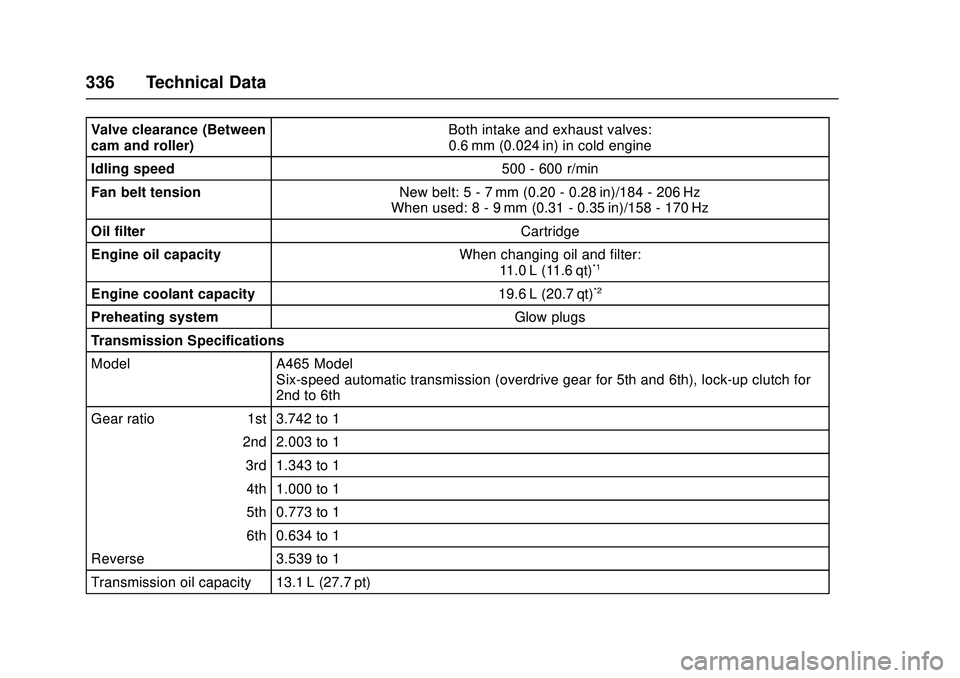
Valve clearance (Between
cam and roller)Both intake and exhaust valves:
0.6 mm (0.024 in) in cold engine
Idling speed 500 - 600 r/min
Fan belt tension New belt: 5 - 7 mm (0.20 - 0.28 in)/184 - 206 Hz
When used: 8 - 9 mm (0.31 - 0.35 in)/158 - 170 Hz
Oil filter Cartridge
Engine oil capacity When changing oil and filter:
11.0 L (11.6 qt)
*1
Engine coolant capacity 19.6 L (20.7 qt)*2
Preheating system Glow plugs
Transmission Specifications
Model A465 Model Six-speed automatic transmission (overdrive gear for 5th and 6th), lock-up clutch for
2nd to 6th
Gear ratio 1st 3.742 to 1 2nd 2.003 to 13rd 1.343 to 1
4th 1.000 to 1
5th 0.773 to 1
6th 0.634 to 1
Reverse 3.539 to 1
Transmission oil capacity 13.1 L (27.7 pt)
Page 342 of 358

Chevrolet Low Cab Forward Owner Manual (GMNA-Localizing-U.S.-
11254764) - 2018 - crc - 12/5/16
Technical Data 341
Engine Drive Belt Routing
Fan Belt and Air Conditioning
Compressor Belt
See theMaintenance Schedule
0 303.
No. Name
1 Fan belt
2 Fan pulley
3 A/C belt
4 A/C compressor
5 Tension pulley No.
Name
6 Crank pulley
7 Alternator
If your air conditioning system is
functioning properly, it is not
necessary to remove and replace
the refrigerant or compressor oil.
. A V-ribbed belt is used for the
fan belt. This type of belt
requires the tension to be
adjusted more accurately than is
required with the conventional V
belt. Inappropriate tension could
cause the belt to make noise or
break. When the fan belt is
damaged, electricity is not
properly generated or becomes
a cause of engine overheating.
You must check the tension of
the fan belt carefully.
. Use dealer-certified genuine
parts when changing the
fan belt.
. Have the vehicle inspected and
serviced at your dealer. .
The air conditioning drive belt,
if equipped, must be adjusted
after fan belt adjustment. If the
belt is not adjusted properly, the
A/C belt may experience
excessive tension, and possible
premature failure.