tire pressure CHEVROLET LOW CAB FORWARD 2018 Owner's Manual
[x] Cancel search | Manufacturer: CHEVROLET, Model Year: 2018, Model line: LOW CAB FORWARD, Model: CHEVROLET LOW CAB FORWARD 2018Pages: 358, PDF Size: 6.32 MB
Page 60 of 358
Chevrolet Low Cab Forward Owner Manual (GMNA-Localizing-U.S.-
11254764) - 2018 - crc - 12/5/16
Storage 59
Model MaximumGVWR
kg (lb.) Front GAWR
Capacitykg (lb.) Rear GAWR
Capacitykg (lb.)
4500HD 6 577 (14,500) 2 431 (5,360) 4 482 (9,880) 4500XD 7 258 (16,000) 3 007 (6,630) 4 998 (11,020)
5500HD 8 142 (17,950) 3 098 (6,830) 5 888 (12,980)
5500XD 8 845 (19,500) 3 300 (7,275) 6 196 (13,660)
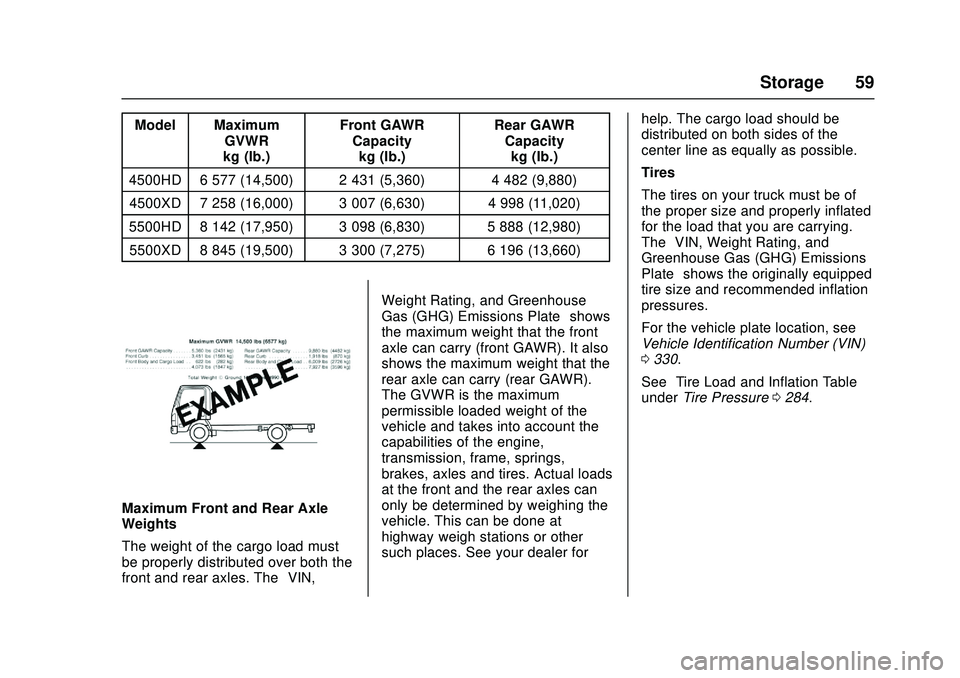
Maximum Front and Rear Axle
Weights
The weight of the cargo load must
be properly distributed over both the
front and rear axles. The “VIN,Weight Rating, and Greenhouse
Gas (GHG) Emissions Plate”
shows
the maximum weight that the front
axle can carry (front GAWR). It also
shows the maximum weight that the
rear axle can carry (rear GAWR).
The GVWR is the maximum
permissible loaded weight of the
vehicle and takes into account the
capabilities of the engine,
transmission, frame, springs,
brakes, axles and tires. Actual loads
at the front and the rear axles can
only be determined by weighing the
vehicle. This can be done at
highway weigh stations or other
such places. See your dealer for help. The cargo load should be
distributed on both sides of the
center line as equally as possible.
Tires
The tires on your truck must be of
the proper size and properly inflated
for the load that you are carrying.
The
“VIN, Weight Rating, and
Greenhouse Gas (GHG) Emissions
Plate” shows the originally equipped
tire size and recommended inflation
pressures.
For the vehicle plate location, see
Vehicle Identification Number (VIN)
0 330.
See “Tire Load and Inflation Table”
under Tire Pressure 0284.
Page 126 of 358

Chevrolet Low Cab Forward Owner Manual (GMNA-Localizing-U.S.-
11254764) - 2018 - crc - 12/5/16
Driving and Operating 125
Warning (Continued)
exhaust pipe are extremely hot.
Be careful not to inadvertently
touch them when working near
them (for example, tilting the cab
or operating an attachment). You
and others could be seriously
injured.
Recommendations for Driving
in Hot Regions
The engine is more likely to
overheat in an environment where
the ambient temperature is high. To
prevent the engine from
overheating, pay attention to the
following points:
.If the engine does not contain
the appropriate concentration of
engine coolant, overheating is
likely to occur.
Refer to Engine Coolant 0231.
. Do not put well water, river water
or other hard water in the engine
cooling system. It would hasten
the formation of rust and scale. .
If foreign matter (insects, mud,
etc.) gets stuck in the radiator's
air passages, the cooling
system's performance will
deteriorate. Check the air
passages for clogging, and
remove any foreign matter using
water under low pressure.
Refer to Exterior Care 0293.
When Turning, the Rear
Wheels will Follow Tighter
Curves than the Front Wheels
Use the mirrors to confirm safety.
Sidewinds
If the vehicle catches a sidewind
and drifts sideways, firmly grip the
steering wheel, decelerate to a
speed that allows you to stay
completely in control, and make a
directional correction. The vehicle
may catch strong sidewinds in the
following situations:
.
Emerging from a tunnel
. Driving over a bridge
. Driving on an embankment
. Driving through a cutting .
Being overtaken by a large truck
or bus
. Overtaking a large truck or bus
Flat Tire
If a blowout or flat tire occurs while
you are driving, calmly grip the
steering wheel and gradually apply
the brakes to decelerate. (Hard
braking would be dangerous
because it could cause the steering
wheel to be pulled to one side.)
Stop the vehicle in a safe place, and
change the tire.
Hard Bump Under Vehicle
If the underside of the vehicle
receives a hard bump, stop in a safe
place where the vehicle will not
obstruct traffic and check for brake
fluid leakage, fuel leakage and
component damage. If any part of
the vehicle is damaged or broken,
promptly have the vehicle inspected
and repaired.
Highways
.Speeds on highways are higher
than those on regular roads, so
there is more danger. Also, a
Page 127 of 358

Chevrolet Low Cab Forward Owner Manual (GMNA-Localizing-U.S.-
11254764) - 2018 - crc - 12/5/16
126 Driving and Operating
breakdown on a highway
represents a hazard to other
vehicles and can cause an
accident. Concentrate on safe
driving. Remember to perform
daily pre-operation inspections
and use highway driving
techniques. When performing
daily pre-operation inspections,
perform the checks shown in the
table on the left with particularly
great care.
Refer toOwner Checks and
Services 0317.
. When merging with traffic on a
highway, use the turn signal
lights to indicate your intentions
ahead of time. Speed up
sufficiently when you are in the
acceleration lane. Pay attention
to vehicles behind you and to
conditions in the lane you are
joining. Merge in such a way that
you do not obstruct vehicles in
the lane.
. Your sense of how fast you are
traveling becomes distorted on
long highway drives. Constantly keep an eye on the
speedometer, and maintain a
suitable headway distance.
. During high-speed driving, even
a little turn of the steering wheel
causes a big movement of the
vehicle. Turn the steering wheel
slowly.
. Excessive use of the brake
pedal is extremely dangerous
because it rapidly wears the
brake linings and causes brake
fade. Make effective use of the
engine brake and the exhaust
brake when you want to
decelerate.
. When you want to turn off a
highway, use the turn signal
lights to indicate your intentions
ahead of time. Paying attention
to vehicles behind you, turn off
the highway smoothly so as not
to obstruct other vehicles.
Brake Fade : Frequent use of the
brakes can cause the brakes to
overheat so that the frictional force
of the brake linings decreases and the brakes become less effective
than normal. This phenomenon is
called brake fade.
Braking
Brake Operation
The brakes give strong braking
force with only light pressure on the
pedal. Do not press the brake pedal
hard except in the event of an
emergency.
Actual stopping distances vary
greatly. Your ability to stop safely
will be greatly affected by the
surface of the road, whether it is
pavement or gravel; the condition of
the road, whether it is wet, dry or
icy; tire tread; the condition of the
brakes; the weight of the vehicle;
the weight of the load; and the
amount of brake force applied.
Please allow for realistic stopping
distances to avoid unnecessary
heavy braking. That means better
braking, longer brake life and safer
driving.
Page 137 of 358

Chevrolet Low Cab Forward Owner Manual (GMNA-Localizing-U.S.-
11254764) - 2018 - crc - 12/5/16
136 Driving and Operating
Remove snow that has stuck to the
inside of the fenders and to the
brake hoses. Otherwise, it may
damage components. After driving
on a salted road, wash the
underside of the vehicle as soon as
possible to prevent the salt from
causing rust. Spraying water under
high pressure is an effective way to
get the salt off.
After washing the vehicle, wipe the
door openings dry.
If the Vehicle Is Stuck
When Driving on Bad Roads
Freeing the Vehicle from Sand,
Mud, Snow, and Ice
If your vehicle gets stuck in sand,
mud, snow or ice, move the selector
lever from "Second" to "Reverse".
Apply a light pressure to the
accelerator pedal while the
transmission is in gear. Remove
your foot from the accelerator and
press the brake pedal while shifting.
Do not race the engine. For best
traction, avoid spinning the wheels.
When you cannot avoid drivingthrough deep mud, using tire chains
is an effective way to avoid getting
stuck.
Do not allow wheels to spin freely in
mud, sand, snow, ice or other poor
road conditions. This free spinning
will damage the rear axle. Even
vehicles equipped with LSD (Limited
Slip Differential) have traction
limitations. If your vehicle gets stuck
and it is difficult to extricate,
immediately stop driving and have
the vehicle towed. Spinning wheels
for an extended period of time may
cause abnormal noises or
malfunction to LSD.
Do not spin wheels faster than
32 km/h (20 MPH). Damage may
result from excessive wheel
spinning, including tire, transmission
and/or rear axle malfunction.
When driving in sand or mud, avoid
hard braking, sudden acceleration
and sharp turns of the steering
wheel. Such actions could get the
vehicle stuck and make it difficult to
extricate.
After driving through deep mud: any
mud stuck to the vehicle can harm
the steering, brakes and powertrain.
Wash the vehicle and remove all
mud and other incrustation.
The vehicle speed sensors are fitted
on the wheels. When removing mud
and other incrustation, take great
care not to damage the
components.
Do not use a sharp implement to
remove mud. Sharp edges could
damage rubber parts.
Refer to
Antilock Brake System
(ABS) 0196 andExterior Care
0 293.
Page 144 of 358
Chevrolet Low Cab Forward Owner Manual (GMNA-Localizing-U.S.-
11254764) - 2018 - crc - 12/5/16
Driving and Operating 143
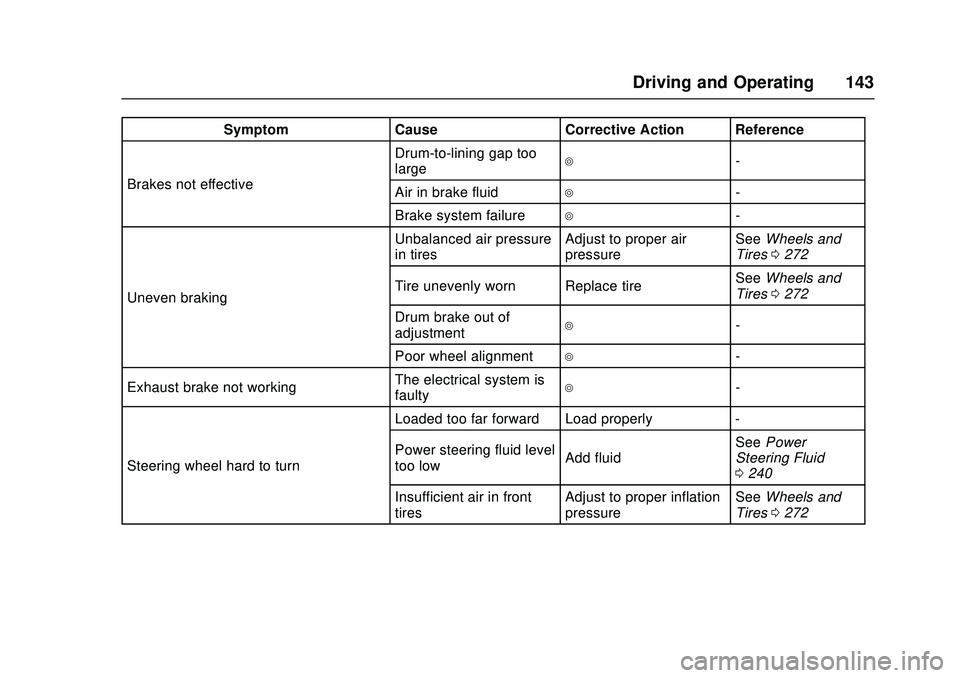
SymptomCauseCorrective Action Reference
Brakes not effective Drum-to-lining gap too
large
4-
Air in brake fluid
4-
Brake system failure
4-
Uneven braking Unbalanced air pressure
in tires
Adjust to proper air
pressureSee
Wheels and
Tires 0272
Tire unevenly worn Replace tire See
Wheels and
Tires 0272
Drum brake out of
adjustment
4-
Poor wheel alignment
4-
Exhaust brake not working The electrical system is
faulty
4-
Steering wheel hard to turn Loaded too far forward Load properly -
Power steering fluid level
too low
Add fluidSee
Power
Steering Fluid
0 240
Insufficient air in front
tires Adjust to proper inflation
pressureSee
Wheels and
Tires 0272
Page 145 of 358
Chevrolet Low Cab Forward Owner Manual (GMNA-Localizing-U.S.-
11254764) - 2018 - crc - 12/5/16
144 Driving and Operating
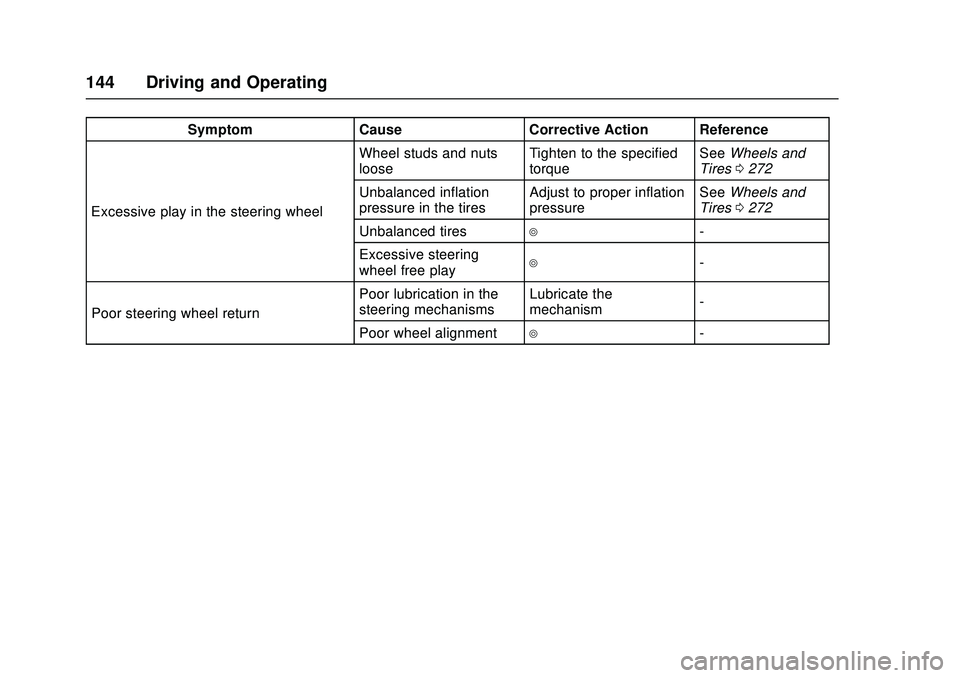
SymptomCauseCorrective Action Reference
Excessive play in the steering wheel Wheel studs and nuts
loose
Tighten to the specified
torqueSee
Wheels and
Tires 0272
Unbalanced inflation
pressure in the tires Adjust to proper inflation
pressureSee
Wheels and
Tires 0272
Unbalanced tires
4-
Excessive steering
wheel free play
4-
Poor steering wheel return Poor lubrication in the
steering mechanisms
Lubricate the
mechanism
-
Poor wheel alignment
4-
Page 198 of 358

Chevrolet Low Cab Forward Owner Manual (GMNA-Localizing-U.S.-
11254764) - 2018 - crc - 12/5/16
Driving and Operating 197
Warning (Continued)
ABS does not prevent accidents if
you do not drive safely. Drive the
vehicle at a safe speed.
Install tires of the specified size,
same brand and same tread
design (including winter tires) on
all wheels. If different tires are
installed, the braking distance
becomes longer and directional
control stability of the vehicle
decreases. This is very
dangerous.
Steering during sudden braking
(when the ABS is working) will
feel slightly different than it does
when the brakes are not applied.
Operate the steering wheel
carefully keeping this in mind.
Driving in sand or on a muddy road
may adversely affect the brakes and
ABS sensors. Wash the vehicle to
remove sand and mud after
operating the vehicle in sandy or
muddy conditions. Before washing the vehicle, provide
necessary protection to prevent
water from being splashed on the
ABS components (sensors and
actuators). Especially when using
high-pressure washing, be careful
not to allow water to be directly
sprayed onto the ABS components
and their harness connectors.
These are not signs of ABS
malfunction:
.
Soon after you start the engine
and the vehicle starts moving,
the sound of motor or valve
working may be heard from the
rear of the vehicle or underside
of the cab. This sound is from a
self-check by the ABS system
and is normal. In addition, you
may also feel some vibration if
the brake pedal is pressed at
this time.
. When ABS is operating,
vibration is felt on the brake
pedal and steering wheel and
you may hear the system
operating. This is normal when
ABS is properly operating. .
The exhaust brake may release
when ABS is activated and the
exhaust brake is in operation.
. ABS is more likely to be
activated when the brake is
applied during cornering or
driving over a bump. This is
because inside wheels or
wheels that have gone over a
bump tend to lock.
. ABS is not activated immediately
after starting the vehicle. It is
activated only when the vehicle
speed reaches approx. 10 km/h
(6 MPH). ABS operation is
inactive when the vehicle speed
reduces to approx. 5 km/h
(3 MPH).
Page 218 of 358

Chevrolet Low Cab Forward Owner Manual (GMNA-Localizing-U.S.-
11254764) - 2018 - crc - 12/5/16
Vehicle Care 217
Vehicle Care
General Information
General Information . . . . . . . . . . 218
California Proposition65 Warning . . . . . . . . . . . . . . . . . 218
California Perchlorate Materials Requirements . . . . . 218
Accessories and Modifications . . . . . . . . . . . . . . . . 218
Vehicle Checks
Doing Your OwnService Work . . . . . . . . . . . . . . . 218
Cab Tilting . . . . . . . . . . . . . . . . . . . . 220
Engine Compartment Overview . . . . . . . . . . . . . . . . . . . . 222
Engine Cover . . . . . . . . . . . . . . . . . 222
Engine Oil . . . . . . . . . . . . . . . . . . . . 223
Automatic Transmission Fluid . . . . . . . . . . . . . . . . . . . . . . . . 229
Engine Air Cleaner/Filter . . . . . . 231
Engine Coolant . . . . . . . . . . . . . . . 231
Engine Overheating . . . . . . . . . . 237
Power Steering Fluid . . . . . . . . . 240
Washer Fluid . . . . . . . . . . . . . . . . . 241
Brakes . . . . . . . . . . . . . . . . . . . . . . . 242
Brake Fluid . . . . . . . . . . . . . . . . . . . 246
Battery . . . . . . . . . . . . . . . . . . . . . . . . 247
Fuel Filter . . . . . . . . . . . . . . . . . . . . 248 Rear Axle (Gear Oil Viscosity
Chart) . . . . . . . . . . . . . . . . . . . . . . . 249
Rear Axle (Oil Level Check) . . . . . . . . . . . . . . . . . . . . . . 249
Noise Control System . . . . . . . . 250
Automatic Transmission Shift
Lock Control Function
Check . . . . . . . . . . . . . . . . . . . . . . . 251
Wiper Blade Replacement . . . . 252
Headlamp Aiming
Headlamp Aiming . . . . . . . . . . . . 254
Bulb Replacement
Bulb Replacement . . . . . . . . . . . . 254
Headlamps and Front Turn Signal . . . . . . . . . . . . . . . . . . . . . . . 257
Roofmarker Lamps . . . . . . . . . . . 261
Sidemarker Lamps (Including Turn Signal and Cornering
Lamps) . . . . . . . . . . . . . . . . . . . . . . 261
Taillamps, Turn Signal, Stoplamps, and Back-Up
Lamps . . . . . . . . . . . . . . . . . . . . . . 263
License Plate Lamp . . . . . . . . . . 263
Interior Lamps . . . . . . . . . . . . . . . . 264
Electrical System
Electrical System Overload . . . 264
Wheels and Tires
Wheels and Tires . . . . . . . . . . . . . 272 Tire Pressure . . . . . . . . . . . . . . . . . 284
Tire Rotation . . . . . . . . . . . . . . . . . 284
If a Tire Goes Flat . . . . . . . . . . . . 287
Jump Starting
Jump Starting - North
America . . . . . . . . . . . . . . . . . . . . . 287
Towing the Vehicle
Towing the Vehicle . . . . . . . . . . . 291
Appearance Care
Exterior Care . . . . . . . . . . . . . . . . . 293
Interior Care . . . . . . . . . . . . . . . . . . 299
Page 273 of 358

Chevrolet Low Cab Forward Owner Manual (GMNA-Localizing-U.S.-
11254764) - 2018 - crc - 12/5/16
272 Vehicle Care
{Warning
Always use fuses specified by the
dealer when replacing the
slow-blow fuse. Using fuses with
a rating other than that specified,
or using wire or tin foil, etc., could
result in fire or damage.
If the new fuses blow right away
and the cause is unknown,
contact your dealer.
Do not inspect or replace fuses
when the starter switch is in the
ON position. Doing so may lead
to an accident.
When inspecting fuses, be sure to
park the vehicle on flat, level
ground and apply chocks to the
wheels.It is not necessary to open or close
the cover unless trouble is found.
The relay box structure makes it
difficult for water to enter. If you
should spill water or a beverage of
the cover, however, wipe it off
before opening the cover.
The area around the cover will get
warm when the vehicle is being
driven, but this is not abnormal.
Wheels and Tires
The operating load and cold inflation
pressure on the rim and wheel must
not exceed the rim and wheel
manufacturer's recommendations
even though the tire may be
approved for a higher load or
inflation. Rim and wheel may be
identified (stamped) with maximum
load and maximum cold inflation
rating. For rims and wheels not so
identified or for service conditions
exceeding the rate capacities,
consult the rim and wheel
manufacturer to determine rim and
wheel capacities for the intended
service. The factory-installed tires
on this vehicle were selected to
provide the best all-around tire
performance for normal operation.
When inflated, as shown on the
vehicle, they have the load carrying
capacity to operate satisfactorily at
all loads up to and including the full
rated load specified for the vehicle.
For more information concerning the
differences in capacities of tires and
rims, refer to the
“Tire and Rim
Association Inc. Yearbook,” or your
authorized dealer or tire dealer.
Page 274 of 358
Chevrolet Low Cab Forward Owner Manual (GMNA-Localizing-U.S.-
11254764) - 2018 - crc - 12/5/16
Vehicle Care 273
Tire Inflation
{Warning
To reduce the risk of loss of
vehicle control and personal
injury:
Tires must be properly inflated,
and your vehicle must not be
overloaded (see the information
onInformation on Loading the
Vehicle 058 and "Tire Load and
Inflation Table" under Tire
Pressure 0284).
Be sure to keep tires properly
inflated. A tire that is run while
seriously underinflated may
overheat to the point where the
tire may lose air suddenly and/or
catch fire, possibly resulting in
personal injury and/or property
damage.
See “Tire Load and Inflation Table”
under Tire Pressure 0284. In no case should the front or rear
tire load exceed the maximum
recommended gross axle weight
rating (front GAWR or rear GAWR).
The efficiency of the vehicle will be
upset if air pressure in the tires are
not equal. Balanced inflation results
when the tires on the same axle
carry the same air pressure.
A difference in pressure between
the front and rear tires may be
permissible within certain limitations,
however, there should not be a
difference in pressures between the
right and left tires on the same axle.
Always use a truck tire pressure
gauge (a pocket-type gauge is not
advised) when checking inflation
pressures. Visual inspection of tires
for inflation pressures is not enough,
especially in the case of radial tires.
Underinflated radial tires may look
similar to correctly inflated radial
tires. If the inflation pressure on a
tire is found to be low frequently,
have your dealer correct the cause.
Be sure to install the tire inflation
valve caps to prevent dirt and
moisture from getting into the valve core, which could cause air leakage.
An underinflated tire in a dual wheel
assembly is harder to notice than
one in a single wheel assembly. The
properly inflated dual tire carries its
own load plus that of the
underinflated tire. Both tires can
overheat, which may result in
property damage and/or personal
injury (see previous WARNING).
Tires Used or Stored for a Long
Period of Time
Tires are a rubber product and
degrade over time, even if they are
not being used. If any of your tires is
5 to 7 years old or more, please
have them inspected for safe
driving. For further information,
please check with the tire
manufacturer.
Dual Tire Operation
The outer tire of a pair on dual
wheel installations generally wears
faster than the inner tire. If this
occurs, reverse the position of the
tires to equalize wear and get better
tire life.