brake CHEVROLET LOW CAB FORWARD 2019 Owners Manual
[x] Cancel search | Manufacturer: CHEVROLET, Model Year: 2019, Model line: LOW CAB FORWARD, Model: CHEVROLET LOW CAB FORWARD 2019Pages: 382, PDF Size: 5.95 MB
Page 308 of 382

Chevrolet Low Cab Forward 5.2L Diesel Engine 4500/5500 Series (GMNA-
Localizing-U.S.-12407814) - 2019 - crc - 12/13/17
Vehicle Care 307
Tire Pressure
Tire Load and Inflation Table
Tire Load and Inflation Table
TIRES FOR VEHICLES IN HIGHWAY SERVICE
TIRE LOAD LIMITS AT VARIOUS COLD INFLATION PRESSURES
Tire Size Designation Cold Inflation Pressure (psi) 50 55 60 65 70 75 80 85 90 95
LT215/85R16E Dual Single(lbs) 2470
2680
225/70R19.5F Dual Single(lbs) 3115
33153245
34503415
3640
See Wheels and Tires 0295.
Tire Rotation
{Warning
Be sure to check the wheel studs,
wheel nuts and disc wheel for any
abnormality whenever the disc
wheel is removed.
(Continued)
Warning (Continued)
If you find any abnormal condition
on the wheel studs, wheel nuts or
disc wheel, do not continue to use
the wheel. Contact the nearest
dealer as soon as possible
Tires at different locations wear
differently. For uniform tire wear and
longer tire life, you should rotate the
tires on your vehicle regularly. Make sure to use tires of the same type
on the same axle. If you install tires
of different types on the same axle,
the vehicle may drift right or left
when you apply the brakes.
New tires are more likely to build up
heat and wear faster than old tires,
so they should be installed on the
front axle where the load is smaller.
If there is a difference in diameter
between the inner and outer tires of
a dual-tire wheel, install the smaller
diameter tire inside.
Page 309 of 382

Chevrolet Low Cab Forward 5.2L Diesel Engine 4500/5500 Series (GMNA-
Localizing-U.S.-12407814) - 2019 - crc - 12/13/17
308 Vehicle Care
The difference in diameter of the
tires for a dual-tire wheel should be
within the limit specified in the table
below. If the limit is exceeded, the
tires wear more rapidly than they
should.
{Warning
If tires of different sizes, load
ranges, constructions, or tread
designs are used between the
front and rear axles, do not
exchange tires between the front
and rear axles; otherwise, the(Continued)
Warning (Continued)
tires may get loaded beyond their
limits. This will also affect vehicle
handling, brake performance, and
ride comfort. This is highly
dangerous because the tires and
disc wheels could break down
under an excessive load. You and
others could be seriously injured.
Permissible diameter difference
Radial tire Within 8 mm (0.31 in)
The tightening torque of the wheel
nuts may decrease after a tire
change due to their initial
settlement. Upon driving 50 to
100 km (31 to 62 mi) after a tire
change, retighten the wheel nuts to
the specified torques according to
the instructions in "Retightening
Wheel Nuts" following.
See Maintenance Schedule 0327. Retightening Wheel Nuts
Check the wheel nuts to make sure
they are tightened to the specific
torque by using a torque wrench.
Use the following methods to check
loose wheel nuts. The tightening
torque of the wheel nuts may
decrease after a tire change or
rotation due to their initial
settlement. After driving 1 040 km
(650 mi) and after 10 400 km
(6,500 mi), be sure to retighten the
wheel nuts to the specified torque.
Repeat whenever a wheel, wheel
bolt, or wheel nut is removed.
Tightening torque
500 N·m (362 lb·ft)
Page 314 of 382

Chevrolet Low Cab Forward 5.2L Diesel Engine 4500/5500 Series (GMNA-
Localizing-U.S.-12407814) - 2019 - crc - 12/13/17
Vehicle Care 313
the negative (–) terminal which
is grounded (attached to the
engine block, or frame rail).
2. Position the vehicle with the good (charged) battery so that
the booster (jumper) cables will
reach. But never let the
vehicles touch. Also, be sure
the booster cables to be used
do not have loose or missing
insulation.
3. In both vehicles, turn off the ignition (engine control) switch
and all lights and accessories
except the hazard flasher or
any lights needed for the work
area. In both vehicles, apply
the parking brake firmly and
move the selector lever to the
"P" position.
4. Unlatch the latches (1) and
remove the battery cover (2)
and connect the jumper cables
in the numbered sequence in
the drawing below. Make sure
the cable clamps do not touch
any other metal parts. Make sure the cables are not
on or near pulleys, fans or
other parts that will move when
the engine is started.
When it is difficult to start the
engine in a cold area, first start
the engine of the vehicle with
the booster battery or batteries
and a few minutes after that
start the engine of the disabled
vehicle.
Page 316 of 382
Chevrolet Low Cab Forward 5.2L Diesel Engine 4500/5500 Series (GMNA-
Localizing-U.S.-12407814) - 2019 - crc - 12/13/17
Vehicle Care 315
Towing the Vehicle
Consult your dealer or a
professional towing service if the
disabled vehicle must be towed.
Proper equipment must be used to
prevent damage to vehicles during
any towing. State and local laws
which apply to vehicles in tow must
be followed. Vehicles should not be
towed at speeds in excess of
88 km/h (55 mph).
Connect to the main structural parts
of the vehicle. Do not attach to
bumpers, tow hooks or brackets.
Use only equipment designed for
this purpose. Follow the instructions
of the wrecker manufacturer.
A safety chain system must
be used.
The procedures below must be
followed when towing to prevent
possible damage.Front End Towing (Front Wheels
Off Ground)
To prepare a disabled vehicle for
front end towing with front wheels
raised off the ground, the following
steps are necessary:
.
Block the rear wheels of the
disabled vehicle.
. Disconnect the driveshaft at the
rear axle. Secure the driveshaft
to the frame or crossmember.
When towing, disconnect the
driveshaft at the rear axle to ensure
the transmission is not damaged.
The rear end of the driveshaft must
be disconnected and safely secured
if the 80 km (50 mi) or 48 km/h
(30 mph) is exceeded.
If there is damage or suspected
damage to the rear axle, remove the
axle shafts. Cover the hub openings
to prevent the loss of lubricant or
entry of dirt or foreign objects.
Place a 10 cm (4 in) wood beam
against the towing guide behind the
bumper. (If no 10 cm (4 in) is
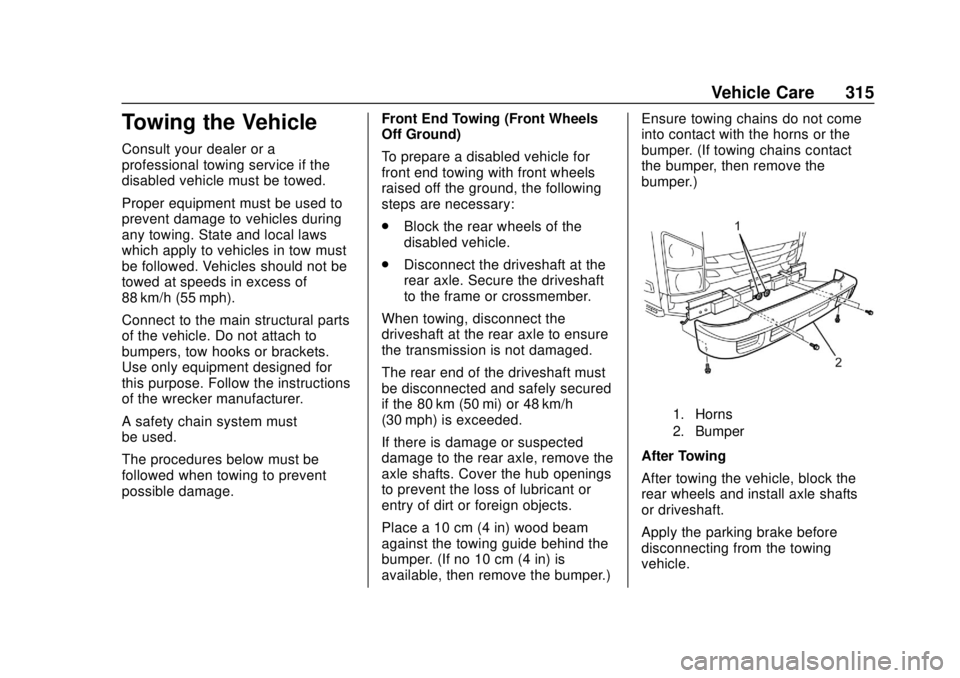
available, then remove the bumper.) Ensure towing chains do not come
into contact with the horns or the
bumper. (If towing chains contact
the bumper, then remove the
bumper.)
1. Horns
2. Bumper
After Towing
After towing the vehicle, block the
rear wheels and install axle shafts
or driveshaft.
Apply the parking brake before
disconnecting from the towing
vehicle.
Page 317 of 382
Chevrolet Low Cab Forward 5.2L Diesel Engine 4500/5500 Series (GMNA-
Localizing-U.S.-12407814) - 2019 - crc - 12/13/17
316 Vehicle Care
Front End Towing (All Wheels On
the Ground)
Your vehicle may be towed on all
wheels provided the steering is
operable. Remember that power
steering and brakes will not have
power assist. There must be a tow
bar installed between the tow
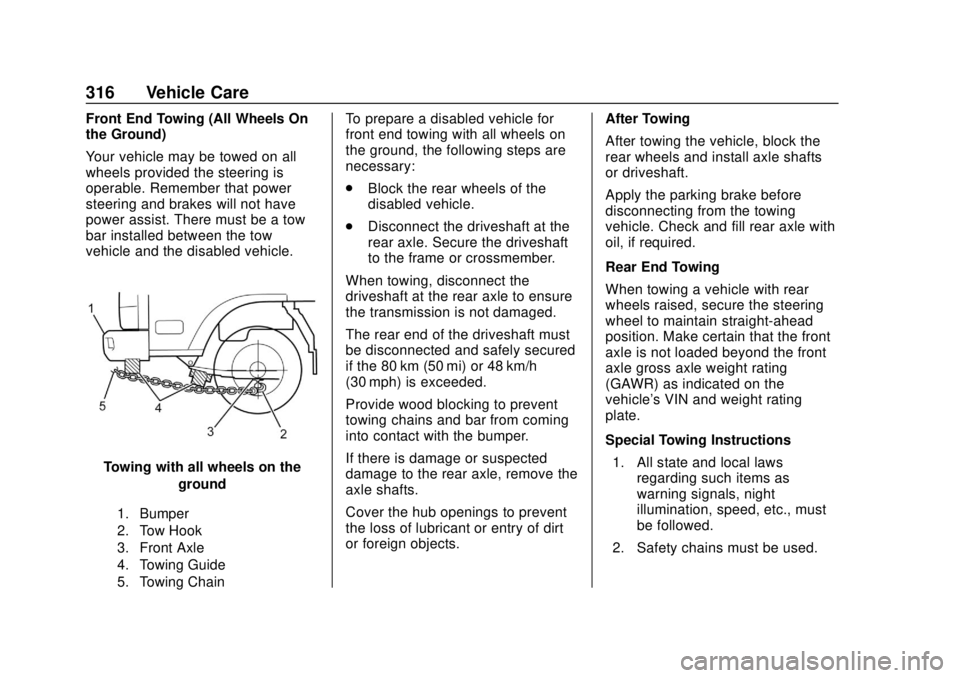
vehicle and the disabled vehicle.
Towing with all wheels on theground
1. Bumper
2. Tow Hook
3. Front Axle
4. Towing Guide
5. Towing Chain
To prepare a disabled vehicle for
front end towing with all wheels on
the ground, the following steps are
necessary:
.Block the rear wheels of the
disabled vehicle.
. Disconnect the driveshaft at the
rear axle. Secure the driveshaft
to the frame or crossmember.
When towing, disconnect the
driveshaft at the rear axle to ensure
the transmission is not damaged.
The rear end of the driveshaft must
be disconnected and safely secured
if the 80 km (50 mi) or 48 km/h
(30 mph) is exceeded.
Provide wood blocking to prevent
towing chains and bar from coming
into contact with the bumper.
If there is damage or suspected
damage to the rear axle, remove the
axle shafts.
Cover the hub openings to prevent
the loss of lubricant or entry of dirt
or foreign objects. After Towing
After towing the vehicle, block the
rear wheels and install axle shafts
or driveshaft.
Apply the parking brake before
disconnecting from the towing
vehicle. Check and fill rear axle with
oil, if required.
Rear End Towing
When towing a vehicle with rear
wheels raised, secure the steering
wheel to maintain straight-ahead
position. Make certain that the front
axle is not loaded beyond the front
axle gross axle weight rating
(GAWR) as indicated on the
vehicle's VIN and weight rating
plate.
Special Towing Instructions
1. All state and local laws regarding such items as
warning signals, night
illumination, speed, etc., must
be followed.
2. Safety chains must be used.
Page 332 of 382

Chevrolet Low Cab Forward 5.2L Diesel Engine 4500/5500 Series (GMNA-
Localizing-U.S.-12407814) - 2019 - crc - 12/13/17
Service and Maintenance 331
No. Service Interval16 000 km/10,000 mi
24 000 km/15,000 mi
32 000 km/20,000 mi
48 000 km/30,000 mi
64 000 km/40,000 mi
72 000 km/45,000 mi
80 000 km/50,000 mi
96 000 km/60,000 mi
112 000 km/70,000 mi
120 000 km/75,000 mi
128 000 km/80,000 mi
144 000 km/90,000 mi
160 000 km/100,000 mi
168 000 km/105,000 mi
176 000 km/110,000 mi
Service intervals
months or
kilometers
(miles)
whichever
occurs first (1)
11 Engine cooling system I - I I I - I I I - I I I - I or every
12 months
12 Engine coolant Every 12 months: I
Every 24 months: R (when dealer recommended coolant is used)
13 Exhaust system I - I I I - I I I - I I I - I
14 DPF (clean filter) - - - - - - - - - - - - C - - or every
3,000 hours
15 DPF (pressure difference
sensor 0 point
adjustment) - - - - - - - - - - - - A - -
or every
3,000 hours
16 DPF (pressure difference
sensor hose) Every 160 000 km (100,000 miles): I
Every 400 000 km (250,000 miles): R or every
3,000 hours: I
17 Fuel line system I - I I I - I I I - I I I - I or every
12 months
18 Brake lining and pad
for wear I - I I I - I I I - I I I - I
Page 333 of 382
Chevrolet Low Cab Forward 5.2L Diesel Engine 4500/5500 Series (GMNA-
Localizing-U.S.-12407814) - 2019 - crc - 12/13/17
332 Service and Maintenance
No. Service Interval16 000 km/10,000 mi
24 000 km/15,000 mi
32 000 km/20,000 mi
48 000 km/30,000 mi
64 000 km/40,000 mi
72 000 km/45,000 mi
80 000 km/50,000 mi
96 000 km/60,000 mi
112 000 km/70,000 mi
120 000 km/75,000 mi
128 000 km/80,000 mi
144 000 km/90,000 mi
160 000 km/100,000 mi
168 000 km/105,000 mi
176 000 km/110,000 mi
Service intervals
months or
kilometers
(miles)
whichever
occurs first (1)
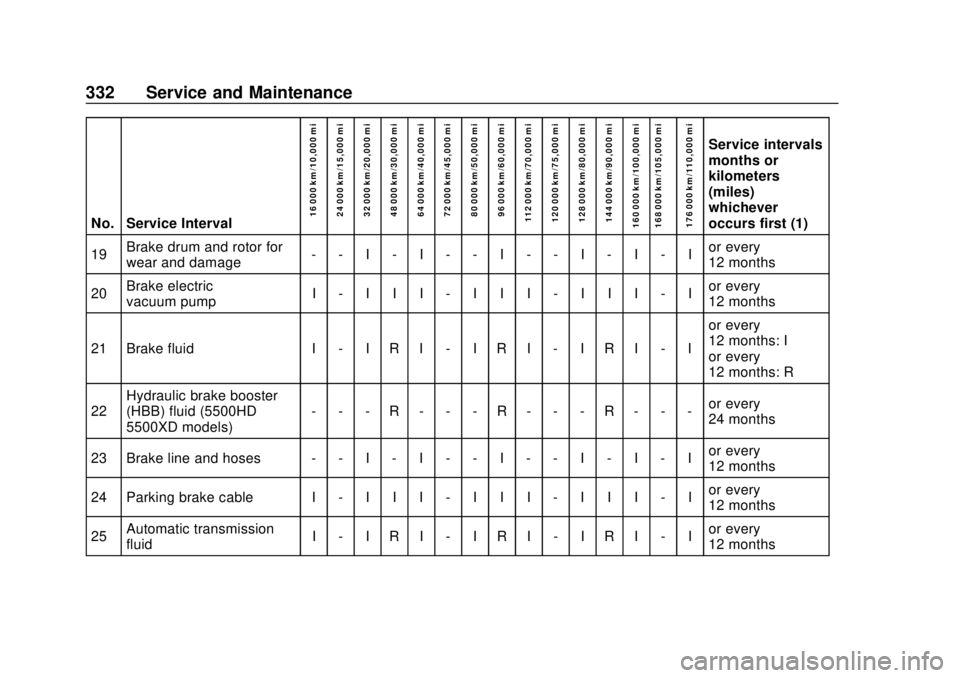
19 Brake drum and rotor for
wear and damage
- - I - I - - I - - I - I - I or every
12 months
20 Brake electric
vacuum pump I - I I I - I I I - I I I - I or every
12 months
21 Brake fluid I - I R I - I R I - I R I - I or every
12 months: I
or every
12 months: R
22 Hydraulic brake booster
(HBB) fluid (5500HD
5500XD models) - - - R - - - R - - - R - - -
or every
24 months
23 Brake line and hoses - - I - I - - I - - I - I - I or every
12 months
24 Parking brake cable I - I I I - I I I - I I I - I or every
12 months
25 Automatic transmission
fluid I - I R I - I R I - I R I - I
or every
12 months
Page 338 of 382
Chevrolet Low Cab Forward 5.2L Diesel Engine 4500/5500 Series (GMNA-
Localizing-U.S.-12407814) - 2019 - crc - 12/13/17
Service and Maintenance 337
Engine Coolant0253. Have the
Engine Coolant replaced by your
authorized dealer.
13. Exhaust System : Check the
complete exhaust system every
16 000 km (10,000 miles). Check
body areas near the exhaust
system. Look for broken, damaged,
missing, or out-of-position parts.
Also inspect for open seams, holes,
loose connections, or other
conditions which could cause heat
build-up at the rear body floor pan,
or could let exhaust fumes seep into
the passenger compartment. Dust
or water in the cabin may indicate a
leak in that area. Required repairs
should be made at once.
14. DPF (Clean Filter) : Clean the
filter every 160 000 km
(100,000 miles) or 3,000 hours
whichever occurs first.
15. DPF (Pressure Difference
Sensor 0 Point Adjustment) :
Adjust the sensor every 160 000 km
(100,000 miles) or 3,000 hours
whichever occurs first. 16. DPF (Pressure Difference
Sensor Hose) :
Inspect the sensor
hose every 160 000 km
(100,000 miles) or 3,000 hours
whichever occurs first. Replace the
sensor hose every 400 000 km
(250,000 miles).
17. Fuel Line System : Inspect the
fuel tank, cap and lines for damage
which could cause leakage every
16 000 km (10,000 miles). Inspect
fuel cap for correct sealing ability
and indications of physical damage.
Replace any damaged or
malfunctioning parts.
18. Brake Lining and Pad for
Wear : Check drum brake lining and
disc brake pad for wear or cracks
every 16 000 km (10,000 miles).
Check brakes (including parking
brake) more often if operating
conditions or driving habits result in
frequent braking.
Front disc brakes have built-in wear
noise indicators which are designed
to make a high pitched squeal or
cricket-like warning sound when the
brake pads are worn to the point
where new pads are needed. When the truck is in motion, the
sound may be constant or it may
come and go. Pressing the brake
pedal firmly may cause the sound
to stop.
Have the brake linings or the brake
pads replaced by your authorized
dealer as soon as possible after the
warning first becomes evident.
Failure to do so can result in
expensive damage to the brake
system or a serious crash.
19. Brake Drum and Rotor for
Wear and Damage :
Check brake
drums (rear and parking) and rotors
(front) for wear or damage every
32 000 km (20,000 miles) or
12 months whichever occurs first.
20. Brake Electric Vacuum Pump
(4500HD, 4500XD models) :
Inspect the brake electric vacuum
pump operation every 16 000 km
(10,000 miles) or 12 months,
whichever occurs first.
Page 339 of 382
Chevrolet Low Cab Forward 5.2L Diesel Engine 4500/5500 Series (GMNA-
Localizing-U.S.-12407814) - 2019 - crc - 12/13/17
338 Service and Maintenance
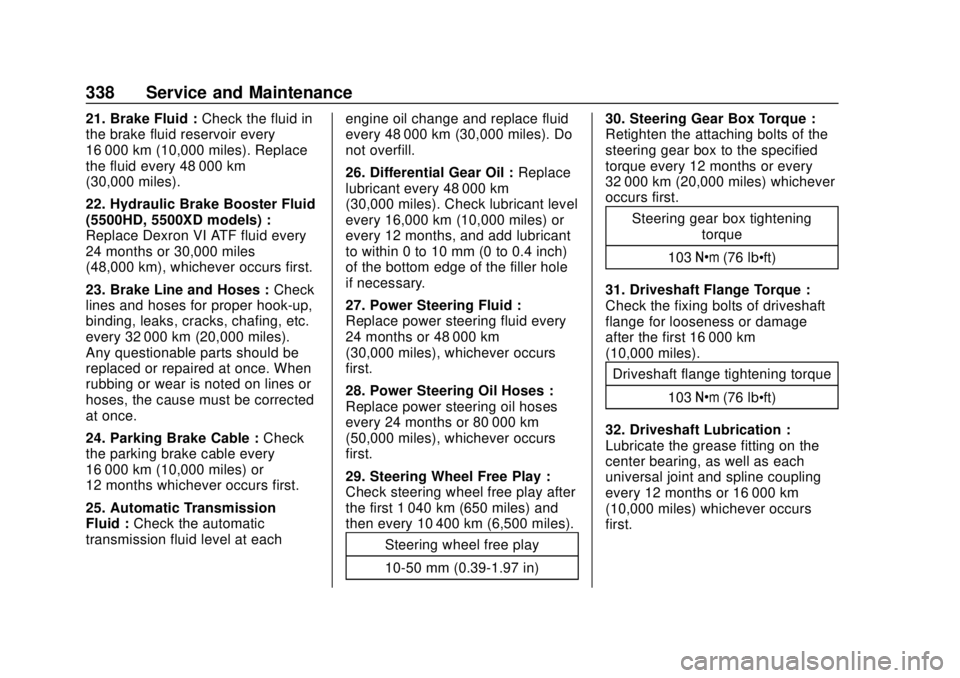
21. Brake Fluid :Check the fluid in
the brake fluid reservoir every
16 000 km (10,000 miles). Replace
the fluid every 48 000 km
(30,000 miles).
22. Hydraulic Brake Booster Fluid
(5500HD, 5500XD models) :
Replace Dexron VI ATF fluid every
24 months or 30,000 miles
(48,000 km), whichever occurs first.
23. Brake Line and Hoses : Check
lines and hoses for proper hook-up,
binding, leaks, cracks, chafing, etc.
every 32 000 km (20,000 miles).
Any questionable parts should be
replaced or repaired at once. When
rubbing or wear is noted on lines or
hoses, the cause must be corrected
at once.
24. Parking Brake Cable : Check
the parking brake cable every
16 000 km (10,000 miles) or
12 months whichever occurs first.
25. Automatic Transmission
Fluid : Check the automatic
transmission fluid level at each engine oil change and replace fluid
every 48 000 km (30,000 miles). Do
not overfill.
26. Differential Gear Oil :
Replace
lubricant every 48 000 km
(30,000 miles). Check lubricant level
every 16,000 km (10,000 miles) or
every 12 months, and add lubricant
to within 0 to 10 mm (0 to 0.4 inch)
of the bottom edge of the filler hole
if necessary.
27. Power Steering Fluid :
Replace power steering fluid every
24 months or 48 000 km
(30,000 miles), whichever occurs
first.
28. Power Steering Oil Hoses :
Replace power steering oil hoses
every 24 months or 80 000 km
(50,000 miles), whichever occurs
first.
29. Steering Wheel Free Play :
Check steering wheel free play after
the first 1 040 km (650 miles) and
then every 10 400 km (6,500 miles).
Steering wheel free play
10-50 mm (0.39-1.97 in) 30. Steering Gear Box Torque :
Retighten the attaching bolts of the
steering gear box to the specified
torque every 12 months or every
32 000 km (20,000 miles) whichever
occurs first.
Steering gear box tightening torque
103 Y(76 lb·ft)
31. Driveshaft Flange Torque :
Check the fixing bolts of driveshaft
flange for looseness or damage
after the first 16 000 km
(10,000 miles). Driveshaft flange tightening torque
103Y(76 lb·ft)
32. Driveshaft Lubrication :
Lubricate the grease fitting on the
center bearing, as well as each
universal joint and spline coupling
every 12 months or 16 000 km
(10,000 miles) whichever occurs
first.
Page 341 of 382

Chevrolet Low Cab Forward 5.2L Diesel Engine 4500/5500 Series (GMNA-
Localizing-U.S.-12407814) - 2019 - crc - 12/13/17
340 Service and Maintenance
Owner Checks and
Services
Before Driving
Proper care and driving is important
not only for extended service life of
your vehicle, but also for improved
fuel and oil economy. Drive carefully
and defensively. Be sure you know
how to use your truck and its
equipment before operating it.
Starting and Operating
Proper care and operation will not
only extend the service life of your
vehicle but also improve fuel
economy.
Check Around the Vehicle Before
Starting the Engine
Before pulling away, perform a
thorough safety check, making sure
there are no children or obstructions
around the vehicle.
Take off the chocks after confirming
that the parking brake is securely
applied. Sit behind the wheel, adjust
the seat position, and buckle up theseat belt. The passengers are also
required to buckle up the seat belts.
Adjust the positions of the steering
wheel and mirrors. Lock the doors.
Turn the power of the dome light or
accessories OFF before starting the
engine.
Engine Conditions
Checking the Engine for
Startability and Abnormal Noises
1. Make sure the parking brake is securely engaged. Step firmly
on the brake pedal.
2. Make sure the selector lever is in "P" or "N" position.
For safety, firmly press the
brake pedal before starting the
engine.
3. Turn the engine control switch to start the engine.
Check that the engine starts
quickly with no abnormal
noises. Checking Condition of the Engine
at Low Speeds and during
Acceleration
1. Make sure the transmission is in the "P" or "N" position and
the parking brake is securely
engaged.
2. Turn the engine control switch to start the engine, and run it to
warm up.
3. Check that the engine is running at a speed within the
standard idle speed range.
During regeneration of the
diesel particulate filter (DPF),
the engine idle speed may
increase.
4. Drive the vehicle, making sure the accelerator pedal does not
stick when gradually
accelerating, the engine speed
rises smoothly and it does not
knock.