light CHEVROLET LOW CAB FORWARD 2019 Owner's Manual
[x] Cancel search | Manufacturer: CHEVROLET, Model Year: 2019, Model line: LOW CAB FORWARD, Model: CHEVROLET LOW CAB FORWARD 2019Pages: 382, PDF Size: 5.95 MB
Page 287 of 382
Chevrolet Low Cab Forward 5.2L Diesel Engine 4500/5500 Series (GMNA-
Localizing-U.S.-12407814) - 2019 - crc - 12/13/17
286 Vehicle Care
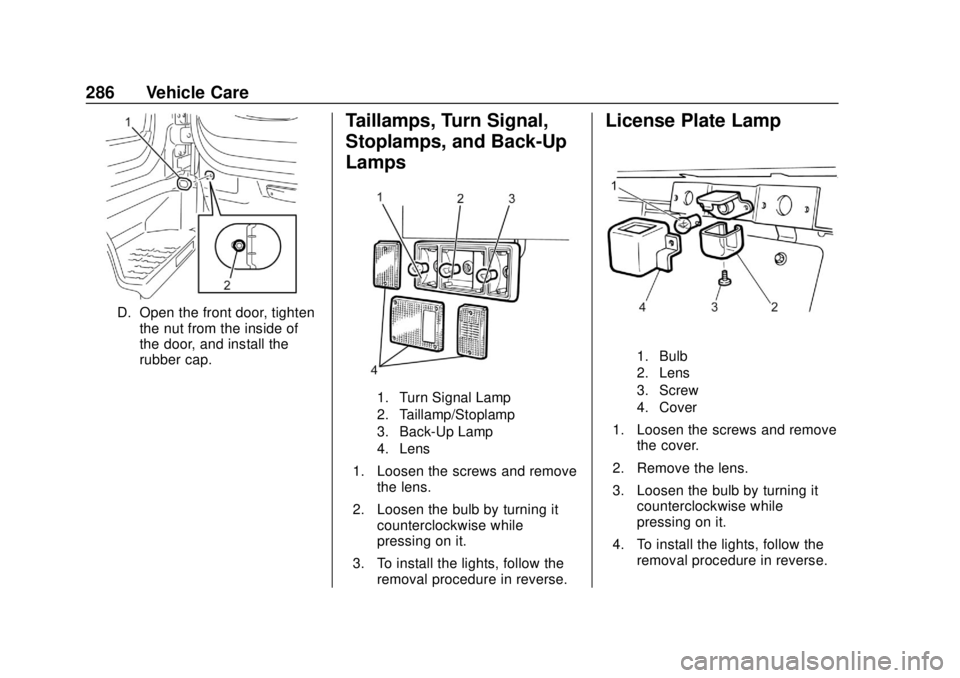
D. Open the front door, tightenthe nut from the inside of
the door, and install the
rubber cap.
Taillamps, Turn Signal,
Stoplamps, and Back-Up
Lamps
1. Turn Signal Lamp
2. Taillamp/Stoplamp
3. Back-Up Lamp
4. Lens
1. Loosen the screws and remove the lens.
2. Loosen the bulb by turning it counterclockwise while
pressing on it.
3. To install the lights, follow the removal procedure in reverse.
License Plate Lamp
1. Bulb
2. Lens
3. Screw
4. Cover
1. Loosen the screws and removethe cover.
2. Remove the lens.
3. Loosen the bulb by turning it counterclockwise while
pressing on it.
4. To install the lights, follow the removal procedure in reverse.
Page 288 of 382

Chevrolet Low Cab Forward 5.2L Diesel Engine 4500/5500 Series (GMNA-
Localizing-U.S.-12407814) - 2019 - crc - 12/13/17
Vehicle Care 287
Interior Lamps
1. Remove the lens and pull outthe bulb.
2. To install the lights, follow the removal procedure in reverse.
Electrical System
Electrical System
Overload
Electrical System
Following the after-delivery service,
it is the owner's responsibility to
check all wiring periodically for
cracked, chafed or oil-soaked
insulation and maintain it in a clean
and tight condition to ensure
satisfactory operation of the
electrical system.
Replacing the Fuses and Relays
Your vehicle is equipped with fuses
and fusible links to protect your
electrical wiring and equipment in
case of electrical overload.
When the lights do not come on or
flash, or the equipment in the
electrical system does not operate,
check to see if a fuse has blown. Fuses :
In case of an electrical
overload, the fuse will blow and stop
the flow of current in the circuit
before electrical components
become damaged.
The cause of the circuit overload
must be identified and corrected
before the blown fuse is replaced,
or else the new fuse will also blow.
Since different circuits handle
different amounts of current, fuses
of various ampere ratings are used.
Be sure to replace a blown fuse with
a fuse of the correct rating.
To know if a fuse is blown or not,
remove the suspected fuse and look
at the wire for a break. If the wire is
broken, replace the fuse with one of
equal amperage rating.
The amperage rating of each fuse is
molded in its head.
Fuses are installed in the fuse
panel.
Page 293 of 382

Chevrolet Low Cab Forward 5.2L Diesel Engine 4500/5500 Series (GMNA-
Localizing-U.S.-12407814) - 2019 - crc - 12/13/17
292 Vehicle Care
Relay LocationRelay locations:
No. Description
1 STOP LAMP
2 DAYTIME RUNNING LAMP
3 KEY ON
4 TCM
5 PARKING/NEUTRAL
6 WIPER MAIN
7 HORN
8 WIPER HI LO
9 TRAILER BRAKE
10 POWER WINDOW
11 –
12 POWER WINDOW
13 HEAD LAMP LO
14 VACUUM PUMP
15 HEAD LAMP HI
16 TAIL LAMP
17 CIGAR LIGHTER
18 CORNERING LAMP
Page 294 of 382

Chevrolet Low Cab Forward 5.2L Diesel Engine 4500/5500 Series (GMNA-
Localizing-U.S.-12407814) - 2019 - crc - 12/13/17
Vehicle Care 293
No. Description19 POWER ACC
20 BLOWER MOTOR Fuse and Relay Location
–Cab Exterior
Fuse and Relay Location
Fuse locations (2): No. Description Rating
1 MARKER LIGHT 20A
2 TAIL MAIN 20A
3 ECM MAIN 15A
4 SCR 20A No. Description Rating
5 PM SENSOR 15A
6 RR DOME LIGHT 15A
7 CONDENSER FAN 20A
Page 295 of 382

Chevrolet Low Cab Forward 5.2L Diesel Engine 4500/5500 Series (GMNA-
Localizing-U.S.-12407814) - 2019 - crc - 12/13/17
294 Vehicle Care
No. Description Rating8 A/C 10A
Relay locations (1): No. Description
1 STARTER
2 ECM MAIN
3 NOX & DEF SENSOR
4 A/C COMPRESSOR
5 CONDENSER FAN
6 RR DOME LIGHT
7 SCR HEATER VALVE
8 MARKER LIGHT
9 –
10 –
11 FUEL HEATER When Slow-blow Fuses Blow Out
Slow-blow fuses protect the
electrical circuits, and they are
installed so that they can be quickly
replaced if there is a malfunction.
If an overload exists in the circuit
from the battery, the slow-blow fuse
will blow out before the wiring
harness is damaged to protect the
electrical circuitry. InspectionWhen the headlights and other
devices in the electrical system do
not work, but there is no problem
with the fuses, check the
slow-blow fuse.
The slow-blow fuse is blown if it
looks like the illustration.
Immediately contact the nearest
dealer.
Page 300 of 382

Chevrolet Low Cab Forward 5.2L Diesel Engine 4500/5500 Series (GMNA-
Localizing-U.S.-12407814) - 2019 - crc - 12/13/17
Vehicle Care 299
Recommended replacement tire for Greenhouse Gas (GHG) emissions
Tire sizeTire makerTire name Rolling
resistance
LT215/85R16E BRIDGESTONE CORPORATION
Duravis R250 LRRA
THE YOKOHAMA RUBBER CO., LTD. TY213A MC2 LRRA
225/70R19.5F BRIDGESTONE CORPORATION
M895Z LRRA
THE YOKOHAMA RUBBER CO., LTD. TY287 MC2 LRRA
If the original equipment tires are
low rolling tires, it is recommended
to use the LRRA tires shown in the
above table.
Refer to the emission control
identifiers on Greenhouse Gas
(GHG) emission plate for your
original equipment tires. Also,
please refer to “VIN, Weight Rating,
and Greenhouse Gas (GHG)
Emissions Plate” for the location of
the Greenhouse Gas (GHG)
emission plate. See Vehicle
Identification Number (VIN) 0353. Wheel Replacement
Recommendations
Wheels must be replaced if they
become damaged (for example:
bent, heavily rusted, leak air) or if
wheel nuts often become loose. Do
not use bent wheels that have been
straightened and do not use inner
tubes in leaking wheels which are
designed for tubeless tires. Such
wheels may have structural damage
and could fail without warning.
When replacing wheels for any
reason, the new wheels should be
equal in load capacity, diameter, width, offset and mounting types to
those originally installed in your
vehicle.
A wheel of the wrong size or type
may adversely affect wheel and
bearing life, brake cooling,
speedometer/odometer calibration,
stopping ability, headlight aim,
bumper height, vehicle ground
clearance and tire or tire chain
clearance on the body and chassis.
Replacement with "used" wheels is
not advised. They may have been
subjected to harsh treatment or very
high mileage and could fail without
warning.
Page 314 of 382

Chevrolet Low Cab Forward 5.2L Diesel Engine 4500/5500 Series (GMNA-
Localizing-U.S.-12407814) - 2019 - crc - 12/13/17
Vehicle Care 313
the negative (–) terminal which
is grounded (attached to the
engine block, or frame rail).
2. Position the vehicle with the good (charged) battery so that
the booster (jumper) cables will
reach. But never let the
vehicles touch. Also, be sure
the booster cables to be used
do not have loose or missing
insulation.
3. In both vehicles, turn off the ignition (engine control) switch
and all lights and accessories
except the hazard flasher or
any lights needed for the work
area. In both vehicles, apply
the parking brake firmly and
move the selector lever to the
"P" position.
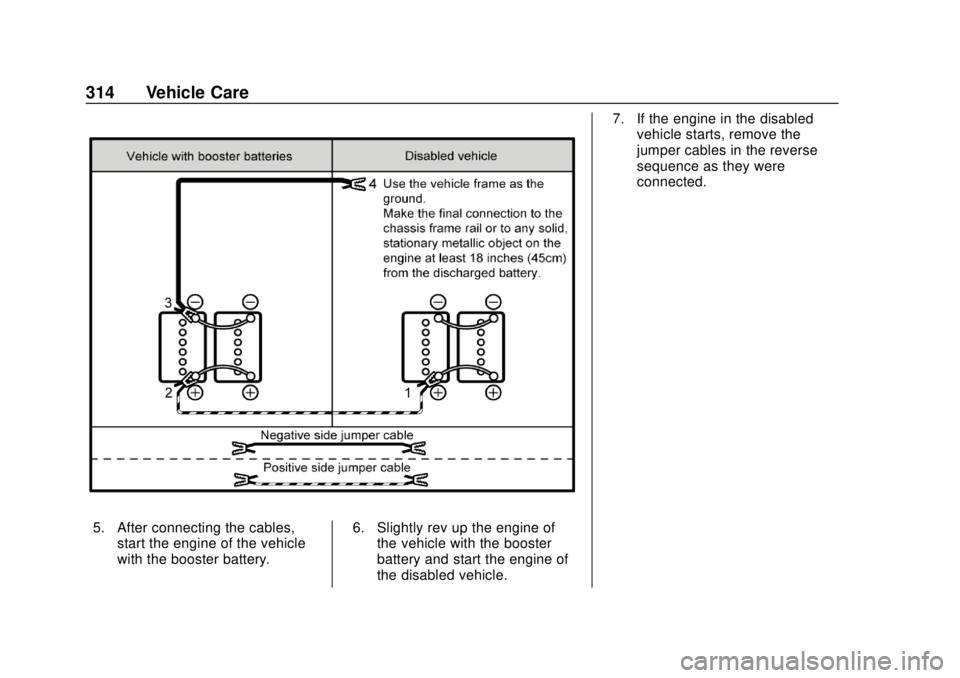
4. Unlatch the latches (1) and
remove the battery cover (2)
and connect the jumper cables
in the numbered sequence in
the drawing below. Make sure
the cable clamps do not touch
any other metal parts. Make sure the cables are not
on or near pulleys, fans or
other parts that will move when
the engine is started.
When it is difficult to start the
engine in a cold area, first start
the engine of the vehicle with
the booster battery or batteries
and a few minutes after that
start the engine of the disabled
vehicle.
Page 315 of 382
Chevrolet Low Cab Forward 5.2L Diesel Engine 4500/5500 Series (GMNA-
Localizing-U.S.-12407814) - 2019 - crc - 12/13/17
314 Vehicle Care
5. After connecting the cables,start the engine of the vehicle
with the booster battery. 6. Slightly rev up the engine of
the vehicle with the booster
battery and start the engine of
the disabled vehicle. 7. If the engine in the disabled
vehicle starts, remove the
jumper cables in the reverse
sequence as they were
connected.
Page 318 of 382
Chevrolet Low Cab Forward 5.2L Diesel Engine 4500/5500 Series (GMNA-
Localizing-U.S.-12407814) - 2019 - crc - 12/13/17
Vehicle Care 317
3. No vehicle should ever betowed over 88 km/h (55 mph).
4. Loose or protruding parts of damaged vehicles should be
secured prior to moving.
5. A safety chain system completely independent of the
primary lifting and towing
attachment must be used.
6. Operators should refrain from going under a vehicle which is
being lifted by the towing
equipment unless the vehicle is
adequately supported by safety
stands.
7. No towing operation which for any reason jeopardizes the
safety of the wrecker operator
or any bystanders or other
motorists should be attempted.Appearance Care
Exterior Care
Exterior Finish
The paint finish on your vehicle
provides beauty, depth of color,
gloss retention and durability.
While cleaning the vehicle, do not
grip the roof marker lights to prevent
damage or water leakage.
Washing
The best way to preserve your
vehicle's finish is to keep it clean by
washing it often.
Wash the vehicle in lukewarm or
cold water. Do not use hot water or
wash your vehicle in the direct rays
of the sun. Do not use strong soap
or chemical detergents. All cleaning
agents should be flushed promptly
from the surface and not allowed to
dry on the finish.
These vehicles are designed to
operate under normal environmental
conditions to withstand natural
elements. However, unusual conditions such as high-pressure
car washers may cause water to
enter inside the vehicle. If the
vehicle is operated with foreign
material adhering to the exterior,
this material may react chemically
with paint, resulting in staining,
discoloration, rusting or corrosion of
components. Also, the material may
become trapped within mechanical
components, adversely affecting
their functions or forming an
aerodynamic resistance. In the
following cases, therefore, the
vehicle must be washed and all
foreign matter removed.
.
When soot, iron powder, dead
bugs, bird droppings, tree sap or
oily matter from coal tar and
smoke has adhered to painted
surfaces.
. When the vehicle has been
driven in coastal areas.
. When the vehicle has been
driven on roads where road
chemicals have been applied.
. When a large amount of mud or
dirt has adhered to the exterior.
Page 320 of 382
Chevrolet Low Cab Forward 5.2L Diesel Engine 4500/5500 Series (GMNA-
Localizing-U.S.-12407814) - 2019 - crc - 12/13/17
Vehicle Care 319
this precaution can lead to heat
deformation and breakage of plastic
components, or to water leaks into
the cab. When using an automatic
car or truck-wash, ensure that a
distance of at least 0.4 m
(15.75 inches) is maintained
between the nozzle and the vehicle,
and when washing door windows,
that the spray is perpendicular to
the surface of the glass.
Ensure that all detergent is fully
washed and wiped away.
Particularly in the case of strong
alkaline detergents (typically those
for industrial uses), there is a
danger that hairline cracks can
develop in lighting-cluster lenses if
the vehicle is operated without
detergent being fully wiped away.
Always read the detergent
manufacturer's instructions carefully
before use. Airborne dirt that
adheres to plastic front bumpers as
a result of rain, for example, can be
difficult to remove. In such a case,
use a commercially-available
cleaner to clean away the dirt, and
then apply a wax for use with plastic
components.Vehicle Storage
In order to maintain your vehicle's
attractive appearance as long as
possible, special consideration must
be given to its storage location.
If the vehicle is stored or kept for an
extended period of time in any of
the following locations, a chemical
change may occur in the paint work,
resulting in staining, discoloration,
rusting, and corrosion of
components.
.Locations where a large amount
of oily matter, soot, heavy smoke
or metal powder can adhere to
the vehicle.
. Areas around pharmaceutical
plants and other facilities that
discharge chemical matter.
. Coastal areas
. Locations where a large amount
of dead bugs, bird droppings or
tree sap can adhere to the
vehicle.
Polishing and Waxing
Periodic polishing and waxing is
recommended to remove built-up
residue and eliminate any
"weathered" appearance.
Your authorized dealer offers
several polishes and cleaners which
have proven value in maintaining
original finish appearance and
durability.
Painted and chrome-plated surfaces
should be waxed once or twice a
month, or whenever water is being
poorly repelled on the surfaces.
Ensure that wax is not applied in
direct sunlight, and that the
temperature of the painted surface
is no more than 40 °C (104 °F).
Always follow the instructions
provided with your wax product.
Do not use wax containing abrasive
material. Failure to observe this
precaution can lead to scratching of
painted surfaces or plastic
components.