engine overheat CHEVROLET LOW CAB FORWARD 2019 User Guide
[x] Cancel search | Manufacturer: CHEVROLET, Model Year: 2019, Model line: LOW CAB FORWARD, Model: CHEVROLET LOW CAB FORWARD 2019Pages: 382, PDF Size: 5.95 MB
Page 148 of 382

Chevrolet Low Cab Forward 5.2L Diesel Engine 4500/5500 Series (GMNA-
Localizing-U.S.-12407814) - 2019 - crc - 12/13/17
Driving and Operating 147
Parking, or Leaving
Driver’s Seat
{Danger
It can be dangerous to get out of
your vehicle if the selector lever is
not fully in "P" (Park) or the
parking brake is not applied all
the way. Your vehicle can roll or
move suddenly.
To be sure your vehicle will not
move, even when you are parking
on level ground, follow the steps
below. (If you have to park on a
hill, also turn your front wheels so
the vehicle will roll away from
traffic.)
You and others could be seriously
injured or killed.
1. Hold the regular brake pedal down with your right foot and
apply the parking brake all the
way before shifting the
transmission. Follow the
Parking Brake instructions in
this manual for your vehicle. 2. To move the selector lever to
"P" (Park), hold in the button
on the lever and push the lever
all the way toward the front of
your vehicle.
3. Turn the key to "LOCK".
4. Remove the key and take it with you.
5. Before you leave the driver's seat, be sure the vehicle is not
moving, or check that your
vehicle is in Park by trying to
pull the selector lever out of "P"
(Park) by pulling the selector
lever toward you without
pushing the button. If you can
do this, it means that the
selector lever was not fully
locked into "P" (Park).
Do Not Touch the Selector Lever
While the Vehicle is Stationary
with the Engine Idling
Do not touch the selector lever while
the vehicle is stationary with the
engine idling. If you touch the
selector lever at this time, a gear
could be selected and the vehicle
could move even with the parking brake applied. The risk of knocking
against the selector lever and
causing a crash is particularly great
when you move in or out of
your seat.Driving Down a Long Slope
When driving down a long slope,
use the exhaust brake together with
the foot brake. Using the exhaust
brake and low-gears reduces the
work load on the foot brakes and
yields greater braking force. Even
so, use the foot brakes
appropriately to prevent the engine
over-revving.
Frequent use of the foot brakes can
cause vapor lock and brake fade,
resulting in reduced brake
effectiveness.
Brake Fade :
Frequent use of the
brakes can cause the brakes to
overheat so that the frictional force
of the brake linings decreases and
the brakes become less effective
than normal. This phenomenon is
called brake fade.
Page 149 of 382
Chevrolet Low Cab Forward 5.2L Diesel Engine 4500/5500 Series (GMNA-
Localizing-U.S.-12407814) - 2019 - crc - 12/13/17
148 Driving and Operating
Vapor Lock :If the brakes overheat
due to frequent use, the heat can
cause the brake fluid to boil so that
air bubbles are created in the brake
fluid. Pressing the brake pedal
simply compresses the air bubbles;
pressure is not transmitted to the
wheel cylinders, so the brakes'
effectiveness sharply deteriorates.
This phenomenon is called
vapor lock.
Even so, you should be very careful
when using engine braking in a low
gear because the engine is likely to
over-rev.
See Exhaust Brake 0222 and
Selector Lever 0214.
Do not adjust the exhaust brake
valve.
The engine should never be allowed
to exceed the governed speed.
Supplement the exhaust brake with
vehicle service brakes intermittently
and/or shift to higher transmission
gear to prevent engine overspeed.
A rule of thumb for gear selection is
that the vehicle should be driven
down a grade in the same gear that
would be used to climb that grade.{Warning
To reduce the risk of personal
injury, before going down a steep
or long grade, reduce speed, turn
on the exhaust brake and shift the
transmission to the next lower
gear. This will help control your
speed. Do not hold the brake
pedal down too long or too often
while going down a steep or long
grade. This could cause the
brakes to get hot and not to work
as well. As a result, the truck will
not slow down at the usual rate.
Failure to take these steps could
result in loss of vehicle control.
You and others could be seriously
injured.
Brake Effectiveness When the
Vehicle Has Been Driven on a
Flooded Road or Washed
{Warning
When the vehicle is driven on a
flooded road, parked on a flooded
road or washed, water can get
into the brakes and reduce their
effectiveness. If the brakes do not
work well afterward, drive slowly
and gently press the brake pedal
several times until the brakes dry
out and start working normally.
Always do this after driving
through water or washing the
vehicle to help reduce the risk of
personal injury. Before parking
the vehicle in winter, press the
brake pedal several times in the
same way to get rid of moisture in
the brakes. Otherwise, the
moisture in the brakes may freeze
and make the vehicle immovable.
You and others could be seriously
injured.
Page 160 of 382

Chevrolet Low Cab Forward 5.2L Diesel Engine 4500/5500 Series (GMNA-
Localizing-U.S.-12407814) - 2019 - crc - 12/13/17
Driving and Operating 159
SymptomCauseCorrective Action Reference
Engine is overheating No engine coolant Add engine coolant
See
Engine
Coolant 0253
Front of radiator is
clogged with dirt Wash clean with tap
waterSee
Exterior Care
0 317
Radiator cap not
sufficiently tightened Make sure it is firmly
tightened or replace the
radiator cap
-
Fan belt loose Adjust the tension or
replace the beltSee
Engine Drive
Belt Routing 0363
Engine coolant dirty
4-
Fan clutch is faulty
4-
Radiator cap dirty or
faulty Clean or replace -
Oil pressure is low Improper engine oil
viscosity
Change to an oil with
proper viscositySee
Engine Oil
0 245
Engine oil level too low Add engine oil See
Engine Oil
0 245
Engine inner
components are faulty
4-
Meter, indicator/warning
lights or switches faulty
4-
Page 170 of 382
Chevrolet Low Cab Forward 5.2L Diesel Engine 4500/5500 Series (GMNA-
Localizing-U.S.-12407814) - 2019 - crc - 12/13/17
Driving and Operating 169
Starting the Engine
Do not keep the engine control
switch in the START position for
more than about 10 seconds.
Operating the starter for too long
might cause starter and battery
failure or may result in overheating.
When the engine does not start,
wait for 20 to 30 seconds and then
turn the engine control switch again.
Before starting the engine sit in the
driver seat, check that the parking
brake is firmly engaged, the selector
lever is in the P or N (P is preferred)
position and the shift indicator also
shows P or N, and firmly press the
brake pedal to start the engine.
When stopped on a slope, start the
engine with the selector lever in the
P position. SeeIgnition Positions
0 166.
1. Make sure that the selector lever is in the P or N position
and firmly press the brake
pedal.
2. When the engine control switch
is turned to the ON position,
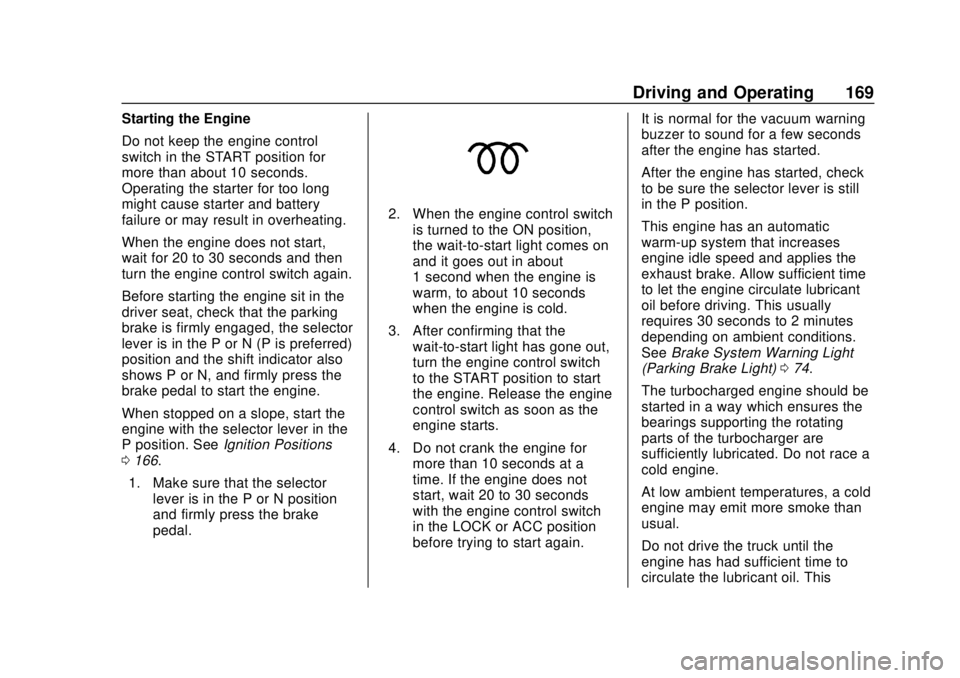
the wait-to-start light comes on
and it goes out in about
1 second when the engine is
warm, to about 10 seconds
when the engine is cold.
3. After confirming that the wait-to-start light has gone out,
turn the engine control switch
to the START position to start
the engine. Release the engine
control switch as soon as the
engine starts.
4. Do not crank the engine for more than 10 seconds at a
time. If the engine does not
start, wait 20 to 30 seconds
with the engine control switch
in the LOCK or ACC position
before trying to start again. It is normal for the vacuum warning
buzzer to sound for a few seconds
after the engine has started.
After the engine has started, check
to be sure the selector lever is still
in the P position.
This engine has an automatic
warm-up system that increases
engine idle speed and applies the
exhaust brake. Allow sufficient time
to let the engine circulate lubricant
oil before driving. This usually
requires 30 seconds to 2 minutes
depending on ambient conditions.
See
Brake System Warning Light
(Parking Brake Light) 074.
The turbocharged engine should be
started in a way which ensures the
bearings supporting the rotating
parts of the turbocharger are
sufficiently lubricated. Do not race a
cold engine.
At low ambient temperatures, a cold
engine may emit more smoke than
usual.
Do not drive the truck until the
engine has had sufficient time to
circulate the lubricant oil. This
Page 174 of 382

Chevrolet Low Cab Forward 5.2L Diesel Engine 4500/5500 Series (GMNA-
Localizing-U.S.-12407814) - 2019 - crc - 12/13/17
Driving and Operating 173
The engine block and oil pan
heaters are designed to warm the
block and oil pan areas that will let
the engine run faster. To use the
heaters:1. On single cab vehicles, tilt the cab.
2. Unwrap the electrical cord and remove the protective cap.
3. Plug the cord into any three-prong 110 volt outlet
(normal household current).
It may require several hours to
sufficiently heat the engine.
Outside temperature, oil
viscosity, etc., will affect how
long the block and oil pan
heater should remain plugged
in. Contact your dealer for the
conditions in your area.
4. After using the heater(s), be sure to restore the cord
properly, to help keep it away
from moving engine parts. If the cord is too short, use a heavy
duty, three-prong extension cord. Do
not use an extension cord such as
you would use for a lamp, because
the cord may overheat.
The engine should go through a
warm-up period to warm up the
engine oil before placing engine
under load. This will ensure proper
lubrication of the engine. See
Cab
Tilting 0243.
Engine Alarm and
Automatic Shutdown
If the system senses any of the
following conditions: high engine
temperature, low engine oil pressure
or low engine coolant, the
corresponding warning light and
engine alarm (shutdown) warning
light will come on. If the engine
alarm (shutdown) warning light
comes on, you will also hear a tone
alarm.
If your vehicle has the engine
shutdown feature, your engine will
shut down in 30 seconds.
Pull safely off the road and shut off
the engine. Do not start it until the
cause of the problem is known, and
the problem is fixed. However, if the
engine shuts down when you are
still in traffic, you can restart the
engine and get another 30 seconds
of operation. Do this only if you
have to, since there is a problem
that can harm the engine if it is not
fixed. See Engine Shutdown
Warning Light 080.
Page 176 of 382
Chevrolet Low Cab Forward 5.2L Diesel Engine 4500/5500 Series (GMNA-
Localizing-U.S.-12407814) - 2019 - crc - 12/13/17
Driving and Operating 175
4. Press the cruise control mainswitch to set it to ON. At this
time, the operation indicating
light will turn to green.
5. Turn and hold the cruise control set switch in the SET
position. After approximately
3 seconds the cruise control
set indicator light will begin to
flash slowly and the engine idle
will increase to 1,200 r/min.
Canceling High Idle Mode
Any of the following actions will
cancel high idle mode.
. The cruise control main switch is
set to OFF.
. The brake pedal is pressed.
. The parking brake is released.
. The selector lever is moved from
P (Park) or N (Neutral) position.
. The accelerator pedal is
pressed, accelerating the engine
beyond the engine speed
threshold. The cruise set indicator light will
stop flashing and the engine speed
will return to normal.
Engine Checks Before
Operating
Checks Before Operating
Allow the engine to warm up before
placing the engine under heavy load
driving. While the engine is warming
up under light load, the following
checks should be made:
1. Observe the red engine oil pressure warning light. The
light should go out when the
engine is running. If it stays on,
shut the engine off and find the
cause.
2. Look at the engine coolant temperature gauge. If the
gauge reaches the H (HOT)
area, stop the engine and find
the cause of the overheating.
3. Check that the battery warning light has gone out. The light
should go off and stay off at
normal idle speeds. If the light does not go out or comes on
during normal operation, have
the charging system checked.
4. Check that the brake low vacuum warning light is out
and that the vacuum buzzer is
not sounding. It is normal for
the warning buzzer to sound
for a few seconds after the
engine starts. If the light and
buzzer remain on, do not drive
the vehicle until the cause has
been found and corrected.
5. Look at the brake system warning light. It should be out
when the parking brake is
released and the engine is
running. If it stays on, it could
mean that the brake fluid level
is low. Check the brake fluid
reservoir. This condition must
be corrected before moving the
vehicle.
Page 177 of 382

Chevrolet Low Cab Forward 5.2L Diesel Engine 4500/5500 Series (GMNA-
Localizing-U.S.-12407814) - 2019 - crc - 12/13/17
176 Driving and Operating
{Warning
To reduce the chance of personal
injury and/or vehicle damage due
to engine overheating, never
leave the engine idling without an
alert driver present. If the engine
should overheat, as indicated by
the engine coolant temperature
gauge, immediate action is
required to correct the condition.
Continued operation of the
engine, even for a short time, may
result in a fire.
Do not engage the exhaust brake
while the engine is idling as this
may cause engine overheating.
You and others could be seriously
injured.
Avoid Unnecessary Idling of the
Diesel Engine
If the diesel engine idles too long,
the engine coolant temperature will
fall below the operating range. Low engine operating temperature
causes several conditions that are
harmful to engine operation and life.
Incomplete combustion of fuel in an
engine that is not fully warmed-up
causes crankcase dilution and
forms lacquer and gummy deposits
on valves, pistons, and rings. It also
causes rapid accumulation of
sludge within the engine.
Parking over Things
That Burn
{Warning
Exhaust parts and gases become
very hot when the DPF is being
regenerated.
Parking over flammable items
could allow them to touch hot
exhaust parts under your vehicle
and cause them to ignite. Do not
park over papers, leaves, grass
or other things that can burn. You
and others could be seriously
injured.Keep Flammable Material Away
from the Vehicle
The exhaust pipe is extremely hot
immediately after vehicle operation.
Before parking, make sure the area
is free of flammable material (for
example, grass, waste paper, oil or
old tires). Take particular care when
parking in a garage.
Use caution concerning exhaust
gases while the engine is idling. Be
particularly careful when the power
take-off (PTO) is operating (if your
vehicle is equipped with a PTO) or
the DPF is regenerating while the
engine is idling. See
Diesel
Particulate Filter 0180.
{Warning
It is not recommended that this
vehicle be parked, idled or
operated over combustible
materials such as grass or
leaves. They could touch the hot
exhaust system and start a fire.
This is particularly important if the
(Continued)
Page 180 of 382

Chevrolet Low Cab Forward 5.2L Diesel Engine 4500/5500 Series (GMNA-
Localizing-U.S.-12407814) - 2019 - crc - 12/13/17
Driving and Operating 179
Warning (Continued)
.Set the air selector lever to
the fresh air position.
. Set the fan speed control
knob to the maximum speed
position.
. Keep the exhaust tailpipe
area clear of snow and
other material to help
reduce the buildup of
exhaust gases under the
vehicle.
This is particularly important when
parked in blizzard conditions. You
and others could be seriously
injured.
See Climate Control Systems 0131
and Maintenance Schedule 0327.
Running the Vehicle
While Parked
Caution
To reduce the chance of personal
injury and/or vehicle damage due
to engine overheating, never
leave the engine idling without an
alert driver present. If the engine
should overheat, as indicated by
the engine coolant temperature
gauge, immediate action is
required to correct the condition.
Continued operation of the
engine, even for a short time, may
result in a fire. Do not engage the
exhaust brake while the engine is
idling as this may cause engine
overheating. Avoid Unnecessary Idling of the
Diesel Engine
If the engine idles too long, the
engine coolant temperature will fall
below the operating range. Low
engine operating temperature
causes several conditions that are
harmful to engine operation and life.
Incomplete combustion of fuel in an
engine that is not fully warmed-up
causes crankcase dilution and
forms lacquer and gummy deposits
on valves, pistons, and rings. It also
causes rapid accumulation of
sludge within the engine.
Page 208 of 382

Chevrolet Low Cab Forward 5.2L Diesel Engine 4500/5500 Series (GMNA-
Localizing-U.S.-12407814) - 2019 - crc - 12/13/17
Driving and Operating 207
Warning (Continued)
When you move the selector lever
into D, 2, 1 or R, creep will cause
the vehicle to move.
When pulling away from a
standstill, you must control the
speed using only the accelerator
pedal. Operate the accelerator
pedal carefully.
Do not operate the selector lever
while pressing the accelerator
pedal. The vehicle may make a
sudden start, possibly causing an
accident.
You and others could be seriously
injured.
When pulling away, visually check
the position of the selector lever.
If you always press the push button
while operating the selector lever,
the lever may occasionally move to
the other gear position against your
intentions. Practice operating the selector lever
between the N and D without
pressing the push button.
Do not operate the selector lever
while pressing the accelerator
pedal. Doing so is dangerous
because the vehicle would
suddenly move.
Do not operate the automatic
transmission at or near stall
condition for more than
five seconds. Stall condition is when
the transmission is in one of the
driving ranges, the engine is running
at high speed, but the drive wheels
are unable to move. This condition
might occur if the vehicle is stuck in
deep sand or is pushing against a
fixed barrier. Operating the
transmission at stall condition will
result in overheating and damage.
Do not hold your vehicle on an
upgrade with the accelerator pedal.
Doing so will result in automatic
transmission overheating and
damage. Use the parking brake or
foot brake to hold the vehicle on an
upgrade.Even if you plan to move only a
short distance, sit in the correct
driving position and make sure you
can firmly press the brake and
accelerator pedals.
When you reverse, you twist to look
rearward so pedal operation
becomes difficult. Firmly press the
brake pedal. Also, practice returning
the selector lever immediately to the
N position after reversing. When
pulling away, visually check the
selector lever position and the shift
indicator.
When the vehicle is stopped, do not
keep pressing the accelerator pedal
with the selector lever in a forward
gear or R position while pressing
the brake pedal. Doing so may
cause a breakdown.
Sit in the correct driving position,
and use your right foot to operate
the brake and accelerator pedals.
To avoid accidentally pressing the
wrong pedal, check the pedal
positions and practice putting your
foot on the desired pedal.
Page 210 of 382

Chevrolet Low Cab Forward 5.2L Diesel Engine 4500/5500 Series (GMNA-
Localizing-U.S.-12407814) - 2019 - crc - 12/13/17
Driving and Operating 209
You can easily accelerate to the
required speed when overtaking
other vehicles or when joining traffic
on a highway. In order to maintain
speed when driving on an uphill
road, as you gradually press the
accelerator pedal the engine may
automatically shift down in
accordance to the current speed
(shifts to a lower speed gear),
increasing the engine speed and
increasing vehicle speed.Driving Uphill or Downhill
Uphill driving:
With the selector lever in D, if you
press down on the accelerator
pedal, kickdown (change to a low
speed gear) may operate causing
the engine revolutions to suddenly
increase (increasing the speed).
Driving for a prolonged duration on
an uphill road with the selector lever
in D may cause the automatic
transmission fluid to overheat.
Drive with the overdrive off switch
ON to keep the engine revolutions
constant to enable smoother driving
with fewer changes in engine
revolutions.