flat tire CHEVROLET LOW CAB FORWARD 2019 User Guide
[x] Cancel search | Manufacturer: CHEVROLET, Model Year: 2019, Model line: LOW CAB FORWARD, Model: CHEVROLET LOW CAB FORWARD 2019Pages: 382, PDF Size: 5.95 MB
Page 297 of 382

Chevrolet Low Cab Forward 5.2L Diesel Engine 4500/5500 Series (GMNA-
Localizing-U.S.-12407814) - 2019 - crc - 12/13/17
296 Vehicle Care
rims, refer to the“Tire and Rim
Association Inc. Yearbook”, or your
tire dealer.
Tire Inflation
{Warning
To reduce the risk of loss of
vehicle control and personal
injury:
Tires must be properly inflated,
and your vehicle must not be
overloaded (see the information
on Information on Loading the
Vehicle 058 and "Tire Load and
Inflation Table" under Tire
Pressure 0307).
Be sure to keep tires properly
inflated. A tire that is run while
seriously underinflated may
overheat to the point where the
tire may lose air suddenly and/or
catch fire, possibly resulting in
personal injury and/or property
damage. See
“Tire Load and Inflation Table”
under Tire Pressure 0307.
In no case should the front or rear
tire load exceed the maximum
recommended gross axle weight
rating (front GAWR or rear GAWR).
The efficiency of the vehicle will be
upset if air pressure in the tires are
not equal. Balanced inflation results
when the tires on the same axle
carry the same air pressure.
A difference in pressure between
the front and rear tires may be
permissible within certain limitations,
however, there should not be a
difference in pressures between the
right and left tires on the same axle.
Always use a truck tire pressure
gauge (a pocket-type gauge is not
advised) when checking inflation
pressures. Visual inspection of tires
for inflation pressures is not enough,
especially in the case of radial tires.
Underinflated radial tires may look
similar to correctly inflated radial
tires. If the inflation pressure on a
tire is found to be low frequently,
have your dealer correct the cause. Be sure to install the tire inflation
valve caps to prevent dirt and
moisture from getting into the valve
core, which could cause air leakage.
An underinflated tire in a dual wheel
assembly is harder to notice than
one in a single wheel assembly. The
properly inflated dual tire carries its
own load plus that of the
underinflated tire. Both tires can
overheat, which may result in
property damage and/or personal
injury (see previous WARNING).
Tires Used or Stored for a Long
Period of Time
Tires are a rubber product and
degrade over time, even if they are
not being used. If any of your tires is
5 to 7 years old or more, please
have them inspected for safe
driving. For further information,
please check with the tire
manufacturer.
Dual Tire Operation
The outer tire of a pair on dual
wheel installations generally wears
faster than the inner tire. If this
Page 298 of 382

Chevrolet Low Cab Forward 5.2L Diesel Engine 4500/5500 Series (GMNA-
Localizing-U.S.-12407814) - 2019 - crc - 12/13/17
Vehicle Care 297
occurs, reverse the position of the
tires to equalize wear and get better
tire life.
In addition, when trucks are driven
continuously on high-crown roads,
an increase in air pressure of
35 kPa (5 psi) in the outer tire of a
dual tire operation will prolong outer
tire life. Be sure not to exceed the
inflation pressure limits shown on
the“VIN, Weight Rating, and
Greenhouse Gas (GHG) Emissions
Plate.” SeeVehicle Identification
Number (VIN) 0353.
Wheel and Tire Balancing
Proper tire balancing provides the
best riding comfort and helps to
reduce tire tread wear.
Out-of-balance tires can cause
annoying vehicle vibration and
uneven tire wear, such as cupping
and flat spots. See your authorized
dealer for wheel balancing.
Front End Alignment
Proper front end alignment improves
tire tread mileage. Your vehicle's
front end suspension parts should
be inspected often and aligned when needed. (See the
Maintenance Schedule for more
information.) Improper alignment will
not cause the vehicle to vibrate;
however, improper toe-in alignment
will cause front tires to roll at an
angle that will result in faster tire
wear. Incorrect caster or camber
alignment will cause your front tires
to wear unevenly, and may cause
the vehicle to "pull" to the left or
right.
Tire Traction
A decrease in driving, cornering and
braking traction occurs when water,
snow, ice, gravel or other material is
on the road surface. Driving
practices and vehicle speed should
be adjusted to the road conditions.
When driving on wet or slushy
roads, it is possible for a wedge of
water to build up between the tire
and road surface. This is known as
hydroplaning, and may cause partial
or complete loss of traction, vehicle
control and stopping ability; this
condition is also more likely with
worn tires.
To reduce the chance of traction
loss, follow these tips:
.
Slow down during rainstorms or
when roads are slushy.
. Slow down if the road has
standing water or puddles.
. Replace tires when front tread
depth is 3.2 mm (4/32 in.) and
rear tread depth is 1.6 mm
(2/32 in.).
. Keep tires properly inflated.
Tire Replacement
Recommendations
{Warning
Do not mix different construction
types of tires on your vehicle such
as radial, bias and bias-belted
tires except in emergencies,
because vehicle handling could
be affected and may result in loss
of vehicle control, or personal
injury or death. (Continued)
Page 302 of 382
Chevrolet Low Cab Forward 5.2L Diesel Engine 4500/5500 Series (GMNA-
Localizing-U.S.-12407814) - 2019 - crc - 12/13/17
Vehicle Care 301
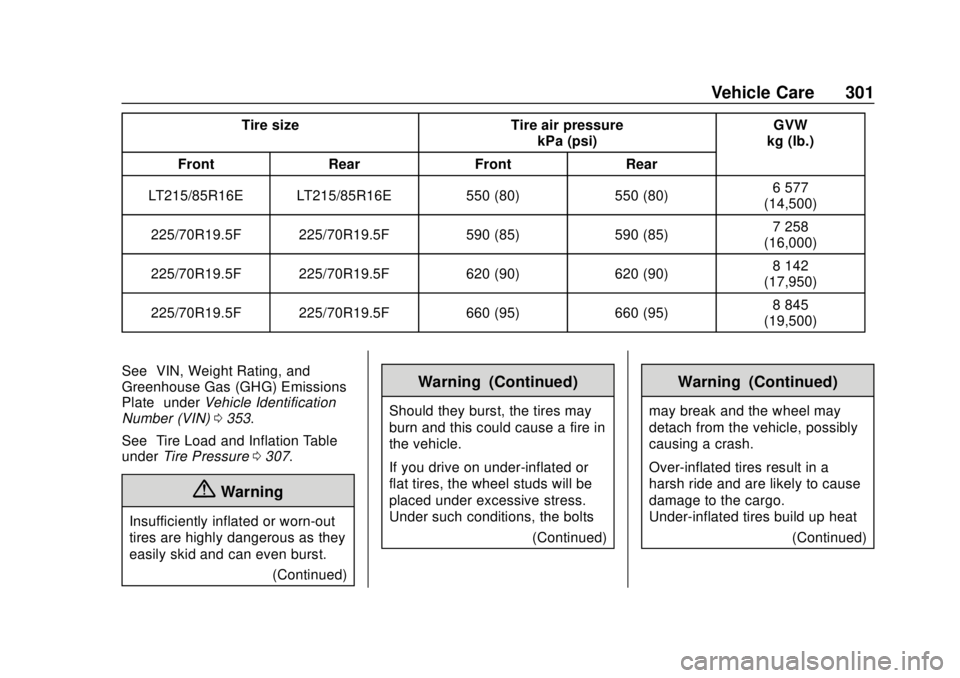
Tire sizeTire air pressure
kPa (psi) GVW
kg (lb.)
Front RearFront Rear
LT215/85R16E LT215/85R16E 550 (80)550 (80) 6 577
(14,500)
225/70R19.5F 225/70R19.5F 590 (85)590 (85) 7 258
(16,000)
225/70R19.5F 225/70R19.5F 620 (90)620 (90) 8 142
(17,950)
225/70R19.5F 225/70R19.5F 660 (95)660 (95) 8 845
(19,500)
See “VIN, Weight Rating, and
Greenhouse Gas (GHG) Emissions
Plate” underVehicle Identification
Number (VIN) 0353.
See “Tire Load and Inflation Table”
under Tire Pressure 0307.
{Warning
Insufficiently inflated or worn-out
tires are highly dangerous as they
easily skid and can even burst.
(Continued)
Warning (Continued)
Should they burst, the tires may
burn and this could cause a fire in
the vehicle.
If you drive on under-inflated or
flat tires, the wheel studs will be
placed under excessive stress.
Under such conditions, the bolts
(Continued)
Warning (Continued)
may break and the wheel may
detach from the vehicle, possibly
causing a crash.
Over-inflated tires result in a
harsh ride and are likely to cause
damage to the cargo.
Under-inflated tires build up heat(Continued)
Page 303 of 382
Chevrolet Low Cab Forward 5.2L Diesel Engine 4500/5500 Series (GMNA-
Localizing-U.S.-12407814) - 2019 - crc - 12/13/17
302 Vehicle Care
Warning (Continued)
and could burst. Always keep the
tires of your vehicle adjusted at
the standard air pressures.
You and others could be seriously
injured.
There should not be a difference in
air pressure between the inside and
outside
tires on a dual-tire wheel.
It is not easy to visually identify an
under-inflated dual-wheel tire or low
aspect ratio tire (aspect ratio at
70%). Always use an appropriate
tire air pressure gauge to check the
air pressure of any tire.
If your vehicle is equipped with
aluminum wheels, use an extension
attached to the inner tire valve
together with a standard tire air
pressure gauge or use a special air
pressure gauge when checking the
air pressure of a dual-wheel's
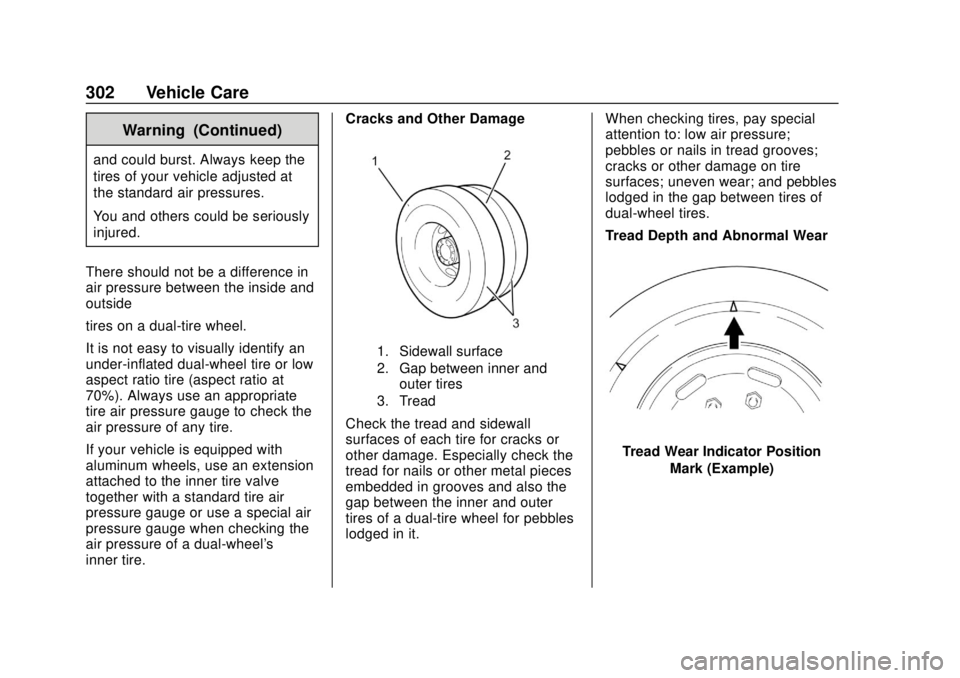
inner tire. Cracks and Other Damage
1. Sidewall surface
2. Gap between inner and
outer tires
3. Tread
Check the tread and sidewall
surfaces of each tire for cracks or
other damage. Especially check the
tread for nails or other metal pieces
embedded in grooves and also the
gap between the inner and outer
tires of a dual-tire wheel for pebbles
lodged in it. When checking tires, pay special
attention to: low air pressure;
pebbles or nails in tread grooves;
cracks or other damage on tire
surfaces; uneven wear; and pebbles
lodged in the gap between tires of
dual-wheel tires.
Tread Depth and Abnormal Wear
Tread Wear Indicator Position
Mark (Example)
Page 305 of 382

Chevrolet Low Cab Forward 5.2L Diesel Engine 4500/5500 Series (GMNA-
Localizing-U.S.-12407814) - 2019 - crc - 12/13/17
304 Vehicle Care
Damaged Tires
{Danger
It is dangerous to mount the
wrong size tire on a wheel. If you
do so, the tire/wheel can explode
as air is being added. This
explosion may result in severe
personal injury or death. To learn
which wheels and tires are
correct, look at the "VIN, Weight
Rating, and Greenhouse Gas
(GHG) Emissions Plate" on the
left side rear pillar panel below
the striker (single cab) or on the
left center pillar panel beside the
shoulder seat belt anchor (crew
cab). Wheel size is also stamped
on the side of each wheel.
To help avoid personal injury and
property damage if a wheel must
be changed, seek expert tire
services if you can. If you must
remove the wheel without any
such help, do the following:(Continued)
Danger (Continued)
.If the tire looks as if it may
be underinflated, stand to
the side and check whether
the wheel assembly
appears normal by
comparing it to another
wheel assembly on the
vehicle.
. Let the air out of the tire by
taking out the valve core.
If you have a way to put air
back in a tire, note that it is
good safety practice to let
the air out of both tires of a
dual assembly before taking
off the damaged tire and rim
assembly from the vehicle.
After letting out the air, take
off the tire and rim assembly
and install a spare tire and
rim assembly.
If your vehicle is equipped
with a differential lock
system or limited slip
differential (LSD), it might
(Continued)
Danger (Continued)
start moving when the
engine power is transmitted
to the rear axle even when
one of the wheels on the
axle is raised clear of the
ground. Do not start the
engine with any rear wheel
in contact with the ground.
If you are not fully
experienced on the
procedures to follow, and/or
are not equipped with the
proper tools and equipment,
again, do not attempt to
raise the vehicle, or remove
or install the tire and wheel
assembly—seek expert tire
services.
. Do not put air back in a tire
that has been run flat, or is
seriously low on air, without
first having the tire taken off
the wheel and the tire
checked for damage.
(Continued)
Page 308 of 382

Chevrolet Low Cab Forward 5.2L Diesel Engine 4500/5500 Series (GMNA-
Localizing-U.S.-12407814) - 2019 - crc - 12/13/17
Vehicle Care 307
Tire Pressure
Tire Load and Inflation Table
Tire Load and Inflation Table
TIRES FOR VEHICLES IN HIGHWAY SERVICE
TIRE LOAD LIMITS AT VARIOUS COLD INFLATION PRESSURES
Tire Size Designation Cold Inflation Pressure (psi) 50 55 60 65 70 75 80 85 90 95
LT215/85R16E Dual Single(lbs) 2470
2680
225/70R19.5F Dual Single(lbs) 3115
33153245
34503415
3640
See Wheels and Tires 0295.
Tire Rotation
{Warning
Be sure to check the wheel studs,
wheel nuts and disc wheel for any
abnormality whenever the disc
wheel is removed.
(Continued)
Warning (Continued)
If you find any abnormal condition
on the wheel studs, wheel nuts or
disc wheel, do not continue to use
the wheel. Contact the nearest
dealer as soon as possible
Tires at different locations wear
differently. For uniform tire wear and
longer tire life, you should rotate the
tires on your vehicle regularly. Make sure to use tires of the same type
on the same axle. If you install tires
of different types on the same axle,
the vehicle may drift right or left
when you apply the brakes.
New tires are more likely to build up
heat and wear faster than old tires,
so they should be installed on the
front axle where the load is smaller.
If there is a difference in diameter
between the inner and outer tires of
a dual-tire wheel, install the smaller
diameter tire inside.
Page 311 of 382

Chevrolet Low Cab Forward 5.2L Diesel Engine 4500/5500 Series (GMNA-
Localizing-U.S.-12407814) - 2019 - crc - 12/13/17
310 Vehicle Care
3. Next, tighten the outer wheelnuts to the specified torque.
{Warning
If you find any abnormal
conditions with the wheel nuts
such as frequent loosening of
retightened nuts, have your
vehicle checked or serviced at the
nearest dealer as soon as
possible.
Fully engage the wheel wrench on a
wheel nut in order to tighten the nut
to the specified torque. However, do
not use a pipe as a handle
extension or your foot to apply force
on the wrench. This would tighten
the nut more than required and
might damage components.
Both under-tightening and
over-tightening of wheel nuts may
cause broken wheel studs or
cracked disc wheels and could lead
to wheel detachment. Adhere to the
specified tightening torques. When replacing a tire with a new
one, use only a tire of the same
type and size as the replaced tire;
otherwise, driving safety could be
affected. Avoid mixed use of
different types or different size tires
at all costs.
If a Tire Goes Flat
When the tire goes flat while driving,
ease off the accelerator pedal, avoid
hard braking, hold on to the steering
wheel firmly, and stop the vehicle.
The tire should be changed in a
safe, open location to prevent
obstructing other vehicles or
pedestrians.
{Warning
If you continue to drive on a flat
tire, undue force will be applied to
the wheel studs, possibly causing
the studs to break and the wheel
to come off. You and others could
be seriously injured.
See “Tire Replacement
Recommendations” underWheels
and Tires 0295.
Page 340 of 382

Chevrolet Low Cab Forward 5.2L Diesel Engine 4500/5500 Series (GMNA-
Localizing-U.S.-12407814) - 2019 - crc - 12/13/17
Service and Maintenance 339
33. Leaf Spring U-bolt Torque :
Tighten the U-Bolt nuts to the
specified torque after the first
1 040 km (650 miles), thereafter
every 16 000 km (10,000 miles).Model Leaf spring U-bolt nut tightening torque
Front Rear
4500HD 127 Y
(94 lb·ft) 177
Y
(131 lb·ft)
4500XD 196 Y
(145lb·ft) 177
Y
(131 lb·ft)
5500HD, 5500XD 196
Y
(145lb·ft) 284
Y
(209 lb·ft)
34. Wheel Nut Torque : Check tires
for excessive or abnormal wear,
or damage. Also check tire inflation
pressures and adjust.
Be sure wheels are not bent or
cracked and that wheel nuts have
been tightened to the specified
torque after the first 1,040 km
(650 miles) and then every
10 400 km (6,500 miles). Note that
there are left and right hand
threads. Wheel nut tightening torque
500Y(362 lb·ft)
35. King Pin : Lubricate the grease
fitting on the king pins every
12 months or 16 000 km
(10,000 miles) whichever occurs
first.
36. Wheel Hub Bearing Grease :
Clean and repack front wheel
bearings every 24 months or
48 000 km (30,000 miles) whichever
occurs first.
37. Air Conditioner Blower
Filter : The air conditioner blower
filter should be removed and
cleaned once a month.
38. Exhaust Injector : Clean the
exhaust injector every 176,000 km
(110,000 miles).
39. DEF Supply Pump Filter
Element : Replace the DEF supply
pump filter element every
192 000 km (120,000 miles) or
24 months whichever occurs first. 40. Starter :
The color displayed by
the starter indicator light will change
from green to amber when the
number of times remaining is 0 or
below and the screen is selected.
When the indicator light (amber)
comes on, have the vehicle
inspected/serviced at the nearest
dealer.
41. Wiper Blades : Inspect wiper
blades for wear, cracking,
or contamination. Clean the
windshield and wiper blades,
if contaminated, replace wiper
blades that are worn or damaged,
or at least once a year. See Wiper
Blade Replacement 0275.
Page 376 of 382

Chevrolet Low Cab Forward 5.2L Diesel Engine 4500/5500 Series (GMNA-
Localizing-U.S.-12407814) - 2019 - crc - 12/13/17
Index 375
DevicesAuxiliary . . . . . . . . . . . . . . . . . . . . . . .117
Diesel Engine Engine Alarm andAutomatic Shutdown . . . . . . . . 173
Diesel Exhaust Fluid . . . . . . . . 24, 189
Diesel Exhaust Fluid (DEF) Gauge . . . . . . . . . . . . . . . . . . . . . . . . . 72
Diesel Exhaust Fluid (DEF) Warning Light . . . . . . . . . . . . . . . . . . 80
Diesel Particulate Filter . . . . . . . . . 180
Distracted Driving . . . . . . . . . . . . . . . 139
Dome Lamps . . . . . . . . . . . . . . . . . . . . 96
Door
Locks . . . . . . . . . . . . . . . . . . . . . . . . . . . 30
Power Locks . . . . . . . . . . . . . . . . . . . . 33
Drive Belt Routing, Engine . . . . . . 363
Driver Behavior . . . . . . . . . . . . . . . . . 139
Driver Information Center (DIC) . . . . . . . . . . . . . . . . . . . 82
Driving
Emergencies . . . . . . . . . . . . 154, 164
For Better Fuel Economy . . . . . . . 24
Hill and Mountain Roads . . . . . . 150
If the Vehicle is Stuck . . . . . . . . . 153
Wet Roads . . . . . . . . . . . . . . . . . . . 149
Winter . . . . . . . . . . . . . . . . . . . . . . . . 151E
Electrical Equipment,Add-On . . . . . . . . . . . . . . . . . . . . . . . 236
Electrical System Overload . . . . . . . . . . . . . . . . . . . . . 287
Emergencies . . . . . . . . . . . . . . 154, 164
Engine Air Cleaner/Filter . . . . . . . . . . . . . 253
Alarm and AutomaticShutdown . . . . . . . . . . . . . . . . . . . 173
Check Light (Malfunction Indicator) . . . . . . . . . . . . . . . . . . . . . . 73
Checks Before Operating . . . . . 175
Compartment Overview . . . . . . . 244
Coolant . . . . . . . . . . . . . . . . . . . . . . . 253
Coolant Temperature Gauge . . . . 72
Cover . . . . . . . . . . . . . . . . . . . . . . . . . 245
Drive Belt Routing . . . . . . . . . . . . 363
Exhaust . . . . . . . . . . . . . . . . . . . . . . 177
Heater . . . . . . . . . . . . . . . . . . . . . . . . 172
High Idle System . . . . . . . . . . . . . 174
Oil Pressure Light . . . . . . . . . . . . . . 79
Overheating . . . . . . . . . . . . . . . . . . 259
Reduced Power Light . . . . . . . . . . . 81
Running While Parked . . . . . . . . 179
Shutdown Warning Light . . . . . . . . 80
Engine Oil Level Indicator Light . . . . . . . . . . . . 79 Engines
Diesel Fuel . . . . . . . . . . . . . . . . . . . 227
Exhaust Brake . . . . . . . . . . . . . . . . . . 222
Exhaust Brake Light . . . . . . . . . . . . . 77
Exhaust Fluid Diesel . . . . . . . . . . . . . . . . . . . . . . . . 189
Extender, Seat Belt . . . . . . . . . . . . . . 49
Exterior Lamp Controls . . . . . . . . . . 92
F
Filter . . . . . . . . . . . . . . . . . . . . . . . . . . . . 180 Fuel . . . . . . . . . . . . . . . . . . . . . . . . . . 270
Filter, Engine Air Cleaner . . . . . . . . . . . 253
Fixed Mast Antenna . . . . . . . . . . . . 102
Flash-to-Pass . . . . . . . . . . . . . . . . . . . . 93
Flashers, Hazard Warning . . . . . . . 94
Flat Tire . . . . . . . . . . . . . . . . . . . . . . . . 310
Fluid Automatic Transmission . . . . . . 251
Brakes . . . . . . . . . . . . . . . . . . . . . . . . 268
Diesel Exhaust . . . . . . . . . . . . . . . . . 24
Power Steering . . . . . . . . . . . . . . . 262
Washer . . . . . . . . . . . . . . . . . . . . . . . 262
Frequency Statement Radio . . . . . . . . . . . . . . . . . . . . . . . . . 370
Front Seat Position Seats Adjustment . . . . . . . . . . . . . . . . . . . . . 38
Page 380 of 382

Chevrolet Low Cab Forward 5.2L Diesel Engine 4500/5500 Series (GMNA-
Localizing-U.S.-12407814) - 2019 - crc - 12/13/17
Index 379
Shift Lock Control FunctionCheck, Automatic
Transmission . . . . . . . . . . . . . . . . . . 274
Shopping Bag Hooks . . . . . . . . . . . . 57
Sidemarker Lamps . . . . . . . . . . . . . 284
Signals, Turn and Lane-Change . . . . . . . . . . . . . . . . . . 94
Specifications and Capacities . . . . . . . . . . . . . . . . . . . . . 357
Speedometer . . . . . . . . . . . . . . . . . . . . 70
Starting and Stopping the Vehicle . . . . . . . . . . . . . . . . . . . . . . . . 168
Steering . . . . . . . . . . . . . . . . . . . . . . . . 149 Fluid, Power . . . . . . . . . . . . . . . . . . 262
Wheel Adjustment . . . . . . . . . . . . . . 65
Stoplamps and Back-up Lamps
Bulb Replacement . . . . . . . . . . . . 286
Storage Rear . . . . . . . . . . . . . . . . . . . . . . . . . . . . 57
Storage Areas Glove Box . . . . . . . . . . . . . . . . . . . . . . 55
Information on Loading the
Vehicle . . . . . . . . . . . . . . . . . . . . . . . . 58
Instrument Panel . . . . . . . . . . . . . . . 55
Storage Compartments . . . . . . . . . . 54
Stuck Vehicle . . . . . . . . . . . . . . . . . . . 153 Sun Visors . . . . . . . . . . . . . . . . . . . . . . . 37
System
Noise Control . . . . . . . . . . . . . . . . . 272
T
Tachometer . . . . . . . . . . . . . . . . . . . . . . 71
TaillampsBulb Replacement . . . . . . . . . . . . 286
Temperature, Operating . . . . . . . . 171
Text Telephone (TTY) Users . . . . 365
Three-Point Seat Belt . . . . . . . . . . . . 45
Tires If a Tire Goes Flat . . . . . . . . . . . . 310
Pressure . . . . . . . . . . . . . . . . . . . . . . 307
Rotation . . . . . . . . . . . . . . . . . . . . . . 307
Tires and Wheels . . . . . . . . . . . . . . . 295
Towing Vehicle . . . . . . . . . . . . . . . . . . . . . . . 315
Trademarks and License Agreements . . . . . . . . . . . . . . . . . . . 129
Transmission
Automatic . . . . . . . . . . . . . . . . . . . . . 205
Fluid, Automatic . . . . . . . . . . . . . . 251
Overdrive Off, Automatic . . . . . . 215
Service Warning Light . . . . . . . . . . 77
Trip Odometer . . . . . . . . . . . . . . . . . . . 70 Turn and Lane-Change
Signals . . . . . . . . . . . . . . . . . . . . . . . . . 94
Turn Signal Bulb Replacement . . . . . . . . . . . . 286U
USB Port . . . . . . . . . . . . . . . . . . . . . . . 109
Using This Manual . . . . . . . . . . . . . . . . 3
V
VehicleControl . . . . . . . . . . . . . . . . . . . . . . . 139
Getting In and Out . . . . . . . . . . . . . . 29
Identification Number (VIN) . . . 353
Messages . . . . . . . . . . . . . . . . . . . . . . 86
Security . . . . . . . . . . . . . . . . . . . . . . . . 33
Service Soon Light . . . . . . . . . . . . . 74
Starting and Stopping . . . . . . . . . 168
Towing . . . . . . . . . . . . . . . . . . . . . . . . 315
Vehicle Care Tire Pressure . . . . . . . . . . . . . . . . . 307
Vehicle Data Recording and
Privacy . . . . . . . . . . . . . . . . . . . . . . . . 372
Ventilation, Air . . . . . . . . . . . . . . . . . . 134
Visors . . . . . . . . . . . . . . . . . . . . . . . . . . . 37