power steering CHEVROLET LOW CAB FORWARD 2019 User Guide
[x] Cancel search | Manufacturer: CHEVROLET, Model Year: 2019, Model line: LOW CAB FORWARD, Model: CHEVROLET LOW CAB FORWARD 2019Pages: 382, PDF Size: 5.95 MB
Page 152 of 382

Chevrolet Low Cab Forward 5.2L Diesel Engine 4500/5500 Series (GMNA-
Localizing-U.S.-12407814) - 2019 - crc - 12/13/17
Driving and Operating 151
.When going down on a steep
slope, avoid driving the vehicle
backward as much as possible.
Drive it forward slowly on the
down slope.
. Compared with forward
movement, the braking distance
of backward movement is longer,
and the steering response of
that is worse.
. If you must drive the vehicle
backward, drive it very carefully
and gradually by moving and
stopping repeatedly in order to
stop it any time.
Engine Brake : Engine brake is the
braking effect that occurs when you
release the accelerator pedal while
driving. The lower the gear, the
stronger the engine brake.
Exhaust Brake : The exhaust brake
is a system that closes the exhaust
pipe and uses the force of the
exhaust emissions to enhance the
effectiveness of engine brake. Overrunning :
An engine overrun is
an engine-speed increase that
causes the tachometer needle to
enter the red zone. It is dangerous
because it can cause engine failure.
Winter Driving
Recommendations for Driving
in Cold Regions
The following recommendations
apply to snowbound regions and to
mountainous regions, ski resorts
and other areas of extreme cold
and/or snowfall. Please follow them
also for reference in winter in other
regions.
For the sake of your vehicle, make
the winter preparations described in
the links below. Also have these
preparations made before driving to
a cold region.
See Engine Oil 0245.
See Engine Coolant 0253.
See Washer Fluid 0262.
See Battery - North America 0269.
When Ice Prevents You from
Putting Your Key in the Door
or Opening the Door
If you try to force the key into the
door, you could bend it. And if you
try to pull the door open with undue
force, the rubber seal around the
door could come unstuck or become
damaged. Use warm water to melt
the ice, then quickly wipe it away
and open the door.
If the wipers, electric door mirrors,
or power windows freeze up, also
use warm water to melt the ice and
then operate the system. Otherwise,
you could damage the mechanism
and drain the battery. After that,
wipe the water away.
Before Driving in Cold Regions
Getting In and Out of the Vehicle
The step can get icy in cold regions.
Be careful not to slip when getting in
and out of the vehicle.
Page 155 of 382

Chevrolet Low Cab Forward 5.2L Diesel Engine 4500/5500 Series (GMNA-
Localizing-U.S.-12407814) - 2019 - crc - 12/13/17
154 Driving and Operating
Caution (Continued)
conditions. Damage may result
from excessive wheel spinning,
including tire, transmission, and/
or rear axle malfunction.
If the vehicle gets stuck and it is
difficult to get out, immediately
stop driving and have the vehicle
towed.
If the vehicle gets stuck in sand,
mud, snow or ice, move the selector
lever from 2 to the R position. Apply
a light pressure to the accelerator
pedal while the transmission is in
gear. Remove your foot from the
accelerator and press the brake
pedal while shifting. Do not race the
engine. For best traction, avoid
spinning the wheels. When you
cannot avoid driving through deep
mud, using tire chains is an effective
way to avoid getting stuck.
When driving in sand or mud, avoid
hard braking, sudden acceleration,
and sharp turns of the steering wheel. Such actions could get the
vehicle stuck and make it difficult to
get out.
After driving through deep mud: any
mud stuck to the vehicle can harm
the steering, brakes and powertrain.
Wash the vehicle and remove all
mud and other debris.
The vehicle speed sensors are fitted
on the wheels. When removing mud
and other debris, take great care not
to damage the components.
Do not use a sharp implement to
remove mud. Sharp edges could
damage rubber parts.
Refer to
Antilock Brake System
(ABS) 0216 andExterior Care
0 317.
Emergencies
(Troubleshooting)
Troubleshooting
Performing regular inspections and
maintenance prevents damage. Be
sure to perform inspections and
maintenance at regular intervals.
Also, quickly rectify any fault in the vehicle (even a small fault) to
prevent it from becoming more
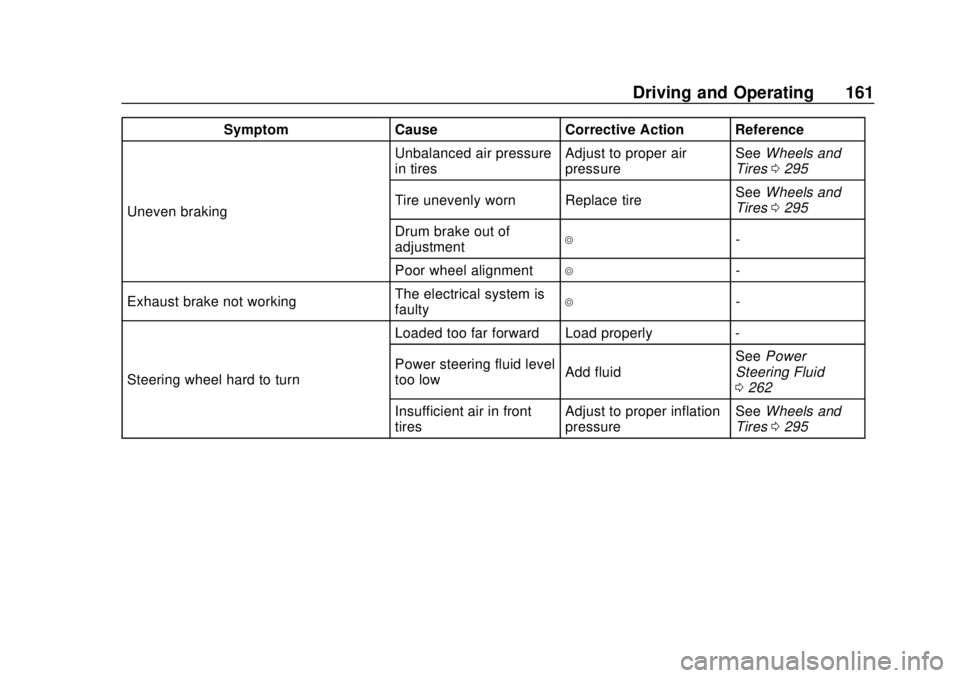
serious. If a symptom shown in the
following table occurs, perform
inspections and take corrective
action in accordance with the table.
If you are unable to perform a
repair, the corrective action shown
in the table does not eliminate a
symptom or you cannot locate a
fault, contact the nearest dealer.
Any item for which there is a
4in
the "Corrective action" column
requires repairs and adjustments.
Contact the nearest dealer.
Page 162 of 382
Chevrolet Low Cab Forward 5.2L Diesel Engine 4500/5500 Series (GMNA-
Localizing-U.S.-12407814) - 2019 - crc - 12/13/17
Driving and Operating 161
SymptomCauseCorrective Action Reference
Uneven braking Unbalanced air pressure
in tires
Adjust to proper air
pressureSee
Wheels and
Tires 0295
Tire unevenly worn Replace tire See
Wheels and
Tires 0295
Drum brake out of
adjustment
4-
Poor wheel alignment
4-
Exhaust brake not working The electrical system is
faulty
4-
Steering wheel hard to turn Loaded too far forward Load properly -
Power steering fluid level
too low
Add fluidSee
Power
Steering Fluid
0 262
Insufficient air in front
tires Adjust to proper inflation
pressureSee
Wheels and
Tires 0295
Page 165 of 382

Chevrolet Low Cab Forward 5.2L Diesel Engine 4500/5500 Series (GMNA-
Localizing-U.S.-12407814) - 2019 - crc - 12/13/17
164 Driving and Operating
Emergencies (Disabled
Vehicle)
When the Vehicle
Breaks Down
When the Vehicle Stops While
Driving
The brake booster will no longer
operate and brake effectiveness will
be reduced. If the engine cannot be
started, promptly have the vehicle
inspected and repaired.
If the engine stopped because the
vehicle ran out of fuel while driving,
refueling alone will not be enough to
restart the engine. Bleed the fuel
system after refueling the vehicle.
When the Fuel Tank is Empty
SeeRunning Out of Fuel 0233.
When the Engine Stalls and
Cannot Be Restarted
Move the selector lever to the "N"
position and push the vehicle to a
safe place.
{Warning
Vehicle operations will change, so
stop the vehicle in a safe place
with the following in mind.
The power steering system will
not work so the steering wheel
will be hard to turn. It will require
more strength than during normal
operation.
As the brake booster will no
longer be functional, brake
effectiveness will be greatly
reduced. Be sure to apply more
pressure than usual to the brake
pedal.
If the power assist steering
system goes out because the
engine has stopped or the assist
system has malfunctioned, the
vehicle can still be steered.
However, much greater effort is
needed, especially in sharp turns
or at low speeds.
You and others could be seriously
injured. When the Vehicle Breaks Down
During Driving
1. Use the hazard warning flasher any time to warn other drivers,
day or night, and pull the
vehicle immediately over to a
safe place that does not
impede traffic (shoulder). Place
triangle reflectors to alert other
traffic to the presence of your
vehicle.
2. If the vehicle can be exited safely, have the other
passengers get out and wait in
a safe place.
3. If the vehicle can be exited safely, walk to a safe place and
take appropriate measures by
using the closest
telephone, etc.
See Hazard Warning Flashers 094.
Page 169 of 382

Chevrolet Low Cab Forward 5.2L Diesel Engine 4500/5500 Series (GMNA-
Localizing-U.S.-12407814) - 2019 - crc - 12/13/17
168 Driving and Operating
4 START :On all engines, start is in
the position furthest clockwise. The
engine is started in this position.
Turn the key against spring
pressure to energize the starter.
When key is released, spring
pressure returns it to the ON
position. Release the key as soon
as the engine has started.
If the key cannot be turned from the
LOCK position to the ON position,
lightly move the steering wheel
clockwise and counterclockwise
while trying to turn the key.
Starting and Stopping the
Vehicle
Check around the Vehicle before
Starting the Engine
Proper care and operation will not
only extend the service life of your
vehicle but also improve fuel
economy.
Before pulling away, perform a
thorough safety check, making sure
there are no children or obstructions around the vehicle. Take off the
chocks after confirming that the
parking brake is securely applied.
Sit behind the wheel, adjust the seat
position, and buckle up the seat
belt. The passengers are also
required to buckle up the seat belts.
Adjust the positions of the steering
wheel and mirrors. Lock the doors.
Turn the power of the dome light or
accessories OFF before starting the
engine. See
Seat Position 038,
Seat Belts 043, Steering Wheel
Adjustment 065, and Mirrors033.
Keep the Floor Around the
Driver's Seat Clean and Tidy{Warning
It is extremely dangerous to have
empty cans, empty bottles or
other items rolling around on the
floor because they could get
trapped under the brake pedal
and prevent brake application.
For proper pedal operation, it is (Continued)
Warning (Continued)
also essential to lay floor mats
properly. Incorrectly installed floor
mats would hinder free movement
of the pedals.
Do not use the dashboard pocket
or the top of the dashboard as a
place to put items that could roll,
which could interfere with your
driving. You and others could be
seriously injured.
Choose Your Footwear Suitable
for Driving
{Warning
Choose footwear that ensures
proper operation of pedals when
driving the vehicle. Use of
footwear unsuitable for driving
may cause an accident.
Page 220 of 382

Chevrolet Low Cab Forward 5.2L Diesel Engine 4500/5500 Series (GMNA-
Localizing-U.S.-12407814) - 2019 - crc - 12/13/17
Driving and Operating 219
Warning (Continued)
‐When tire chains are used.
‐ When driving over road
joints or bumps such as
light reflectors on the road.
‐ When driving on a bumpy
road, stone-paved road or
track.
‐ When driving over an iron
plate or manhole lid.
ABS does not work for wheel skid
during a standing start,
acceleration and cornering which
do not involve braking. On a very
slippery icy road, tires may lose
grip and steering wheel operation
may not be able to control the
vehicle's direction, resulting in
very unstable driving. Always
drive the vehicle observing a safe
speed well matched with both
road surface and tire conditions,
and avoid sudden braking. (Continued)
Warning (Continued)
If powerful engine braking is
applied on a very slippery icy
road, the drive wheels may be
locked (the ABS then does not
work), resulting in loss of vehicle
control.
When ABS is activated, a slight
vibration (especially when the
road surface is different between
right and left wheels) and pulling
may be felt on the brake pedal
and steering wheel. In addition,
an operating sound is produced
from the ABS actuators. This
does not indicate any abnormal
condition. Stay calm and operate
the steering wheel properly.
Electronic Braking force
Distribution (EBD)
EBD is a function that uses the ABS
to distribute braking force ideally
between the front and rear wheels
in order to compensate for changes
in load conditions or any shift of the load due to acceleration or
deceleration, thus preventing
premature locking of the rear
wheels.
{Warning
If a problem should occur with the
EBD function, the ABS warning
light and the brake system
warning light will come on
simultaneously.
The rear wheels will lock more
easily if there is a problem with
the EBD function. Have it
checked and serviced at the
nearest dealer as soon as
possible. You and others could be
seriously injured.
When the EBD operates, the brake
pedal may push back slightly or you
may hear a sound similar to that
generated by the ABS when
operational. Neither of them
indicates any abnormal condition.
Page 240 of 382

Chevrolet Low Cab Forward 5.2L Diesel Engine 4500/5500 Series (GMNA-
Localizing-U.S.-12407814) - 2019 - crc - 12/13/17
Vehicle Care 239
Vehicle Care
General Information
General Information . . . . . . . . . . 240
California Proposition65 Warning . . . . . . . . . . . . . . . . . 240
California Perchlorate Materials Requirements . . . . . 240
Accessories and Modifications . . . . . . . . . . . . . . . . 240
Vehicle Checks
Doing Your OwnService Work . . . . . . . . . . . . . . . 241
Cab Tilting . . . . . . . . . . . . . . . . . . . . 243
Engine Compartment Overview . . . . . . . . . . . . . . . . . . . . 244
Engine Cover . . . . . . . . . . . . . . . . . 245
Engine Oil . . . . . . . . . . . . . . . . . . . . 245
Automatic Transmission Fluid . . . . . . . . . . . . . . . . . . . . . . . . 251
Engine Air Cleaner/Filter . . . . . . 253
Engine Coolant . . . . . . . . . . . . . . . 253
Engine Overheating . . . . . . . . . . 259
Power Steering Fluid . . . . . . . . . 262
Washer Fluid . . . . . . . . . . . . . . . . . 262
Brakes . . . . . . . . . . . . . . . . . . . . . . . 263
Brake Fluid . . . . . . . . . . . . . . . . . . . 268
Battery - North America . . . . . . 269 Fuel Filter . . . . . . . . . . . . . . . . . . . . 270
Rear Axle (Gear Oil Viscosity
Chart) . . . . . . . . . . . . . . . . . . . . . . . 271
Rear Axle (Oil Level Check) . . . . . . . . . . . . . . . . . . . . . . 272
Noise Control System . . . . . . . . 272
Automatic Transmission Shift Lock Control Function
Check . . . . . . . . . . . . . . . . . . . . . . . 274
Wiper Blade Replacement . . . . 275
Headlamp Aiming
Headlamp Aiming . . . . . . . . . . . . 277
Bulb Replacement
Bulb Replacement . . . . . . . . . . . . 277
Headlamps and Front Turn Signal . . . . . . . . . . . . . . . . . . . . . . . 280
Roofmarker Lamps . . . . . . . . . . . 284
Sidemarker Lamps (Including Turn Signal and Cornering
Lamps) . . . . . . . . . . . . . . . . . . . . . . 284
Taillamps, Turn Signal, Stoplamps, and Back-Up
Lamps . . . . . . . . . . . . . . . . . . . . . . 286
License Plate Lamp . . . . . . . . . . 286
Interior Lamps . . . . . . . . . . . . . . . . 287
Electrical System
Electrical System Overload . . . 287
Wheels and Tires
Wheels and Tires . . . . . . . . . . . . . 295
Tire Pressure . . . . . . . . . . . . . . . . . 307
Tire Rotation . . . . . . . . . . . . . . . . . 307
If a Tire Goes Flat . . . . . . . . . . . . 310
Jump Starting
Jump Starting - North America . . . . . . . . . . . . . . . . . . . . . 311
Towing the Vehicle
Towing the Vehicle . . . . . . . . . . . 315
Appearance Care
Exterior Care . . . . . . . . . . . . . . . . . 317
Interior Care . . . . . . . . . . . . . . . . . . 323
Page 263 of 382

Chevrolet Low Cab Forward 5.2L Diesel Engine 4500/5500 Series (GMNA-
Localizing-U.S.-12407814) - 2019 - crc - 12/13/17
262 Vehicle Care
Power Steering Fluid
The power steering fluid level must
be checked and it must be changed
according to the Maintenance
Schedule. SeeMaintenance
Schedule 0327.
When replenishing power steering
fluid or flushing the power steering
system, always use ATF
(Dexron
®-VI). Failure to use the
proper fluid may damage the power
steering system seals and hoses,
leading to fluid leakage.
Checking the Power Steering
Fluid Level
The fluid level is correct if it is
between the “MAX”and“MIN” lines
on the power steering fluid tank.
If the level is lower that the “MIN”
line, add fluid up to the “MAX”line.
The reserve tank is located at the
rear of the engine compartment on
the right. When you have finished
checking the fluid level, securely
reinstall the cap and cover.
{Warning
Before adding fluid, clean the
area around the cap and pour
fluid from a clean jug or filler.
Foreign matter getting in the tank
may cause power steering system
failure.
Do not mix the recommended
power steering fluid with fluids of
other brands. Due to chemical
reactions, any mixture of
differently branded fluids may
cause failure of the system.
You and others could be seriously
injured.
Washer Fluid
Windshield Washer Fluid
The windshield washer is equipped
on the windshield wiper arm.
Check the level of fluid in the
windshield washer fluid tank. In
addition, spray windshield washer
fluid and operate the windshield
wipers to check for any areas not
Page 265 of 382

Chevrolet Low Cab Forward 5.2L Diesel Engine 4500/5500 Series (GMNA-
Localizing-U.S.-12407814) - 2019 - crc - 12/13/17
264 Vehicle Care
Follow the recommendations for
brake checks in the Maintenance
Schedule.
GM replacement brake lining
material is recommended for this
vehicle to maintain the balance
between front and rear brake
performance. GM replacement
brake parts have been carefully
selected to provide the proper brake
balance for purposes of both
stopping distance and controllability
over the full range of operating
conditions. Installation of front or
rear brake lining material with
performance different from that of
the replacement parts
recommended for this vehicle can
change the intended brake balance
of this vehicle.
Checking the Brake Electric
Vacuum Pump (4500HD/
4500XD Series)
1. Turn the engine control switchto the "ON" position (do not
start the engine), and press the
brake pedal several times. 2. Check for the noisy sound of
the electric vacuum pump
inside the instrument panel at
the same time as vacuum
warning buzzer sound, and
check that the brake low
vacuum warning light
comes on.
3. Then, start the engine. The main vacuum pump driven by
the engine will start running.
If the electric vacuum pump
operation (noisy sound) and
the vacuum warning buzzer
stop, and the brake low
vacuum warning light goes off
thereafter, the operation is
normal.
4. If you cannot hear the noisy sound or the noisy sound stays
on all the time, have the
vehicle inspected by the
nearest dealer immediately.Hydraulic Brake Booster (HBB)
The 5500HD, 5500XD models are
equipped with an HBB system. HBB
is a brake booster device that utilizes hydraulic pressure from the
HBB pump integral with the power
steering pump.
If the brake booster warning light
comes on or a warning buzzer
continues to sound, there may be a
problem with the HBB.
If this warning light comes on while
driving, immediately stop your
vehicle at a safe place well clear of
traffic and promptly contact the
nearest dealer for inspection.
Hydraulic brake booster (HBB)
characteristics
In the 5500HD, 5500XD models, an
unusual sound from under the
instrument panel may be heard from
the hydraulic system while brakes
are used. It does not mean trouble.
It is not a sign of malfunction.
If you pump the brakes with the
engine off, a squeaking sound can
be heard. This comes from the
auxiliary accumulator. It is not a
malfunction. With the engine
running, a similar sound can be
heard during sudden braking.
Page 266 of 382
Chevrolet Low Cab Forward 5.2L Diesel Engine 4500/5500 Series (GMNA-
Localizing-U.S.-12407814) - 2019 - crc - 12/13/17
Vehicle Care 265
Another characteristic of the HBB
system is that the brake pedal may
be pressed easily to the floor with
the vehicle at a stop. This is not a
sign of malfunction.
When the engine is running, the
system automatically charges the
accumulator whenever pressure has
been reduced after braking. Auto
charge may be activated without
braking, depending on temperature
changes in the accumulator. During
auto charge, a hissing and clicking
sound can be heard. This is not a
malfunction.
With the engine running, a booming
sound can be heard during hard
braking. This comes from the
brake-fluid pump. It is not a
malfunction.
Applying continuous hard braking
for a long time will lead to
considerable temperature rise in the
HBB pump. Such overworking of the
brakes is best avoided.Vacuum or hydraulic power
assisted brakes
If the engine stops, do not pump the
brakes. The system is designed to
stop the vehicle with reserve power
assist if the brake pedal is held
down. This reserve is greatly
reduced each time you apply and
release the brakes. If, when you
turn the steering wheel during
braking, the vehicle does not turn,
release some pressure from the
brake pedal.
In a Vehicle Equipped with an
HBB, Do Not Keep the Brake
Pedal Pressed for an Extended
Period
Caution
Failure to follow the above
instruction will cause the oil inside
the HBB oil pump to get very hot.
This could damage the HBB tank
and deteriorate seals and also
could cause damage to the HBB
oil pump, HBB unit and/or HBB
(Continued)
Caution (Continued)
hosing. Eventual leakage of HBB
oil, sudden increase in brake
pedal resistance and fire could
unexpectedly result in a crash.
Hydraulic Brake Booster (HBB)
Fluid (5500HD/5500XD Series)
The HBB system has been
designed to use Dexron VI ATF
fluid. If any other fluid is used with
this system, rubber components
may be damaged, oil may leak and
the system may malfunction. It is
important to remember that the fluid
used in the hydro-booster is
completely different in
characteristics from the brake fluid
used in the master and wheel
cylinders.
If hydro-booster fluid and brake fluid
from the master cylinder are
mistakenly mixed together and
used, rubber components will
deteriorate as a result of insufficient
lubrication. Any resultant oil leakage
or system malfunction can in turn