tires CHEVROLET LOW CAB FORWARD 2019 User Guide
[x] Cancel search | Manufacturer: CHEVROLET, Model Year: 2019, Model line: LOW CAB FORWARD, Model: CHEVROLET LOW CAB FORWARD 2019Pages: 382, PDF Size: 5.95 MB
Page 177 of 382

Chevrolet Low Cab Forward 5.2L Diesel Engine 4500/5500 Series (GMNA-
Localizing-U.S.-12407814) - 2019 - crc - 12/13/17
176 Driving and Operating
{Warning
To reduce the chance of personal
injury and/or vehicle damage due
to engine overheating, never
leave the engine idling without an
alert driver present. If the engine
should overheat, as indicated by
the engine coolant temperature
gauge, immediate action is
required to correct the condition.
Continued operation of the
engine, even for a short time, may
result in a fire.
Do not engage the exhaust brake
while the engine is idling as this
may cause engine overheating.
You and others could be seriously
injured.
Avoid Unnecessary Idling of the
Diesel Engine
If the diesel engine idles too long,
the engine coolant temperature will
fall below the operating range. Low engine operating temperature
causes several conditions that are
harmful to engine operation and life.
Incomplete combustion of fuel in an
engine that is not fully warmed-up
causes crankcase dilution and
forms lacquer and gummy deposits
on valves, pistons, and rings. It also
causes rapid accumulation of
sludge within the engine.
Parking over Things
That Burn
{Warning
Exhaust parts and gases become
very hot when the DPF is being
regenerated.
Parking over flammable items
could allow them to touch hot
exhaust parts under your vehicle
and cause them to ignite. Do not
park over papers, leaves, grass
or other things that can burn. You
and others could be seriously
injured.Keep Flammable Material Away
from the Vehicle
The exhaust pipe is extremely hot
immediately after vehicle operation.
Before parking, make sure the area
is free of flammable material (for
example, grass, waste paper, oil or
old tires). Take particular care when
parking in a garage.
Use caution concerning exhaust
gases while the engine is idling. Be
particularly careful when the power
take-off (PTO) is operating (if your
vehicle is equipped with a PTO) or
the DPF is regenerating while the
engine is idling. See
Diesel
Particulate Filter 0180.
{Warning
It is not recommended that this
vehicle be parked, idled or
operated over combustible
materials such as grass or
leaves. They could touch the hot
exhaust system and start a fire.
This is particularly important if the
(Continued)
Page 217 of 382

Chevrolet Low Cab Forward 5.2L Diesel Engine 4500/5500 Series (GMNA-
Localizing-U.S.-12407814) - 2019 - crc - 12/13/17
216 Driving and Operating
Overdrive Off Indicator Light
Indicator lightFunction Usage conditions
Goes Off. 6-Speed (4-speed + overdrive) automatic
change (Overdrive ON). Use under normal driving conditions.
Comes On. 4-speed automatic change, but no change to
overdrive (overdrive OFF). Used when a light engine brake is required.
Doing so will reduce the number of gear
changes making the ride smoother on roads
that have many hills.
. During cold weather, the
transmission may not shift to the
5th or 6th gear (overdrive) until
the engine warms up.
. Even if the engine is stopped
with the overdrive OFF, the
overdrive will be ON the next
time the engine is started.
Brakes
Antilock Brake
System (ABS)
Wheels may be locked and slip
during sudden braking or braking on
a slippery road surface such as a
snowy road. ABS is a device to
prevent the wheels from locking by
detecting a slippery condition during
braking and securing the directional
stability and handling stability of the
vehicle. ABS only assists in limited
road conditions and will not prevent
a crash if you exceed safe driving
speeds for road conditions. Always
drive safely.
{Warning
The braking distance on slippery
road surfaces is longer than that
on a normal dry paved road even
with an ABS-equipped vehicle. In
addition the braking distance can
be slightly longer in deep snow
and on a gravel road when ABS
is activated. Therefore, always
keep in mind the road condition
and tire condition (type of tires
and worn condition), observe safe
(Continued)
Page 218 of 382

Chevrolet Low Cab Forward 5.2L Diesel Engine 4500/5500 Series (GMNA-
Localizing-U.S.-12407814) - 2019 - crc - 12/13/17
Driving and Operating 217
Warning (Continued)
driving habits and drive the
vehicle while keeping a proper
distance between vehicles.
ABS does not prevent crashes if
you do not drive safely. Drive the
vehicle at a safe speed.
Install tires of the specified size,
same brand and same tread
design (including winter tires) on
all wheels. If different tires are
installed, the braking distance
becomes longer and directional
control stability of the vehicle
decreases. This is very
dangerous.
Steering during sudden braking
(when the ABS is working) will
feel slightly different than it does
when the brakes are not applied.
Operate the steering wheel
carefully keeping this in mind.Driving in sand or on a muddy road
may adversely affect the brakes and
ABS sensors. Wash the vehicle to
remove sand and mud after
operating the vehicle in sandy or
muddy conditions.
Before washing the vehicle, provide
necessary protection to prevent
water from being splashed on the
ABS components (sensors and
actuators). Especially when using
high-pressure washing, be careful
not to allow water to be directly
sprayed onto the ABS components
and their harness connectors.
These are not signs of ABS
malfunction:
.
Soon after you start the engine
and the vehicle starts moving,
the sound of motor or valve
working may be heard from the
rear of the vehicle or underside
of the cab. This sound is from a
self-check by the ABS system
and is normal. In addition, you
may also feel some vibration if
the brake pedal is pressed at
this time. .
When ABS is operating,
vibration is felt on the brake
pedal and steering wheel and
you may hear the system
operating. This is normal when
ABS is properly operating.
. The exhaust brake may release
when ABS is activated and the
exhaust brake is in operation.
. ABS is more likely to be
activated when the brake is
applied during cornering or
driving over a bump. This is
because inside wheels or
wheels that have gone over a
bump tend to lock.
. ABS is not activated immediately
after starting the vehicle. It is
activated only when the vehicle
speed reaches approx. 10 km/h
(6 MPH). ABS operation is
inactive when the vehicle speed
reduces to approx. 5 km/h
(3 MPH).
Page 220 of 382

Chevrolet Low Cab Forward 5.2L Diesel Engine 4500/5500 Series (GMNA-
Localizing-U.S.-12407814) - 2019 - crc - 12/13/17
Driving and Operating 219
Warning (Continued)
‐When tire chains are used.
‐ When driving over road
joints or bumps such as
light reflectors on the road.
‐ When driving on a bumpy
road, stone-paved road or
track.
‐ When driving over an iron
plate or manhole lid.
ABS does not work for wheel skid
during a standing start,
acceleration and cornering which
do not involve braking. On a very
slippery icy road, tires may lose
grip and steering wheel operation
may not be able to control the
vehicle's direction, resulting in
very unstable driving. Always
drive the vehicle observing a safe
speed well matched with both
road surface and tire conditions,
and avoid sudden braking. (Continued)
Warning (Continued)
If powerful engine braking is
applied on a very slippery icy
road, the drive wheels may be
locked (the ABS then does not
work), resulting in loss of vehicle
control.
When ABS is activated, a slight
vibration (especially when the
road surface is different between
right and left wheels) and pulling
may be felt on the brake pedal
and steering wheel. In addition,
an operating sound is produced
from the ABS actuators. This
does not indicate any abnormal
condition. Stay calm and operate
the steering wheel properly.
Electronic Braking force
Distribution (EBD)
EBD is a function that uses the ABS
to distribute braking force ideally
between the front and rear wheels
in order to compensate for changes
in load conditions or any shift of the load due to acceleration or
deceleration, thus preventing
premature locking of the rear
wheels.
{Warning
If a problem should occur with the
EBD function, the ABS warning
light and the brake system
warning light will come on
simultaneously.
The rear wheels will lock more
easily if there is a problem with
the EBD function. Have it
checked and serviced at the
nearest dealer as soon as
possible. You and others could be
seriously injured.
When the EBD operates, the brake
pedal may push back slightly or you
may hear a sound similar to that
generated by the ABS when
operational. Neither of them
indicates any abnormal condition.
Page 221 of 382

Chevrolet Low Cab Forward 5.2L Diesel Engine 4500/5500 Series (GMNA-
Localizing-U.S.-12407814) - 2019 - crc - 12/13/17
220 Driving and Operating
Parking Brake
Parking Brake Lever
When parking or stopping your
vehicle, engage the parking brake
and make sure that the vehicle does
not start moving. Avoid parking your
vehicle on a slope as much as
possible and choose a level and flat
place. If parking on a slope is
unavoidable, be sure to set the
parking brake, make sure that the
vehicle does not move, and block
the wheels with chocks for added
safety.
Illumination of the parking brake
warning light does not mean that the
parking brake is fully applied. The
parking brake lever must be fully
engaged.
When you engage the parking brake
lever, air pressure is reduced and all
four wheel brakes are applied.
{Warning
Although the parking brake
indicator light will come on if the
parking brake is engaged while
the engine control switch is in the
ON position, this does not mean
the parking brake is fully
engaged, so always make sure
the lever is fully pulled up.
Never drive the vehicle with the
parking brake set as this will
cause excessive wear, reduce
parking brake effectiveness and
increase fuel consumption.
Choose a flat place where
stopping and parking are
permitted and where the vehicle
will not obstruct traffic.
Remove all dirt from the vehicle's
light lenses and reflectors to
ensure that the vehicle can be
seen from other vehicles. You and
others could be seriously injured.
Avoid parking for long periods with
cargo on the vehicle.
{Warning
Do not use the parking brake
while the vehicle is in motion
except in an emergency. Applying
the parking brake before the
vehicle has stopped can cause
the tires to lock or the vehicle to
spin, possibly causing an
accident. Unless the parking
brake is fully released during
driving, a fault and/or a fire may
result.
If it was necessary to use the
parking brake during driving, be
sure to check afterwards to
determine if any fault or failure
has resulted.
Page 223 of 382
Chevrolet Low Cab Forward 5.2L Diesel Engine 4500/5500 Series (GMNA-
Localizing-U.S.-12407814) - 2019 - crc - 12/13/17
222 Driving and Operating
If the number of notches is not
within the standard value range
below, adjust it to the standard
value. Lever stroke is 6 to 8
notches.
Number of notches before parking
brake is set when lever is pulled
slowly from released position with
pull force of about 147 N (15 kgf/
33 lbs).
SeeMaintenance Schedule 0327
and Additional Maintenance and
Care 0346.
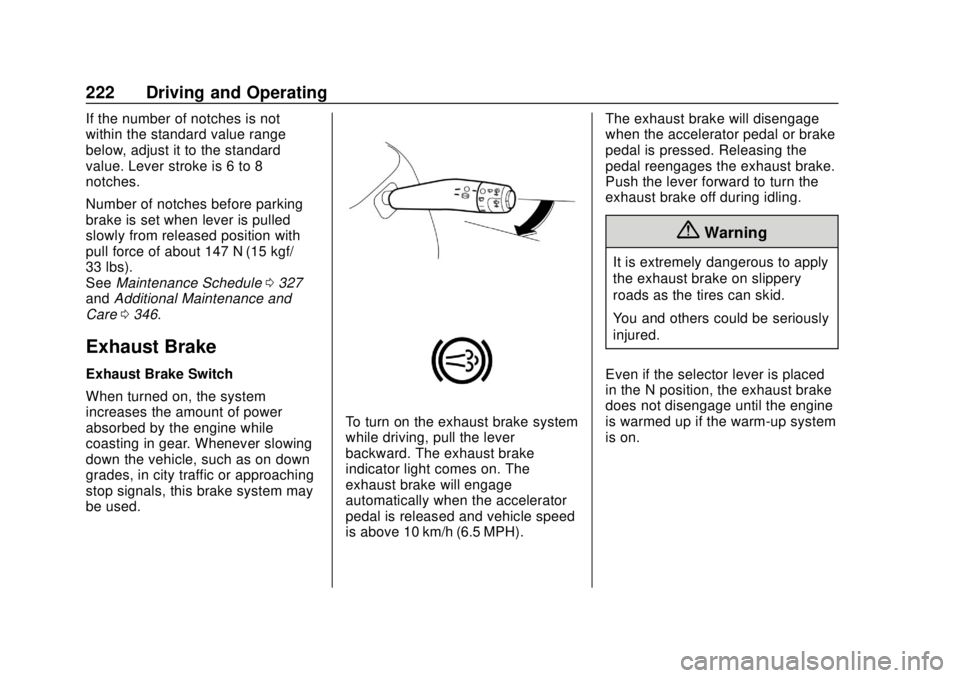
Exhaust Brake
Exhaust Brake Switch
When turned on, the system
increases the amount of power
absorbed by the engine while
coasting in gear. Whenever slowing
down the vehicle, such as on down
grades, in city traffic or approaching
stop signals, this brake system may
be used.
To turn on the exhaust brake system
while driving, pull the lever
backward. The exhaust brake
indicator light comes on. The
exhaust brake will engage
automatically when the accelerator
pedal is released and vehicle speed
is above 10 km/h (6.5 MPH). The exhaust brake will disengage
when the accelerator pedal or brake
pedal is pressed. Releasing the
pedal reengages the exhaust brake.
Push the lever forward to turn the
exhaust brake off during idling.
{Warning
It is extremely dangerous to apply
the exhaust brake on slippery
roads as the tires can skid.
You and others could be seriously
injured.
Even if the selector lever is placed
in the N position, the exhaust brake
does not disengage until the engine
is warmed up if the warm-up system
is on.
Page 240 of 382

Chevrolet Low Cab Forward 5.2L Diesel Engine 4500/5500 Series (GMNA-
Localizing-U.S.-12407814) - 2019 - crc - 12/13/17
Vehicle Care 239
Vehicle Care
General Information
General Information . . . . . . . . . . 240
California Proposition65 Warning . . . . . . . . . . . . . . . . . 240
California Perchlorate Materials Requirements . . . . . 240
Accessories and Modifications . . . . . . . . . . . . . . . . 240
Vehicle Checks
Doing Your OwnService Work . . . . . . . . . . . . . . . 241
Cab Tilting . . . . . . . . . . . . . . . . . . . . 243
Engine Compartment Overview . . . . . . . . . . . . . . . . . . . . 244
Engine Cover . . . . . . . . . . . . . . . . . 245
Engine Oil . . . . . . . . . . . . . . . . . . . . 245
Automatic Transmission Fluid . . . . . . . . . . . . . . . . . . . . . . . . 251
Engine Air Cleaner/Filter . . . . . . 253
Engine Coolant . . . . . . . . . . . . . . . 253
Engine Overheating . . . . . . . . . . 259
Power Steering Fluid . . . . . . . . . 262
Washer Fluid . . . . . . . . . . . . . . . . . 262
Brakes . . . . . . . . . . . . . . . . . . . . . . . 263
Brake Fluid . . . . . . . . . . . . . . . . . . . 268
Battery - North America . . . . . . 269 Fuel Filter . . . . . . . . . . . . . . . . . . . . 270
Rear Axle (Gear Oil Viscosity
Chart) . . . . . . . . . . . . . . . . . . . . . . . 271
Rear Axle (Oil Level Check) . . . . . . . . . . . . . . . . . . . . . . 272
Noise Control System . . . . . . . . 272
Automatic Transmission Shift Lock Control Function
Check . . . . . . . . . . . . . . . . . . . . . . . 274
Wiper Blade Replacement . . . . 275
Headlamp Aiming
Headlamp Aiming . . . . . . . . . . . . 277
Bulb Replacement
Bulb Replacement . . . . . . . . . . . . 277
Headlamps and Front Turn Signal . . . . . . . . . . . . . . . . . . . . . . . 280
Roofmarker Lamps . . . . . . . . . . . 284
Sidemarker Lamps (Including Turn Signal and Cornering
Lamps) . . . . . . . . . . . . . . . . . . . . . . 284
Taillamps, Turn Signal, Stoplamps, and Back-Up
Lamps . . . . . . . . . . . . . . . . . . . . . . 286
License Plate Lamp . . . . . . . . . . 286
Interior Lamps . . . . . . . . . . . . . . . . 287
Electrical System
Electrical System Overload . . . 287
Wheels and Tires
Wheels and Tires . . . . . . . . . . . . . 295
Tire Pressure . . . . . . . . . . . . . . . . . 307
Tire Rotation . . . . . . . . . . . . . . . . . 307
If a Tire Goes Flat . . . . . . . . . . . . 310
Jump Starting
Jump Starting - North America . . . . . . . . . . . . . . . . . . . . . 311
Towing the Vehicle
Towing the Vehicle . . . . . . . . . . . 315
Appearance Care
Exterior Care . . . . . . . . . . . . . . . . . 317
Interior Care . . . . . . . . . . . . . . . . . . 323
Page 264 of 382

Chevrolet Low Cab Forward 5.2L Diesel Engine 4500/5500 Series (GMNA-
Localizing-U.S.-12407814) - 2019 - crc - 12/13/17
Vehicle Care 263
properly wiped. At this time, also
check the spraying condition of the
windshield washer.
Inspect the washer fluid level
regularly, especially during bad
weather conditions.
Use a high quality premixed solvent
available at most dealers or service
stations.
Avoid hard water when mixing
windshield washer solvents. Hard
water contaminants may plug
orifices in the washer system and
reduce performance.
Do not use radiator antifreeze in the
windshield washer; it could cause
cab paint damage.
In cold weather, warm the
windshield with the defrosters
before using the washer, to help
prevent icing that may block the
driver's vision.Refilling Windshield Washer
Fluid
1. The windshield washer fluidtank (1) is located under the
instrument panel on the
passenger side.
2. Open the cap (2) and fill the tank with windshield washer
fluid.
Upon factory shipment, new
vehicles contain only tap water in
the washer fluid tank. Adjust the
concentration of the fluid to suit your
own usage. Follow the instructions provided with
the windshield washer fluid
regarding the ratio for mixing with
tap water.
Poor quality products, engine
coolant, and soapy water must not
be used. Failure to observe this
precaution can result in nozzle
blockage or damage to painted
surfaces.
The washer should never be used
while the tank is empty. Operating
the washer with the tank empty can
result in motor damage.Brakes
For the most effective braking and
for maximum life from brake system
components, follow these
suggestions:
.
Keep any obstructions from
interfering with brake pedal
travel.
. Keep tires properly inflated.
Improperly inflated tires can
reduce the efficiency of the
brakes.
Page 296 of 382

Chevrolet Low Cab Forward 5.2L Diesel Engine 4500/5500 Series (GMNA-
Localizing-U.S.-12407814) - 2019 - crc - 12/13/17
Vehicle Care 295
{Warning
Always use fuses specified by the
dealer when replacing the
slow-blow fuse. Using fuses with
a rating other than that specified,
or using wire or tin foil, etc., could
result in fire or damage.
If the new fuses blow right away
and the cause is unknown,
contact your dealer.
Do not inspect or replace fuses
when the starter switch is in the
ON position. Doing so may lead
to an accident.
When inspecting fuses, be sure to
park the vehicle on flat, level
ground and apply chocks to the
wheels.It is not necessary to open or close
the cover unless trouble is found.
The relay box structure makes it
difficult for water to enter. If you
should spill water or a beverage of
the cover, however, wipe it off
before opening the cover.
The area around the cover will get
warm when the vehicle is being
driven, but this is not abnormal.
Wheels and Tires
The operating load and cold inflation
pressure on the rim and wheel must
not exceed the rim and wheel
manufacturer's recommendations
even though the tire may be
approved for a higher load or
inflation. Rim and wheel may be
identified (stamped) with maximum
load and maximum cold inflation
rating. For rims and wheels not so
identified or for service conditions
exceeding the rate capacities,
consult the rim and wheel
manufacturer to determine rim and
wheel capacities for the intended
service. The factory-installed tires
on this vehicle were selected to
provide the best all-around tire
performance for normal operation.
When inflated, as shown on the
vehicle, they have the load carrying
capacity to operate satisfactorily at
all loads up to and including the full
rated load specified for the vehicle.
For more information concerning the
differences in capacities of tires and
Page 297 of 382

Chevrolet Low Cab Forward 5.2L Diesel Engine 4500/5500 Series (GMNA-
Localizing-U.S.-12407814) - 2019 - crc - 12/13/17
296 Vehicle Care
rims, refer to the“Tire and Rim
Association Inc. Yearbook”, or your
tire dealer.
Tire Inflation
{Warning
To reduce the risk of loss of
vehicle control and personal
injury:
Tires must be properly inflated,
and your vehicle must not be
overloaded (see the information
on Information on Loading the
Vehicle 058 and "Tire Load and
Inflation Table" under Tire
Pressure 0307).
Be sure to keep tires properly
inflated. A tire that is run while
seriously underinflated may
overheat to the point where the
tire may lose air suddenly and/or
catch fire, possibly resulting in
personal injury and/or property
damage. See
“Tire Load and Inflation Table”
under Tire Pressure 0307.
In no case should the front or rear
tire load exceed the maximum
recommended gross axle weight
rating (front GAWR or rear GAWR).
The efficiency of the vehicle will be
upset if air pressure in the tires are
not equal. Balanced inflation results
when the tires on the same axle
carry the same air pressure.
A difference in pressure between
the front and rear tires may be
permissible within certain limitations,
however, there should not be a
difference in pressures between the
right and left tires on the same axle.
Always use a truck tire pressure
gauge (a pocket-type gauge is not
advised) when checking inflation
pressures. Visual inspection of tires
for inflation pressures is not enough,
especially in the case of radial tires.
Underinflated radial tires may look
similar to correctly inflated radial
tires. If the inflation pressure on a
tire is found to be low frequently,
have your dealer correct the cause. Be sure to install the tire inflation
valve caps to prevent dirt and
moisture from getting into the valve
core, which could cause air leakage.
An underinflated tire in a dual wheel
assembly is harder to notice than
one in a single wheel assembly. The
properly inflated dual tire carries its
own load plus that of the
underinflated tire. Both tires can
overheat, which may result in
property damage and/or personal
injury (see previous WARNING).
Tires Used or Stored for a Long
Period of Time
Tires are a rubber product and
degrade over time, even if they are
not being used. If any of your tires is
5 to 7 years old or more, please
have them inspected for safe
driving. For further information,
please check with the tire
manufacturer.
Dual Tire Operation
The outer tire of a pair on dual
wheel installations generally wears
faster than the inner tire. If this