brake fluid CHEVROLET LOW CAB FORWARD 2019 Owner's Guide
[x] Cancel search | Manufacturer: CHEVROLET, Model Year: 2019, Model line: LOW CAB FORWARD, Model: CHEVROLET LOW CAB FORWARD 2019Pages: 382, PDF Size: 5.95 MB
Page 214 of 382
Chevrolet Low Cab Forward 5.2L Diesel Engine 4500/5500 Series (GMNA-
Localizing-U.S.-12407814) - 2019 - crc - 12/13/17
Driving and Operating 213
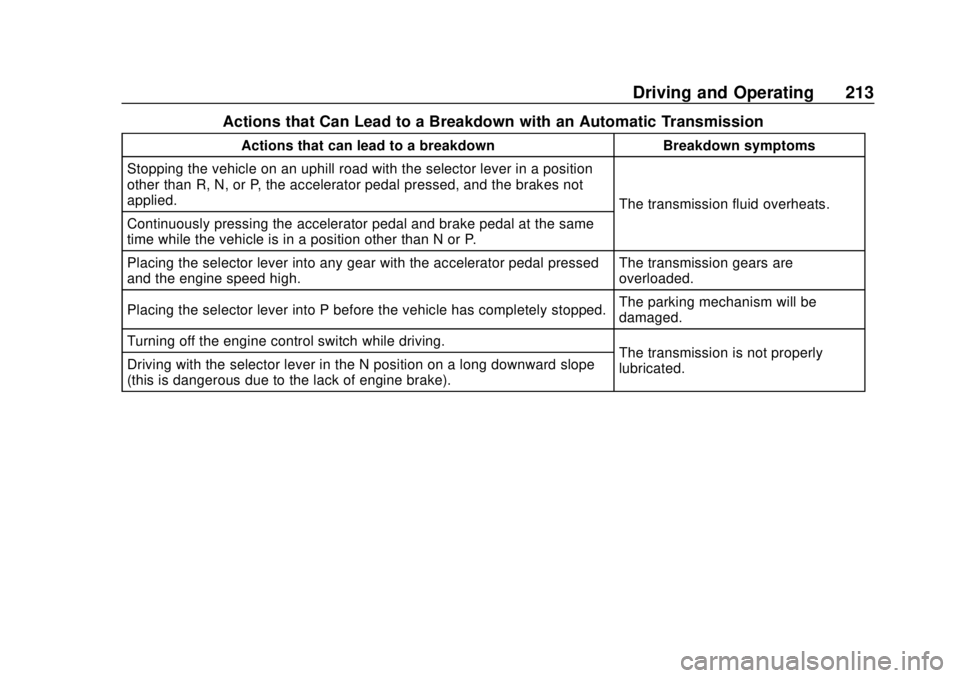
Actions that Can Lead to a Breakdown with an Automatic Transmission
Actions that can lead to a breakdownBreakdown symptoms
Stopping the vehicle on an uphill road with the selector lever in a position
other than R, N, or P, the accelerator pedal pressed, and the brakes not
applied. The transmission fluid overheats.
Continuously pressing the accelerator pedal and brake pedal at the same
time while the vehicle is in a position other than N or P.
Placing the selector lever into any gear with the accelerator pedal pressed
and the engine speed high. The transmission gears are
overloaded.
Placing the selector lever into P before the vehicle has completely stopped. The parking mechanism will be
damaged.
Turning off the engine control switch while driving. The transmission is not properly
lubricated.
Driving with the selector lever in the N position on a long downward slope
(this is dangerous due to the lack of engine brake).
Page 240 of 382

Chevrolet Low Cab Forward 5.2L Diesel Engine 4500/5500 Series (GMNA-
Localizing-U.S.-12407814) - 2019 - crc - 12/13/17
Vehicle Care 239
Vehicle Care
General Information
General Information . . . . . . . . . . 240
California Proposition65 Warning . . . . . . . . . . . . . . . . . 240
California Perchlorate Materials Requirements . . . . . 240
Accessories and Modifications . . . . . . . . . . . . . . . . 240
Vehicle Checks
Doing Your OwnService Work . . . . . . . . . . . . . . . 241
Cab Tilting . . . . . . . . . . . . . . . . . . . . 243
Engine Compartment Overview . . . . . . . . . . . . . . . . . . . . 244
Engine Cover . . . . . . . . . . . . . . . . . 245
Engine Oil . . . . . . . . . . . . . . . . . . . . 245
Automatic Transmission Fluid . . . . . . . . . . . . . . . . . . . . . . . . 251
Engine Air Cleaner/Filter . . . . . . 253
Engine Coolant . . . . . . . . . . . . . . . 253
Engine Overheating . . . . . . . . . . 259
Power Steering Fluid . . . . . . . . . 262
Washer Fluid . . . . . . . . . . . . . . . . . 262
Brakes . . . . . . . . . . . . . . . . . . . . . . . 263
Brake Fluid . . . . . . . . . . . . . . . . . . . 268
Battery - North America . . . . . . 269 Fuel Filter . . . . . . . . . . . . . . . . . . . . 270
Rear Axle (Gear Oil Viscosity
Chart) . . . . . . . . . . . . . . . . . . . . . . . 271
Rear Axle (Oil Level Check) . . . . . . . . . . . . . . . . . . . . . . 272
Noise Control System . . . . . . . . 272
Automatic Transmission Shift Lock Control Function
Check . . . . . . . . . . . . . . . . . . . . . . . 274
Wiper Blade Replacement . . . . 275
Headlamp Aiming
Headlamp Aiming . . . . . . . . . . . . 277
Bulb Replacement
Bulb Replacement . . . . . . . . . . . . 277
Headlamps and Front Turn Signal . . . . . . . . . . . . . . . . . . . . . . . 280
Roofmarker Lamps . . . . . . . . . . . 284
Sidemarker Lamps (Including Turn Signal and Cornering
Lamps) . . . . . . . . . . . . . . . . . . . . . . 284
Taillamps, Turn Signal, Stoplamps, and Back-Up
Lamps . . . . . . . . . . . . . . . . . . . . . . 286
License Plate Lamp . . . . . . . . . . 286
Interior Lamps . . . . . . . . . . . . . . . . 287
Electrical System
Electrical System Overload . . . 287
Wheels and Tires
Wheels and Tires . . . . . . . . . . . . . 295
Tire Pressure . . . . . . . . . . . . . . . . . 307
Tire Rotation . . . . . . . . . . . . . . . . . 307
If a Tire Goes Flat . . . . . . . . . . . . 310
Jump Starting
Jump Starting - North America . . . . . . . . . . . . . . . . . . . . . 311
Towing the Vehicle
Towing the Vehicle . . . . . . . . . . . 315
Appearance Care
Exterior Care . . . . . . . . . . . . . . . . . 317
Interior Care . . . . . . . . . . . . . . . . . . 323
Page 243 of 382

Chevrolet Low Cab Forward 5.2L Diesel Engine 4500/5500 Series (GMNA-
Localizing-U.S.-12407814) - 2019 - crc - 12/13/17
242 Vehicle Care
chock the wheels. It would be very
dangerous if the vehicle started
to move.
When performing work on the
electrical system, begin by turning
the engine control switch to the
"LOCK" position, wait at least
3 minutes, and then disconnect the
negative cable from the negative
terminal on battery. If the negative
cable is disconnected within
3 minutes, the engine control
module may malfunction.
When working on the fuel line or
fuel filter, remove the fuel tank filler
cap. The fuel system is under
pressure and the fuel will overspill
unless the pressure is relieved,
possibly leading to combustion or
a fire.
Do not make engine adjustments
yourself. Be sure to consult your
dealer.
Use only appropriate tools.Oils, brake fluid and engine coolant
have lubrication, cooling and rust
prevention functions. If these liquids
deteriorate through loss or
contamination, it will cause a
decline in the performance of the
parts and such problems as seizure
or malfunctioning. Replenish or
change these liquids when
performing the checks (daily and
periodic checks) as required by the
relevant regulations or in
accordance with the Maintenance
Schedule (when either the specified
driving distance or period of time,
whichever comes first, has expired).
Confirm that all systems and
components are normal after
performing the work.
Do not leave the removed parts or
tools in the engine compartment.
They could damage the equipment if
caught in the belts or other moving
components.
Dirty water, dirt and other impurities
seriously impair the effectiveness of
the oil, grease and fluids, and
damage the parts. Exercise all due
caution to prevent waste or otherrefuse from coming in contact with
parts or materials that have been
removed when changing or
replenishing them.
Do not step on the engine or climb
onto it. You could cause an engine
failure by, for example, damaging
the cylinder head cover or various
connectors.
Electric Welding
Careless electric welding of vehicle
parts can cause welding current to
flow back through the vehicle’s
ground circuit and damage electrical
and electronic parts so that they do
not function normally. Whenever
electric welding is necessary,
consult your dealer.
Page 253 of 382

Chevrolet Low Cab Forward 5.2L Diesel Engine 4500/5500 Series (GMNA-
Localizing-U.S.-12407814) - 2019 - crc - 12/13/17
252 Vehicle Care
For the crew cab vehicle, the
dipstick is located beneath the
rear-of-engine inspection panel.
After unlatching the A/T fluid
inspection cover, the dipstick will be
visible.
Inspection
Wait at least 30 minutes before
checking the transmission fluid if
you have been driving at high speed
for a long period of time, in city/
heavy traffic or while pulling a trailer.1. Start the engine, and drive the vehicle for approximately
10 minutes to warm up the
engine. During 10 minutes, the automatic transmission fluid
should reach a temperature of
approximately 70 - 80 °C (158 -
176 °F). During the winter
when temperatures are low,
adjust the amount of driving
time according to the actual
conditions.
2. Park the vehicle on level ground, and firmly apply the
parking brake.
3. With the engine idling, move the selector lever from the “P”
position to the “1”position
while pressing the brake pedal,
and then return the lever from
the “1”position to the “P”
position.
4. With the engine still idling, pull out the dipstick and wipe it with
a clean cloth.Transmission Dipstick
5. Reinsert the dipstick into position, pull out the dipstick
slowly, and check whether the
fluid level is within the “H”
marked range. Always check
the fluid level at least twice.
Consistently is important in
maintaining accuracy.
If inconsistent readings persist,
check the transmission
breather to ensure that it is
clean and free of debris.
. Dipstick C (COLD) —
Transmission fluid
temperature Approx. 20 -
30 °C (68 - 86 °F).
Page 264 of 382

Chevrolet Low Cab Forward 5.2L Diesel Engine 4500/5500 Series (GMNA-
Localizing-U.S.-12407814) - 2019 - crc - 12/13/17
Vehicle Care 263
properly wiped. At this time, also
check the spraying condition of the
windshield washer.
Inspect the washer fluid level
regularly, especially during bad
weather conditions.
Use a high quality premixed solvent
available at most dealers or service
stations.
Avoid hard water when mixing
windshield washer solvents. Hard
water contaminants may plug
orifices in the washer system and
reduce performance.
Do not use radiator antifreeze in the
windshield washer; it could cause
cab paint damage.
In cold weather, warm the
windshield with the defrosters
before using the washer, to help
prevent icing that may block the
driver's vision.Refilling Windshield Washer
Fluid
1. The windshield washer fluidtank (1) is located under the
instrument panel on the
passenger side.
2. Open the cap (2) and fill the tank with windshield washer
fluid.
Upon factory shipment, new
vehicles contain only tap water in
the washer fluid tank. Adjust the
concentration of the fluid to suit your
own usage. Follow the instructions provided with
the windshield washer fluid
regarding the ratio for mixing with
tap water.
Poor quality products, engine
coolant, and soapy water must not
be used. Failure to observe this
precaution can result in nozzle
blockage or damage to painted
surfaces.
The washer should never be used
while the tank is empty. Operating
the washer with the tank empty can
result in motor damage.Brakes
For the most effective braking and
for maximum life from brake system
components, follow these
suggestions:
.
Keep any obstructions from
interfering with brake pedal
travel.
. Keep tires properly inflated.
Improperly inflated tires can
reduce the efficiency of the
brakes.
Page 266 of 382
Chevrolet Low Cab Forward 5.2L Diesel Engine 4500/5500 Series (GMNA-
Localizing-U.S.-12407814) - 2019 - crc - 12/13/17
Vehicle Care 265
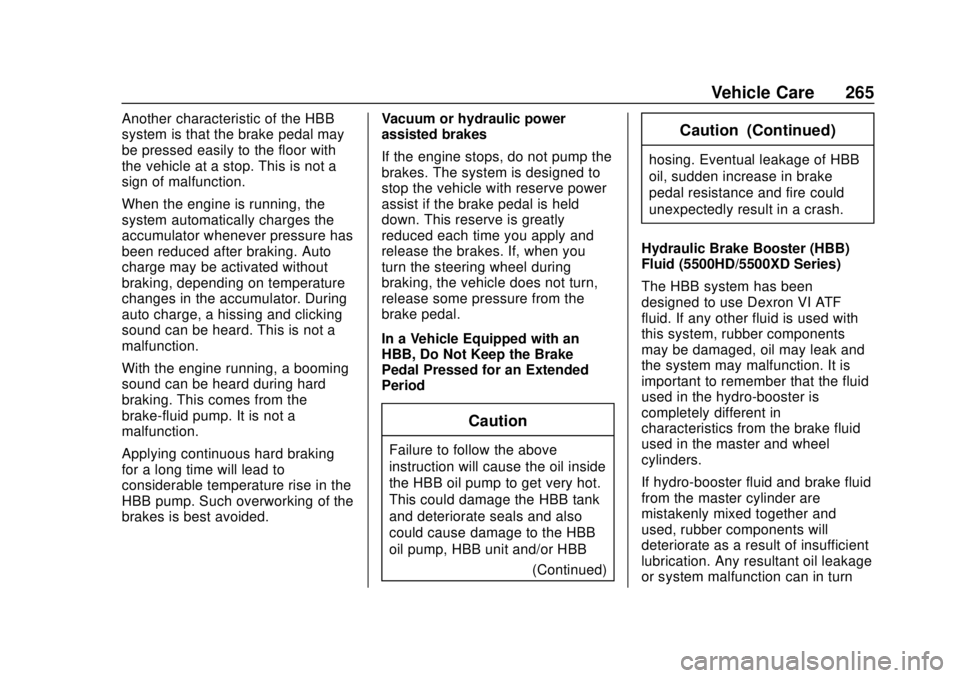
Another characteristic of the HBB
system is that the brake pedal may
be pressed easily to the floor with
the vehicle at a stop. This is not a
sign of malfunction.
When the engine is running, the
system automatically charges the
accumulator whenever pressure has
been reduced after braking. Auto
charge may be activated without
braking, depending on temperature
changes in the accumulator. During
auto charge, a hissing and clicking
sound can be heard. This is not a
malfunction.
With the engine running, a booming
sound can be heard during hard
braking. This comes from the
brake-fluid pump. It is not a
malfunction.
Applying continuous hard braking
for a long time will lead to
considerable temperature rise in the
HBB pump. Such overworking of the
brakes is best avoided.Vacuum or hydraulic power
assisted brakes
If the engine stops, do not pump the
brakes. The system is designed to
stop the vehicle with reserve power
assist if the brake pedal is held
down. This reserve is greatly
reduced each time you apply and
release the brakes. If, when you
turn the steering wheel during
braking, the vehicle does not turn,
release some pressure from the
brake pedal.
In a Vehicle Equipped with an
HBB, Do Not Keep the Brake
Pedal Pressed for an Extended
Period
Caution
Failure to follow the above
instruction will cause the oil inside
the HBB oil pump to get very hot.
This could damage the HBB tank
and deteriorate seals and also
could cause damage to the HBB
oil pump, HBB unit and/or HBB
(Continued)
Caution (Continued)
hosing. Eventual leakage of HBB
oil, sudden increase in brake
pedal resistance and fire could
unexpectedly result in a crash.
Hydraulic Brake Booster (HBB)
Fluid (5500HD/5500XD Series)
The HBB system has been
designed to use Dexron VI ATF
fluid. If any other fluid is used with
this system, rubber components
may be damaged, oil may leak and
the system may malfunction. It is
important to remember that the fluid
used in the hydro-booster is
completely different in
characteristics from the brake fluid
used in the master and wheel
cylinders.
If hydro-booster fluid and brake fluid
from the master cylinder are
mistakenly mixed together and
used, rubber components will
deteriorate as a result of insufficient
lubrication. Any resultant oil leakage
or system malfunction can in turn
Page 267 of 382

Chevrolet Low Cab Forward 5.2L Diesel Engine 4500/5500 Series (GMNA-
Localizing-U.S.-12407814) - 2019 - crc - 12/13/17
266 Vehicle Care
lead to dragging brakes or other
major brake problems. As such,
mixing of these two fluids can
ultimately lead to vehicle fire or
other serious crashes.
When the pump operates while the
engine is running, the fluid in the
hydro-booster will become hot.
During normal braking, the
temperature in piping and within the
hydro-booster can rise above 100 °
C (212 °F). For this reason, special
care will be required when working
with hydro-booster components.
If the hydro-booster is to be
removed from the vehicle, shut off
the engine and then allow at least
30 minutes for it to cool down before
beginning this operation.
Even when the engine is stopped,
the hydro-booster's accumulator will
remain in a highly-pressurized
condition for a significant period of
time. Before removing the
hydro-booster or piping from the
vehicle, stop the engine and press
the brake pedal at least 10 times in
order to lower the accumulator
pressure to atmospheric pressure.This is of particular importance
when removing components such
as the accumulator or pressure
switch from the hydro-booster.
If these operations are attempted
while the accumulator is still at a
high pressure, hydro-booster fluid
may spray out.
Checking the Hydro-booster Fluid
Level
Check the hydro-booster fluid level
and change the fluid according to
the Maintenance Schedule.
The hydro-booster fluid level is
correct if it is between the "MAX"
and "MIN" lines. If the level is too
low, add fluid up to the "MAX" line.
Be sure to use Dexron VI ATF fluid
when adding fluid. The brake
booster reservoir is located behind
the cab on the left side.
Brake Pedal
Stroke
Shut off the engine and press the
brake pedal about 10 times strongly,
then check the brake pedal for free
play by lightly pushing it by hand
until you feel resistance.
Page 269 of 382
Chevrolet Low Cab Forward 5.2L Diesel Engine 4500/5500 Series (GMNA-
Localizing-U.S.-12407814) - 2019 - crc - 12/13/17
268 Vehicle Care
free of any type of damage. Check
the right front brake hose and pipe
in the same way. The rear left and
right brake hoses and pipes should
also be checked in the same
manner.
Disc Brakes and Drum Brakes
If the brake pads and shoe linings
wear out beyond their usable limit,
not only will the brake performance
be impaired, but brake components
could also fail.
{Warning
Do not drive with brake pads and
shoe linings worn out beyond the
limit. Excessively worn brake
pads and shoe linings may cause
breakdown of brake components
and poor braking performance.
You and others could be seriously
injured.
Caution
The pad has an embedded wear
indicator. A squeaking noise from
the indicator means that the pad
is approaching the usable limit.
If the squeaking noise from the
indicator can be heard, contact
the nearest dealer for inspection
or replacement.
Brake Fluid
Checking the Brake Fluid
Level
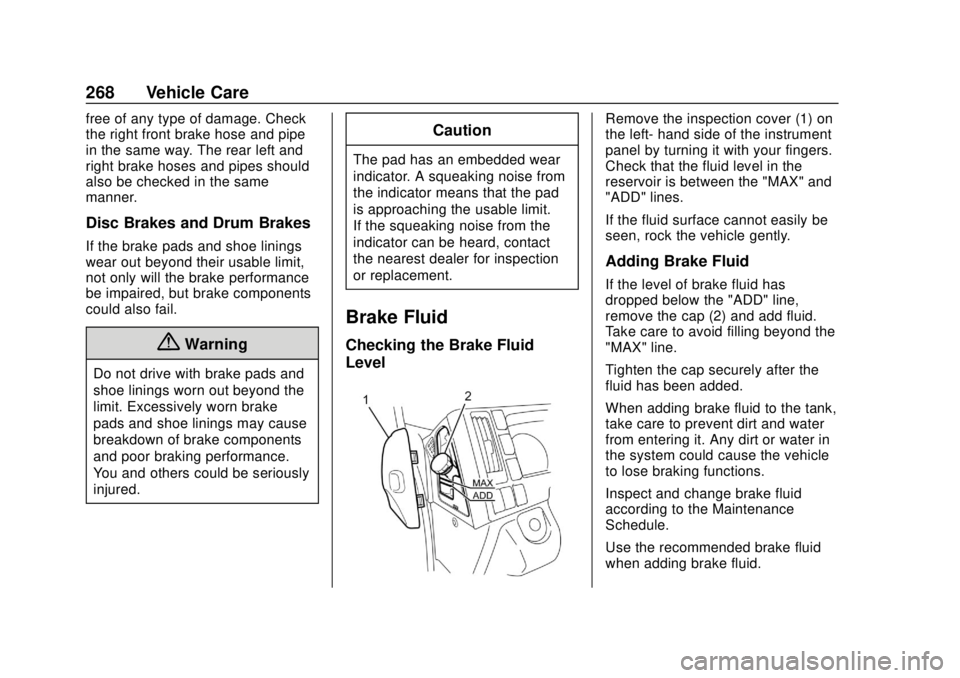
Remove the inspection cover (1) on
the left- hand side of the instrument
panel by turning it with your fingers.
Check that the fluid level in the
reservoir is between the "MAX" and
"ADD" lines.
If the fluid surface cannot easily be
seen, rock the vehicle gently.
Adding Brake Fluid
If the level of brake fluid has
dropped below the "ADD" line,
remove the cap (2) and add fluid.
Take care to avoid filling beyond the
"MAX" line.
Tighten the cap securely after the
fluid has been added.
When adding brake fluid to the tank,
take care to prevent dirt and water
from entering it. Any dirt or water in
the system could cause the vehicle
to lose braking functions.
Inspect and change brake fluid
according to the Maintenance
Schedule.
Use the recommended brake fluid
when adding brake fluid.
Page 270 of 382

Chevrolet Low Cab Forward 5.2L Diesel Engine 4500/5500 Series (GMNA-
Localizing-U.S.-12407814) - 2019 - crc - 12/13/17
Vehicle Care 269
Never mix the specified brake fluid
with fluids of another brand.
Be careful not to spill brake fluid
onto painted surfaces or to let it
come in contact with skin. If fluid is
spilled onto a painted surface or
comes in contact with skin, wash
away the fluid with water and
immediately wipe the area clean.
Brake fluid readily absorbs moisture.
Therefore, it is necessary to close
the brake fluid container tightly for
storage.
If the brake fluid level decreases
rapidly, there may be a problem in
the brake system or brake pads or
shoe linings may have worn out.
Have your vehicle inspected by the
nearest dealer immediately.Battery - North America
Working Near Battery
The batteries are located on the
outboard side of the left frame rail,
behind the cab. The batteries are in
a carrier with the cover (2) retained
by spring clips (1).
{Danger
Follow the precautions listed in
the jump starting Danger (see
"When the Battery is Discharged")(Continued)
Danger (Continued)
when working on or near the
battery. Personal injury
(particularly to eyes) or property
damage may result from battery
explosion, battery fluid or
electrical (short circuit) burns. You
and others could be seriously
injured or killed.
If the negative cable is disconnected
from the negative terminal on the
battery within 3 minutes after turning
the engine control switch to the
"LOCK" position, the engine control
module may malfunction.
Checking the Battery
Your new vehicle is equipped with
DELKOR batteries. They need no
periodic electrolyte level
maintenance. Its top is permanently
sealed (except for two small vent
holes) and has no filler caps. You
will never have to add water.
Page 333 of 382
Chevrolet Low Cab Forward 5.2L Diesel Engine 4500/5500 Series (GMNA-
Localizing-U.S.-12407814) - 2019 - crc - 12/13/17
332 Service and Maintenance
No. Service Interval16 000 km/10,000 mi
24 000 km/15,000 mi
32 000 km/20,000 mi
48 000 km/30,000 mi
64 000 km/40,000 mi
72 000 km/45,000 mi
80 000 km/50,000 mi
96 000 km/60,000 mi
112 000 km/70,000 mi
120 000 km/75,000 mi
128 000 km/80,000 mi
144 000 km/90,000 mi
160 000 km/100,000 mi
168 000 km/105,000 mi
176 000 km/110,000 mi
Service intervals
months or
kilometers
(miles)
whichever
occurs first (1)
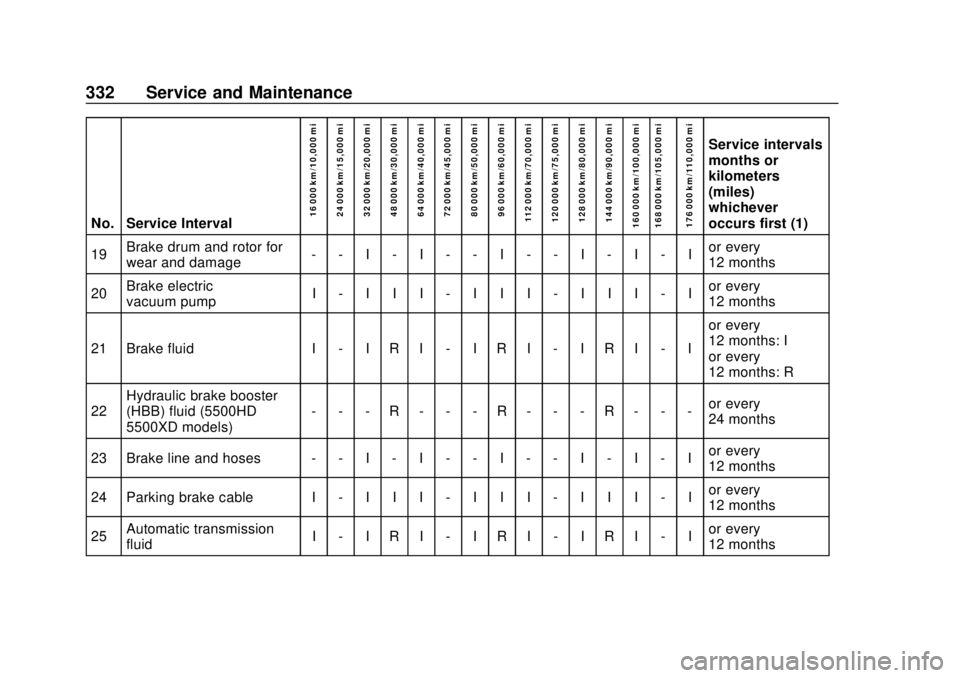
19 Brake drum and rotor for
wear and damage
- - I - I - - I - - I - I - I or every
12 months
20 Brake electric
vacuum pump I - I I I - I I I - I I I - I or every
12 months
21 Brake fluid I - I R I - I R I - I R I - I or every
12 months: I
or every
12 months: R
22 Hydraulic brake booster
(HBB) fluid (5500HD
5500XD models) - - - R - - - R - - - R - - -
or every
24 months
23 Brake line and hoses - - I - I - - I - - I - I - I or every
12 months
24 Parking brake cable I - I I I - I I I - I I I - I or every
12 months
25 Automatic transmission
fluid I - I R I - I R I - I R I - I
or every
12 months