steering CHEVROLET LOW CAB FORWARD 2019 Owner's Guide
[x] Cancel search | Manufacturer: CHEVROLET, Model Year: 2019, Model line: LOW CAB FORWARD, Model: CHEVROLET LOW CAB FORWARD 2019Pages: 382, PDF Size: 5.95 MB
Page 218 of 382

Chevrolet Low Cab Forward 5.2L Diesel Engine 4500/5500 Series (GMNA-
Localizing-U.S.-12407814) - 2019 - crc - 12/13/17
Driving and Operating 217
Warning (Continued)
driving habits and drive the
vehicle while keeping a proper
distance between vehicles.
ABS does not prevent crashes if
you do not drive safely. Drive the
vehicle at a safe speed.
Install tires of the specified size,
same brand and same tread
design (including winter tires) on
all wheels. If different tires are
installed, the braking distance
becomes longer and directional
control stability of the vehicle
decreases. This is very
dangerous.
Steering during sudden braking
(when the ABS is working) will
feel slightly different than it does
when the brakes are not applied.
Operate the steering wheel
carefully keeping this in mind.Driving in sand or on a muddy road
may adversely affect the brakes and
ABS sensors. Wash the vehicle to
remove sand and mud after
operating the vehicle in sandy or
muddy conditions.
Before washing the vehicle, provide
necessary protection to prevent
water from being splashed on the
ABS components (sensors and
actuators). Especially when using
high-pressure washing, be careful
not to allow water to be directly
sprayed onto the ABS components
and their harness connectors.
These are not signs of ABS
malfunction:
.
Soon after you start the engine
and the vehicle starts moving,
the sound of motor or valve
working may be heard from the
rear of the vehicle or underside
of the cab. This sound is from a
self-check by the ABS system
and is normal. In addition, you
may also feel some vibration if
the brake pedal is pressed at
this time. .
When ABS is operating,
vibration is felt on the brake
pedal and steering wheel and
you may hear the system
operating. This is normal when
ABS is properly operating.
. The exhaust brake may release
when ABS is activated and the
exhaust brake is in operation.
. ABS is more likely to be
activated when the brake is
applied during cornering or
driving over a bump. This is
because inside wheels or
wheels that have gone over a
bump tend to lock.
. ABS is not activated immediately
after starting the vehicle. It is
activated only when the vehicle
speed reaches approx. 10 km/h
(6 MPH). ABS operation is
inactive when the vehicle speed
reduces to approx. 5 km/h
(3 MPH).
Page 219 of 382

Chevrolet Low Cab Forward 5.2L Diesel Engine 4500/5500 Series (GMNA-
Localizing-U.S.-12407814) - 2019 - crc - 12/13/17
218 Driving and Operating
ABS Operation Indications and
Signs
ABS warning light
Operation Indications of ABS
When the engine control switch is
placed into the "ON" position, the
ABS warning light comes on and
then goes out in approx. 3 seconds.
The ABS is normal if the warning
light goes out.
Operation Signs of ABS
When ABS is activated, slight
vibration is generated on the brake
pedal (hydraulic brake model) and
steering wheel, and an operating
sound can be heard from the ABS
equipment.
If the ABS warning light does any of
the following, the ABS may be
faulty. Please contact the nearest
dealer. ‐
If the ABS warning light comes
on during driving
‐ The light does not come on when
the engine control switch is
placed into the "ON" position
See Antilock Brake System
(ABS) Warning Light 076.
Even if a problem has occurred with
the ABS, the regular brakes will still
work normally. However, ABS will
not operate.
Precautions for Driving an
ABS-Equipped Vehicle
ABS is not a device that enables
driving and stopping under
conditions exceeding safe driving
limits. Always drive safely.
{Warning
When braking suddenly, continue
pressing brake pedal hard so that
the ABS can take effect. (Continued)
Warning (Continued)
When braking suddenly, do not
pump the brakes (pushing and
releasing the brake pedal little by
little). Pumping brakes will
increase the braking distance.
The braking distance on slippery
road surfaces is longer than that
on a normal dry paved road even
with an ABS-equipped vehicle.
When ABS is activated in the
following road surface conditions,
the braking distance may be
slightly longer compared to that of
vehicles not equipped with an
ABS. Therefore, always be aware
of the road and tire condition (tire
type and wear condition), observe
safe driving habits and drive the
vehicle while keeping a safe
following distance.
‐ When driving on a gravel
road, or a road with a deep
snow covering.
(Continued)
Page 220 of 382

Chevrolet Low Cab Forward 5.2L Diesel Engine 4500/5500 Series (GMNA-
Localizing-U.S.-12407814) - 2019 - crc - 12/13/17
Driving and Operating 219
Warning (Continued)
‐When tire chains are used.
‐ When driving over road
joints or bumps such as
light reflectors on the road.
‐ When driving on a bumpy
road, stone-paved road or
track.
‐ When driving over an iron
plate or manhole lid.
ABS does not work for wheel skid
during a standing start,
acceleration and cornering which
do not involve braking. On a very
slippery icy road, tires may lose
grip and steering wheel operation
may not be able to control the
vehicle's direction, resulting in
very unstable driving. Always
drive the vehicle observing a safe
speed well matched with both
road surface and tire conditions,
and avoid sudden braking. (Continued)
Warning (Continued)
If powerful engine braking is
applied on a very slippery icy
road, the drive wheels may be
locked (the ABS then does not
work), resulting in loss of vehicle
control.
When ABS is activated, a slight
vibration (especially when the
road surface is different between
right and left wheels) and pulling
may be felt on the brake pedal
and steering wheel. In addition,
an operating sound is produced
from the ABS actuators. This
does not indicate any abnormal
condition. Stay calm and operate
the steering wheel properly.
Electronic Braking force
Distribution (EBD)
EBD is a function that uses the ABS
to distribute braking force ideally
between the front and rear wheels
in order to compensate for changes
in load conditions or any shift of the load due to acceleration or
deceleration, thus preventing
premature locking of the rear
wheels.
{Warning
If a problem should occur with the
EBD function, the ABS warning
light and the brake system
warning light will come on
simultaneously.
The rear wheels will lock more
easily if there is a problem with
the EBD function. Have it
checked and serviced at the
nearest dealer as soon as
possible. You and others could be
seriously injured.
When the EBD operates, the brake
pedal may push back slightly or you
may hear a sound similar to that
generated by the ABS when
operational. Neither of them
indicates any abnormal condition.
Page 240 of 382

Chevrolet Low Cab Forward 5.2L Diesel Engine 4500/5500 Series (GMNA-
Localizing-U.S.-12407814) - 2019 - crc - 12/13/17
Vehicle Care 239
Vehicle Care
General Information
General Information . . . . . . . . . . 240
California Proposition65 Warning . . . . . . . . . . . . . . . . . 240
California Perchlorate Materials Requirements . . . . . 240
Accessories and Modifications . . . . . . . . . . . . . . . . 240
Vehicle Checks
Doing Your OwnService Work . . . . . . . . . . . . . . . 241
Cab Tilting . . . . . . . . . . . . . . . . . . . . 243
Engine Compartment Overview . . . . . . . . . . . . . . . . . . . . 244
Engine Cover . . . . . . . . . . . . . . . . . 245
Engine Oil . . . . . . . . . . . . . . . . . . . . 245
Automatic Transmission Fluid . . . . . . . . . . . . . . . . . . . . . . . . 251
Engine Air Cleaner/Filter . . . . . . 253
Engine Coolant . . . . . . . . . . . . . . . 253
Engine Overheating . . . . . . . . . . 259
Power Steering Fluid . . . . . . . . . 262
Washer Fluid . . . . . . . . . . . . . . . . . 262
Brakes . . . . . . . . . . . . . . . . . . . . . . . 263
Brake Fluid . . . . . . . . . . . . . . . . . . . 268
Battery - North America . . . . . . 269 Fuel Filter . . . . . . . . . . . . . . . . . . . . 270
Rear Axle (Gear Oil Viscosity
Chart) . . . . . . . . . . . . . . . . . . . . . . . 271
Rear Axle (Oil Level Check) . . . . . . . . . . . . . . . . . . . . . . 272
Noise Control System . . . . . . . . 272
Automatic Transmission Shift Lock Control Function
Check . . . . . . . . . . . . . . . . . . . . . . . 274
Wiper Blade Replacement . . . . 275
Headlamp Aiming
Headlamp Aiming . . . . . . . . . . . . 277
Bulb Replacement
Bulb Replacement . . . . . . . . . . . . 277
Headlamps and Front Turn Signal . . . . . . . . . . . . . . . . . . . . . . . 280
Roofmarker Lamps . . . . . . . . . . . 284
Sidemarker Lamps (Including Turn Signal and Cornering
Lamps) . . . . . . . . . . . . . . . . . . . . . . 284
Taillamps, Turn Signal, Stoplamps, and Back-Up
Lamps . . . . . . . . . . . . . . . . . . . . . . 286
License Plate Lamp . . . . . . . . . . 286
Interior Lamps . . . . . . . . . . . . . . . . 287
Electrical System
Electrical System Overload . . . 287
Wheels and Tires
Wheels and Tires . . . . . . . . . . . . . 295
Tire Pressure . . . . . . . . . . . . . . . . . 307
Tire Rotation . . . . . . . . . . . . . . . . . 307
If a Tire Goes Flat . . . . . . . . . . . . 310
Jump Starting
Jump Starting - North America . . . . . . . . . . . . . . . . . . . . . 311
Towing the Vehicle
Towing the Vehicle . . . . . . . . . . . 315
Appearance Care
Exterior Care . . . . . . . . . . . . . . . . . 317
Interior Care . . . . . . . . . . . . . . . . . . 323
Page 263 of 382

Chevrolet Low Cab Forward 5.2L Diesel Engine 4500/5500 Series (GMNA-
Localizing-U.S.-12407814) - 2019 - crc - 12/13/17
262 Vehicle Care
Power Steering Fluid
The power steering fluid level must
be checked and it must be changed
according to the Maintenance
Schedule. SeeMaintenance
Schedule 0327.
When replenishing power steering
fluid or flushing the power steering
system, always use ATF
(Dexron
®-VI). Failure to use the
proper fluid may damage the power
steering system seals and hoses,
leading to fluid leakage.
Checking the Power Steering
Fluid Level
The fluid level is correct if it is
between the “MAX”and“MIN” lines
on the power steering fluid tank.
If the level is lower that the “MIN”
line, add fluid up to the “MAX”line.
The reserve tank is located at the
rear of the engine compartment on
the right. When you have finished
checking the fluid level, securely
reinstall the cap and cover.
{Warning
Before adding fluid, clean the
area around the cap and pour
fluid from a clean jug or filler.
Foreign matter getting in the tank
may cause power steering system
failure.
Do not mix the recommended
power steering fluid with fluids of
other brands. Due to chemical
reactions, any mixture of
differently branded fluids may
cause failure of the system.
You and others could be seriously
injured.
Washer Fluid
Windshield Washer Fluid
The windshield washer is equipped
on the windshield wiper arm.
Check the level of fluid in the
windshield washer fluid tank. In
addition, spray windshield washer
fluid and operate the windshield
wipers to check for any areas not
Page 265 of 382

Chevrolet Low Cab Forward 5.2L Diesel Engine 4500/5500 Series (GMNA-
Localizing-U.S.-12407814) - 2019 - crc - 12/13/17
264 Vehicle Care
Follow the recommendations for
brake checks in the Maintenance
Schedule.
GM replacement brake lining
material is recommended for this
vehicle to maintain the balance
between front and rear brake
performance. GM replacement
brake parts have been carefully
selected to provide the proper brake
balance for purposes of both
stopping distance and controllability
over the full range of operating
conditions. Installation of front or
rear brake lining material with
performance different from that of
the replacement parts
recommended for this vehicle can
change the intended brake balance
of this vehicle.
Checking the Brake Electric
Vacuum Pump (4500HD/
4500XD Series)
1. Turn the engine control switchto the "ON" position (do not
start the engine), and press the
brake pedal several times. 2. Check for the noisy sound of
the electric vacuum pump
inside the instrument panel at
the same time as vacuum
warning buzzer sound, and
check that the brake low
vacuum warning light
comes on.
3. Then, start the engine. The main vacuum pump driven by
the engine will start running.
If the electric vacuum pump
operation (noisy sound) and
the vacuum warning buzzer
stop, and the brake low
vacuum warning light goes off
thereafter, the operation is
normal.
4. If you cannot hear the noisy sound or the noisy sound stays
on all the time, have the
vehicle inspected by the
nearest dealer immediately.Hydraulic Brake Booster (HBB)
The 5500HD, 5500XD models are
equipped with an HBB system. HBB
is a brake booster device that utilizes hydraulic pressure from the
HBB pump integral with the power
steering pump.
If the brake booster warning light
comes on or a warning buzzer
continues to sound, there may be a
problem with the HBB.
If this warning light comes on while
driving, immediately stop your
vehicle at a safe place well clear of
traffic and promptly contact the
nearest dealer for inspection.
Hydraulic brake booster (HBB)
characteristics
In the 5500HD, 5500XD models, an
unusual sound from under the
instrument panel may be heard from
the hydraulic system while brakes
are used. It does not mean trouble.
It is not a sign of malfunction.
If you pump the brakes with the
engine off, a squeaking sound can
be heard. This comes from the
auxiliary accumulator. It is not a
malfunction. With the engine
running, a similar sound can be
heard during sudden braking.
Page 266 of 382
Chevrolet Low Cab Forward 5.2L Diesel Engine 4500/5500 Series (GMNA-
Localizing-U.S.-12407814) - 2019 - crc - 12/13/17
Vehicle Care 265
Another characteristic of the HBB
system is that the brake pedal may
be pressed easily to the floor with
the vehicle at a stop. This is not a
sign of malfunction.
When the engine is running, the
system automatically charges the
accumulator whenever pressure has
been reduced after braking. Auto
charge may be activated without
braking, depending on temperature
changes in the accumulator. During
auto charge, a hissing and clicking
sound can be heard. This is not a
malfunction.
With the engine running, a booming
sound can be heard during hard
braking. This comes from the
brake-fluid pump. It is not a
malfunction.
Applying continuous hard braking
for a long time will lead to
considerable temperature rise in the
HBB pump. Such overworking of the
brakes is best avoided.Vacuum or hydraulic power
assisted brakes
If the engine stops, do not pump the
brakes. The system is designed to
stop the vehicle with reserve power
assist if the brake pedal is held
down. This reserve is greatly
reduced each time you apply and
release the brakes. If, when you
turn the steering wheel during
braking, the vehicle does not turn,
release some pressure from the
brake pedal.
In a Vehicle Equipped with an
HBB, Do Not Keep the Brake
Pedal Pressed for an Extended
Period
Caution
Failure to follow the above
instruction will cause the oil inside
the HBB oil pump to get very hot.
This could damage the HBB tank
and deteriorate seals and also
could cause damage to the HBB
oil pump, HBB unit and/or HBB
(Continued)
Caution (Continued)
hosing. Eventual leakage of HBB
oil, sudden increase in brake
pedal resistance and fire could
unexpectedly result in a crash.
Hydraulic Brake Booster (HBB)
Fluid (5500HD/5500XD Series)
The HBB system has been
designed to use Dexron VI ATF
fluid. If any other fluid is used with
this system, rubber components
may be damaged, oil may leak and
the system may malfunction. It is
important to remember that the fluid
used in the hydro-booster is
completely different in
characteristics from the brake fluid
used in the master and wheel
cylinders.
If hydro-booster fluid and brake fluid
from the master cylinder are
mistakenly mixed together and
used, rubber components will
deteriorate as a result of insufficient
lubrication. Any resultant oil leakage
or system malfunction can in turn
Page 268 of 382
Chevrolet Low Cab Forward 5.2L Diesel Engine 4500/5500 Series (GMNA-
Localizing-U.S.-12407814) - 2019 - crc - 12/13/17
Vehicle Care 267
Free play (measured at the tip ofpedal)
5 - 10 mm (0.20 - 0.39 in) (4500HD/4500XD)
24 - 29 mm (0.95 - 1.14 in) (5500HD/5500XD)
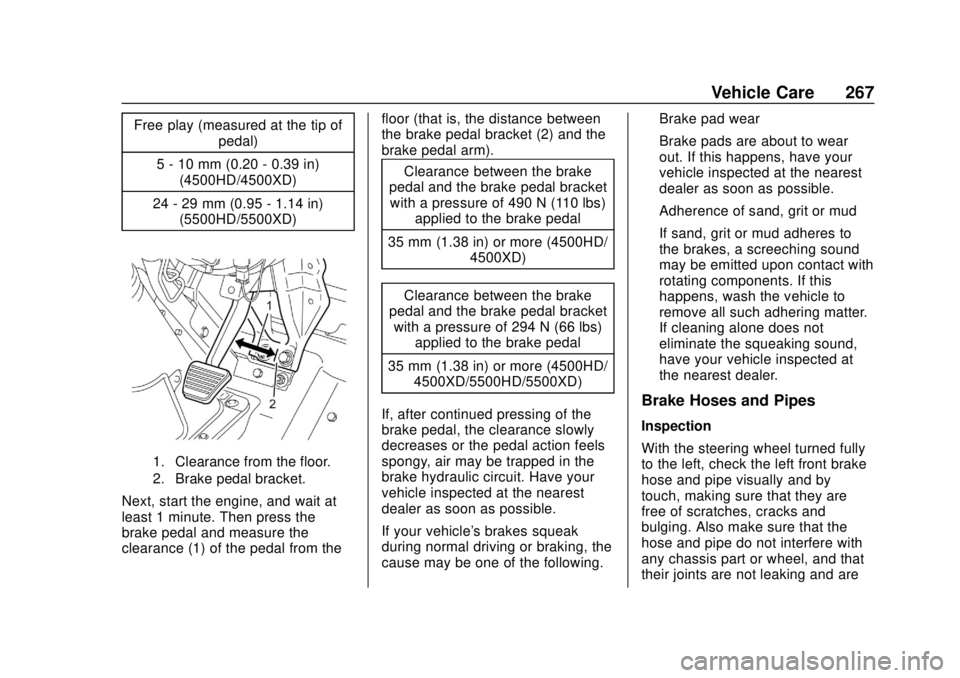
1. Clearance from the floor.
2. Brake pedal bracket.
Next, start the engine, and wait at
least 1 minute. Then press the
brake pedal and measure the
clearance (1) of the pedal from the floor (that is, the distance between
the brake pedal bracket (2) and the
brake pedal arm).
Clearance between the brake
pedal and the brake pedal bracket with a pressure of 490 N (110 lbs)
applied to the brake pedal
35 mm (1.38 in) or more (4500HD/ 4500XD)
Clearance between the brake
pedal and the brake pedal bracket with a pressure of 294 N (66 lbs) applied to the brake pedal
35 mm (1.38 in) or more (4500HD/ 4500XD/5500HD/5500XD)
If, after continued pressing of the
brake pedal, the clearance slowly
decreases or the pedal action feels
spongy, air may be trapped in the
brake hydraulic circuit. Have your
vehicle inspected at the nearest
dealer as soon as possible.
If your vehicle's brakes squeak
during normal driving or braking, the
cause may be one of the following. ‐
Brake pad wear
Brake pads are about to wear
out. If this happens, have your
vehicle inspected at the nearest
dealer as soon as possible.
‐ Adherence of sand, grit or mud
If sand, grit or mud adheres to
the brakes, a screeching sound
may be emitted upon contact with
rotating components. If this
happens, wash the vehicle to
remove all such adhering matter.
If cleaning alone does not
eliminate the squeaking sound,
have your vehicle inspected at
the nearest dealer.
Brake Hoses and Pipes
Inspection
With the steering wheel turned fully
to the left, check the left front brake
hose and pipe visually and by
touch, making sure that they are
free of scratches, cracks and
bulging. Also make sure that the
hose and pipe do not interfere with
any chassis part or wheel, and that
their joints are not leaking and are
Page 304 of 382

Chevrolet Low Cab Forward 5.2L Diesel Engine 4500/5500 Series (GMNA-
Localizing-U.S.-12407814) - 2019 - crc - 12/13/17
Vehicle Care 303
Tread Wear Indicator (Example)
1. Lug pattern
2. Rib pattern
Using worn-out tires is dangerous
because they might have an
increased chance of getting
punctured or bursting while driving.
Check all tires to see if tread wear
indicators appear on their treads
and also check their entire tread for
its depth with a depth gauge to
make sure that the grooves are
deeper than the specified depth.
A tire with tread wear indicators
appearing must be changed. Also,
check the tires for uneven or
otherwise abnormal wear.
{Warning
Tires with excessively shallow
tread grooves will increase the
chance of skidding and, when
driving at high speeds,
hydroplaning. You and others
could be seriously injured.
Hydroplaning occurs when a vehicle
is running at high speeds on a wet
road and a layer of water forms
between the road surface and tires
causing the tires to float on it.
Hydroplaning prevents the driver
from steering correctly and from
slowing down the vehicle with the
brake pedal. Use of Low Aspect Ratio Tires
1. Standard tire
2. Low aspect ratio tire
Low aspect ratio tires for truck
applications (aspect ratio at 70%)
have an air volume 20% to 30%
smaller than that of standard tires.
Therefore, if air begins to leak, low
aspect ratio tires adversely affect
vehicle operation much faster than
standard tires. Check air pressure of
low aspect ratio tires more often
than standard tires using a tire air
pressure gauge.
Page 311 of 382

Chevrolet Low Cab Forward 5.2L Diesel Engine 4500/5500 Series (GMNA-
Localizing-U.S.-12407814) - 2019 - crc - 12/13/17
310 Vehicle Care
3. Next, tighten the outer wheelnuts to the specified torque.
{Warning
If you find any abnormal
conditions with the wheel nuts
such as frequent loosening of
retightened nuts, have your
vehicle checked or serviced at the
nearest dealer as soon as
possible.
Fully engage the wheel wrench on a
wheel nut in order to tighten the nut
to the specified torque. However, do
not use a pipe as a handle
extension or your foot to apply force
on the wrench. This would tighten
the nut more than required and
might damage components.
Both under-tightening and
over-tightening of wheel nuts may
cause broken wheel studs or
cracked disc wheels and could lead
to wheel detachment. Adhere to the
specified tightening torques. When replacing a tire with a new
one, use only a tire of the same
type and size as the replaced tire;
otherwise, driving safety could be
affected. Avoid mixed use of
different types or different size tires
at all costs.
If a Tire Goes Flat
When the tire goes flat while driving,
ease off the accelerator pedal, avoid
hard braking, hold on to the steering
wheel firmly, and stop the vehicle.
The tire should be changed in a
safe, open location to prevent
obstructing other vehicles or
pedestrians.
{Warning
If you continue to drive on a flat
tire, undue force will be applied to
the wheel studs, possibly causing
the studs to break and the wheel
to come off. You and others could
be seriously injured.
See “Tire Replacement
Recommendations” underWheels
and Tires 0295.