oil CHEVROLET LOW CAB FORWARD 2019 Service Manual
[x] Cancel search | Manufacturer: CHEVROLET, Model Year: 2019, Model line: LOW CAB FORWARD, Model: CHEVROLET LOW CAB FORWARD 2019Pages: 382, PDF Size: 5.95 MB
Page 260 of 382

Chevrolet Low Cab Forward 5.2L Diesel Engine 4500/5500 Series (GMNA-
Localizing-U.S.-12407814) - 2019 - crc - 12/13/17
Vehicle Care 259
Engine Overheating
When the Engine Overheats
The engine cooling system may
overheat if the engine coolant level
is too low, if there is a sudden loss
of engine coolant (such as radiator
hose failure), or if other problems
occur. It may also temporarily
overheat during severe operating
conditions such as:
.Climbing a long hill on a hot day.
. Stopping after high-speed
driving.
. Idling for long periods in traffic.
If engine power drops and the
needle on the engine coolant
temperature gauge goes up above
the upper limit of the safety zone
and enters the "H" zone, the engine
is overheating. The engine overheat
warning light will come on and the
warning buzzer will sound. Either
steam or boiling engine coolant will
squirt out of the radiator. The
vehicle will also have an “OVERHEAT”
message displayed. Take the
following corrective actions
immediately.{Warning
To help avoid being burned:
Do not tilt the cab or open the
engine access cover if you see or
hear steam or engine coolant
escaping from the engine
compartment. Wait until no steam
or engine coolant can be seen or
heard before tilting the cab or
opening the engine cover.
Do not remove the radiator cap or
engine coolant reserve tank cap if
the engine coolant in the tank is
boiling. Also do not remove the
radiator cap while the engine and
radiator are still hot. Scalding fluid
and steam can be blown out
under pressure if either cap is
taken off too soon.
You and others could be seriously
injured. If Steam Is Coming from the
Engine Compartment
{Warning
If the engine coolant temperature
gauge shows an overheat
condition or you have other
reasons to suspect the engine
may be overheating, continued
operation of the engine (other
than as described here) even for
a short period of time may cause
a fire and the result in personal
injury and severe vehicle
damage. Take immediate action
as outlined.
You and others could be seriously
injured.
If you see or hear escaping steam
or have any other reason to suspect
there is a serious overheat
condition, stop and park the vehicle
as soon as it is safe to do so, turn
on the hazard warning flasher and
then turn off the engine immediately
and safely exit the vehicle.
Page 262 of 382

Chevrolet Low Cab Forward 5.2L Diesel Engine 4500/5500 Series (GMNA-
Localizing-U.S.-12407814) - 2019 - crc - 12/13/17
Vehicle Care 261
4. If no steam or engine coolantcan be seen or heard from the
engine compartment:
.Tilt the cab or open the
engine access cover.
‐If the engine coolant is
boiling, wait until it stops
before proceeding.
‐ Look at the see-through
reserve tank. The
engine coolant level
should be between the
"MAX" and "MIN" lines
on the reserve tank.
‐ If necessary, pour
engine coolant (See
Engine Coolant 0253
for the proper coolant
and water mixture) into
the reserve tank only,
not directly into the
radiator. Also, do not
check engine coolant
level at the radiator.
. Make sure the fan belts are
not broken, or off the
pulleys, and that the fan
turns when the engine is started. Make sure the fan
blade and pulleys are not
broken.
. Check the radiator hoses
and connections, heater
hoses and connections,
radiator, water pump, EGR
cooler, and SCR system
and hoses for leakage.
If you do not find a leak or
other problem, carefully add
engine coolant to the
reserve tank.
If the engine coolant level in
the reserve tank is at the
correct level but there is still
an indication on the
instrument panel of an
overheat condition:
You must let the engine
cool first. You may then add
engine coolant directly to
the radiator. See “Adding
Engine Coolant” under
Engine Coolant 0253. 5. Inspect to see if there is any
dirt, etc. attached to the front
surface of the radiator. Also,
inspect to see if there is
anything blocking the core.
If there is anything attached,
clean and remove it.
6. After the inspection, regardless of the vehicle condition, please
contact the nearest dealer.
Once the engine coolant
temperature gauge no longer
signals an overheat condition, you
can resume driving at a reduced
speed. Return to normal driving
after about 10 minutes if the gauge
pointer does not again show an
overheat condition.
When tap water only has been used
for engine coolant in an emergency,
change the engine coolant as soon
as possible.
Engine damage may be caused if
an overheating engine is suddenly
refilled with water. Instead, refill
slowly.
Page 266 of 382
Chevrolet Low Cab Forward 5.2L Diesel Engine 4500/5500 Series (GMNA-
Localizing-U.S.-12407814) - 2019 - crc - 12/13/17
Vehicle Care 265
Another characteristic of the HBB
system is that the brake pedal may
be pressed easily to the floor with
the vehicle at a stop. This is not a
sign of malfunction.
When the engine is running, the
system automatically charges the
accumulator whenever pressure has
been reduced after braking. Auto
charge may be activated without
braking, depending on temperature
changes in the accumulator. During
auto charge, a hissing and clicking
sound can be heard. This is not a
malfunction.
With the engine running, a booming
sound can be heard during hard
braking. This comes from the
brake-fluid pump. It is not a
malfunction.
Applying continuous hard braking
for a long time will lead to
considerable temperature rise in the
HBB pump. Such overworking of the
brakes is best avoided.Vacuum or hydraulic power
assisted brakes
If the engine stops, do not pump the
brakes. The system is designed to
stop the vehicle with reserve power
assist if the brake pedal is held
down. This reserve is greatly
reduced each time you apply and
release the brakes. If, when you
turn the steering wheel during
braking, the vehicle does not turn,
release some pressure from the
brake pedal.
In a Vehicle Equipped with an
HBB, Do Not Keep the Brake
Pedal Pressed for an Extended
Period
Caution
Failure to follow the above
instruction will cause the oil inside
the HBB oil pump to get very hot.
This could damage the HBB tank
and deteriorate seals and also
could cause damage to the HBB
oil pump, HBB unit and/or HBB
(Continued)
Caution (Continued)
hosing. Eventual leakage of HBB
oil, sudden increase in brake
pedal resistance and fire could
unexpectedly result in a crash.
Hydraulic Brake Booster (HBB)
Fluid (5500HD/5500XD Series)
The HBB system has been
designed to use Dexron VI ATF
fluid. If any other fluid is used with
this system, rubber components
may be damaged, oil may leak and
the system may malfunction. It is
important to remember that the fluid
used in the hydro-booster is
completely different in
characteristics from the brake fluid
used in the master and wheel
cylinders.
If hydro-booster fluid and brake fluid
from the master cylinder are
mistakenly mixed together and
used, rubber components will
deteriorate as a result of insufficient
lubrication. Any resultant oil leakage
or system malfunction can in turn
Page 272 of 382
Chevrolet Low Cab Forward 5.2L Diesel Engine 4500/5500 Series (GMNA-
Localizing-U.S.-12407814) - 2019 - crc - 12/13/17
Vehicle Care 271
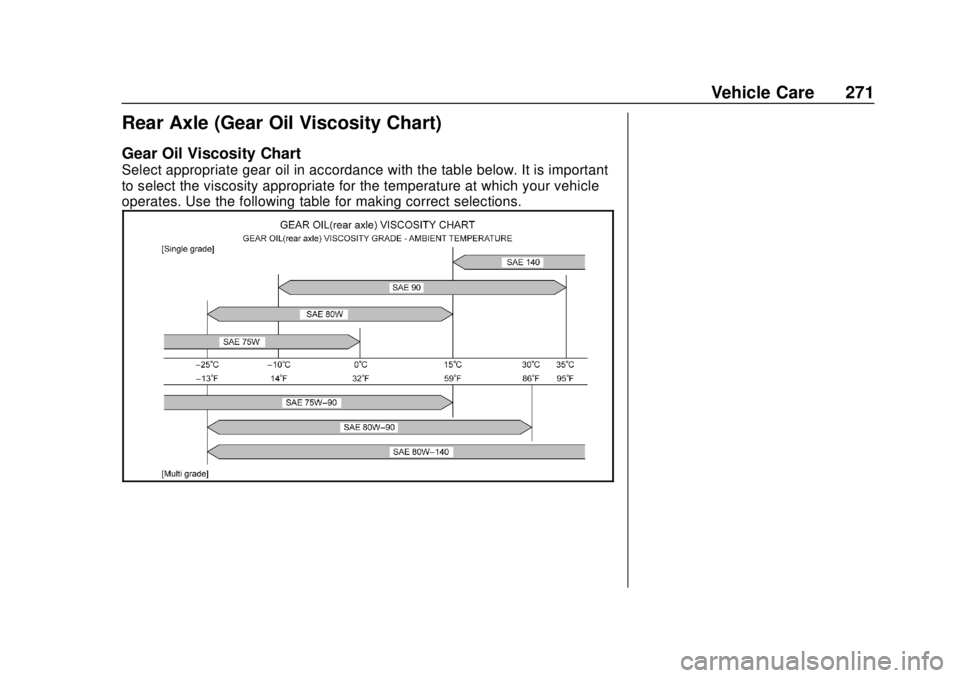
Rear Axle (Gear Oil Viscosity Chart)
Gear Oil Viscosity Chart
Select appropriate gear oil in accordance with the table below. It is important
to select the viscosity appropriate for the temperature at which your vehicle
operates. Use the following table for making correct selections.
Page 273 of 382

Chevrolet Low Cab Forward 5.2L Diesel Engine 4500/5500 Series (GMNA-
Localizing-U.S.-12407814) - 2019 - crc - 12/13/17
272 Vehicle Care
Rear Axle (Oil Level
Check)
Rear Axle Differential Gear Oil
The rear axle differential gear oil
level must be checked for its level
and it must be changed according to
the Maintenance Schedule.
Use the oil quantities indicated later
in this section only as guidelines
when changing the rear axle
differential gear oil.
After changing the oil, ensure that it
is at the correct level.
Drained oil must be disposed of in a
method conforming to the regulatory
requirements in your state.Checking the Oil Level
1. Remove the oil level plug.
2. Check that the oil level (1) is
0 mm to 10 mm (0 to 0.4 in)
below the bottom edge of the
oil level plug hole (2). If the oil
level is too low, add oil through
the oil level plug hole.
3. Fasten the oil level plug to the specified torque. Plug
tightening torque is 84 Nm
(8.6 kgFm/62 lb ft).
Any dirt on the plug should be
wiped off before installing it.
Noise Control System
Noise Emissions Warranty
General Motors warrants to the first
person who purchases this vehicle
for purposes other than resale and
to each subsequent purchaser that
this vehicle as manufactured by
General Motors, was designed, built
and equipped to conform at the time
it left General Motors’ s control with
all applicable U.S. EPA Noise
Control Regulations. This warranty
covers this vehicle as designed,
built and equipped by General
Motors, and is not limited to any
Page 283 of 382

Chevrolet Low Cab Forward 5.2L Diesel Engine 4500/5500 Series (GMNA-
Localizing-U.S.-12407814) - 2019 - crc - 12/13/17
282 Vehicle Care
8. Remove the rubber boot (2).Push the right side of the
clip (1) that holds the bulb (3)
in place and slide it upwards to
disengage the clip.9. Remove the bulb (1) from thesocket (2) and replace with a
new one.
10. After replacing the bulb, reverse steps 1-8 to install.
Do not touch the glass of the bulb
with your hand. Soiling the glass will
cause the bulb to blow out.
When attaching the rubber boot,
press in both the outside and inside
circumference of it. Make sure that
the rubber boot, the headlamp
assembly, and the bulb are securely
installed without any raised section. If the rubber boot is not firmly in
place, water could get inside the
headlamp and lead to a breakdown.
Replacing Parking Lamps
1. Refer to
“Replacing the
Headlamps” and remove the
headlamp assembly.
2. Pull the bulb out from the parking lamp socket and
replace with a new one.
Page 288 of 382

Chevrolet Low Cab Forward 5.2L Diesel Engine 4500/5500 Series (GMNA-
Localizing-U.S.-12407814) - 2019 - crc - 12/13/17
Vehicle Care 287
Interior Lamps
1. Remove the lens and pull outthe bulb.
2. To install the lights, follow the removal procedure in reverse.
Electrical System
Electrical System
Overload
Electrical System
Following the after-delivery service,
it is the owner's responsibility to
check all wiring periodically for
cracked, chafed or oil-soaked
insulation and maintain it in a clean
and tight condition to ensure
satisfactory operation of the
electrical system.
Replacing the Fuses and Relays
Your vehicle is equipped with fuses
and fusible links to protect your
electrical wiring and equipment in
case of electrical overload.
When the lights do not come on or
flash, or the equipment in the
electrical system does not operate,
check to see if a fuse has blown. Fuses :
In case of an electrical
overload, the fuse will blow and stop
the flow of current in the circuit
before electrical components
become damaged.
The cause of the circuit overload
must be identified and corrected
before the blown fuse is replaced,
or else the new fuse will also blow.
Since different circuits handle
different amounts of current, fuses
of various ampere ratings are used.
Be sure to replace a blown fuse with
a fuse of the correct rating.
To know if a fuse is blown or not,
remove the suspected fuse and look
at the wire for a break. If the wire is
broken, replace the fuse with one of
equal amperage rating.
The amperage rating of each fuse is
molded in its head.
Fuses are installed in the fuse
panel.
Page 290 of 382

Chevrolet Low Cab Forward 5.2L Diesel Engine 4500/5500 Series (GMNA-
Localizing-U.S.-12407814) - 2019 - crc - 12/13/17
Vehicle Care 289
{Warning
Always use fuses specified for the
vehicle. Using fuses with a rating
other than that specified, or using
wire or tin foil, etc., could result in
fire or damage.
If the new fuses blow right away
and the cause is unknown,
contact your dealer.
Do not inspect or replace fuses
when the starter switch is in the
ON position. Doing so may lead
to an accident.
When inspecting fuses, be sure to
park the vehicle on flat, level
ground and apply chocks to the
wheels.Replacing Relays
Before replacing the relays, contact
the nearest dealer.
The vehicle may not be equipped
with all of the fuses, relays, and
features shown.
It is not necessary to open or close
the cover unless trouble is found.
The relay box structure makes it
difficult for water to enter. If you
should spill water or a beverage of
the cover, however, wipe it off
before opening the cover.
The area around the cover will get
warm when the vehicle is being
driven, but this is not abnormal.
Page 296 of 382

Chevrolet Low Cab Forward 5.2L Diesel Engine 4500/5500 Series (GMNA-
Localizing-U.S.-12407814) - 2019 - crc - 12/13/17
Vehicle Care 295
{Warning
Always use fuses specified by the
dealer when replacing the
slow-blow fuse. Using fuses with
a rating other than that specified,
or using wire or tin foil, etc., could
result in fire or damage.
If the new fuses blow right away
and the cause is unknown,
contact your dealer.
Do not inspect or replace fuses
when the starter switch is in the
ON position. Doing so may lead
to an accident.
When inspecting fuses, be sure to
park the vehicle on flat, level
ground and apply chocks to the
wheels.It is not necessary to open or close
the cover unless trouble is found.
The relay box structure makes it
difficult for water to enter. If you
should spill water or a beverage of
the cover, however, wipe it off
before opening the cover.
The area around the cover will get
warm when the vehicle is being
driven, but this is not abnormal.
Wheels and Tires
The operating load and cold inflation
pressure on the rim and wheel must
not exceed the rim and wheel
manufacturer's recommendations
even though the tire may be
approved for a higher load or
inflation. Rim and wheel may be
identified (stamped) with maximum
load and maximum cold inflation
rating. For rims and wheels not so
identified or for service conditions
exceeding the rate capacities,
consult the rim and wheel
manufacturer to determine rim and
wheel capacities for the intended
service. The factory-installed tires
on this vehicle were selected to
provide the best all-around tire
performance for normal operation.
When inflated, as shown on the
vehicle, they have the load carrying
capacity to operate satisfactorily at
all loads up to and including the full
rated load specified for the vehicle.
For more information concerning the
differences in capacities of tires and
Page 306 of 382

Chevrolet Low Cab Forward 5.2L Diesel Engine 4500/5500 Series (GMNA-
Localizing-U.S.-12407814) - 2019 - crc - 12/13/17
Vehicle Care 305
Danger (Continued)
.Note that taking off and
mounting tires on wheels
requires proper tools, safety
equipment and special
training. A person can be
severely injured or killed
and damage can result from
using the wrong service
methods. Truck tires and
wheels should be serviced
only by trained people using
the proper equipment.
. Never add air to your tires
unless an accurate pressure
gauge is also used. When
putting air in a tire on the
vehicle, stand to the side
and use a clip-on chuck and
hose extension. In choosing
the right tire pressure, be
careful not to exceed the
maximum pressure
capability shown on the tire;
see the tire pressure charts
in this manual.
(Continued)
Danger (Continued)
.Tire mounting or repair can
result in serious personal
injury or death, if not
performed correctly. This
section has detailed
instructions for proper wheel
and tire replacement, so be
sure to read and follow
them. Truck fleet owners
and operators: You can get
written instructions on truck
tire demounting, repair and
mounting from Rubber
Manufacturers Association
(RMA), 1400 K Street N.W.,
Washington, D.C. 20005,
and also from many tire
stores. Wheel Nut Torque{Warning
Never use oil or grease on studs
or nuts. Use the torque specified
for the type of wheels on the
vehicle. Snug all wheel nuts and
then tighten to the specified
torque in the numerical sequence
shown. Improperly tightened
wheel nuts could eventually allow
the wheel to come off while the
vehicle is moving, possibly
causing loss of control and
personal injury and property
damage.
When the vehicle, wheel or
fasteners are new, have a
technician tighten wheel stud nuts
and rim clamp nuts with a torque
wrench at 1 040 km (650 mi). This is
necessary because the clamping
system used on the wheels must
seat before the fastener will hold a
uniform clamp load and remain fully
tightened. Also have a technician