wheel CHEVROLET LOW CAB FORWARD 2019 Service Manual
[x] Cancel search | Manufacturer: CHEVROLET, Model Year: 2019, Model line: LOW CAB FORWARD, Model: CHEVROLET LOW CAB FORWARD 2019Pages: 382, PDF Size: 5.95 MB
Page 240 of 382

Chevrolet Low Cab Forward 5.2L Diesel Engine 4500/5500 Series (GMNA-
Localizing-U.S.-12407814) - 2019 - crc - 12/13/17
Vehicle Care 239
Vehicle Care
General Information
General Information . . . . . . . . . . 240
California Proposition65 Warning . . . . . . . . . . . . . . . . . 240
California Perchlorate Materials Requirements . . . . . 240
Accessories and Modifications . . . . . . . . . . . . . . . . 240
Vehicle Checks
Doing Your OwnService Work . . . . . . . . . . . . . . . 241
Cab Tilting . . . . . . . . . . . . . . . . . . . . 243
Engine Compartment Overview . . . . . . . . . . . . . . . . . . . . 244
Engine Cover . . . . . . . . . . . . . . . . . 245
Engine Oil . . . . . . . . . . . . . . . . . . . . 245
Automatic Transmission Fluid . . . . . . . . . . . . . . . . . . . . . . . . 251
Engine Air Cleaner/Filter . . . . . . 253
Engine Coolant . . . . . . . . . . . . . . . 253
Engine Overheating . . . . . . . . . . 259
Power Steering Fluid . . . . . . . . . 262
Washer Fluid . . . . . . . . . . . . . . . . . 262
Brakes . . . . . . . . . . . . . . . . . . . . . . . 263
Brake Fluid . . . . . . . . . . . . . . . . . . . 268
Battery - North America . . . . . . 269 Fuel Filter . . . . . . . . . . . . . . . . . . . . 270
Rear Axle (Gear Oil Viscosity
Chart) . . . . . . . . . . . . . . . . . . . . . . . 271
Rear Axle (Oil Level Check) . . . . . . . . . . . . . . . . . . . . . . 272
Noise Control System . . . . . . . . 272
Automatic Transmission Shift Lock Control Function
Check . . . . . . . . . . . . . . . . . . . . . . . 274
Wiper Blade Replacement . . . . 275
Headlamp Aiming
Headlamp Aiming . . . . . . . . . . . . 277
Bulb Replacement
Bulb Replacement . . . . . . . . . . . . 277
Headlamps and Front Turn Signal . . . . . . . . . . . . . . . . . . . . . . . 280
Roofmarker Lamps . . . . . . . . . . . 284
Sidemarker Lamps (Including Turn Signal and Cornering
Lamps) . . . . . . . . . . . . . . . . . . . . . . 284
Taillamps, Turn Signal, Stoplamps, and Back-Up
Lamps . . . . . . . . . . . . . . . . . . . . . . 286
License Plate Lamp . . . . . . . . . . 286
Interior Lamps . . . . . . . . . . . . . . . . 287
Electrical System
Electrical System Overload . . . 287
Wheels and Tires
Wheels and Tires . . . . . . . . . . . . . 295
Tire Pressure . . . . . . . . . . . . . . . . . 307
Tire Rotation . . . . . . . . . . . . . . . . . 307
If a Tire Goes Flat . . . . . . . . . . . . 310
Jump Starting
Jump Starting - North America . . . . . . . . . . . . . . . . . . . . . 311
Towing the Vehicle
Towing the Vehicle . . . . . . . . . . . 315
Appearance Care
Exterior Care . . . . . . . . . . . . . . . . . 317
Interior Care . . . . . . . . . . . . . . . . . . 323
Page 243 of 382

Chevrolet Low Cab Forward 5.2L Diesel Engine 4500/5500 Series (GMNA-
Localizing-U.S.-12407814) - 2019 - crc - 12/13/17
242 Vehicle Care
chock the wheels. It would be very
dangerous if the vehicle started
to move.
When performing work on the
electrical system, begin by turning
the engine control switch to the
"LOCK" position, wait at least
3 minutes, and then disconnect the
negative cable from the negative
terminal on battery. If the negative
cable is disconnected within
3 minutes, the engine control
module may malfunction.
When working on the fuel line or
fuel filter, remove the fuel tank filler
cap. The fuel system is under
pressure and the fuel will overspill
unless the pressure is relieved,
possibly leading to combustion or
a fire.
Do not make engine adjustments
yourself. Be sure to consult your
dealer.
Use only appropriate tools.Oils, brake fluid and engine coolant
have lubrication, cooling and rust
prevention functions. If these liquids
deteriorate through loss or
contamination, it will cause a
decline in the performance of the
parts and such problems as seizure
or malfunctioning. Replenish or
change these liquids when
performing the checks (daily and
periodic checks) as required by the
relevant regulations or in
accordance with the Maintenance
Schedule (when either the specified
driving distance or period of time,
whichever comes first, has expired).
Confirm that all systems and
components are normal after
performing the work.
Do not leave the removed parts or
tools in the engine compartment.
They could damage the equipment if
caught in the belts or other moving
components.
Dirty water, dirt and other impurities
seriously impair the effectiveness of
the oil, grease and fluids, and
damage the parts. Exercise all due
caution to prevent waste or otherrefuse from coming in contact with
parts or materials that have been
removed when changing or
replenishing them.
Do not step on the engine or climb
onto it. You could cause an engine
failure by, for example, damaging
the cylinder head cover or various
connectors.
Electric Welding
Careless electric welding of vehicle
parts can cause welding current to
flow back through the vehicle’s
ground circuit and damage electrical
and electronic parts so that they do
not function normally. Whenever
electric welding is necessary,
consult your dealer.
Page 244 of 382

Chevrolet Low Cab Forward 5.2L Diesel Engine 4500/5500 Series (GMNA-
Localizing-U.S.-12407814) - 2019 - crc - 12/13/17
Vehicle Care 243
Cab Tilting
Before Tilting the Cab (Single Cab
Model)
{Warning
To help avoid personal injury and
property damage:. Park the vehicle on level
ground and check that there
is enough space in front of
and above the cab.
. Set the parking brake firmly
and block the front wheels.
. Move the selector lever in
the "P" position.
. Secure loose articles in
the cab.
. Stop the engine.
. Close the cab door.
. Keep the area surrounding
the cab clear.
You and others could be seriously
injured. Tilting the Cab
1. Check that all personnel are clear of the cab.
2. Unlock the handle (2) whilepulling the lever (1).
3. Hold the assist handle (3) andpull the safety hook (4).
Page 257 of 382

Chevrolet Low Cab Forward 5.2L Diesel Engine 4500/5500 Series (GMNA-
Localizing-U.S.-12407814) - 2019 - crc - 12/13/17
256 Vehicle Care
{Warning
For storage, close the cap of
coolant container securely and
keep it in a place inaccessible to
children.
You and others could be seriously
injured.
Using any coolant other than that
recommended by your dealer could
cause damage to the engine,
radiator or heater core. In particular,
use of coolants containing borate
salts or silicates may result in
engine or radiator corrosion,
causing engine coolant leaks and
other problems.
To dilute the coolant, use distilled
water or deionized water.
Do not use the coolant at any
coolant concentration other than
that specified. If the coolant
concentration is 60% or higher,
overheating is likely to occur, while
if it is 30% or lower, anti-corrosion
function is not provided sufficiently. Using coolant at any coolant
concentration other than that
specified may reduce anti-freezing
performance, and engine coolant
may freeze.
If the engine coolant decreases
rapidly, stop the vehicle in a safe
place and contact your dealer for
advice and repair.
Checking the Engine Coolant
Level
For the single cab model, the
engine coolant reserve tank is
located behind the front-right wheel.
See
Cab Tilting 0243.
For the crew cab model, the engine
coolant reserve tank is under the
access panel beneath the left rear
seat. See Engine Cover 0245.
When the engine has cooled down,
make sure that the fluid level in the
engine coolant reserve tank is no
lower than the “MIN”line. In
addition, carefully remove the
radiator cap and check to see if it is
damaged. Check that the engine
coolant is full to the filler neck.
Check the engine coolant level only
when it is cold.
Page 266 of 382
Chevrolet Low Cab Forward 5.2L Diesel Engine 4500/5500 Series (GMNA-
Localizing-U.S.-12407814) - 2019 - crc - 12/13/17
Vehicle Care 265
Another characteristic of the HBB
system is that the brake pedal may
be pressed easily to the floor with
the vehicle at a stop. This is not a
sign of malfunction.
When the engine is running, the
system automatically charges the
accumulator whenever pressure has
been reduced after braking. Auto
charge may be activated without
braking, depending on temperature
changes in the accumulator. During
auto charge, a hissing and clicking
sound can be heard. This is not a
malfunction.
With the engine running, a booming
sound can be heard during hard
braking. This comes from the
brake-fluid pump. It is not a
malfunction.
Applying continuous hard braking
for a long time will lead to
considerable temperature rise in the
HBB pump. Such overworking of the
brakes is best avoided.Vacuum or hydraulic power
assisted brakes
If the engine stops, do not pump the
brakes. The system is designed to
stop the vehicle with reserve power
assist if the brake pedal is held
down. This reserve is greatly
reduced each time you apply and
release the brakes. If, when you
turn the steering wheel during
braking, the vehicle does not turn,
release some pressure from the
brake pedal.
In a Vehicle Equipped with an
HBB, Do Not Keep the Brake
Pedal Pressed for an Extended
Period
Caution
Failure to follow the above
instruction will cause the oil inside
the HBB oil pump to get very hot.
This could damage the HBB tank
and deteriorate seals and also
could cause damage to the HBB
oil pump, HBB unit and/or HBB
(Continued)
Caution (Continued)
hosing. Eventual leakage of HBB
oil, sudden increase in brake
pedal resistance and fire could
unexpectedly result in a crash.
Hydraulic Brake Booster (HBB)
Fluid (5500HD/5500XD Series)
The HBB system has been
designed to use Dexron VI ATF
fluid. If any other fluid is used with
this system, rubber components
may be damaged, oil may leak and
the system may malfunction. It is
important to remember that the fluid
used in the hydro-booster is
completely different in
characteristics from the brake fluid
used in the master and wheel
cylinders.
If hydro-booster fluid and brake fluid
from the master cylinder are
mistakenly mixed together and
used, rubber components will
deteriorate as a result of insufficient
lubrication. Any resultant oil leakage
or system malfunction can in turn
Page 268 of 382
Chevrolet Low Cab Forward 5.2L Diesel Engine 4500/5500 Series (GMNA-
Localizing-U.S.-12407814) - 2019 - crc - 12/13/17
Vehicle Care 267
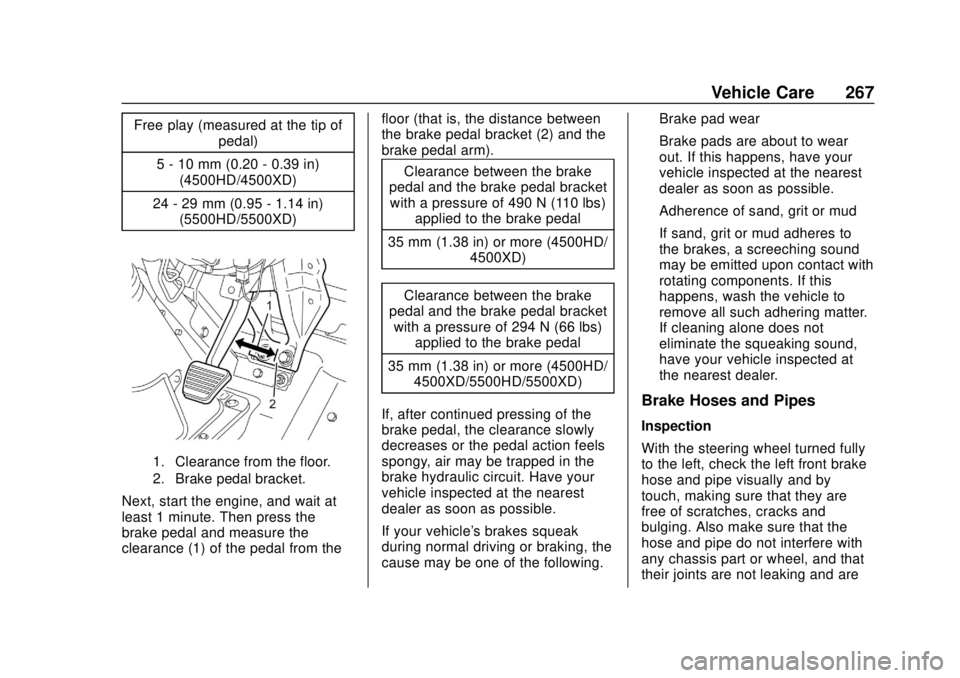
Free play (measured at the tip ofpedal)
5 - 10 mm (0.20 - 0.39 in) (4500HD/4500XD)
24 - 29 mm (0.95 - 1.14 in) (5500HD/5500XD)
1. Clearance from the floor.
2. Brake pedal bracket.
Next, start the engine, and wait at
least 1 minute. Then press the
brake pedal and measure the
clearance (1) of the pedal from the floor (that is, the distance between
the brake pedal bracket (2) and the
brake pedal arm).
Clearance between the brake
pedal and the brake pedal bracket with a pressure of 490 N (110 lbs)
applied to the brake pedal
35 mm (1.38 in) or more (4500HD/ 4500XD)
Clearance between the brake
pedal and the brake pedal bracket with a pressure of 294 N (66 lbs) applied to the brake pedal
35 mm (1.38 in) or more (4500HD/ 4500XD/5500HD/5500XD)
If, after continued pressing of the
brake pedal, the clearance slowly
decreases or the pedal action feels
spongy, air may be trapped in the
brake hydraulic circuit. Have your
vehicle inspected at the nearest
dealer as soon as possible.
If your vehicle's brakes squeak
during normal driving or braking, the
cause may be one of the following. ‐
Brake pad wear
Brake pads are about to wear
out. If this happens, have your
vehicle inspected at the nearest
dealer as soon as possible.
‐ Adherence of sand, grit or mud
If sand, grit or mud adheres to
the brakes, a screeching sound
may be emitted upon contact with
rotating components. If this
happens, wash the vehicle to
remove all such adhering matter.
If cleaning alone does not
eliminate the squeaking sound,
have your vehicle inspected at
the nearest dealer.
Brake Hoses and Pipes
Inspection
With the steering wheel turned fully
to the left, check the left front brake
hose and pipe visually and by
touch, making sure that they are
free of scratches, cracks and
bulging. Also make sure that the
hose and pipe do not interfere with
any chassis part or wheel, and that
their joints are not leaking and are
Page 290 of 382

Chevrolet Low Cab Forward 5.2L Diesel Engine 4500/5500 Series (GMNA-
Localizing-U.S.-12407814) - 2019 - crc - 12/13/17
Vehicle Care 289
{Warning
Always use fuses specified for the
vehicle. Using fuses with a rating
other than that specified, or using
wire or tin foil, etc., could result in
fire or damage.
If the new fuses blow right away
and the cause is unknown,
contact your dealer.
Do not inspect or replace fuses
when the starter switch is in the
ON position. Doing so may lead
to an accident.
When inspecting fuses, be sure to
park the vehicle on flat, level
ground and apply chocks to the
wheels.Replacing Relays
Before replacing the relays, contact
the nearest dealer.
The vehicle may not be equipped
with all of the fuses, relays, and
features shown.
It is not necessary to open or close
the cover unless trouble is found.
The relay box structure makes it
difficult for water to enter. If you
should spill water or a beverage of
the cover, however, wipe it off
before opening the cover.
The area around the cover will get
warm when the vehicle is being
driven, but this is not abnormal.
Page 296 of 382

Chevrolet Low Cab Forward 5.2L Diesel Engine 4500/5500 Series (GMNA-
Localizing-U.S.-12407814) - 2019 - crc - 12/13/17
Vehicle Care 295
{Warning
Always use fuses specified by the
dealer when replacing the
slow-blow fuse. Using fuses with
a rating other than that specified,
or using wire or tin foil, etc., could
result in fire or damage.
If the new fuses blow right away
and the cause is unknown,
contact your dealer.
Do not inspect or replace fuses
when the starter switch is in the
ON position. Doing so may lead
to an accident.
When inspecting fuses, be sure to
park the vehicle on flat, level
ground and apply chocks to the
wheels.It is not necessary to open or close
the cover unless trouble is found.
The relay box structure makes it
difficult for water to enter. If you
should spill water or a beverage of
the cover, however, wipe it off
before opening the cover.
The area around the cover will get
warm when the vehicle is being
driven, but this is not abnormal.
Wheels and Tires
The operating load and cold inflation
pressure on the rim and wheel must
not exceed the rim and wheel
manufacturer's recommendations
even though the tire may be
approved for a higher load or
inflation. Rim and wheel may be
identified (stamped) with maximum
load and maximum cold inflation
rating. For rims and wheels not so
identified or for service conditions
exceeding the rate capacities,
consult the rim and wheel
manufacturer to determine rim and
wheel capacities for the intended
service. The factory-installed tires
on this vehicle were selected to
provide the best all-around tire
performance for normal operation.
When inflated, as shown on the
vehicle, they have the load carrying
capacity to operate satisfactorily at
all loads up to and including the full
rated load specified for the vehicle.
For more information concerning the
differences in capacities of tires and
Page 297 of 382

Chevrolet Low Cab Forward 5.2L Diesel Engine 4500/5500 Series (GMNA-
Localizing-U.S.-12407814) - 2019 - crc - 12/13/17
296 Vehicle Care
rims, refer to the“Tire and Rim
Association Inc. Yearbook”, or your
tire dealer.
Tire Inflation
{Warning
To reduce the risk of loss of
vehicle control and personal
injury:
Tires must be properly inflated,
and your vehicle must not be
overloaded (see the information
on Information on Loading the
Vehicle 058 and "Tire Load and
Inflation Table" under Tire
Pressure 0307).
Be sure to keep tires properly
inflated. A tire that is run while
seriously underinflated may
overheat to the point where the
tire may lose air suddenly and/or
catch fire, possibly resulting in
personal injury and/or property
damage. See
“Tire Load and Inflation Table”
under Tire Pressure 0307.
In no case should the front or rear
tire load exceed the maximum
recommended gross axle weight
rating (front GAWR or rear GAWR).
The efficiency of the vehicle will be
upset if air pressure in the tires are
not equal. Balanced inflation results
when the tires on the same axle
carry the same air pressure.
A difference in pressure between
the front and rear tires may be
permissible within certain limitations,
however, there should not be a
difference in pressures between the
right and left tires on the same axle.
Always use a truck tire pressure
gauge (a pocket-type gauge is not
advised) when checking inflation
pressures. Visual inspection of tires
for inflation pressures is not enough,
especially in the case of radial tires.
Underinflated radial tires may look
similar to correctly inflated radial
tires. If the inflation pressure on a
tire is found to be low frequently,
have your dealer correct the cause. Be sure to install the tire inflation
valve caps to prevent dirt and
moisture from getting into the valve
core, which could cause air leakage.
An underinflated tire in a dual wheel
assembly is harder to notice than
one in a single wheel assembly. The
properly inflated dual tire carries its
own load plus that of the
underinflated tire. Both tires can
overheat, which may result in
property damage and/or personal
injury (see previous WARNING).
Tires Used or Stored for a Long
Period of Time
Tires are a rubber product and
degrade over time, even if they are
not being used. If any of your tires is
5 to 7 years old or more, please
have them inspected for safe
driving. For further information,
please check with the tire
manufacturer.
Dual Tire Operation
The outer tire of a pair on dual
wheel installations generally wears
faster than the inner tire. If this
Page 298 of 382

Chevrolet Low Cab Forward 5.2L Diesel Engine 4500/5500 Series (GMNA-
Localizing-U.S.-12407814) - 2019 - crc - 12/13/17
Vehicle Care 297
occurs, reverse the position of the
tires to equalize wear and get better
tire life.
In addition, when trucks are driven
continuously on high-crown roads,
an increase in air pressure of
35 kPa (5 psi) in the outer tire of a
dual tire operation will prolong outer
tire life. Be sure not to exceed the
inflation pressure limits shown on
the“VIN, Weight Rating, and
Greenhouse Gas (GHG) Emissions
Plate.” SeeVehicle Identification
Number (VIN) 0353.
Wheel and Tire Balancing
Proper tire balancing provides the
best riding comfort and helps to
reduce tire tread wear.
Out-of-balance tires can cause
annoying vehicle vibration and
uneven tire wear, such as cupping
and flat spots. See your authorized
dealer for wheel balancing.
Front End Alignment
Proper front end alignment improves
tire tread mileage. Your vehicle's
front end suspension parts should
be inspected often and aligned when needed. (See the
Maintenance Schedule for more
information.) Improper alignment will
not cause the vehicle to vibrate;
however, improper toe-in alignment
will cause front tires to roll at an
angle that will result in faster tire
wear. Incorrect caster or camber
alignment will cause your front tires
to wear unevenly, and may cause
the vehicle to "pull" to the left or
right.
Tire Traction
A decrease in driving, cornering and
braking traction occurs when water,
snow, ice, gravel or other material is
on the road surface. Driving
practices and vehicle speed should
be adjusted to the road conditions.
When driving on wet or slushy
roads, it is possible for a wedge of
water to build up between the tire
and road surface. This is known as
hydroplaning, and may cause partial
or complete loss of traction, vehicle
control and stopping ability; this
condition is also more likely with
worn tires.
To reduce the chance of traction
loss, follow these tips:
.
Slow down during rainstorms or
when roads are slushy.
. Slow down if the road has
standing water or puddles.
. Replace tires when front tread
depth is 3.2 mm (4/32 in.) and
rear tread depth is 1.6 mm
(2/32 in.).
. Keep tires properly inflated.
Tire Replacement
Recommendations
{Warning
Do not mix different construction
types of tires on your vehicle such
as radial, bias and bias-belted
tires except in emergencies,
because vehicle handling could
be affected and may result in loss
of vehicle control, or personal
injury or death. (Continued)