manual transmission CHEVROLET LOW CAB FORWARD 2020 User Guide
[x] Cancel search | Manufacturer: CHEVROLET, Model Year: 2020, Model line: LOW CAB FORWARD, Model: CHEVROLET LOW CAB FORWARD 2020Pages: 374, PDF Size: 6.18 MB
Page 91 of 374
Chevrolet Low Cab Forward 5.2L Diesel Engine 4500 HD/XD/5500 HD/XD
Owner Manual (GMNA-Localizing-U.S.-13337621) - 2020 - crc - 12/5/18
90 Infotainment System
AM Transmissions
Fading - AM broadcasts are
reflected by the upper atmosphere,
especially at night. These reflected
signals can interfere with those
received directly from the radio
station, causing the radio station to
sound alternately strong and weak.
Station interference - When a
reflected signal and a signal
received directly from a radio station
are very nearly the same frequency,
they can interfere with each other,
making it difficult to hear the
broadcast.
Static - AM is easily affected by
external sources of electrical noise,
such as high tension power lines,
lightning, or electrical motors. This
results in static.
Certification
For Federal Communications
Commission (FCC) compliance
information for this device, see
Radio Frequency Statement0362.
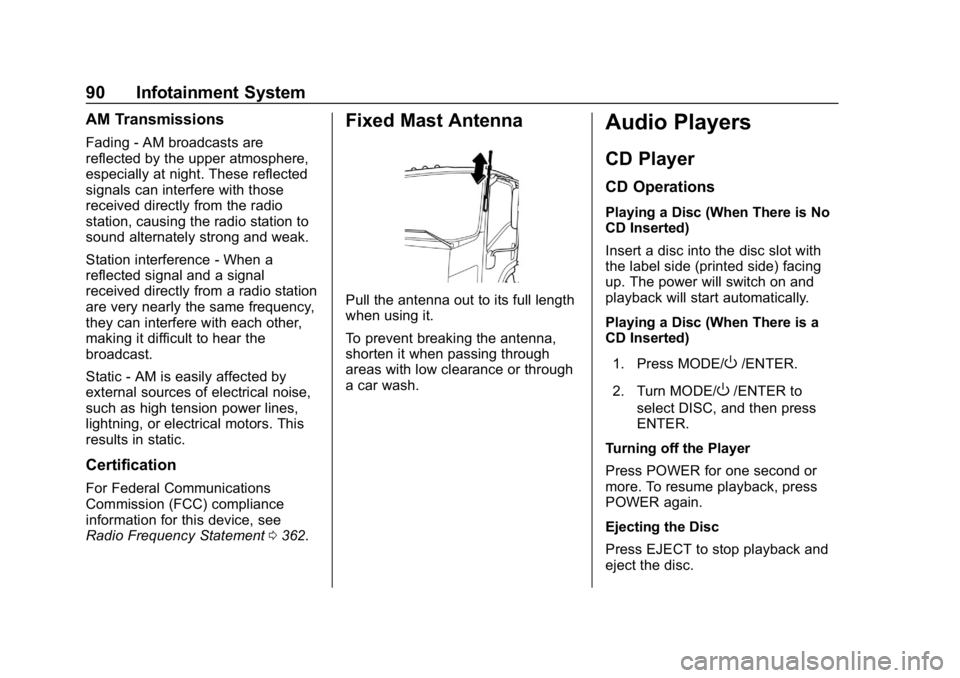
Fixed Mast Antenna
Pull the antenna out to its full length
when using it.
To prevent breaking the antenna,
shorten it when passing through
areas with low clearance or through
a car wash.
Audio Players
CD Player
CD Operations
Playing a Disc (When There is No
CD Inserted)
Insert a disc into the disc slot with
the label side (printed side) facing
up. The power will switch on and
playback will start automatically.
Playing a Disc (When There is a
CD Inserted)
1. Press MODE/
O/ENTER.
2. Turn MODE/
O/ENTER to
select DISC, and then press
ENTER.
Turning off the Player
Press POWER for one second or
more. To resume playback, press
POWER again.
Ejecting the Disc
Press EJECT to stop playback and
eject the disc.
Page 118 of 374
Chevrolet Low Cab Forward 5.2L Diesel Engine 4500 HD/XD/5500 HD/XD
Owner Manual (GMNA-Localizing-U.S.-13337621) - 2020 - crc - 12/5/18
Infotainment System 117
You can enter phone numbers
by one digit at a time.
Alphanumeric characters and
the following symbols are
available. '< > * + - . / \ = _
(space)
y: Advance to the next digit.
z: Delete the entered digit and
return to the previous digit.
5. After entering the name, press ENTER.
SAVED is displayed and the
name registration to the Speed
Dial is complete.
Setting the Volume
Call Volume: Turn Volume Adjust
during a call.
. Turn clockwise: Increase the
volume.
. Turn counterclockwise:
Decrease the volume. The
adjusted volume value is saved.
Ringtone Volume: Turn Volume
Adjust during an incoming call. .
Turn clockwise: Increase the
volume.
. Turn counterclockwise:
Decrease the volume. The
adjusted volume value is saved.
The volume and microphone gain
setting of each mobile phone is
different according to its
specification.
Setting the Sensitivity of the
Built-In Microphone
If your voice is too low or difficult to
hear for the person you are talking
to, or there is an echo or howling,
you can adjust the microphone
sensitivity.
Press the Level Adjust during a call.
y: Increase the sensitivity. (The
sound transmission is more
effective.)
z: Decrease the sensitivity. (The
sound transmission is less
effective.)
The setting can be adjusted within
the range of zero to MAX (10).
(Default: five). MIC LEVEL is displayed. MIC
LEVEL disappears in two seconds
after the operation is completed,
and the display returns to its original
state.
Talking on the Mobile Phone
(Private Mode)
You can switch phone calls from this
unit (handsfree mode) to the mobile
phone.
Press and hold down the Off Hook
for more than one second during
a call.
Entering Tone Numbers
You can transmit tone numbers
during a call.
1. Press FUNC during a call.
2. Turn MODE/
O/ENTER to
select the tone number. You
can enter phone numbers by
one digit at a time.
Numeric character (0-9) and
symbols (*, #, +) are available.
You can use the symbols (+)
only for the first digit.
Page 129 of 374

Chevrolet Low Cab Forward 5.2L Diesel Engine 4500 HD/XD/5500 HD/XD
Owner Manual (GMNA-Localizing-U.S.-13337621) - 2020 - crc - 12/5/18
128 Driving and Operating
Driving and
Operating
Driving Information
Driver Behavior . . . . . . . . . . . . . . . 129
Driving for Better FuelEconomy . . . . . . . . . . . . . . . . . . . . 129
Distracted Driving . . . . . . . . . . . . 130
Control of a Vehicle . . . . . . . . . . . 130
Braking . . . . . . . . . . . . . . . . . . . . . . . 134
Steering . . . . . . . . . . . . . . . . . . . . . . 140
Driving on Wet Roads . . . . . . . . 140
Hill and Mountain Roads . . . . . 141
Winter Driving . . . . . . . . . . . . . . . . 142
If the Vehicle Is Stuck . . . . . . . . 144
Emergencies (Troubleshooting) . . . . . . . . . . . 145
Emergencies (Disabled Vehicle) . . . . . . . . . . . . . . . . . . . . . 155
Starting and Operating
New Vehicle Break-In . . . . . . . . . 156
Pedals . . . . . . . . . . . . . . . . . . . . . . . . 157
Ignition Positions . . . . . . . . . . . . . 157
Starting and Stopping theVehicle . . . . . . . . . . . . . . . . . . . . . . 159
Operating Temperature . . . . . . . 162
Winter Cover . . . . . . . . . . . . . . . . . 163 Engine Heater . . . . . . . . . . . . . . . . 163
Engine Alarm and Automatic
Shutdown . . . . . . . . . . . . . . . . . . . 164
Idle Shutdown . . . . . . . . . . . . . . . . 164
High Idle System . . . . . . . . . . . . . 165
Engine Checks Before Operating . . . . . . . . . . . . . . . . . . . 166
Parking over Things That Burn . . . . . . . . . . . . . . . . . . . 167
Engine Exhaust
Engine Exhaust . . . . . . . . . . . . . . 168
Running the Vehicle WhileParked . . . . . . . . . . . . . . . . . . . . . . 170
Diesel Particulate Filter
Diesel Particulate Filter . . . . . . . 171
Diesel Exhaust Fluid
Diesel Exhaust Fluid . . . . . . . . . . 180
Automatic Transmission
Automatic Transmission . . . . . . 196
Selector Lever . . . . . . . . . . . . . . . . 205
Overdrive Off . . . . . . . . . . . . . . . . . 206
Brakes
Antilock BrakeSystem (ABS) . . . . . . . . . . . . . . . 207
Parking Brake . . . . . . . . . . . . . . . . 211
Exhaust Brake . . . . . . . . . . . . . . . . 213
Cruise Control
Cruise Control . . . . . . . . . . . . . . . . 214
Fuel
Fuel for Diesel Engines . . . . . . . 218
Biodiesel . . . . . . . . . . . . . . . . . . . . . 219
Cold Weather Operation . . . . . . 221
Water in Fuel . . . . . . . . . . . . . . . . . 221
Running Out of Fuel . . . . . . . . . . 224
Filling the Tank . . . . . . . . . . . . . . . 225
Conversions and Add-Ons
Add-On Electrical Equipment . . . . . . . . . . . . . . . . . . 227
Power Take-Off (PTO) . . . . . . . . 227
Page 137 of 374
Chevrolet Low Cab Forward 5.2L Diesel Engine 4500 HD/XD/5500 HD/XD
Owner Manual (GMNA-Localizing-U.S.-13337621) - 2020 - crc - 12/5/18
136 Driving and Operating
The exhaust brake should be turned
on as soon as service brake
malfunction is detected. This will
slow the engine speed. With the
engine speed under control and
providing the grade conditions
permit, the transmission can be
progressively downshifted using the
exhaust brake in each gear.
Eventually the exhaust brake should
slow the vehicle to a controllable
“crawl.”Gradually pull the parking
brake lever while firmly holding on
to the steering wheel. Stop the
vehicle on the side of the road. The
vehicle should not be driven further
until corrective measures are taken.
See Exhaust Brake 0213 and
Parking Brake 0211.
Riding the Brake
{Warning
"Riding the brake" by resting your
foot on the pedal, when you do
not intend to brake, can overheat
the brakes and wear out the (Continued)
Warning (Continued)
brake linings faster. This may also
damage the brakes and will waste
fuel. It can also result in reduced
braking performance.
You and others could be seriously
injured.
Applying the Parking Brake
Except in an emergency, do not
apply the parking brake until the
vehicle has come to a complete
stop. Applying the parking brake
before the vehicle has stopped can
cause a breakdown.
Refer toParking Brake 0211.
Parking Safely on a Slope
Avoid parking your vehicle on a
slope as much as possible and
choose a level and flat place. If you
must park your vehicle on a slope,
be sure to set the parking brake
fully. Make sure that the vehicle
does not move, and block the
wheels with chocks for added safety. Also, leave the vehicle in
gear to further ensure that it will not
move. Leave the steering wheel
turned such that the vehicle will be
stopped by an obstruction (for
example, the curb) in the unlikely
event that it moves.
Stopping and Parking with the
Engine Running
{Warning
When parking with the engine
running, first come to a complete
stop, then firmly apply the parking
brake, then move the selector
lever to the "P" (Park) position.
Unless you take these steps, any
unintended pressure on the
accelerator pedal could cause a
crash.
To reduce the chance of personal
injury and/or vehicle damage due
to engine overheating, never
leave the engine idling without an
alert driver present. If the engine
(Continued)
Page 138 of 374

Chevrolet Low Cab Forward 5.2L Diesel Engine 4500 HD/XD/5500 HD/XD
Owner Manual (GMNA-Localizing-U.S.-13337621) - 2020 - crc - 12/5/18
Driving and Operating 137
Warning (Continued)
should overheat, as indicated by
the engine coolant temperature
gauge, immediate action is
required to correct the condition.
Continued operation of the
engine, even for a short time, may
result in a fire. Do not engage the
exhaust brake while the engine is
idling as this may cause engine
overheating.
The diesel particulate filter (DPF)
may automatically start
regeneration when the vehicle is
stopped and parked with the
engine running. To prevent a fire,
make sure there is no flammable
material near the muffler, DPF,
and exhaust pipe. Be careful not
to get burned by hot exhaust
gases.
You and others could be seriously
injured.Do Not Forget to Release the
Parking Brake
Pulling away with the parking brake
still applied can damage the brake
system.
Before pulling away, make sure the
parking brake is not set by checking
that the parking brake indicator light
is not on.
Be Sure to Have the Engine
Running When the Vehicle is
Moving
{Warning
When the engine is not running,
the power steering system does
not work so the steering wheel is
hard to turn. Also, the brake
booster does not work so there is
little braking ability. If you coast
down a slope without the engine
running, you would not be able to
properly control the vehicle and
could have a crash.
Parking, or Leaving
Driver
’s Seat
{Danger
It can be dangerous to get out of
your vehicle if the selector lever is
not fully in "P" (Park) or the
parking brake is not applied all
the way. Your vehicle can roll or
move suddenly.
To be sure your vehicle will not
move, even when you are parking
on level ground, follow the steps
below. (If you have to park on a
hill, also turn your front wheels so
the vehicle will roll away from
traffic.)
You and others could be seriously
injured or killed.
1. Hold the regular brake pedal down with your right foot and
apply the parking brake all the
way before shifting the
transmission. Follow the
Parking Brake instructions in
this manual for your vehicle.
Page 139 of 374

Chevrolet Low Cab Forward 5.2L Diesel Engine 4500 HD/XD/5500 HD/XD
Owner Manual (GMNA-Localizing-U.S.-13337621) - 2020 - crc - 12/5/18
138 Driving and Operating
2. To move the selector lever to"P" (Park), hold in the button
on the lever and push the lever
all the way toward the front of
your vehicle.
3. Turn the key to "LOCK".
4. Remove the key and take it with you.
5. Before you leave the driver's seat, be sure the vehicle is not
moving, or check that your
vehicle is in Park by trying to
pull the selector lever out of "P"
(Park) by pulling the selector
lever toward you without
pushing the button. If you can
do this, it means that the
selector lever was not fully
locked into "P" (Park).
Do Not Touch the Selector Lever
While the Vehicle is Stationary
with the Engine Idling
Do not touch the selector lever while
the vehicle is stationary with the
engine idling. If you touch the
selector lever at this time, a gear
could be selected and the vehicle
could move even with the parking brake applied. The risk of knocking
against the selector lever and
causing a crash is particularly great
when you move in or out of
your seat.
Driving Down a Long Slope
When driving down a long slope,
use the exhaust brake together with
the foot brake. Using the exhaust
brake and low-gears reduces the
work load on the foot brakes and
yields greater braking force. Even
so, use the foot brakes
appropriately to prevent the engine
over-revving.
Frequent use of the foot brakes can
cause vapor lock and brake fade,
resulting in reduced brake
effectiveness.
Brake Fade :
Frequent use of the
brakes can cause the brakes to
overheat so that the frictional force
of the brake linings decreases and
the brakes become less effective
than normal. This phenomenon is
called brake fade. Vapor Lock :
If the brakes overheat
due to frequent use, the heat can
cause the brake fluid to boil so that
air bubbles are created in the brake
fluid. Pressing the brake pedal
simply compresses the air bubbles;
pressure is not transmitted to the
wheel cylinders, so the brakes'
effectiveness sharply deteriorates.
This phenomenon is called
vapor lock.
Even so, you should be very careful
when using engine braking in a low
gear because the engine is likely to
over-rev. See Exhaust Brake 0213
and
Selector Lever 0205.
Do not adjust the exhaust brake
valve.
The engine should never be allowed
to exceed the governed speed.
Supplement the exhaust brake with
vehicle service brakes intermittently
and/or shift to higher transmission
gear to prevent engine overspeed.
A rule of thumb for gear selection is
that the vehicle should be driven
down a grade in the same gear that
would be used to climb that grade.
Page 140 of 374

Chevrolet Low Cab Forward 5.2L Diesel Engine 4500 HD/XD/5500 HD/XD
Owner Manual (GMNA-Localizing-U.S.-13337621) - 2020 - crc - 12/5/18
Driving and Operating 139
{Warning
To reduce the risk of personal
injury, before going down a steep
or long grade, reduce speed, turn
on the exhaust brake and shift the
transmission to the next lower
gear. This will help control your
speed. Do not hold the brake
pedal down too long or too often
while going down a steep or long
grade. This could cause the
brakes to get hot and not to work
as well. As a result, the truck will
not slow down at the usual rate.
Failure to take these steps could
result in loss of vehicle control.
You and others could be seriously
injured.
Brake Effectiveness When the
Vehicle Has Been Driven on a
Flooded Road or Washed
{Warning
When the vehicle is driven on a
flooded road, parked on a flooded
road or washed, water can get
into the brakes and reduce their
effectiveness. If the brakes do not
work well afterward, drive slowly
and gently press the brake pedal
several times until the brakes dry
out and start working normally.
Always do this after driving
through water or washing the
vehicle to help reduce the risk of
personal injury. Before parking
the vehicle in winter, press the
brake pedal several times in the
same way to get rid of moisture in
the brakes. Otherwise, the
moisture in the brakes may freeze
and make the vehicle immovable.
You and others could be seriously
injured.If the vehicle must be driven on a
flooded road or is parked in an area
that becomes flooded, promptly
perform a check for the following
points:
.
Effectiveness of the brakes
. Water-ingress or damage to
drum brakes, disc brakes
. Engine damage due to
water-ingress
. Shorting of electrical
components
. Oil level and degradation
(cloudiness) of the engine,
transmission, differential
. Greasing of each components
(lubrication)
Page 145 of 374

Chevrolet Low Cab Forward 5.2L Diesel Engine 4500 HD/XD/5500 HD/XD
Owner Manual (GMNA-Localizing-U.S.-13337621) - 2020 - crc - 12/5/18
144 Driving and Operating
{Warning
If you park in a place where there
is a lot of snowfall, snow
accumulating around the vehicle
could limit ventilation. Running
the engine with the vehicle in
these conditions could cause
exhaust gases to enter the cabin,
resulting in carbon monoxide
poisoning. Take preventive action
by, for example, clearing the snow
around the vehicle.
You and others could be seriously
injured.
Do not park under trees or under
the eaves of a building. Chunks of
ice could fall on the vehicle if you
park in such a place.
Cleaning the Vehicle after
Driving on Snowy Roads
. The vehicle speed sensors are
fitted on the wheels. When
removing snow, ice, and other
incrustation, take great care not
to damage the components. .
Do not use a sharp implement to
remove snow. Sharp edges
could damage rubber parts.
Refer to Antilock Brake System
(ABS) 0207.
Remove snow that has stuck to the
inside of the fenders and to the
brake hoses. Otherwise, it may
damage components. After driving
on a salted road, wash the
underside of the vehicle as soon as
possible to prevent the salt from
causing rust. Spraying water under
high pressure is an effective way to
get the salt off.
After washing the vehicle, wipe the
door openings dry.
If the Vehicle Is Stuck
When Driving on Bad Roads
Caution
Do not spin wheels faster than
32 km/h (20 mph) in mud, sand,
snow, ice, or other poor road (Continued)
Caution (Continued)
conditions. Damage may result
from excessive wheel spinning,
including tire, transmission, and/
or rear axle malfunction.
If the vehicle gets stuck and it is
difficult to get out, immediately
stop driving and have the vehicle
towed.
If the vehicle gets stuck in sand,
mud, snow or ice, move the selector
lever from 2 to the R position. Apply
a light pressure to the accelerator
pedal while the transmission is in
gear. Remove your foot from the
accelerator and press the brake
pedal while shifting. Do not race the
engine. For best traction, avoid
spinning the wheels. When you
cannot avoid driving through deep
mud, using tire chains is an effective
way to avoid getting stuck.
When driving in sand or mud, avoid
hard braking, sudden acceleration,
and sharp turns of the steering
Page 155 of 374

Chevrolet Low Cab Forward 5.2L Diesel Engine 4500 HD/XD/5500 HD/XD
Owner Manual (GMNA-Localizing-U.S.-13337621) - 2020 - crc - 12/5/18
154 Driving and Operating
SymptomCauseCorrective Action Reference
Loud or abnormal
noises From the
transmission
Insufficient
transmission oil
Add oilSee
Automatic
Transmission Fluid
0 241
Transmission inner
components faulty
4-
From differential Insufficient differential
gear oil
Add oilSee
Rear Axle
(Gear Oil Viscosity
Chart) 0261 or
Rear Axle (Oil
Level Check) 0262
Differential inner
components faulty
4-
From the
suspension Spring pins, shackles,
or stoppers worn
4-
From the driveshaft Poor lubrication in each
component
Lubricate themSee
Owner Checks
and Services 0330
Splines or bearings worn
4-
Page 157 of 374

Chevrolet Low Cab Forward 5.2L Diesel Engine 4500 HD/XD/5500 HD/XD
Owner Manual (GMNA-Localizing-U.S.-13337621) - 2020 - crc - 12/5/18
156 Driving and Operating
If There is a Fuel Leak
{Danger
Leaking fuel from the vehicle is
dangerous due to possible
combustion or explosion. Stop the
engine immediately.
You and others could be seriously
injured or killed.
Starting and
Operating
New Vehicle Break-In
Good vehicle care begins with
proper break-in. While every new
vehicle goes through rigid factory
and dealer inspection and tests
before delivery, the care you give
your vehicle during the initial
break-in period can pay off in longer
life, better performance and more
economical operation.
It is therefore always recommended
that during the initial 1 000 km
(600 mile) break-in period, the
following few simple precautions are
carefully observed.
Follow the recommendations listed
below:
.Warm up the engine by driving
easily for the first few minutes
before placing it under load.
. Do not drive for extended
periods at any one constant
speed, either fast or slow, during
the first 800 km (500 miles). .
Use the correct gear to maintain
the desired road speed without
lugging the engine.
. Avoid racing the engine,
full-throttle starts and aggressive
application of brakes when
stopping.
. Keep tires properly inflated for
the load carried.
. Check lubricant levels in the
engine and transmission weekly.
. Keep speeds below 80 km/h
(50 MPH) for the first 800 km
(500 miles).
. Use the lowest gear ratio
available when starting a loaded
vehicle and when climbing
slopes to avoid lugging the
engine.
. It is recommended that the
engine speed is restricted to
2,300 r/min.