brake light CHEVROLET LUMINA 1993 1.G Owner's Manual
[x] Cancel search | Manufacturer: CHEVROLET, Model Year: 1993, Model line: LUMINA, Model: CHEVROLET LUMINA 1993 1.GPages: 324, PDF Size: 17.44 MB
Page 156 of 324
Downloaded from www.Manualslib.com manuals search engine Your Driving and the Road
I
If You’re Caught in a Blizzard
(CONT.)
Run your engine only as long as you
must. This saves fuel. When you run
the engine, make it go a little faster
than just idle. That is, push the
accelerator slightly. This uses less fuel
for the heat that you get and it keeps
the battery charged.
You will need a
well-charged battery to restart the
vehicle and possibly for signaling later
on with your headlights. Let the
heater run for a while.
Then, shut the engine
off and close
the window almost all the way to
preserve the heat. Start the engine
again and repeat this only when you
feel really uncomfortable from the
cold. But do it as little as possible.
Preserve the fuel as long as you can.
To help keep warm, you can get out of
the vehicle and do some fairly
vigorous exercises every half-hour or
so until help comes.
I54
If You’re Stuck in Deep Snow
This manual explains how to get the
vehicle out of deep snow without
damaging it. See the
Index under
Rocking Your Vehicle.
Towing a Trailer
II
CAUTION I
L
p.,gerly, you can lose control when
you pull a trailer. For example, if
the trailer is too heavy, the brakes
may not work well-or even at
all.
You and your passengers could be
seriously injured. Pull a trailer only
if you have followed all the steps in
this section.
L
railer improperly car
amage your vehicle and result in
costly repairs not covered by your
--
warranty. To pull a trailer
correctly, follow the advice
in this
__
Page 161 of 324
Downloaded from www.Manualslib.com manuals search engine Driving with a Trailer
Towing a trailer requires a certain
amount of experience. Before setting out for the open road, you’ll want to get
to know your rig. Acquaint yourself
with the feel of handling and braking
with the added weight of the trailer.
And always keep in mind that the
vehicle you are driving is now
a good
deal longer and not nearly
so responsive
as your vehicle is by itself.
Before you start, check the trailer hitch
and platform, safety chains, electrical connector, lights, tires and mirror
adjustment. If the trailer has electric
brakes, start your vehicle and trailer
moving and then apply the trailer brake
controller by hand to be sure the brakes
are worling. This lets you check your
electrical connection at the same time. During your
trip, check occasionally to
be sure that the load is secure, and that
the lights and any trailer brakes are still
working.
Following Distance
Stay at least twice as far behind the
vehicle ahead
as you would when
driving your vehicle without a trailer.
This can help you avoid situations that
require heavy braking and sudden
turns.
Passing
You’ll need more passing distance up
ahead when you’re towing a trailer.
And, because you’re a good deal longer,
you’ll need to go much farther beyond
the passed vehicle before you can return
to your lane.
Backing Up
Hold the bottom of the steering wheel
with one hand. Then, to move the
trailer to the left, just move that hand
to
the left. To move the trailer to the right,
move your hand to the right. Always
back up slowly and, if possible, have
someone guide you.
Page 162 of 324
Downloaded from www.Manualslib.com manuals search engine Your Driving and the Road
Driving with a Trailer (CONT.)
Making Turns
When you’re turning with a trailer, make wider turns than normal. Do this
so your trailer won’t strike soft
shoulders, curbs, road signs, trees, or
other objects. Avoid jerky or sudden
maneuvers. Signal well in advance.
Turn Signals When Towing a Trailer
When you tow a trailer, your vehicle has
to have a different turn signal flasher
and extra wiring. The green arrows on
your instrument panel will flash
whenever you signal a turn or lane
change. Properly hooked up, the trailer
lights will also flash, telling other
drivers you’re about to turn, change
lanes or stop.
I60
When towing a trailer, the green arrows
on your instrument panel will flash for
turns even if the bulbs on the trailer are
burned out. Thus, you may think
drivers behind you are seeing your
signal when they are not. It’s important
to check occasionally to be sure the
trailer bulbs are still working.
Your vehicle has bulb warning .lights.
When you plug trailer lights into your
vehicle’s lighting system, its bulb
warning lights may not let you know if
one
of your lights goes out. So, when
you have trailer lights plugged in, be
sure to check your vehicle and trailer
lights from time to time to be sure
they’re all working. Once you disconnect the trailer lights, the bulb
warning lights again can tell you if one
of your vehicle lights
is out.
Driving On Grades
Reduce speed and shift to a lower gear
before you start down a long or steep
downgrade. If you don’t shift down,
you
might have to use your brakes so much
that they would get hot and no longer
work well.
On a long uphill grade, shift down and
reduce your speed to around
45 mph
(70 Wh) to reduce the possibility of
engine and transaxle overheating.
If you are towing a trailer and you have
an automatic transaxle with Overdrive,
it’s best to drive in
D instead of (or,
as you need to, a lower gear). This will
minimize heat build-up and extend the
life of your transaxle.
Page 168 of 324
Downloaded from www.Manualslib.com manuals search engine I
, “ >,
1 -. i,
Problems on the Road
Jump Starting (CONT.)
2. Get the vehicles close enough so the
jumper cables can reach, but be sure
the vehicles aren’t touching each
other.
If they are, it could cause a
ground connection you don’t want.
You wouldn’t be able to start your
Chevrolet, and the bad grounding
could damage the electrical systems.
You could be injured if the
vehicles roll. Set the parking
brake firmly
on each vehicle. Put an
automatic transaxle in
P (Park) or
3. Turn off the ignition on both
vehicles. Turn
off all lights that aren’t
needed, and radios. This will avoid
sparks and help save both batteries.
And it could save your radio!
If you leave your radio on, it
be badly damaged. The repairs
:,’
wouldn’t be covered by your
warranty.
4. Open the hoods and locate the
batteries.
r-
An electric fan can start up
- L even when the engine is not
running and can injure
you. Keep
hands, clothing and tools away
from any underhood electric fan.
Find the positive
(+) and negative (-)
terminals on each battery. Your
Chevrolet has a remote positive
(+)
jump starting terminal. The terminal is
on the same side of the engine
compartment as your battery.
You should always use the remote
positive
(+) terminal instead of the
positive
(+) terminal on your battery.
To uncover the remote positive
(+)
terminal, lift the red plastic cap.
Page 189 of 324
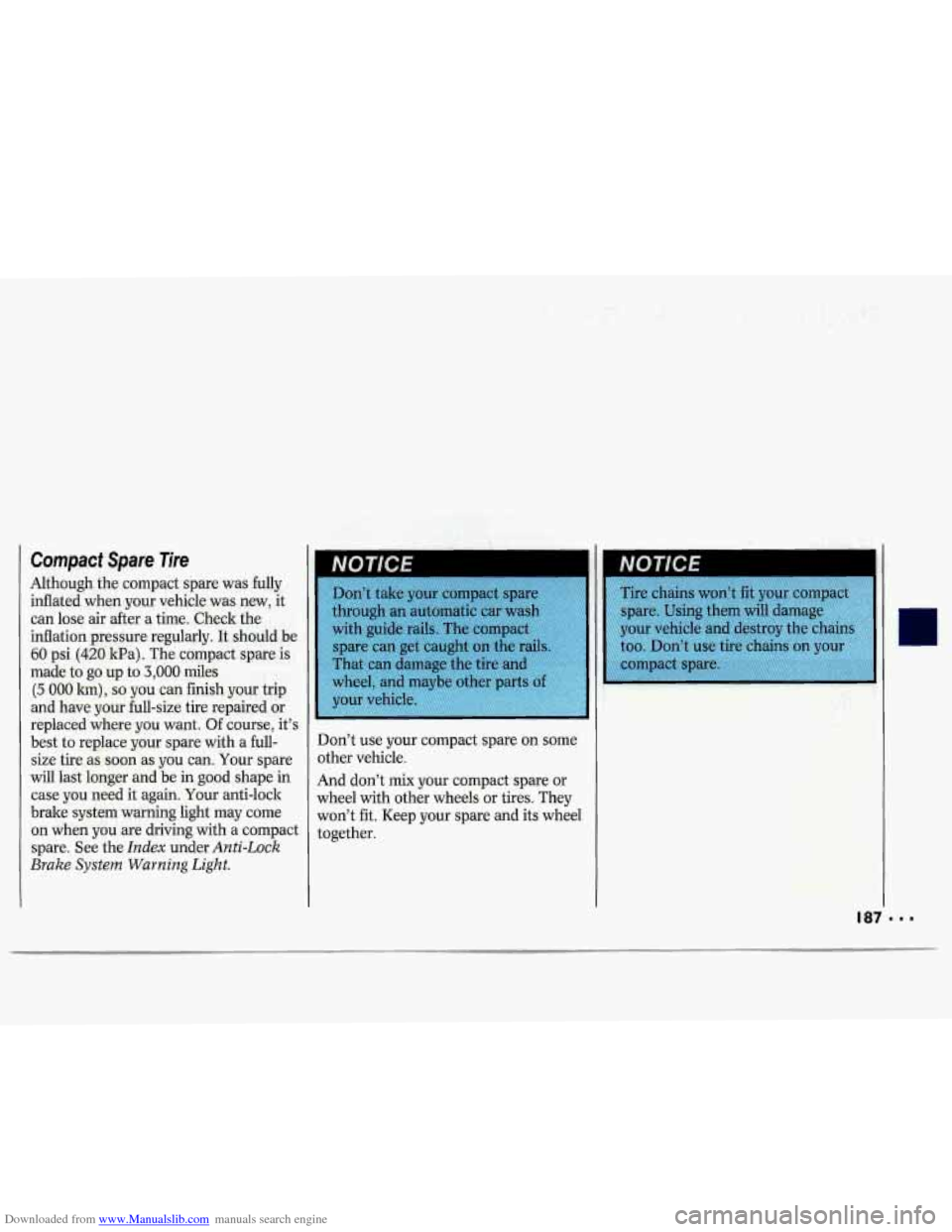
Downloaded from www.Manualslib.com manuals search engine Compact Spare Tire
Although the compact spare was fully
inflated when your vehicle was new, it
can lose air after a time. Check the
inflation pressure regularly. It should be
60 psi (420 kPa). The compact spare is
made to go up to
3,000 miles
(5 000 Inn), so you can finish your trip
and have
your full-size tire repaired or
replaced where
you want. Of course, it’s
best to replace your spare with a full-
size tire as soon as you can. Your spare
will last longer and be in good shape in
case you need it again. Your anti-lock
brake system warning light may come
on when you are driving with a compact
spare. See the
Index under Anti-Lock
Brake System Warning Light.
Don’t use your compact spare on some
other vehicle.
And don’t
mix your compact spare or
wheel with other wheels or tires. They
won’t fit. Keep your spare and its wheel
together.
Page 219 of 324
Downloaded from www.Manualslib.com manuals search engine p LA
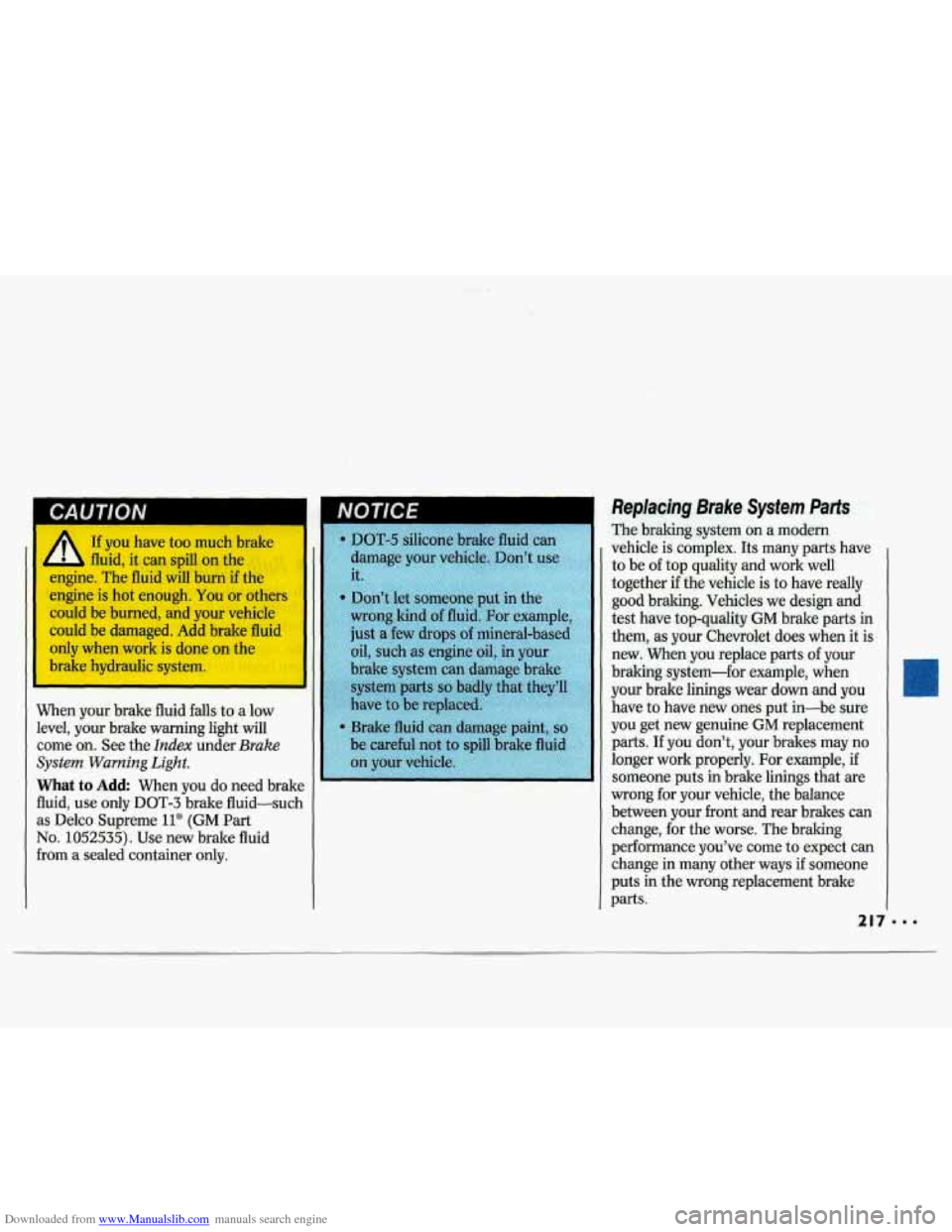
If you have too much brake
fluid, it can spill on the
engine. The fluid will burn
if the
engine is hot enough. You or others
could be burned, and your vehicle
could be damaged. Add brake fluid only when work is done on the
brake hydraulic system.
When your brake fluid falls
to a low
level, your brake warning light will
come
on. See the Index under Brake
System Warning Light.
What to Add When you do need brake
fluid, use only DOT-3 brake fluid-such as Delco Supreme
11@ (GM Part
No. 1052535). Use new brake fluid
from a sealed container only.
NOTICE I
Replacing Brake System Parts
The braking system on a modern
vehicle is complex. Its many parts have
to be of top quality and work well
together
if the vehicle is to have really
good braking. Vehicles we design and
test have top-quality
GM brake parts in
them, as your Chevrolet does when it is
new. When you replace parts of your
braking system-for example, when
your brake linings wear
down and you
have to have new ones put in-be sure
you get new genuine
GM replacement
parts. If you don’t, your brakes may no
longer work properly. For example,
if
someone puts in brake linings that are
wrong for your vehicle, the balance
between your front and rear brakes can
change, for the worse. The braking
performance you’ve come to expect can
change in many other ways
if someone
puts in the wrong replacement brake
parts.
Page 233 of 324
Downloaded from www.Manualslib.com manuals search engine A
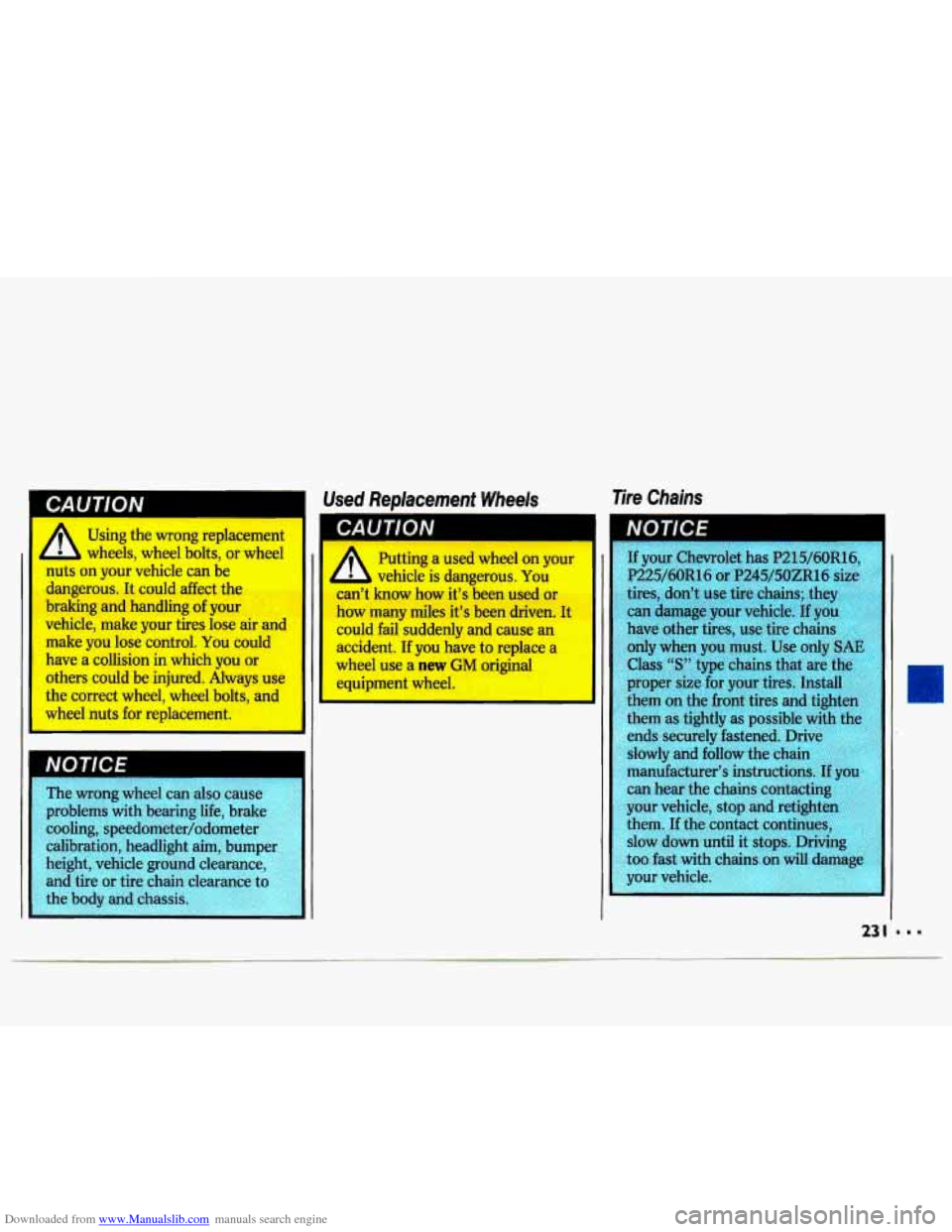
Using the wrong replacement
wheels, wheel bolts, or wheel
nuts on your vehicle can be
dangerous. It could affect the
braking and handling
of your
vehicle, make your tires lose air and
make you lose control.
You could
have a collision in which you or
others could be injured. Always use
the correct wheel, wheel bolts, and
wheel nuts for replacement.
-
The wrong wheel can also cause
problems with bearing life, brake
cooling, speedometer/odorneter
calibration, headlight aim, bumper
height, vehicle ground clearance,
and tire or tire chain clearance
to
the body and chassis.
Used Replacement Wheels Tire Chains
Putting a used wheel on your
L vehicle is dangerous. You
can’t know how it’s been used or
how many miles it’s been driven. It could fail suddenly and cause an
accident. If you have to replace a
wheel use a
new GM original
L equiDment wheel.
the
I
’I
Page 244 of 324
Downloaded from www.Manualslib.com manuals search engine Service & Appearance Care
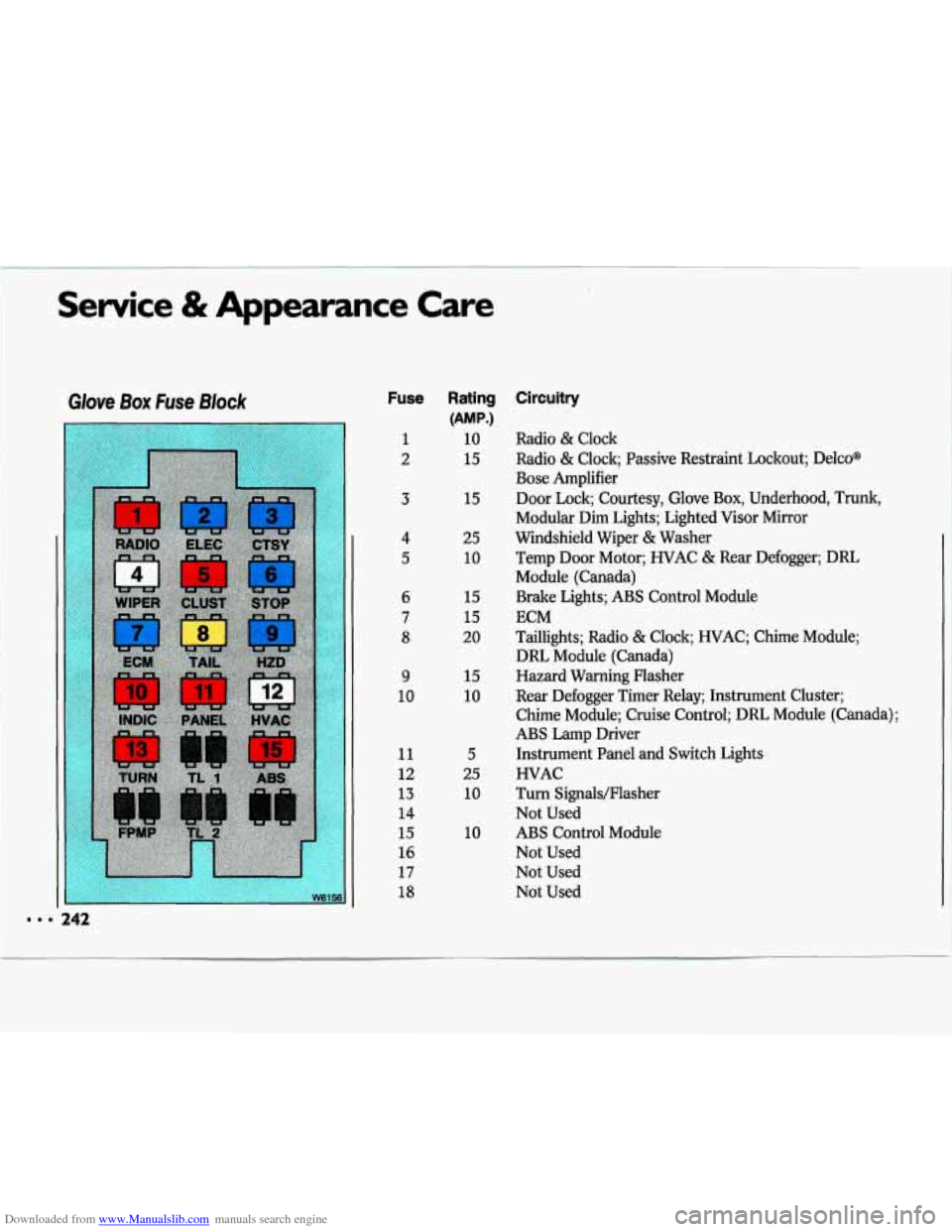
Glove Box Fuse Block
I-
. . . 242
W61561
Fuse
3
4
5
6
7
8
9
10
11
12
13
14
15
16
17
18
15
25
10
15
15
20
15
10 5
25
10 10
Rating Circuitry
1 10 Radio & Clock
2 15 Radio & Clock; Passive Restraint Lockout; Delcom
Bose Amplifier
Door Lock; Courtesy, Glove
Box, Underhood, Trunk,
Modular Dim Lights; Lighted Visor Mirror
Windshield Wiper
& Washer
Temp Door Motor; HVAC
& Rear Defogger; DRL
Module (Canada)
Brake Lights; ABS Control Module
ECM
Taillights; Radio
& Clock HVAC; Chime Module;
DRL Module (Canada)
Hazard Warning Flasher
Rear Defogger Timer Relay; Instrument Cluster;
Chime Module; Cruise Control; DIU Module (Canada);
ABS Lamp Driver
Instrument Panel and Switch Lights
HVAC
Turn Signals/Flasher
Not Used
ABS Control Module
Not Used
Not Used
Not Used
(AMP.)
Page 276 of 324
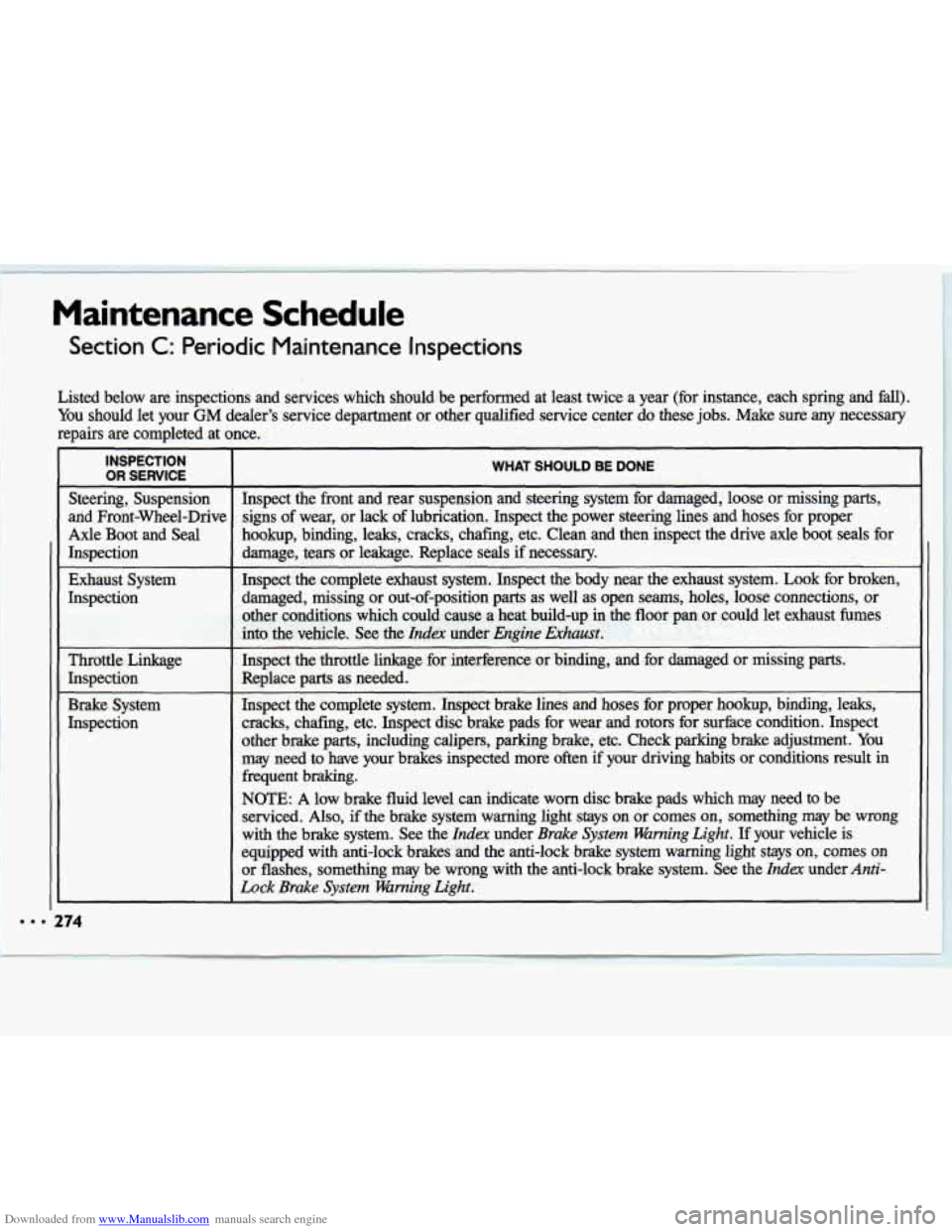
Downloaded from www.Manualslib.com manuals search engine Maintenance Schedule
Section C: Periodic Maintenance Inspections
Listed below are inspections and services which should be performed at least twice a year (for instance, each spring an\
d M).
You should let your GM dealer’s service department or other qualified service center do these jobs. Make sure any necessary
repairs are completed at once.
INSPECTION
OR SERVICE
Steering, Suspension
and Front-Wheel-Drive
Axle Boot and Seal
Inspection
Exhaust System
Inspection
Throttle Linkage
Inspection
Brake System
Inspection
I
WHAT SHOULD BE DONE
Inspect the front and rear suspension and steering system for damaged, loose or missing parts,
signs of wear, or lack of lubrication. Inspect the power steering lines and hoses for pro\
per
hookup, binding,
leaks, cracks, chafing, etc. Clean and then inspect the drive axle boot seals for
damage, tears or leakage. Replace
seals if necessary.
Inspect the complete exhaust system. Inspect the body near the exhaust system.
Look for broken,
damaged, missing or out-of-position parts as well as open seams, holes, loose connections, or
other conditions which could cause
a heat build-up in the floor an or could let exhaust fumes
into
the vehicle. See the Index under Engine Exhaust.
Inspect the throttle linkage for interference or binding, and for damaged or missing parts.
Replace parts as needed.
-~~
Inspect the complete system. Inspect brake lines and hoses for proper hookup, binding, leaks,
cracks, chafing, etc. Inspect disc brake pads for wear and rot\
ors for surface condition. Inspect
other brake parts, including calipers, parking brake, etc. Check parking brake adjustment. You
may need to have your brakes inspected more often
if your driving habits or conditions result in
frequent braking.
NOTE: A low brake fluid level can indicate worn disc brake pads which \
may need to be
serviced.
Also, if the brake system warning light stays on or comes on, something may be wrong
with the brake system.
See the Ida under Brake System Warning Light. If your vehicle is
equipped with anti-lock brakes and the anti-lock brake system w\
arning light
stays on, comes on
or flashes, something may be wrong with the anti-lock brake system. See the
Index under Anti-
Lock Brake System Warning Light.
I
Page 311 of 324
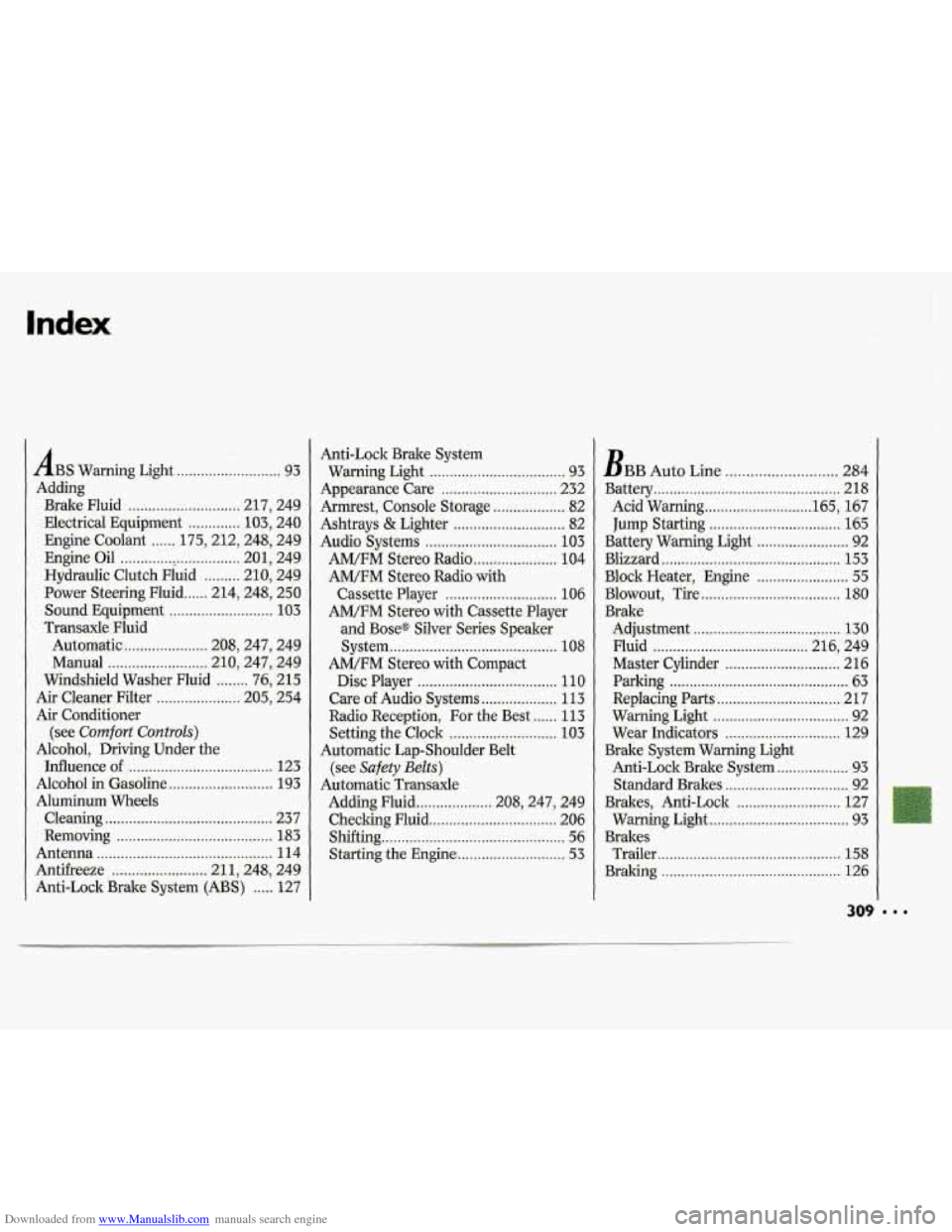
Downloaded from www.Manualslib.com manuals search engine Index
ABS Warning Light .......................... 93
Adding Brake Fluid
............................ 217. 249
Electrical Equipment
............. 103. 240
Engine Coolant
...... 175.212.248. 249
Engine Oil
.............................. 201. 249
Power Steering Fluid
...... 214.248. 250
Sound Equipment
.......................... 103
Transaxle Fluid Automatic
..................... 208. 247. 249
Manual
......................... 210. 247. 249
Air Cleaner Filter
..................... 205. 254
Air Conditioner
(see
Comfort ControZs)
Alcohol. Driving Under the
Influence
of .................................... 123
Alcohol in Gasoline
.......................... 193
Aluminum Wheels
Cleaning
.......................................... 23 7
Removing ....................................... 183
Antenna ............................................ 114
Antifreeze
........................ 21 1. 248. 249
Anti-Lock Brake System
(ABS) ..... 127
Hydraulic Clutch Fluid
......... 210. 249
Windshield Washer Fluid
........ 76. 215 Anti-Lock Brake System
Warning Light
.................................. 93
Appearance Care
............................. 232
Armrest. Console Storage
.................. 82
Ashtrays
& Lighter ............................ 82
Audio Systems
................................. 103
AM/FM Stereo Radio
..................... 104
AM/FM Stereo Radio with
Cassette Player
............................ 106
AM/FM Stereo with Cassette Player
and
Base@ Silver Series Speaker
System
.......................................... 108
AM/FM Stereo with Compact
Disc Player ................................... 110
Care
of Audio Systems ................... 113
Radio Reception. For the Best
...... 113
Setting the Clock
........................... 103
Automatic Lap-Shoulder Belt
(see
Safety Belts)
Automatic Transaxle
Adding Fluid ................... 208. 247. 249
Checking Fluid
................................ 206
Shifting
.............................................. 56
Starting the Engine
........................... 53
BBB Auto Line ........................... 284
Battery
............................................... 218
Acid Warning
........................... 165. 167
Jump Starting
................................. 165
Battery Warning Light
....................... 92
Blizzard
............................................. 153
Block Heater. Engine
....................... 55
Blowout. Tire ................................... 180
Brake Adjustment
..................................... 130
Fluid
....................................... 216. 249
Master Cylinder
............................. 216
Parlung
............................................. 63
Replacing Parts
............................... 217
Warning Light
.................................. 92
Wear Indicators
............................. 129
Anti-Lock Brake System
.................. 93
Standard Brakes
............................... 92
Brakes. Anti-Lock
.......................... 127
Warning Light
................................... 93
Brakes Trailer
.............................................. 158
Braking ............................................. 126
Brake System Warning Light