check engine CHEVROLET MALIBU 1997 5.G Workshop Manual
[x] Cancel search | Manufacturer: CHEVROLET, Model Year: 1997, Model line: MALIBU, Model: CHEVROLET MALIBU 1997 5.GPages: 354, PDF Size: 18.87 MB
Page 260 of 354
Downloaded from www.Manualslib.com manuals search engine When It’s Time for New Tires
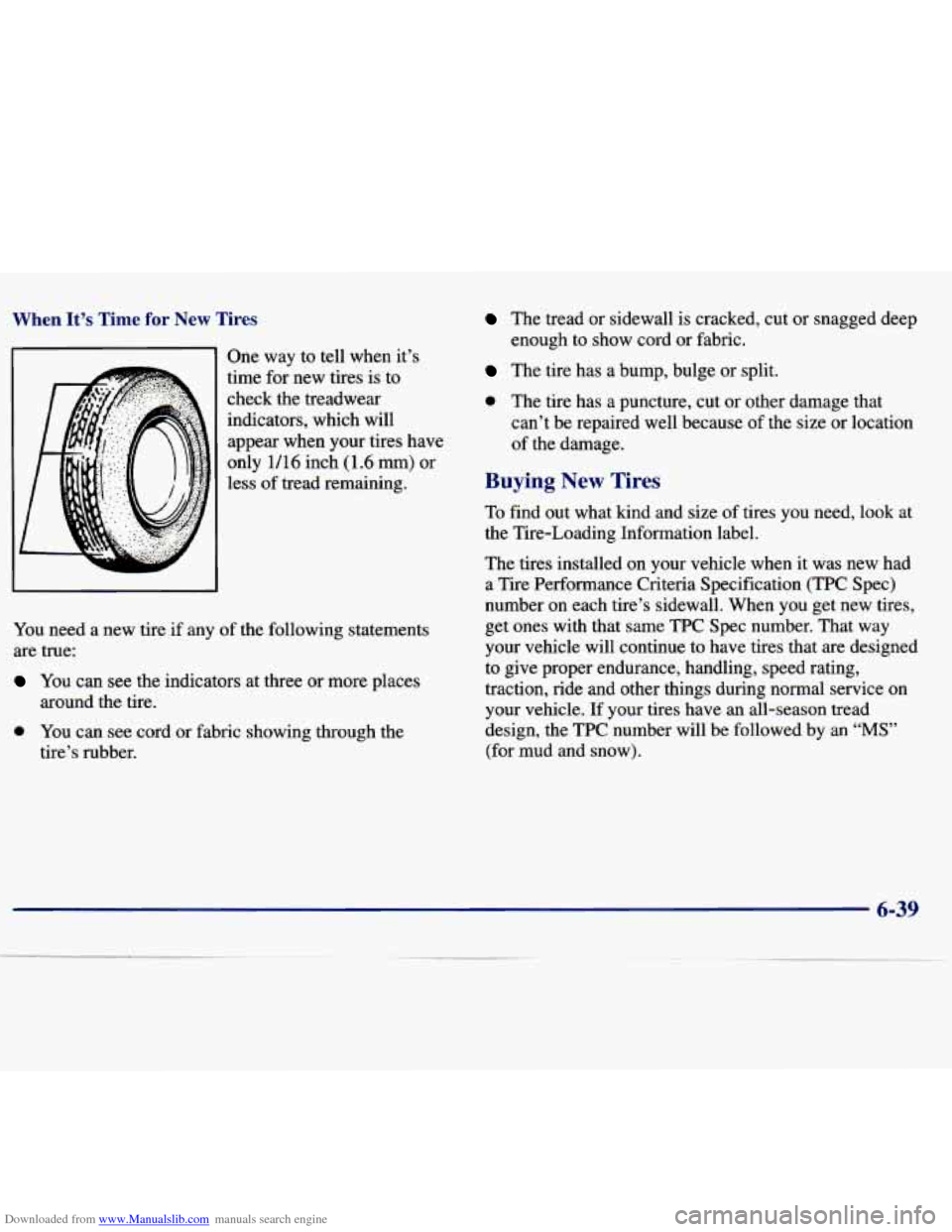
One way to tell when it’s
time for new tires is to
check the treadwear
indicators, which will appear when your tires have
only
1/16 inch (1.6 mm) or
less of tread remaining.
You need a new tire if any of the following statements
are true:
You can see the indicators at three or more places
around the tire.
0 You can see cord or fabric showing through the
tire’s rubber.
The tread or sidewall is cracked, cut or snagged deep
enough to show cord or fabric.
The tire has a bump, bulge or split.
0 The tire has a puncture, cut or other damage that
can’t be repaired well because
of the size or location
of the damage.
Buying New Tires
To find out what kind and size of tires you need, look at
the Tire-Loading Information label.
The tires installed on your vehicle when it was new had
a Tire Performance Criteria Specification (TPC Spec)
number on each tire’s sidewall. When you get new tires, get ones with that same
TPC Spec number. That way
your vehicle will continue to have tires that are designed
to give proper endurance, handling, speed rating,
traction, ride and other things during normal service on
your vehicle.
If your tires have an all-season tread
design, the
TPC number will be followed by an “MS”
(for mud and snow).
6-39
Page 269 of 354
Downloaded from www.Manualslib.com manuals search engine Cleaning the Outside of the
Windshield and Wiper Blades
If the windshield is not clear after using the windshield
washer, or
if the wiper blade chatters when running,
wax, sap or other material may be on the blade
or windshield.
Clean the outside of the windshield with GM
Windshield Cleaner, Bon
Ami@ Powder (non-scratching
glass cleaning powder), GM
Part No. 105001 1. The
windshield is clean if beads do not form when you rinse
it with water.
Grime from the windshield will stick
to the wiper blades
and affect their performance. Clean the blade by wiping
vigorously with a cloth soaked in full-strength
windshield washer solvent. Then rinse the blade
with water.
Check the wiper blades and clean them as necessary;
replace blades that look worn.
Weatherstrips
Silicone grease on weatherstrips will make them last
longer, seal better, and not stick or squeak. Apply
silicone grease with a clean cloth at least every six
months. During very cold, damp weather more frequent application may be required. (See “Recommended
Fluids and Lubricants” in the Index.)
Cleaning the Outside of Your Chevrolet
The paint finish on your vehicle provides beauty, depth
of color, gloss retention and durability.
Washing Your Vehicle
The best way to preserve your vehicle’s finish is to
keep it clean by washing
it often with lukewarm or
cold water.
Don’t wash your vehicle in the direct rays of the sun.
Don’t use strong soaps or chemical detergents. Use liquid hand, dish or car washing (mild detergent) soaps.
Don’t use cleaning agents that are petroleum based, or
that contain acid or abrasives. All cleaning agents
should be flushed promptly and not allowed to dry on
the surface, or they could stain. Dry the finish with a soft, clean chamois or an all-cotton towel
to avoid
surface scratches and water spotting.
6-48
Page 275 of 354
Downloaded from www.Manualslib.com manuals search engine Electrical System Headlamp Wiring
Add-on Electrical Equipment
NOTICE:
Don’t add anything electrical to your Chevrolet
unless you check with your dealer first.
Some
electrical equipment can damage your vehicle
and the damage wouldn’t be covered by your
warranty. Some add-on electrical equipment
can keep other components from working as
they should.
Your vehicle has an air bag system. Before attempting to add anything electrical to your Chevrolet, see “Servicing
Your Air Bag-Equipped Chevrolet” in the Index. The
headlamp wiring is protected by fuses, one for each
headlamp, in the fuse block.
An electrical overload will
cause the lamps to turn
off. If this happens, have your
headlamp wiring checked right away.
dshield Wipers
lne windshield wiper motor is protected by an internal
circuit breaker and a fuse.
If the motor overheats due to
heavy snow, etc., the wiper will stop until the motor
cools. If
the overload is caused by some electrical
problem and not snow, etc., be sure to get it fixed.
Power Windows and Other Power Options
Circuit breakers in the fuse block protect the power
windows and other power accessories. When
the current
load is too heavy, the circuit breaker opens and closes,
protecting the circuit until the problem
is fixed or
goes away.
6-54
Page 284 of 354
Downloaded from www.Manualslib.com manuals search engine 0 Section 7 Maintenance Schedule
This section covers the maintenance required for your Chevrolet. Your vehicle needs these services to retain its safety,
dependability and emission control performance.
7-2
7-2
7-3
7-4
7-4
7-5
7-5
7-6
7-6
Introduction to Your Maintenance Schedule
Your Vehicle and the Environment
How
this Section is Organized
Using Your Maintenance Schedule
Selecting the Right Schedule for
Your Vehicle
Short Trip/City Definition
Short TripKity Intervals
Long TripMghway Definition
Long TripMghway Intervals
7-37
7-37
7-38
7-41
7-42
7-43
7-43
7-38 Owner Checks
at Each Fuel Fill-up
What to Check at Least Once a Month
What to Check at Least Twice a Year
What to Check at Least Once a Year
Periodic Maintenance Inspections
Recommended Fluids and Lubricants
Tips for Keeping Track of Maintenance
A Place to Record Maintenance Procedures
Page 286 of 354
Downloaded from www.Manualslib.com manuals search engine How This Section is Organized
The remainder of this section is divided into five parts:
“Part A: Scheduled Maintenance Services” shows
what to have done and how often. Some of these
services can be complex,
so unless you are technically
qualified and have the necessary equipment, you should
let your dealer’s service department or another qualified
service center do these jobs.
Performing maintenance work on a vehicle can
be dangerous. In trying to do some jobs, you can
be seriously injured.
Do your own maintenance
work only if you have the required know-how
and the proper
tools and equipment for the job.
If you have any doubt, have a qualified
technician do the work.
If you are skilled enough to do some work on your
vehicle, you will probably want to get the service
information GM publishes. See “Service and Owner
Publications’’ in the Index.
“Part B: Owner Checks and Services” tells
you what should be checked and when. It also explains what you can easily do to help keep your vehicle in
good condition.
“Part C: Periodic Maintenance Inspections’’ explains
important inspections that your Chevrolet dealer’s service department or another qualified service center
should perform.
“Part D: Recommended Fluids and Lubricants” lists
some products GM recommends to help keep your
vehicle properly maintained. These products, or their
equivalents, should be used whether you do the work
yourself or have it done.
“Part E: Maintenance Record” provides a place for
you to record the maintenance performed on your
vehicle. Whenever
any maintenance is performed, be
sure to write it down in this part. This will help you
determine when your next maintenance should be done.
In addition,
it is a good idea to keep your maintenance
receipts. They may be needed to qualify your vehicle for
warranty repairs.
7-3
Page 287 of 354
Downloaded from www.Manualslib.com manuals search engine Part A: Scheduled Maintenance
Services
Using Your Maintenance Schedule
We at General Motors want to help you keep your
vehicle in good working condition. But we don’t know
exactly how you’ll drive it. You may drive
very short
distances only a few times a week. Or you may drive
long distances all the time in very hot, dusty weather.
You may use your vehicle in making deliveries. Or
you may drive it to work,
to do errands or in many
other ways.
Because
of all the different ways people use their GM
vehicles, maintenance needs vary. You may even need
more frequent checks and replacements than you’ll find
in the schedules in this section.
So please read this
section and note how you drive. If you have any
questions on how to keep your vehicle in good
condition,
see your Chevrolet dealer.
This part tells you the maintenance services you should
have done and when you should schedule them.
If you
go
to your dealer for your service needs, you’ll know
that GM-trained and supported service people will
perform the work using genuine GM
parts.
The proper fluids and lubricants to use are listed in Part D.
Make sure whoever services your vehicle uses these. All
parts should be replaced and all necessary repairs done
before you or anyone else drives the vehicle.
These schedules are for vehicles that:
carry passengers and cargo within recommended
limits. You will find these limits on your vehicle’s
Tire-Loading Information label. See “Loading
Your
Vehicle” in the Index.
0 are driven on reasonable road surfaces within legal
driving limits.
use the recommended fuel. See “Fuel” in the Index.
Selecting the Right Schedule
First you’ll need to decide which of the two schedules is
right for your vehicle. Here’s how to decide which
schedule to follow:
7-4
Page 290 of 354
Downloaded from www.Manualslib.com manuals search engine IShort TripKity Maintenance Schedule I
The services shown in this schedule up to 100,000 miles
(166
000 km) should be performed after 100,000 miles
(166
000 km) at the same intervals. The services shown
at 150,000 miles
(240 000 km) should be performed at
the same interval after
150,000 miles (240 000 km).
See “Owner Checks and Services” and “Periodic
Maintenance Inspections” following.
Footnotes
The U.S. Environmental Protection Agency or the
California Air Resources Board has determined that the
failure to perform this maintenance item will not nullify
the emission warranty or limit recall liability prior
to the
completion of the vehicle’s useful life. We, however,
urge that
all recommended maintenance services be
performed at the indicated intervals and the maintenance
be recorded.
+ A good time to check your brakes is during tire
rotation. See “Brake System Inspection” under “Periodic
Maintenance Inspection” in Part
C of this schedule.
3,000 Miles (5 000 km)
0 Change engine oil and filter (or every
3 months, whichever occurs first).
An Emission Control Service.
DATE ACTUAL MILEAGE SERVICED BY: I
7-7
Page 310 of 354
Downloaded from www.Manualslib.com manuals search engine Long Trip/Highway Maintenance Schedule
The services shown in this schedule up to 100,000 miles
(166
000 km) should be performed after 100,000 miles
(166
000 km) at the same intervals. The services shown
at
150,000 miles (240 000 km) should be performed at
the same interval after 150,000 miles (240
000 km).
See “Owner Checks and Services” and “Periodic
Maintenance Inspections” following.
Footnotes
The U.S. Environmental Protection Agency or the
California Air Resources Board has determined that the
failure to perform this maintenance item will not nullify
the emission warranty or limit recall liability prior to the
completion of the vehicle’s useful
life. We, however,
urge that all recommended maintenance services be
performed at the indicated intervals and the maintenance
be recorded.
+ A good time to check your brakes is during tire
rotation. See “Brake System Inspection” under “Periodic
Maintenance Inspections” in
Part C of this schedule.
7,500 Miles (12 500 km)
0 Change engine oil and filter (or every
12 months, whichever occurs first).
I7 Rotate tires. See “Tire Inspection and
Rotation” in the Index for proper rotation
pattern and additional information. (See footnote
+.)
An Emission Control Service.
I DATE ACTUAL MILEAGE SERVICED BY:
7-27
Page 320 of 354
Downloaded from www.Manualslib.com manuals search engine Part B: Owner Checks and Services
Listed below are owner checks and services which
should be performed at the intervals specified to help
ensure the safety, dependability and emission control
performance of your vehicle.
Be sure any necessary repairs
are completed at once.
Whenever any fluids or lubricants
are added to your
vehicle, make sure they
are the proper ones, as shown in
Part D.
At Each Fuel Fill
It is important for you or a service station attendant to
pe@orm these underhood checks
at each fuel fill.
Engine Oil Level Check
Check the engine oil level and add the proper oil
if necessary. See “Engine Oil” in the Index for
further details.
Engine Coolant Level Check
Check the engine coolant level and add the proper
coolant mix if necessary. See “Engine Coolant” in the
Index for further details.
Windshield Washer Fluid Level Check
Check the windshield washer fluid level in the
windshield washer tank and add the proper fluid if
necessary. See “Windshield Washer Fluid” in the Index
for further details.
At Least Once a Month
Tire Inflation Check
Make sure tires are inflated to the correct pressures.
See “Tires”
in the Index for further details.
Cassette Deck Service
Clean cassette deck. Cleaning should be done every
50 hours of tape play. See “Audio Systems” in the
Index for further details.
7-37
Page 321 of 354
Downloaded from www.Manualslib.com manuals search engine At Least Twice a Year
Restraint System Check
Make sure the safety belt reminder light and all your belts, buckles, latch plates, retractors and anchorages are working properly. Look for any other loose or damaged
safety belt system parts. If you see anything that might
keep a safety belt system from doing its job, have it
repaired. Have any torn or frayed safety belts replaced.
Also
look for any opened or broken air bag coverings,
and have them repaired or replaced. (The air bag system
does not need regular maintenance.)
Wiper Blade Check
Inspect wiper blades for wear or cracking. Replace blade
inserts that appear worn or damaged or that streak or
miss areas of the windshield. Also see “Wiper Blades,
Cleaning” in the Index.
At Least Once a Year
Key Lock Cylinders Service
Lubricate the key lock cylinders with the lubricant
specified in Part
D.
Body Lubrication Service
Lubricate all body door hinges and latches, including
those for the hood and trunk lid. Part
D tells you what to
use. More frequent lubrication may be required when
exposed to a corrosive environment.
7-3s