ignition CHEVROLET MALIBU 1997 5.G Owners Manual
[x] Cancel search | Manufacturer: CHEVROLET, Model Year: 1997, Model line: MALIBU, Model: CHEVROLET MALIBU 1997 5.GPages: 354, PDF Size: 18.87 MB
Page 36 of 354
Downloaded from www.Manualslib.com manuals search engine Servicing Your Air Bag-Equipped Chevrolet
Air bags affect how your Chevrolet should be serviced.
There are parts of the air bag system in several places
around your vehicle. You don’t want the system to
inflate while someone is working on your vehicle. Your
Chevrolet dealer and the Malibu Service Manual have
information about servicing your vehicle and the air bag system. To purchase a service manual, see “Service and
Owner Publications” in the Index.
Rear Seat Passengers
It’s very important for rear seat passengers to buckle up!
Accident statistics show that unbelted people
in the rear
seat are
hurt more often in crashes than those who are
wearing safety belts.
Rear passengers who aren’t safety belted can be thrown out of the vehicle
in a crash. And they can strike others
in the vehicle who are wearing safety belts.
I
A CAUTION:
F- 1
For up to 10 minutes after the ignition key is
turned
off and the battery is disconnected, an air
bag can still inflate during improper service. You
can be injured if you are close to an air bag when
it inflates.
Avoid yellow connectors. They are
probably part of the air bag system. Be sure to
follow proper service procedures, and make sure
the person performing work for you is qualified
to do
so.
The air bag system does not need regular maintenance.
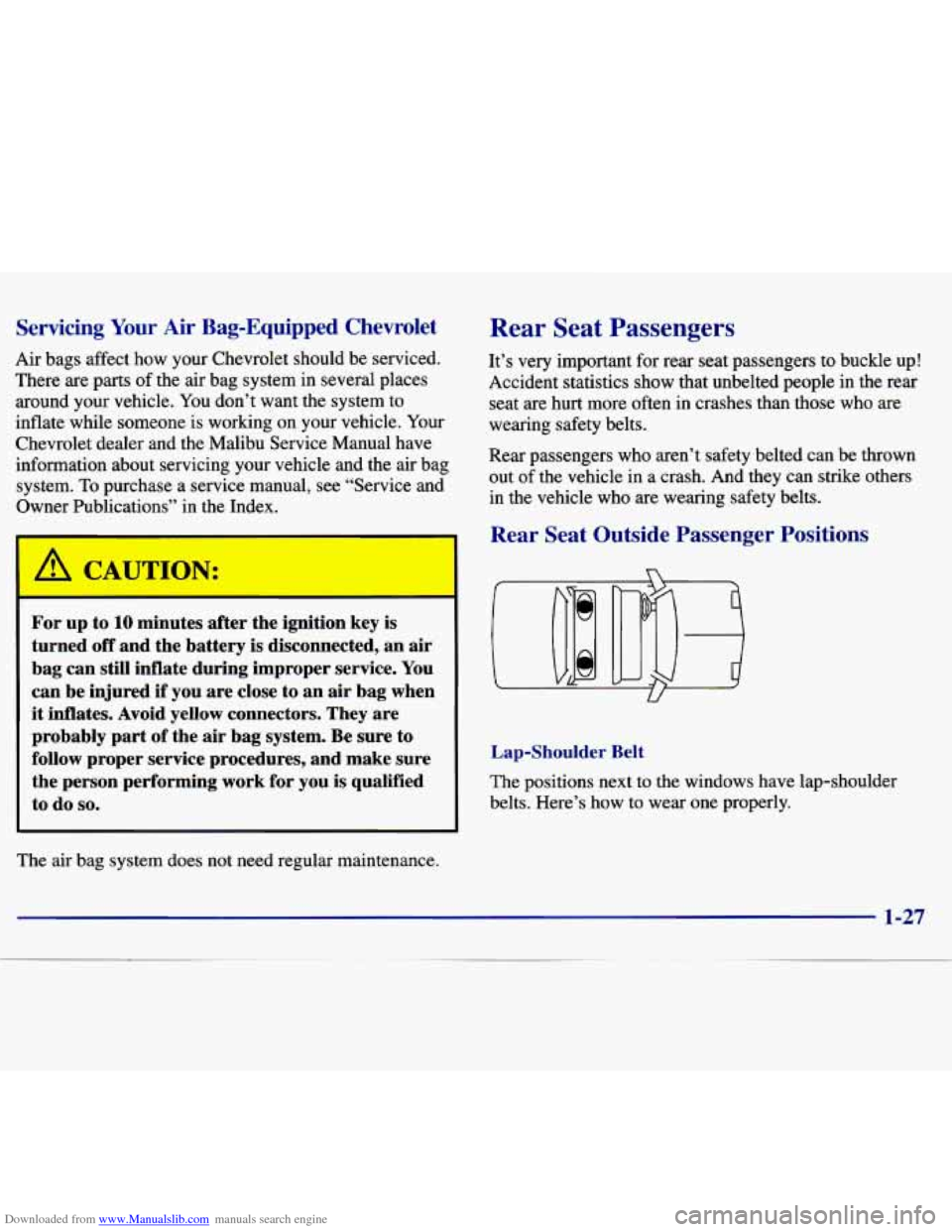
Rear Seat Outside Passenger Positions
Lap-Shoulder Belt
The positions next to the windows have lap-shoulder
belts. Here’s how to wear one properly.
1-27
Page 58 of 354
Downloaded from www.Manualslib.com manuals search engine Section 2 Features and Controls
2-2
2-4
2-5
2-6 2- 8
2-1
1
2-13 2-13
2- 14
2-
17
2-18
2-22
2-22
2-26
Here you can learn about the many standard and optional featur\
es on your Chevrolet, and information
on starting,
shifting and braking. Also explained are the instrument panel and the warning systems that tell you if everything is
working properly
-- and what to do if you have a problem.
Important Information About Keys
Door Locks Operation of Child Security Locks
Keyless Entry System
Battery Replacement for Keyless
Entry System
Preventing Theft
of Your Vehicle
New Vehicle “Break-In”
Ignition Positions
Tips on Starting Your Engine
Using the Engine Coolant Heater
Automatic Transaxle Operation
Second-Gear Start
Parking Brake Guidelines
Important Information on Engine Exhaust 2-27
2-28
2-29
2-30
2-30
2-33
2-36 2-37
2-3 8
2-40
2-42
2-47
2-48
2-52 Operation
of Your Windows
Adjusting the Tilt Steering Wheel
Functions of the Multifunction Lever
How to Use the High/Low Beam
Headlamp Changer
Windshield Wipers and Fluid
Using Cruise Control
Exterior Lamps Daytime Running Lamps (DRL)
Interior Lamps Rearview Mirrors
Storage Compartments
Sunroof
Instrument Panel Overview
All About Your Warning Lights and Gages
Page 59 of 354
Downloaded from www.Manualslib.com manuals search engine Keys
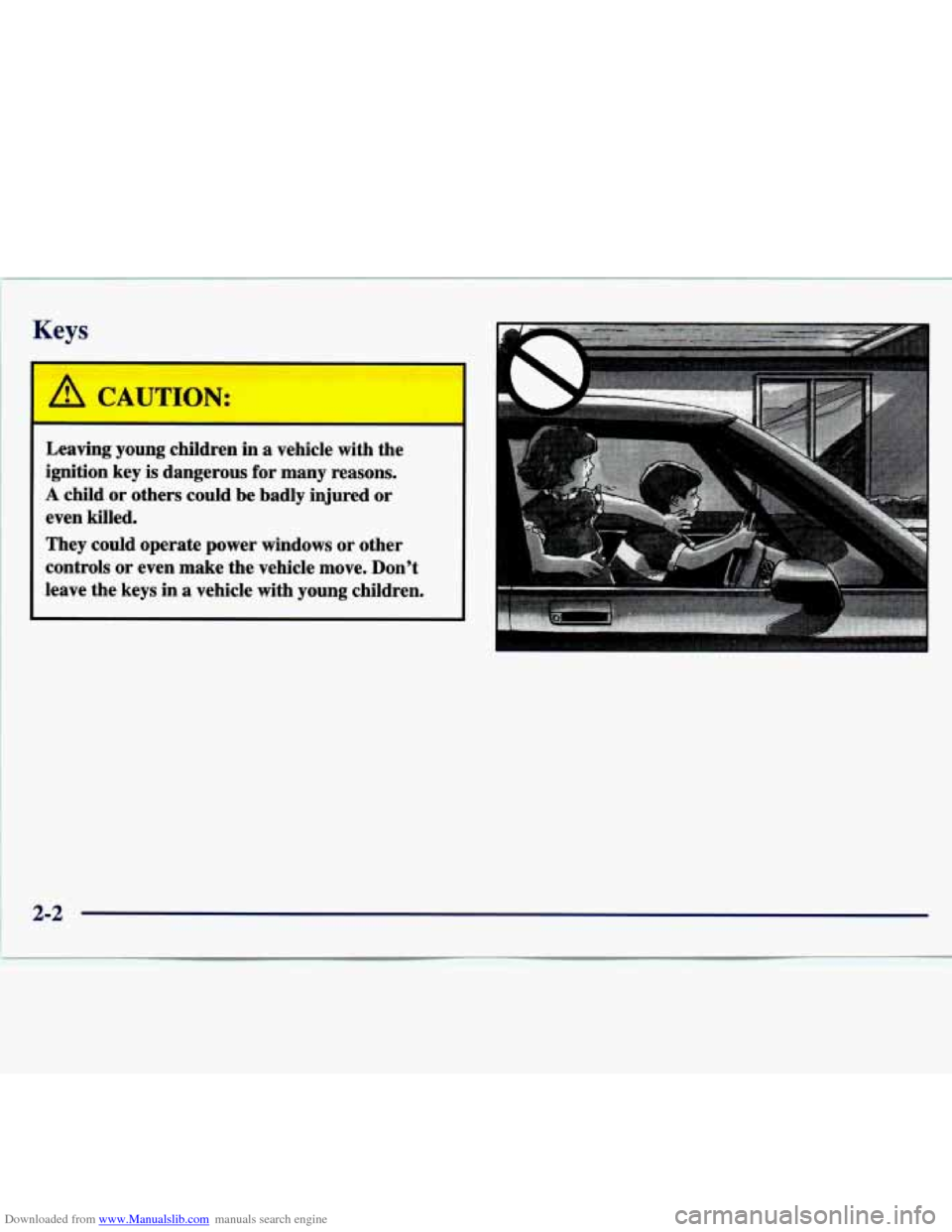
Leaving young children in a vehicle with the
ignition key is dangerous for many reasons.
A child or others could be badly injured or
even killed.
They could operate power windows or other
controls
or even make the vehicle move. Don’t
leave the keys in a vehicle with young children.
2-2
Page 60 of 354
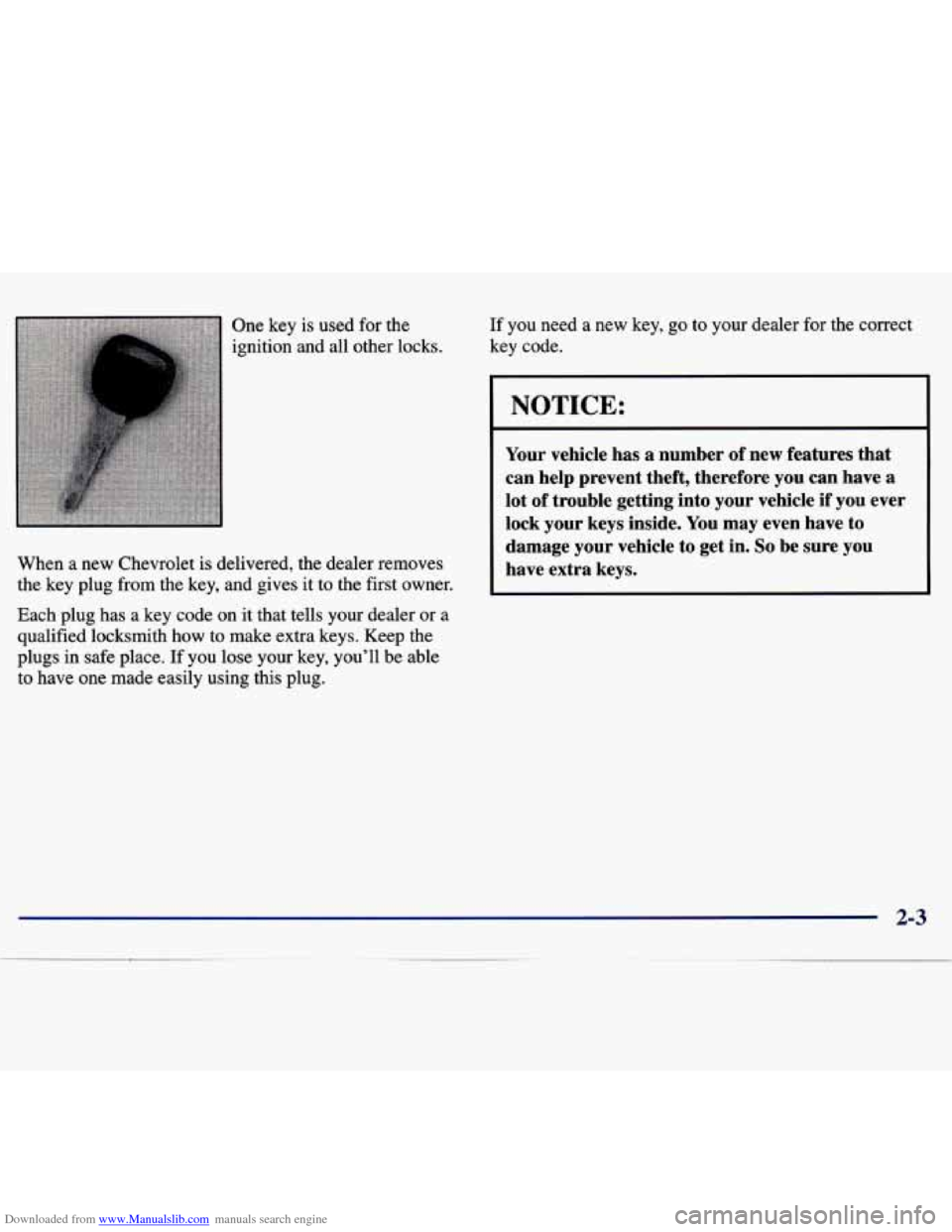
Downloaded from www.Manualslib.com manuals search engine One key is used for the
ignition and
all other locks. If you need
a new key, go to your dealer for the correct
key code.
When a new Chevrolet is delivered, the dealer removes
the key plug from the key, and gives it to the first owner.
Each plug has a key code on it that tells your dealer or a
qualified locksmith how to
make extra keys. Keep the
plugs in safe place.
If you lose your key, you’ll be able
to have one made easily using this plug.
I NOTICE:
Your vehicle has a number of new features that
can help prevent theft, therefore you can have a
lot of trouble getting into your vehicle if you ever
lock your keys inside. You may even have to
damage your vehicle to get
in. So be sure you
have extra keys.
2-3
~
Page 62 of 354
Downloaded from www.Manualslib.com manuals search engine Power Door Locks (If Equipped)
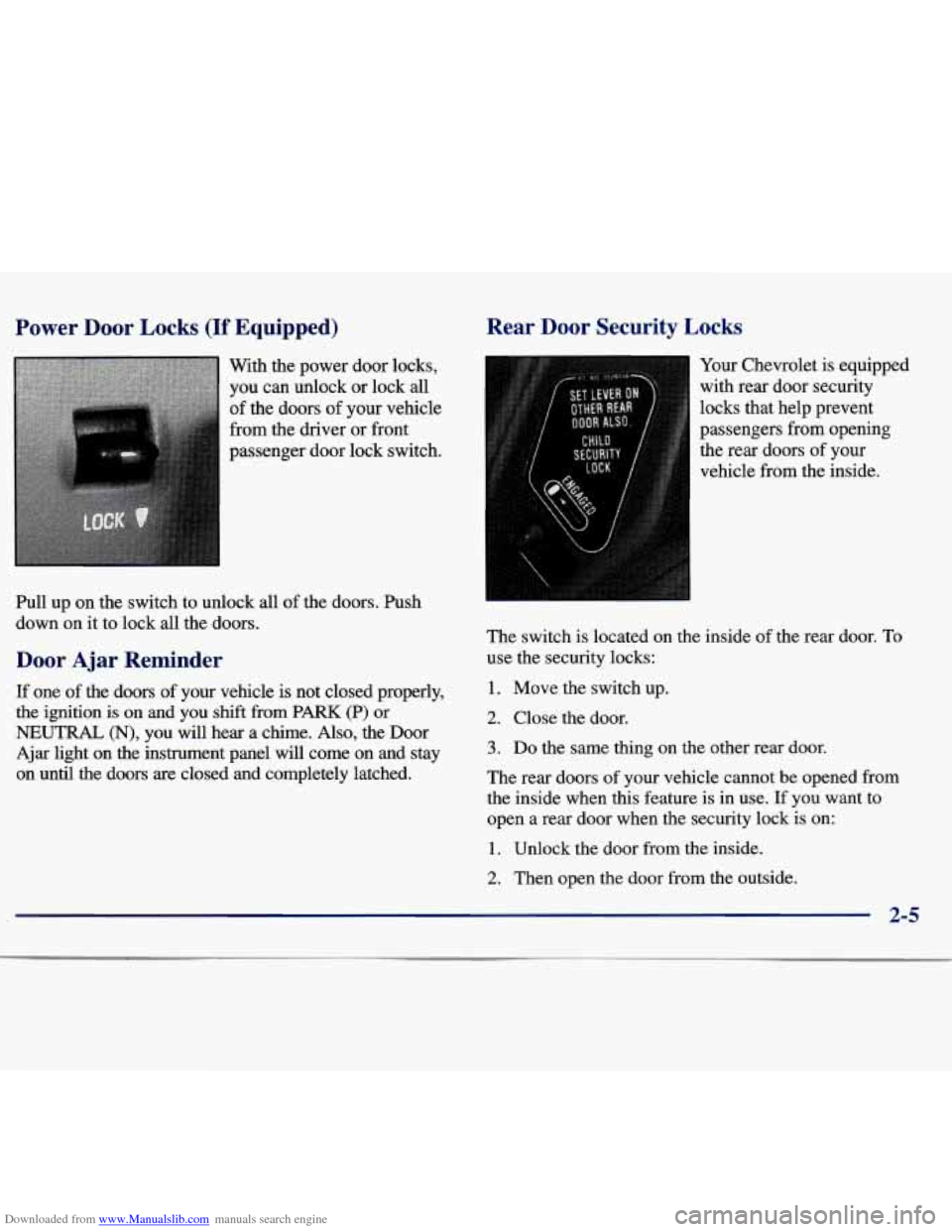
With the power door locks,
you can unlock or lock
all
of the doors of your vehicle
from the driver or front
passenger door lock switch.
Pull up on the switch to unlock all of the doors. Push
down on it to lock
all the doors.
Door Ajar Reminder
If one of the doors of your vehicle is not closed properly,
the ignition is on and you shift from PARK (P) or
NEUTRAL (N), you will hear a chime. Also, the Door
Ajar light on the instrument panel will come on and stay
on until the doors are closed and completely latched.
Rear Door Security Locks
-
Your Chevrolet is equipped
with rear door security
locks that help prevent
passengers from opening
the rear doors
of your
vehicle from the inside.
The switch is located on the inside of the rear door.
To
use the security locks:
1. Move the switch up.
2. Close the door.
3. Do the same thing on the other rear door.
The rear doors of your vehicle cannot be opened from
the inside when this feature is in use.
If you want to
open
a rear door when the security lock is on:
1. Unlock the door from the inside.
2. Then open the door from the outside.
2-5
Page 68 of 354
Downloaded from www.Manualslib.com manuals search engine ..
I
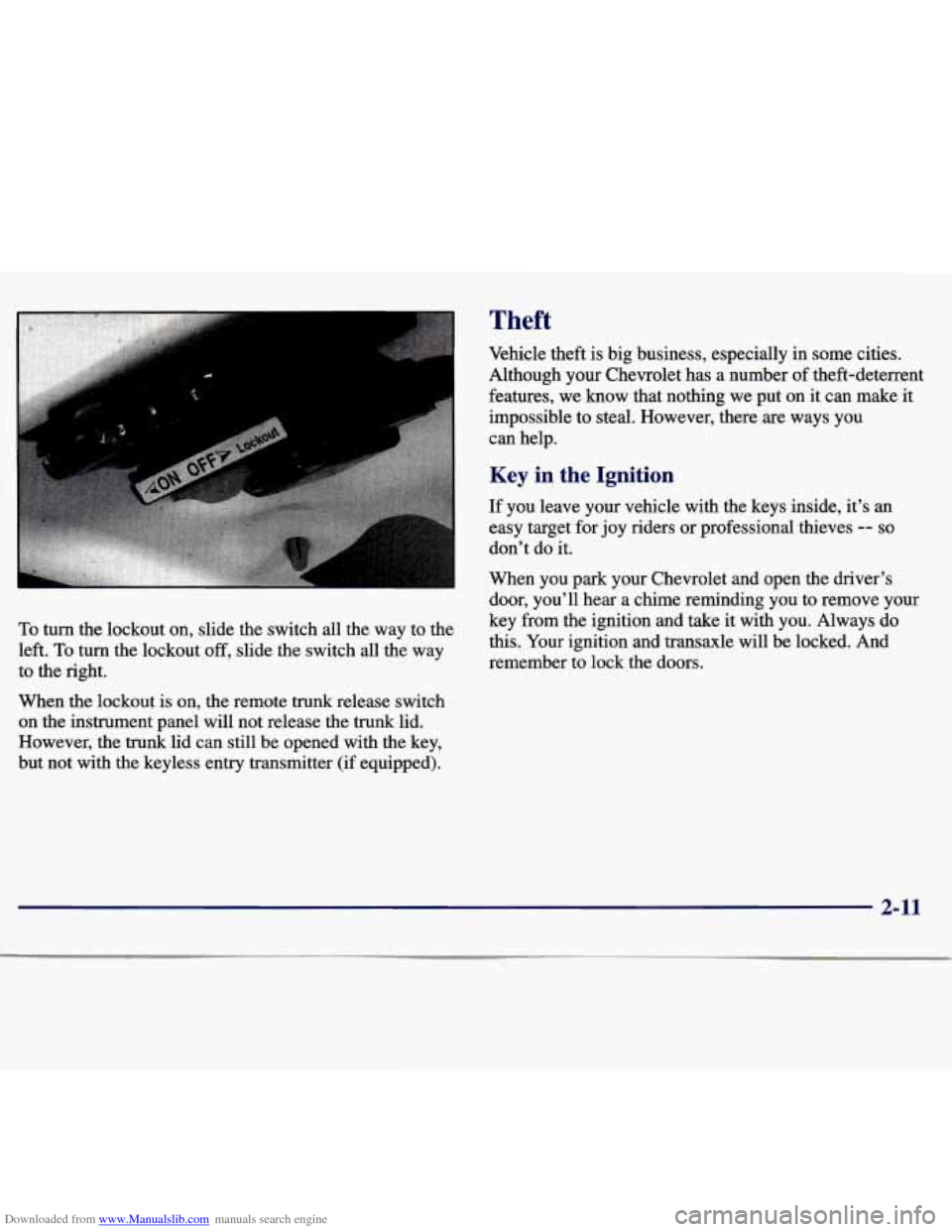
To turn the lockout on, slide the switch all the way to the
left.
To turn the lockout off, slide the switch all the way
to the right.
When
the lockout is on, the remote trunk release switch
on the instrument panel
will not release the trunk lid.
However, the
trunk lid can still be opened with the key,
but not with the keyless entry transmitter
(if equipped).
Theft
Vehicle theft is big business, especially in some cities.
Although your Chevrolet has a number of theft-deterrent
features, we know that nothing we put on it can make
it
impossible to steal. However, there are ways you
can help.
Key in the Ignition
If you leave your vehicle with the keys inside, it’s an
easy target for joy riders or professional thieves
-- so
don’t do it.
When you park your Chevrolet and open the driver’s
door, you’ll hear a chime reminding you to remove your
key from the ignition and take it with you. Always do
this. Your ignition and transaxle will be locked. And
remember to lock the doors.
2-11
Page 69 of 354
Downloaded from www.Manualslib.com manuals search engine Parking at Night Passlock TM
Park in a lighted spot, close all windows and lock your
vehicle. Remember to keep your valuables out of sight.
Put them
in a storage area, or take them with you.
Parking Lots
If you park in a lot where someone will be watching
your vehicle, it’s best to lock it up and take your keys. \
But what if you have to leave your key? What if you
have to leave something valuable in your vehicle?
Put your valuables in a storage area, like your trunk
or glove box.
Lock the glove box.
0 Lock all the doors except the driver’s. Your
vehicle is equipped with the Passlock
theft-deterrent system.
Passlock is a passive theft-deterrent system. The system
is armed once the key is removed from the ignition.
Passlock enables fuel
if the ignition lock cylinder is
turned with a valid key. If a correct key is not used,
fuel is disabled.
During normal operation, the THEFT SYSTEM light
will go
off after the engine is started. If the THEFT
SYSTEM light flashes, wait until the light stops flashing
before starting the engine.
If the
THEFT SYSTEM light comes on while the engine
is running, a problem has been detected and the system
may need service. See your dealer for service.
In an emergency, call the Chevrolet Roadside Assistance
Program at 1-800-CHEV-USA
(1-800-243-8872).
2-12
Page 70 of 354
Downloaded from www.Manualslib.com manuals search engine New Vehicle “Break-In”
NOTICE:
Your modern Chevrolet doesn’t need an
elaborate “break-in.” But it
will perform better
in the long run
if you follow these guidelines:
0 Don’t drive at any one speed -- fast or
slow
-- for the first 500 miles (805 km).
Don’t make full-throttle starts.
200 miles (322 km) or so. During this time
your new brake linings aren’t yet broken
in. Hard stops with new linings can mean
premature wear and earlier replacement.
Follow this breaking-in guideline every
time you get new brake
linings.
See “Towing a nailer” in the Index for
more information.
0 Avoid making hard stops for the first
Don’t tow a trailer during break-in.
Ignition Positions
A
hB
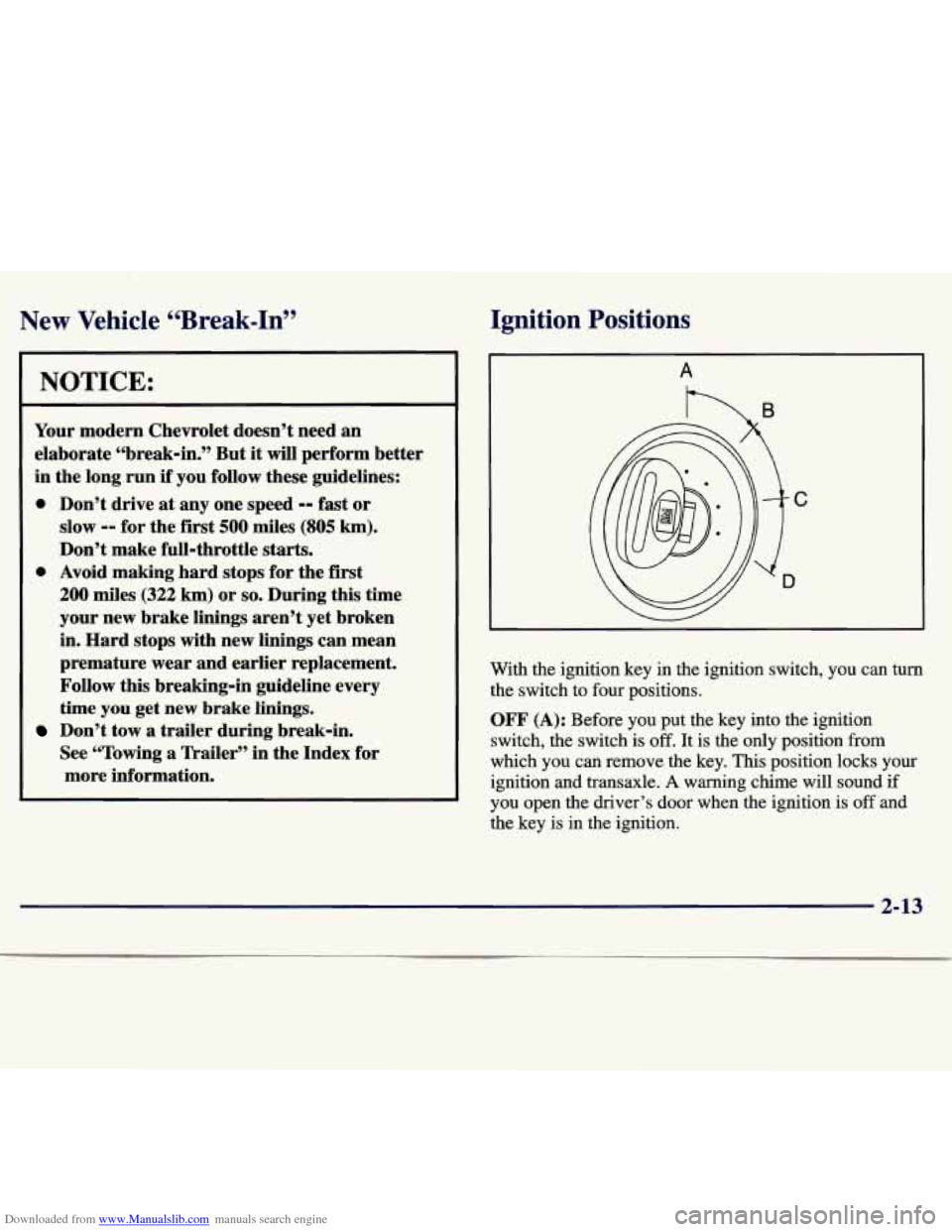
With the ignition key in the ignition switch, you can turn
the switch to four positions.
OFF (A): Before you put the key into the ignition
switch, the switch is
off. It is the only position from
which you can remove the key. This position locks your
ignition and transaxle.
A warning chime will sound if
you open the driver’s door when the ignition is off and
the key is in the ignition.
2-13
Page 71 of 354
Downloaded from www.Manualslib.com manuals search engine ACC (Accessory) (B): This position unlocks the
transaxle.
It also lets you use things like the radio and
windshield wipers when the engine is not running. To
use ACC, push in the key and turn it to the right. Use
this position if
your vehicle must be pushed or towed,
but never
try to push-start your vehicle.
ON (C): This position unlocks the ignition and
transaxle. This position is also where the key returns
after you start your engine and release the switch. The
switch stays in
ON when the engine is running. But even
when the engine is not running, you
can use ON to
operate your electrical power accessories, and to display some instrument panel warning lights.
START (D): This position starts the engine. When the
engine starts, release
the key. The ignition switch will
return to
ON for normal driving.
Starting Your Engine
Move your shift lever to PARK (P) or NEUTRAL (N).
Your engine won’t start in any other position -- that’s a
safety feature. To restart when you’re already moving,
use NEUTRAL (N) only.
I NOTICE:
Don’t try to shift to PARK (P) if your Chevrolet
is moving. If you do, you could damage the
transaxle. Shift to PARK
(P) only when your
vehicle is stopped.
Starting Your 2.4 Liter Engine
1. Without pushing the accelerator pedal, turn your
ignition key to START. When the engine starts, let
go of the key. The idle speed will go down as your
engine gets warm.
I NOTICE:
Holding your key in START for longer than
15 seconds at a time will cause your battery to be
drained much sooner. And the excessive heat can damage your starter motor.
2-14
Page 73 of 354
Downloaded from www.Manualslib.com manuals search engine Starting Your 3100 Engine
1. Without pushing the accelerator pedal, turn your
ignition key to START. When the engine starts, let
go
of the key. The idle speed will go down as your
engine gets warrn.
I NOTICE:
Holding your key in START for longer than
15 seconds at a time will cause your battery to be
drained much sooner. And the excessive heat can
damage your starter motor.
2. If your engine won’t start (or starts but then stops),
it could be flooded with too much gasoline. Try
pushing your accelerator pedal all the way to the
floor and holding it there as you hold the key in
START for up to 15 seconds. This clears the extra
gasoline from the engine.
NOTICE:
Your engine is designed to work with the
electronics in your vehicle.
If you add electrical
parts or accessories, you could change the
way
the engine operates. Before adding electrical
equipment, check with your dealer.
If you don’t,
your engine might not perform properly.
If you ever have to have your vehicle towed, see
the part of this manual that tells how to do
it
without damaging your vehicle. See “Towing
Your Vehicle” in the Index.
2-16