bulb CHEVROLET MALIBU 1999 5.G Owners Manual
[x] Cancel search | Manufacturer: CHEVROLET, Model Year: 1999, Model line: MALIBU, Model: CHEVROLET MALIBU 1999 5.GPages: 344, PDF Size: 2.43 MB
Page 93 of 344
yellowblue
2-31 Turn and Lane Change Signals
The turn signal has two upward (for right) and two
downward (for left) positions. These positions allow you
to signal a turn or a lane change.
To signal a turn, move the lever all the way up or down.
When the turn is finished, the lever will
return automatically.
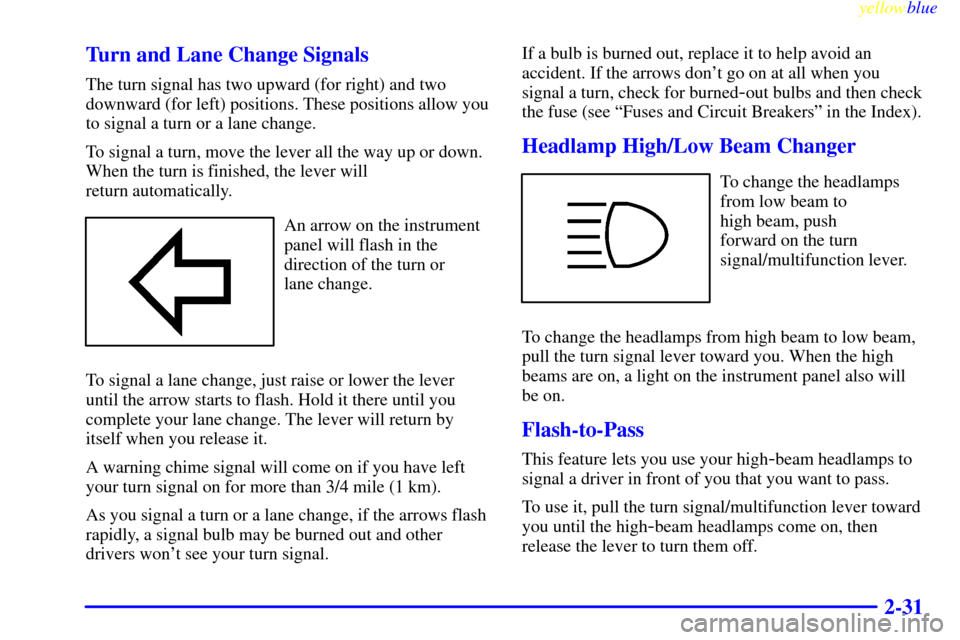
An arrow on the instrument
panel will flash in the
direction of the turn or
lane change.
To signal a lane change, just raise or lower the lever
until the arrow starts to flash. Hold it there until you
complete your lane change. The lever will return by
itself when you release it.
A warning chime signal will come on if you have left
your turn signal on for more than 3/4 mile (1 km).
As you signal a turn or a lane change, if the arrows flash
rapidly, a signal bulb may be burned out and other
drivers won't see your turn signal.If a bulb is burned out, replace it to help avoid an
accident. If the arrows don't go on at all when you
signal a turn, check for burned
-out bulbs and then check
the fuse (see ªFuses and Circuit Breakersº in the Index).
Headlamp High/Low Beam Changer
To change the headlamps
from low beam to
high beam, push
forward on the turn
signal/multifunction lever.
To change the headlamps from high beam to low beam,
pull the turn signal lever toward you. When the high
beams are on, a light on the instrument panel also will
be on.
Flash-to-Pass
This feature lets you use your high-beam headlamps to
signal a driver in front of you that you want to pass.
To use it, pull the turn signal/multifunction lever toward
you until the high
-beam headlamps come on, then
release the lever to turn them off.
Page 119 of 344

yellowblue
2-57
Did you just drive through a deep puddle of water?
If so, your electrical system may be wet. The condition
will usually be corrected when the electrical system
dries out. A few driving trips should turn the light off.
Have you recently changed brands of fuel?
If so, be sure to fuel your vehicle with quality fuel (see
ªFuelº in the Index). Poor fuel quality will cause your
engine not to run as efficiently as designed. You may
notice this as stalling after start
-up, stalling when you
put the vehicle into gear, misfiring, hesitation on
acceleration or stumbling on acceleration. (These
conditions may go away once the engine is warmed up.)
This will be detected by the system and cause the light
to turn on.
If you experience one or more of these conditions,
change the fuel brand you use. It will require at least one
full tank of the proper fuel to turn the light off.
If none of the above steps have made the light turn off,
have your dealer or qualified service center check the
vehicle. Your dealer has the proper test equipment and
diagnostic tools to fix any mechanical or electrical
problems that may have developed.
Oil Pressure Warning Light
If you have a low engine oil
pressure problem, this light
will stay on after you start
your engine, or come on
and you will hear a chime
when you are driving.
This indicates that your engine is not receiving enough
oil. The engine could be low on oil, or could have some
other oil problem. Have it fixed immediately.
When the ignition is on but the engine is not running,
the light will come on as a test to show you it is
working, but the light will go out when the engine is
running. If it doesn't come on with the ignition on, you
may have a problem with the fuse or bulb. Have it fixed
right away.
Page 188 of 344
yellowblue
4-38 Turn Signals When Towing a Trailer
When you tow a trailer, your vehicle may need
additional wiring. Check with your dealer. The arrows
on your instrument panel will flash whenever you signal
a turn or lane change. Properly hooked up, the trailer
lamps will also flash, telling other drivers you're about
to turn, change lanes or stop.
When towing a trailer, the arrows on your instrument
panel will flash for turns even if the bulbs on the trailer
are burned out. Thus, you may think drivers behind you
are seeing your signal when they are not. It's important
to check occasionally to be sure the trailer bulbs are
still working.
Driving On Grades
NOTICE:
Do not tow on steep continuous grades exceeding
6 miles (9.6 km). Extended, higher than normal
engine and transaxle temperatures may result
and damage your vehicle. Frequent stops are
very important to allow the engine and transaxle
to cool.
Reduce speed and shift to a lower gear before you start
down a long or steep downgrade. If you don't shift
down, you might have to use your brakes so much that
they would get hot and no longer work well.
On a long uphill grade, shift down and reduce your
speed to around 45 mph (70 km/h) to reduce the
possibility of engine and transaxle overheating.
Pay attention to the engine coolant gage. If the indicator
is in the red area, turn off the air conditioning to reduce
engine load (see ªEngine Overheatingº in the Index).
Page 221 of 344
6-
yellowblue
6-1
Section 6 Service and Appearance Care
Here you will find information about the care of your vehicle. This section begins with service and fuel information,
and then it shows how to check important fluid and lubricant levels. There is also technical information about your
vehicle, and a part devoted to its appearance care.
6
-2 Service
6
-3 Fuel
6
-5 Fuels in Foreign Countries
6
-5 Filling Your Tank
6
-7 Filling a Portable Fuel Container
6
-8 Checking Things Under the Hood
6
-13 Engine Oil
6
-18 Engine Air Cleaner/Filter
6
-19 Automatic Transaxle Fluid
6
-20 Surge Tank Pressure Cap
6
-20 Thermostat
6
-20 Engine Coolant
6
-24 Power Steering Fluid
6
-25 Windshield Washer Fluid
6
-26 Brakes
6
-29 Battery6
-30 Bulb Replacement
6
-38 Windshield Wiper Blade Replacement
6
-38 Tires
6
-46 Appearance Care
6
-47 Cleaning the Inside of Your Vehicle
6
-49 Care of Safety Belts
6
-50 Cleaning the Outside of Your Vehicle
6
-51 Cleaning Aluminum Wheels (If Equipped)
6
-52 Finish Damage
6
-53 GM Vehicle Care/Appearance Materials
6
-54 Vehicle Identification Number (VIN)
6
-55 Electrical System
6
-60 Replacement Bulbs
6
-61 Capacities and Specifications
6
-62 Air Conditioning Refrigerants
6
-62 Normal Maintenance Replacement Parts
Page 250 of 344
yellowblue
6-30 Vehicle Storage
If you're not going to drive your vehicle for 25 days or
more, remove the black, negative (
-) cable from the
battery. This will help keep your battery from
running down.
CAUTION:
Batteries have acid that can burn you and gas
that can explode. You can be badly hurt if you
aren't careful. See ªJump Startingº in the Index
for tips on working around a battery without
getting hurt.
Contact your dealer to learn how to prepare your vehicle
for longer storage periods.
Also, for your audio system, see ªTheft
-Deterrent
Featureº in the Index.
Bulb Replacement
This section describes bulb changing procedures for some
of your interior and exterior lamps. For bulb sizes, see
ªReplacement Bulbsº in the Index. For any bulbs not listed
in this section, contact your dealer service department.
Halogen Bulbs
CAUTION:
Halogen bulbs have pressurized gas inside and
can burst if you drop or scratch the bulb. You or
others could be injured. Be sure to read and
follow the instructions on the bulb package.
Headlamps
1. With the hood open and the engine off, pull the
fastener out of the plastic splash shield covering the
top of the headlamp assembly and remove it.
Page 251 of 344
yellowblue
6-31
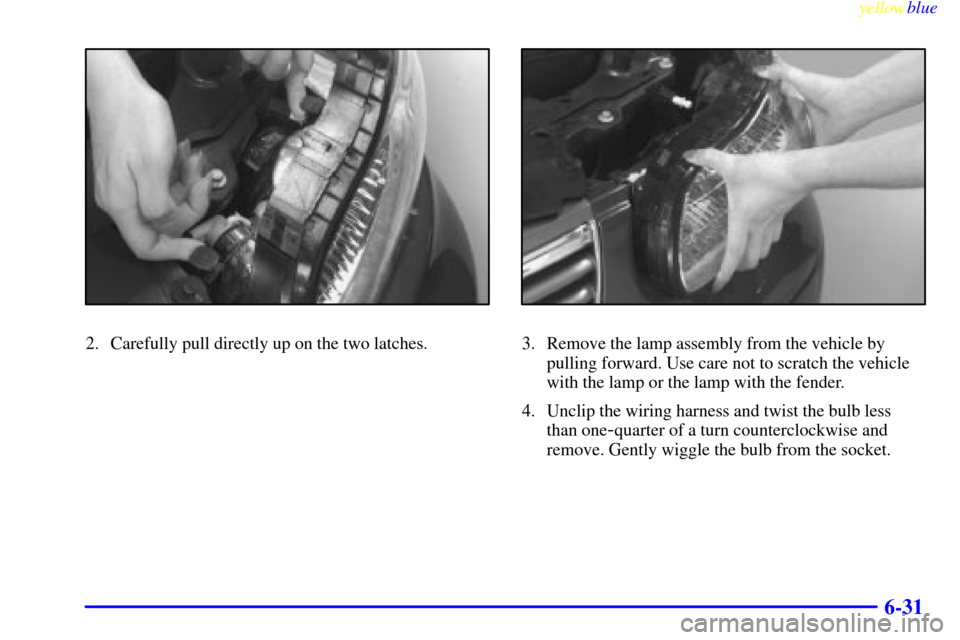
2. Carefully pull directly up on the two latches.3. Remove the lamp assembly from the vehicle by
pulling forward. Use care not to scratch the vehicle
with the lamp or the lamp with the fender.
4. Unclip the wiring harness and twist the bulb less
than one
-quarter of a turn counterclockwise and
remove. Gently wiggle the bulb from the socket.
Page 252 of 344
yellowblue
6-32
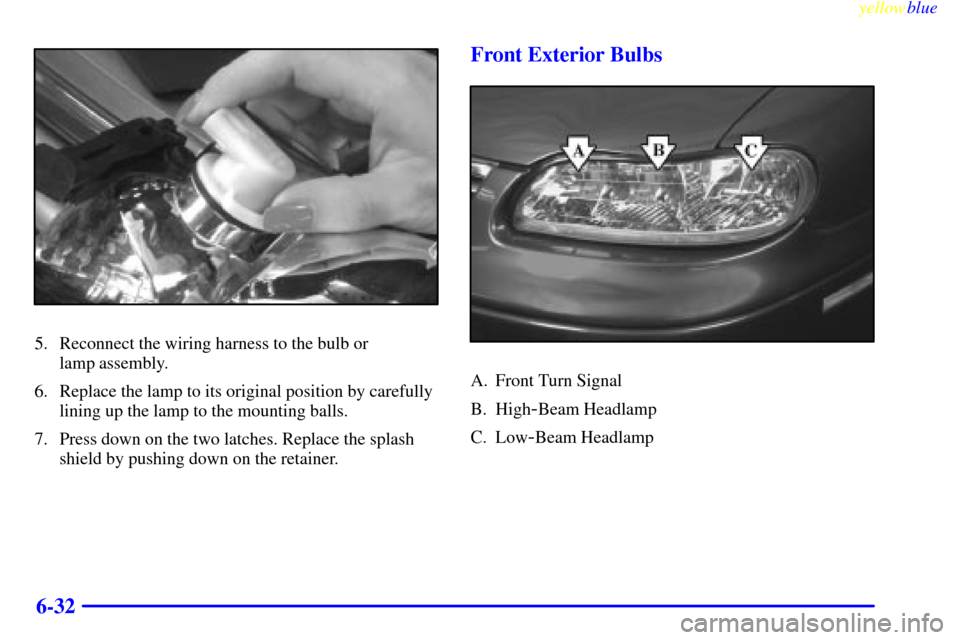
5. Reconnect the wiring harness to the bulb or
lamp assembly.
6. Replace the lamp to its original position by carefully
lining up the lamp to the mounting balls.
7. Press down on the two latches. Replace the splash
shield by pushing down on the retainer.
Front Exterior Bulbs
A. Front Turn Signal
B. High
-Beam Headlamp
C. Low
-Beam Headlamp
Page 253 of 344
yellowblue
6-33 Front Turn Signal Lamp Bulb Replacement
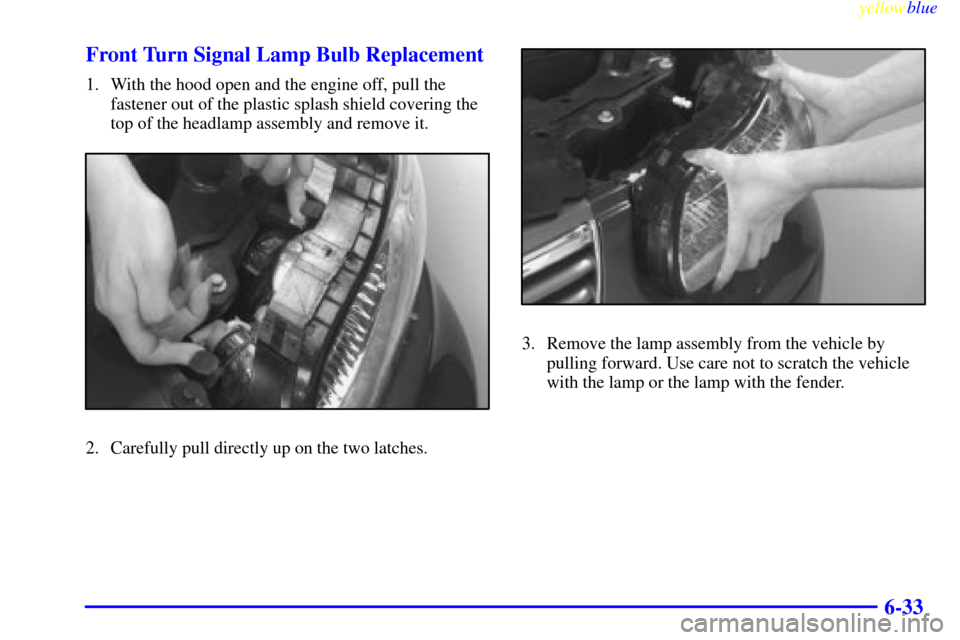
1. With the hood open and the engine off, pull the
fastener out of the plastic splash shield covering the
top of the headlamp assembly and remove it.
2. Carefully pull directly up on the two latches.
3. Remove the lamp assembly from the vehicle by
pulling forward. Use care not to scratch the vehicle
with the lamp or the lamp with the fender.
Page 254 of 344
yellowblue
6-34
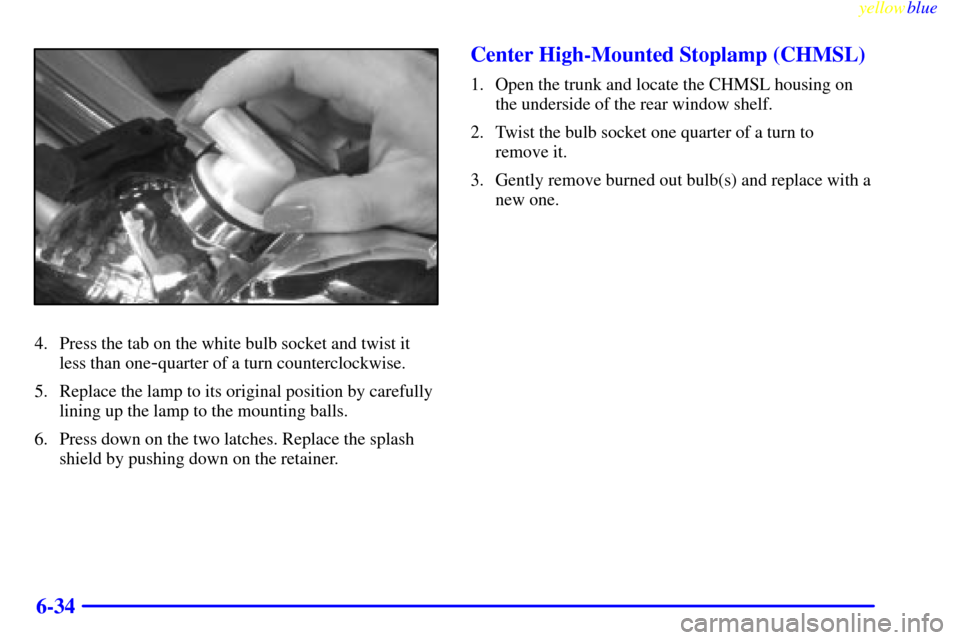
4. Press the tab on the white bulb socket and twist it
less than one
-quarter of a turn counterclockwise.
5. Replace the lamp to its original position by carefully
lining up the lamp to the mounting balls.
6. Press down on the two latches. Replace the splash
shield by pushing down on the retainer.
Center High-Mounted Stoplamp (CHMSL)
1. Open the trunk and locate the CHMSL housing on
the underside of the rear window shelf.
2. Twist the bulb socket one quarter of a turn to
remove it.
3. Gently remove burned out bulb(s) and replace with a
new one.
Page 257 of 344
yellowblue
6-37
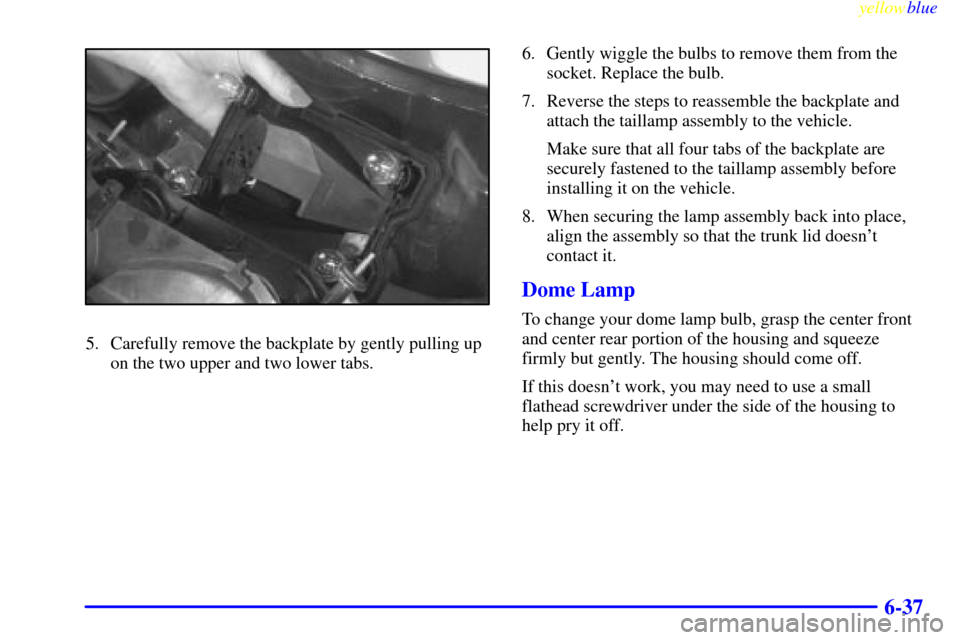
5. Carefully remove the backplate by gently pulling up
on the two upper and two lower tabs.6. Gently wiggle the bulbs to remove them from the
socket. Replace the bulb.
7. Reverse the steps to reassemble the backplate and
attach the taillamp assembly to the vehicle.
Make sure that all four tabs of the backplate are
securely fastened to the taillamp assembly before
installing it on the vehicle.
8. When securing the lamp assembly back into place,
align the assembly so that the trunk lid doesn't
contact it.
Dome Lamp
To change your dome lamp bulb, grasp the center front
and center rear portion of the housing and squeeze
firmly but gently. The housing should come off.
If this doesn't work, you may need to use a small
flathead screwdriver under the side of the housing to
help pry it off.