Engine Oil with Filter CHEVROLET MALIBU 2003 5.G Owners Manual
[x] Cancel search | Manufacturer: CHEVROLET, Model Year: 2003, Model line: MALIBU, Model: CHEVROLET MALIBU 2003 5.GPages: 326, PDF Size: 2.41 MB
Page 211 of 326
What to Do with Used Oil
Used engine oil contains certain elements that may be
unhealthy for your skin and could even cause cancer.
Don't let used oil stay on your skin for very long. Clean
your skin and nails with soap and water, or a good
hand cleaner. Wash or properly dispose of clothing or
rags containing used engine oil. See the manufacturer's
warnings about the use and disposal of oil products.
Used oil can be a threat to the environment. If you
change your own oil, be sure to drain all the oil from the
®lter before disposal. Never dispose of oil by putting it
in the trash, pouring it on the ground, into sewers, or into
streams or bodies of water. Instead, recycle it by
taking it to a place that collects used oil. If you have a
problem properly disposing of your used oil, ask
your dealer, a service station or a local recycling center
for help.
Engine Air Cleaner/Filter
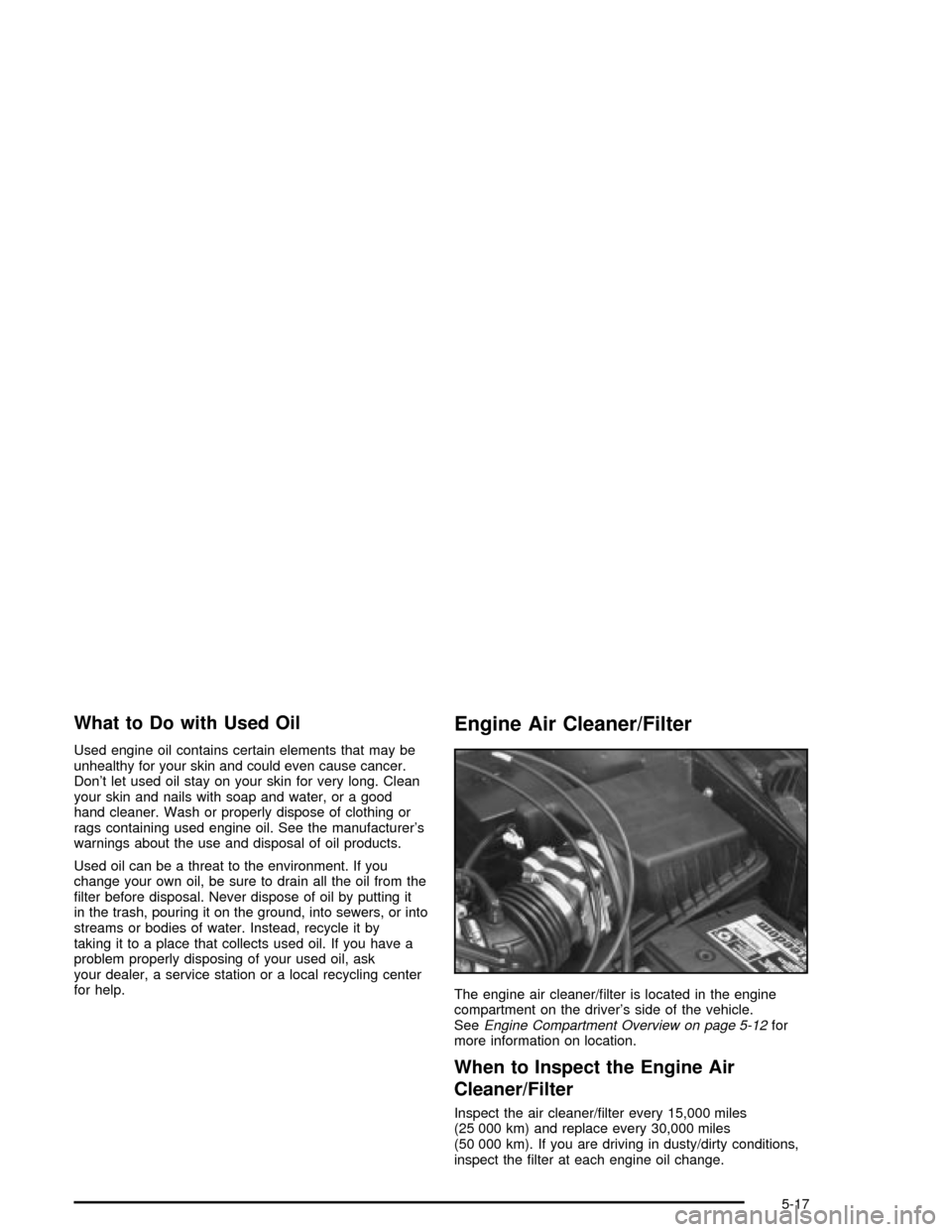
The engine air cleaner/®lter is located in the engine
compartment on the driver's side of the vehicle.
See
Engine Compartment Overview on page 5-12for
more information on location.
When to Inspect the Engine Air
Cleaner/Filter
Inspect the air cleaner/®lter every 15,000 miles
(25 000 km) and replace every 30,000 miles
(50 000 km). If you are driving in dusty/dirty conditions,
inspect the ®lter at each engine oil change.
5-17
Page 212 of 326
How to Inspect the Engine Air
Cleaner/Filter
To inspect the air cleaner/®lter remove the ®lter from the
vehicle and lightly shake ®lter to release loose dust
and dirt. If the ®lter remains ªcakedº with dirt, a new ®lter
is required.
To inspect or replace the engine air cleaner/®lter,
do the following:
1. Remove the screws that hold the cover on.
2. Lift off the cover.
3. Check or replace the engine air cleaner/®lter.
See
Normal Maintenance Replacement Parts
on page 5-83for replacement part numbers.
4. Put the cover back on tightly.
See
Using Your Maintenance Schedule on page 6-4for
replacement intervals.
{CAUTION:
Operating the engine with the air cleaner/®lter
off can cause you or others to be burned. The
air cleaner not only cleans the air, it helps to
stop ¯ame if the engine back®res. If it isn't there
and the engine back®res, you could be burned.
Don't drive with it off, and be careful working on
the engine with the air cleaner/®lter off.
Notice:If the air cleaner/®lter is off, a back®re can
cause a damaging engine ®re. And, dirt can
easily get into your engine, which will damage it.
Always have the air cleaner/®lter in place when
you're driving.
Automatic Transaxle Fluid
It is not necessary to check the transaxle ¯uid level.
A transaxle ¯uid leak is the only reason for ¯uid loss. If a
leak occurs, take the vehicle to the dealership service
department and have it repaired as soon as possible. You
may also have your ¯uid level checked by your dealer or
service center when you have your oil changed.
5-18
Page 276 of 326
Capacities and Speci®cations
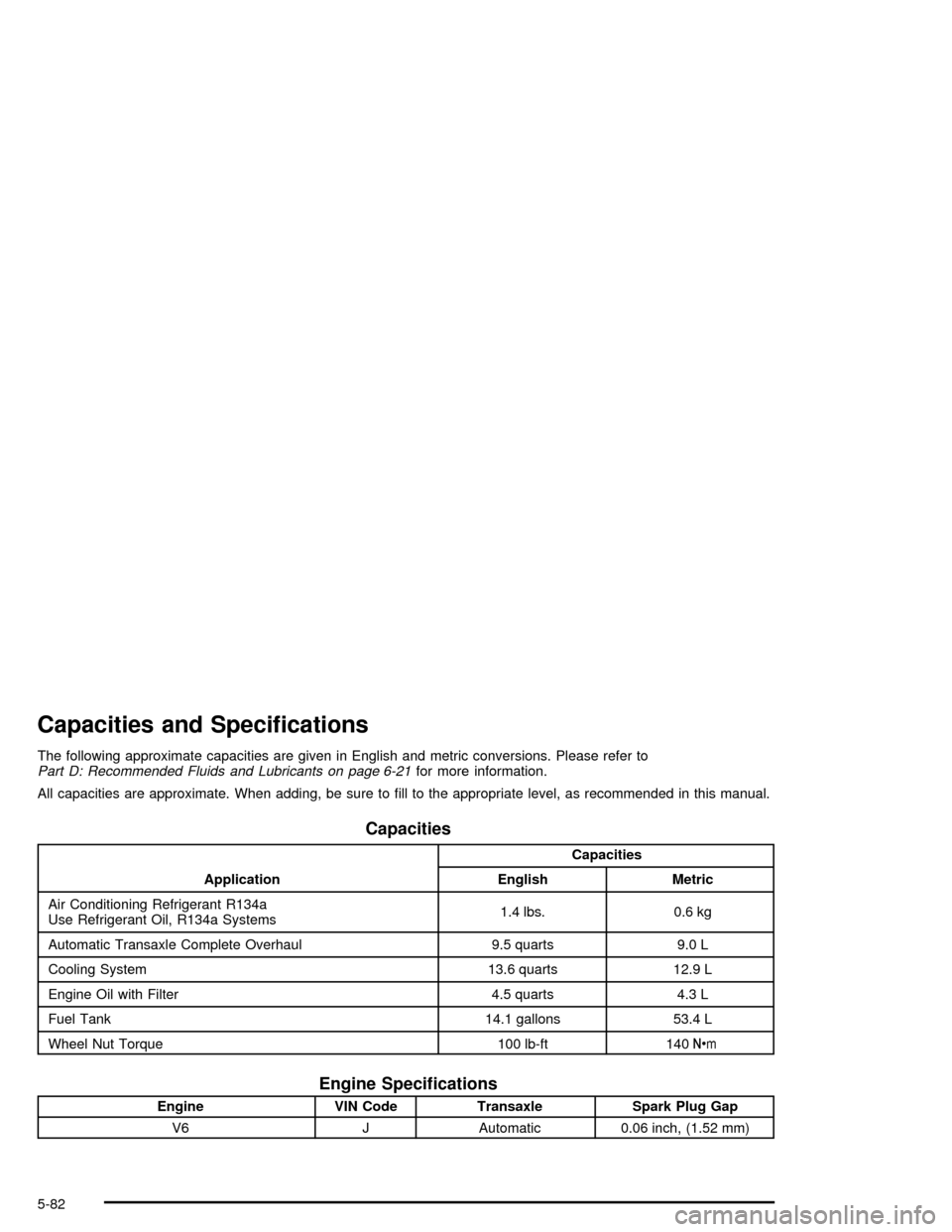
The following approximate capacities are given in English and metric conversions. Please refer toPart D: Recommended Fluids and Lubricants on page 6-21for more information.
All capacities are approximate. When adding, be sure to ®ll to the appropriate level, as recommended in this manual.
Capacities
ApplicationCapacities
English Metric
Air Conditioning Refrigerant R134a
Use Refrigerant Oil, R134a Systems1.4 lbs. 0.6 kg
Automatic Transaxle Complete Overhaul 9.5 quarts 9.0 L
Cooling System 13.6 quarts 12.9 L
Engine Oil with Filter 4.5 quarts 4.3 L
Fuel Tank 14.1 gallons 53.4 L
Wheel Nut Torque 100 lb-ft 140Y
Engine Speci®cations
Engine VIN Code Transaxle Spark Plug Gap
V6 J Automatic 0.06 inch, (1.52 mm)
5-82
Page 283 of 326
·Most trips include extensive idling (such as frequent
driving in stop-and-go traffic).
·You frequently tow a trailer or use a carrier on top
of your vehicle.
·If the vehicle is used for delivery service, police,
taxi or other commercial application.
One of the reasons you should follow this schedule if
you operate your vehicle under any of these conditions
is that these conditions cause engine oil to break
down sooner.
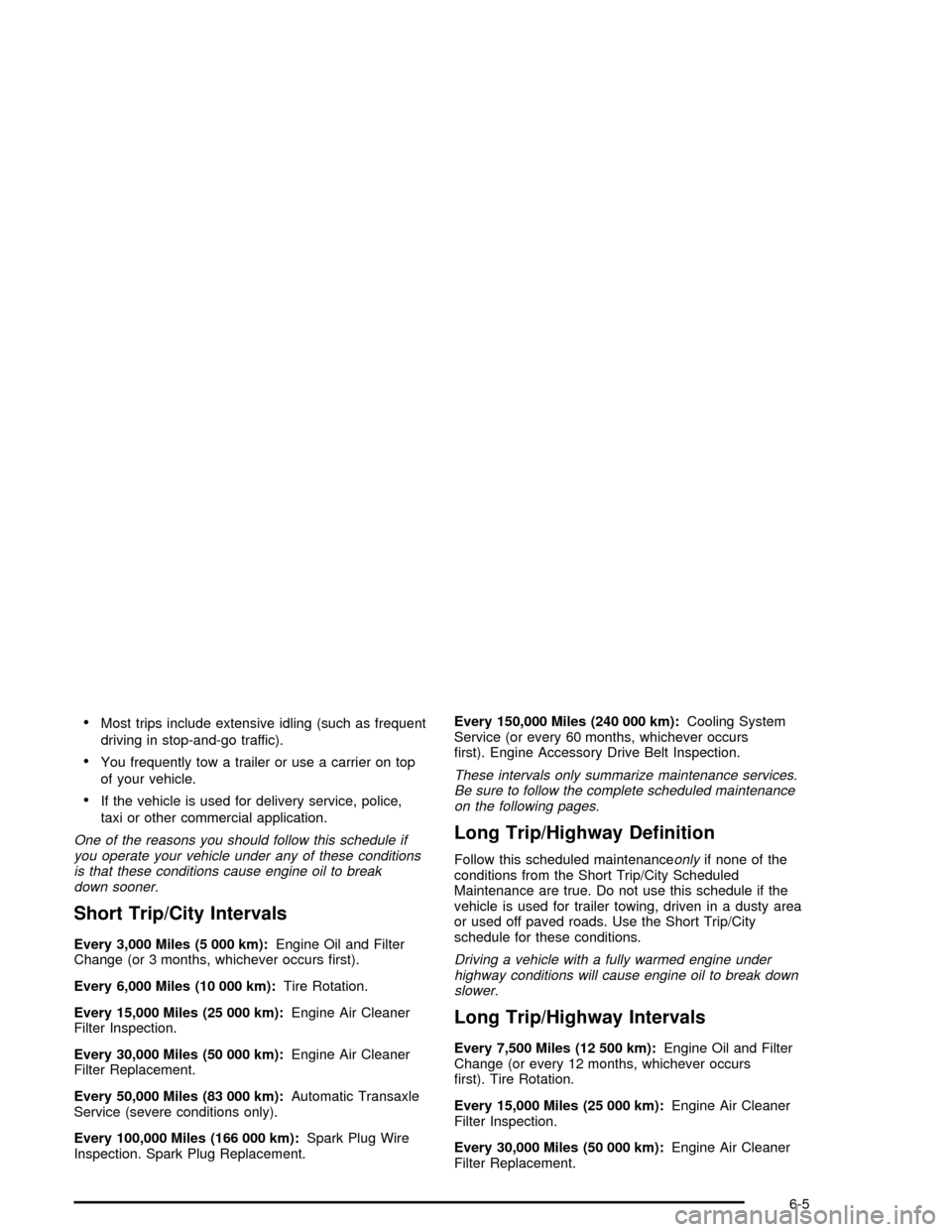
Short Trip/City Intervals
Every 3,000 Miles (5 000 km):Engine Oil and Filter
Change (or 3 months, whichever occurs ®rst).
Every 6,000 Miles (10 000 km):Tire Rotation.
Every 15,000 Miles (25 000 km):Engine Air Cleaner
Filter Inspection.
Every 30,000 Miles (50 000 km):Engine Air Cleaner
Filter Replacement.
Every 50,000 Miles (83 000 km):Automatic Transaxle
Service (severe conditions only).
Every 100,000 Miles (166 000 km):Spark Plug Wire
Inspection. Spark Plug Replacement.Every 150,000 Miles (240 000 km):Cooling System
Service (or every 60 months, whichever occurs
®rst). Engine Accessory Drive Belt Inspection.
These intervals only summarize maintenance services.
Be sure to follow the complete scheduled maintenance
on the following pages.
Long Trip/Highway De®nition
Follow this scheduled maintenanceonlyif none of the
conditions from the Short Trip/City Scheduled
Maintenance are true. Do not use this schedule if the
vehicle is used for trailer towing, driven in a dusty area
or used off paved roads. Use the Short Trip/City
schedule for these conditions.
Driving a vehicle with a fully warmed engine under
highway conditions will cause engine oil to break down
slower.
Long Trip/Highway Intervals
Every 7,500 Miles (12 500 km):Engine Oil and Filter
Change (or every 12 months, whichever occurs
®rst). Tire Rotation.
Every 15,000 Miles (25 000 km):Engine Air Cleaner
Filter Inspection.
Every 30,000 Miles (50 000 km):Engine Air Cleaner
Filter Replacement.
6-5
Page 326 of 326

Vehicle Storage..............................................5-36
Vehicle............................................................ 4-5
Control........................................................ 4-5
Damage Warnings........................................... iv
Loading......................................................4-32
Service Soon Light......................................3-35
Symbols......................................................... iv
Ventilation Adjustment......................................3-21
Visors...........................................................2-15
W
Warning Lights, Gages and Indicators................3-22
Warnings......................................................... 3-4
Hazard Warning Flashers............................... 3-4
Other Warning Devices.................................. 3-4
Safety and Symbols......................................... iii
Vehicle Damage.............................................. iv
Washer Fluid, Low Warning Light......................3-34
Washing Your Vehicle......................................5-71
Weatherstrip Lubrication...................................6-16
Weight of the Trailer Tongue.............................4-36
Weight of the Trailer........................................4-35
What Kind of Engine Oil to Use........................5-14
What to Do with Used Oil................................5-17
What to Use..........................................5-20, 5-31
Wheels..........................................................5-54
Alignment and Tire Balance..........................5-54
Replacement...............................................5-54When to Add Engine Oil..................................5-14
When to Change Engine Oil.............................5-16
When to Check Power Steering Fluid................5-30
When to Check..............................................5-50
When to Inspect the Engine Air Cleaner/Filter.....5-17
When You Are Ready to Leave After
Parking on a Hill.........................................4-40
Where to Put the Restraint...............................1-38
Why Safety Belts Work..................................... 1-8
Window Lockout.............................................2-15
Windows.......................................................2-14
Manual......................................................2-14
Power........................................................2-15
Windshield Washer Fluid Level Check................6-15
Windshield Washer.........................................5-31
Fluid..........................................................5-31
Windshield Wiper............................................5-48
Blade Replacement......................................5-48
Fuses........................................................5-76
Windshield Wipers............................................ 3-8
Winshield Washer............................................. 3-9
Winter Driving................................................4-23
Wiper Blade Check.........................................6-16
Y
Your Vehicle and the Environment....................... 6-2
14